Unit 1 · Topic 1.6 · about 30 minutes · 7 parts · 14 scored checks, 2 of them multiple choice
AP Psychology 1.6: Sensation
Unit 1: 15 to 25% of the multiple-choice section
 Tap to open the picture full size
Part 1 Think first One more candle
Make a guess first. Getting it wrong still helps the right answer stick.
Predict first
In a dark room lit by one candle, a friend lights a second candle. Later, in a hall lit by 50 candles, she lights one more. Each time, exactly one candle was added. In which place are you more likely to notice that the light changed?
In short. Sensation is the process by which receptor cells detect energy from the world and turn it into messages the brain can process.
- Every sense has a level a stimulus must reach to be detected and a size a change must reach to be noticed, and a stimulus that never changes fades from notice.
- In vision and hearing, particular structures and theories explain how light becomes color and detail, and how vibration becomes pitch and loudness.
- Smell, taste, touch, pain, balance and body movement each have their own receptors and structures, and the senses constantly work together.
Part 2 Learn it Four groups of senses
2a. What every sense does
Sensation is the process of detecting information from the world around you. Each sense has receptor cells tuned to one kind of energy, such as light, sound waves or chemicals. When a stimulus is strong enough, the receptors transduce it: they turn it into neurochemical messages that travel to the brain for processing.
How strong is strong enough? The absolute threshold is the faintest level of a stimulus a person can detect at least 50% of the time. A whisper just below it goes unheard more often than not.
Noticing a change works the same way. The just-noticeable difference is the smallest change in a stimulus a person can detect. Weber's law says that difference is a constant proportion of the starting stimulus, not a fixed amount. If you can just feel 1 extra gram added to a 50-gram letter, you would need about 2 extra grams to feel a change in a 100-gram one.
Senses also turn themselves down. In sensory adaptation, sensitivity to a stimulus that does not change fades: the watch on your wrist, the smell of your own house.
And the senses never work alone. Sensory interaction is the way they constantly work together, so what you see can change what you hear. Synesthesia is rarer: one sense is experienced through another, as when a person sees a color every time a certain note plays.
Quick check · Fill the statement
Tap a blank, then tap a word.
At a hearing check, Zoe, an invented student, listens to fainter and fainter beeps. The softest beep she hears on at least half of its trials marks her . Inside her ear, receptor cells turn each beep's vibrations into neural messages, a step called . Next the beeps grow louder in tiny steps, and the smallest increase she can detect is her . The clinic smelled strongly of disinfectant when she walked in, but after a few minutes she stops noticing it, which is . Her friend Ravi says he sees a flash of pale blue every time a beep plays, which is .
2b. Vision
The lens focuses light onto the retina, the light-sensitive surface at the back of the eye. To focus near or far, the lens changes shape: accommodation. When that goes wrong, nearsightedness (far things blur) or farsightedness (near things blur) can result.
The retina has two kinds of receptor cells. Rods lie toward the edges. They detect shape and movement but not color, work mainly in dim light, and play a role in dark adaptation (slowly seeing better in a dark room) and light adaptation (adjusting back to bright light). Cones are packed into the fovea, the center of the retina, and handle color and fine detail.
Two theories explain color vision. In the trichromatic theory, cones come in three kinds, responding best to short (blue), medium (green) or long (red) wavelengths. In the opponent-process theory, ganglion cells in the retina work in pairs: red/green, blue/yellow, black/white. Stare at red and its side of the pair tires, so a white wall then looks green: an afterimage. Damaged cones or ganglion cells cause color vision deficiency, such as dichromatism (only two working cone types) or monochromatism (little or no color).
Ganglion cells send messages along the visual nerve to the thalamus, then mainly to the occipital lobes. Where that nerve leaves the eye there are no receptors, the blind spot, and the brain fills the gap. Damage to the occipital lobes can cause prosopagnosia (face blindness) or blindsight, responding to things a person does not consciously see.
Quick check · Match
Every person here is invented. Tap a term, then tap the experience it explains best.
2c. Hearing
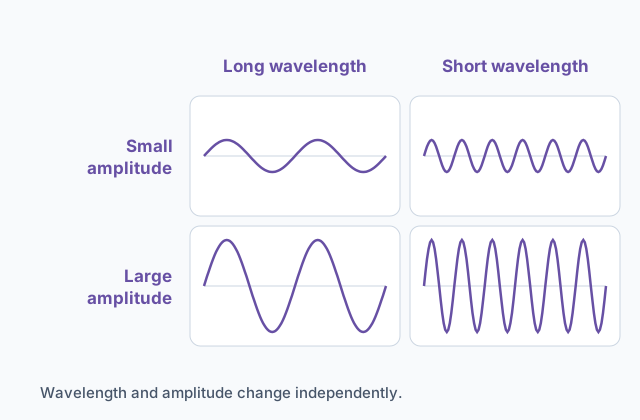
Sound is air molecules moving in waves. A wave's wavelength, the distance from one peak to the next, sets its pitch: shorter waves arrive more often each second and sound higher. Its amplitude, the height of each wave, sets its loudness.
Receptor cells in the inner ear transduce the vibrations. Three theories explain how pitch is coded:
- Place theory: each pitch most strongly stirs receptors at its own place in the inner ear. It works best for high pitches.
- Frequency theory: the nerve to the brain fires at the same rate the sound vibrates. It works best for low pitches.
- Volley theory: no single neuron can fire as fast as a higher sound vibrates, so groups of neurons take turns, and their combined firing keeps pace.
Sound localization is working out where a sound comes from. A sound on your left reaches your left ear a split second sooner, and a little louder, than your right, and the brain uses that difference. A sound straight ahead or straight behind reaches both ears at once, so those two are easy to confuse.
Hearing can fade with age or after damage. Conduction deafness comes from damage to the parts that carry vibrations into the inner ear, such as the eardrum. Sensorineural deafness comes from damage to the receptor cells of the inner ear or to the nerve that carries their messages, which years of loud noise can cause.
Quick check · Sort it
Every person here is invented. Tap a card, then tap the theory or the kind of hearing loss it fits.
Place theory
Frequency theory
Volley theory
Conduction deafness
Sensorineural deafness
2d. Smell, taste, touch, pain and balance
Smell (olfaction) and taste (gustation) are the chemical senses. Receptors in the nose transduce airborne chemicals. Smell is the only sense not processed first in the thalamus. Pheromones are chemicals an animal releases that carry messages to another's olfactory system.
Receptors on the tongue and in the mouth detect six tastes: sweet, sour, salty, bitter, umami (savory, as in broth) and oleogustus (fat). The more taste receptors on a person's tongue, the more sensitive they are: supertasters have the most, then medium tasters, then nontasters. The chemical senses also interact. Without smell, taste is muted or lost.
Receptors in the skin transduce touch, and the brain processes it. The feeling of hot comes from warm and cold receptors firing at once.
Pain is processed in both the body and the brain. Gate control theory proposes a gate in the spinal cord that lets pain messages through or blocks them; other signals, such as rubbing a bumped knee, or messages from the brain can close it. Phantom limb sensation is feeling sensation or pain where a lost limb used to be.
The vestibular sense controls balance. It is detected mainly by the semicircular canals of the inner ear and by structures in the brain. Kinesthesis is the sense of your body's movement. It lets you move in coordinated ways without watching your arms and legs.
Quick check · Match
Every person here is invented. Tap a term, then tap the example it explains best.
Part 3 Watch it done How much sugar before she notices
Follow each step, then finish the last one yourself.
A taste tester can just tell the difference between a cup of tea with 20 grams of sugar and one with 21 grams. A jug of the same tea holds 300 grams of sugar. By Weber's law, how many grams of sugar would have to be added to the jug before she could just notice it is sweeter?
Step 1 · Find her just-noticeable difference at the start
With 20 grams in the cup, the smallest change she can detect is 1 gram, from 20 to 21.
Step 2 · Turn it into a proportion
The change she can just notice is 1 gram out of 20, so 1 / 20 = 0.05, or 5% of the starting amount.
Why this step?
Why turn the 1 gram into a proportion instead of keeping it as 1 gram?
Because Weber's law says the just-noticeable difference is a constant proportion of the starting stimulus. One gram added to 300 grams is a far smaller share than one gram added to 20, so it would go unnoticed.
Your step · Calculate
Finish the calculation. A taste tester can just tell the difference between a cup of tea with 20 grams of sugar and one with 21 grams. By Weber's law, how many grams of sugar would have to be added to a jug of the same tea that holds 300 grams of sugar before she could just notice it is sweeter?
grams
Part 4 Try it Sound in a new setting
First, describe two sounds a violinist plays. Then read an illustrative experiment about locating sounds and judge a claim about it.
Try it · Fill the statement
Tap a blank, then tap a word.
Mei, an invented violinist, plays one note softly, then plays the same note again with a much harder stroke of the bow. The second time, the sound waves have a greater , so a listener hears more . Then she moves her finger and plays a new note whose waves are packed closer together, reaching the ear more often each second. Those waves have a shorter , so the listener hears a higher .
Illustrative study (made up for practice, not a published study). Researchers recruited 40 adult volunteers with typical hearing, and each signed a form saying they could stop at any time. A coin flip put each volunteer in one of two groups. Volunteers in the one-ear group wore a foam plug that blocked sound in the right ear. Volunteers in the comparison group wore a plug that looked the same but had a channel that let sound through. Every volunteer sat blindfolded in the middle of a ring of 12 speakers. A short beep played from one speaker at a time, 24 times in a random order, and the volunteer pointed toward it. The researchers measured how far off each point was, in degrees. The one-ear group was off by a mean of 31 degrees and the comparison group by a mean of 9 degrees, and a statistical test showed the difference was statistically significant.
Try it · Decide and justify
In an illustrative experiment, a coin flip put 40 blindfolded adults into two groups. One group wore a plug that blocked sound in the right ear; the other wore a plug that looked the same but let sound through. Pointing toward beeps from 12 speakers around them, the blocked-ear group was off by a mean of 31 degrees and the other group by 9 degrees, a statistically significant difference. A classmate says the result fits the idea that people locate sounds by comparing what reaches their two ears. Does it?
Which reason supports your answer?
Part 5 Explain it Write it the way the exam asks
Nothing you type leaves this page.
Free response is 33.3% of the exam score. This one is shaped like Question 2, Evidence-Based Question.
Free-response practice · Question 2 style
Read the three sources, then answer the question they share: does the pain a person feels depend only on what is happening to the body? In parts B and C, cite the source you use, for example (Source 1).
Source 1. Illustrative study (made up for practice, not a published study). Researchers recruited 60 adult volunteers, and each signed a form saying they could stop at any time. A device pressed a blunt tip against the back of each volunteer's left hand with the same moderate pressure for 20 seconds. A coin flip put each volunteer in one of two groups. One group rubbed the skin around the spot with their right hand during the press; the other kept both hands still. Afterward everyone rated the pain from 0 (none) to 10 (the worst imaginable). The rubbing group gave a mean rating of 3.2 and the still group a mean of 5.6, and a statistical test showed the difference was statistically significant.
Source 2. Illustrative study (made up for practice, not a published study). Researchers surveyed 80 adults at two rehabilitation clinics, each of whom had lost an arm or a leg at least one year earlier. There were no groups: everyone answered the same questions. Of the 80, 64 (80%) said that in the past month they had felt sensation, such as itching or tingling, in the place where the missing limb used to be, and 45 of those 64 said it included pain.
Source 3. Illustrative study (made up for practice, not a published study). Researchers recruited 50 college students, each of whom could stop at any time. Names drawn from a hat put half the students in a game group and half in a screen group. Each student held one hand in very cold water for up to two minutes. Students in the game group played a fast puzzle game on a tablet with the other hand; students in the screen group looked at a blank tablet. Afterward each rated the pain from 0 to 10. The game group gave a mean rating of 4.1 and the screen group a mean of 6.3, and a statistical test showed the difference was statistically significant.
(A) Propose a specific and defensible claim, based in psychological science, that answers the question.
(B) (i) Support your claim using one piece of specific and relevant evidence from one of the sources. (ii) Explain how the evidence from part B (i) supports your claim, using a psychological perspective, theory, concept, or research finding.
(C) (i) Support your claim using a piece of specific and relevant evidence from a different source. (ii) Explain how the evidence from part C (i) supports your claim, using a different psychological perspective, theory, concept, or research finding from the one in part B (ii).
Model answer
(A) Pain depends on how the spinal cord and brain handle signals, not only on what is happening to the body: the same stimulus hurts less when other signals compete with it, and pain or other sensation can be felt where no body part exists.
(B) (i) In Source 1, volunteers who rubbed the skin around the pressed spot rated the pain at a mean of 3.2 out of 10, against 5.6 for volunteers who kept still, though every hand got the same pressure for the same 20 seconds. (ii) Gate control theory proposes a gate in the spinal cord that lets pain messages through or blocks them, and signals such as rubbing can help close it. The stimulus to the body was identical in both groups, yet rubbing went with much less pain, which is what the claim predicts if signals arriving alongside the pain change how much of it gets through. A coin flip formed the groups, so the difference fits an effect of rubbing rather than of who was in each group.
(C) (i) In Source 2, 64 of 80 adults who had lost an arm or a leg (80%) said that in the past month they had felt sensation where the missing limb used to be, and for 45 of them it included pain. (ii) This is phantom limb sensation, a different concept from part B. There is no limb left to be injured or touched, so the sensation cannot come from what is happening to that part of the body. It has to be produced in the nervous system, which supports the claim that pain does not depend only on the body.
Score your own answer. This is a self-check, not a grade. Tick each point your answer makes.
Part 6 Check yourself A nose clip and a bag of jelly beans
Exam multiple-choice questions sometimes come in sets that share one table or passage, like these two.
Illustrative study (made up for practice, not a published study). Researchers recruited 48 high school students, and each student and a parent signed a consent form. A coin flip put each student in one of two groups. Every student was blindfolded and ate 10 jelly beans, one at a time, each a different flavor, such as cherry, lemon or cinnamon, and named each flavor aloud. Students in one group wore a clip that closed off the nose; students in the other group did not. An answer counted as correct only if it named the exact flavor. A statistical test showed the difference between the groups was statistically significant.
| Group | Students | Mean flavors named correctly |
|---|---|---|
| No nose clip | 24 | 7.6 |
| Nose clip | 24 | 2.9 |
Case question 1 · Multiple choice
In an illustrative experiment, a coin flip put 48 blindfolded students into two groups, and each student named the flavors of 10 jelly beans. Students without a nose clip named a mean of 7.6 correctly, and students wearing a clip that closed off the nose named a mean of 2.9, a statistically significant difference. Which idea does this result fit best?
Case question 2 · Decide and justify
In an illustrative experiment, blindfolded students named the flavors of 10 jelly beans, such as cherry, lemon or cinnamon. A coin flip decided who wore a clip that closed off the nose. The clip group named a mean of 2.9 flavors correctly and the no-clip group 7.6, a statistically significant difference. A classmate concludes that the nose clip made the students' tongues worse at detecting the basic tastes, such as sweet and sour. Does the study show that?
Which reason supports your answer?
The rest stand on their own and do not use the case.
Check yourself · Put it in order
Put the steps of seeing in order, from light entering the eye to the brain.
Check yourself · Sort it
Every person here is invented. Tap a card, then tap the condition or process it describes.
Nearsightedness
Farsightedness
Dichromatism
Monochromatism
Dark adaptation
Light adaptation
Check yourself · Fill the statement
Tap a blank, then tap a word.
Over a bowl of mushroom broth, Priya, an invented student, notices its rich, savory taste, which is . The butter on her bread adds the taste of fat, which is . Raw kale tastes harshly bitter to her, and she has a great many taste receptors on her tongue, which fits a . To her brother, who has very few taste receptors, the same kale tastes barely bitter at all, which fits a . As the smell of the broth reaches Priya's brain, it is not processed first in the , unlike the sight and sound of her family around the table.
Part 7 Keep it Two questions from earlier topics
Older ideas stay usable when you pull them back up now and then.
Bring it back · Multiple choice
During a week of exams, Tess, an invented student, sets her alarm two hours early every morning, cutting off the last part of each night's sleep, when REM sleep is usually most frequent. On Saturday she sleeps in, and a sleep lab recording shows far more REM sleep than on a typical night. Which term names what the recording shows on Saturday?
Bring it back · Fill the statement
Tap a blank, then tap a word.
Nia, an invented student, brushes her hand against a cactus spine. Receptors in her skin send signals along to her spinal cord. There, pass the message across, and carry it out to the muscles of her arm, which pull her hand away. This quick loop through the spinal cord is a reflex arc.
In three lines
- Receptors transduce stimuli that reach a threshold, a noticeable change is a constant proportion of the start, and an unchanging stimulus fades from notice.
- Rods and cones in the retina capture light, two theories explain color, and place, frequency and volley theories explain pitch.
- Smell, taste, touch, pain, balance and body movement each have their own structures, and the senses constantly work together.
Vocabulary
- Sensation
- The process of detecting information from the environment that meets a certain threshold and transducing it into neurochemical messages for the brain to process.
- Transduction
- Turning a stimulus, such as light or sound waves, into neurochemical messages the brain can process.
- Absolute threshold
- The lowest level of a stimulus that a person can detect at least 50% of the time.
- Just-noticeable difference
- The smallest change in a stimulus that a person can detect.
- Weber's law
- The principle that describes how different two stimuli must be for the difference to be detected: by a constant proportion, not a fixed amount.
- Sensory adaptation
- Diminished sensitivity to a stimulus that does not change.
- Sensory interaction
- The way the sensory systems constantly work together.
- Synesthesia
- An experience of sensation in which one sensory system is experienced through another.
- Retina
- The light-sensitive surface at the back of the eye, whose cells capture visual information.
- Blind spot
- The place where the visual nerve exits the eye, where there are no receptor cells; the brain fills in the gap.
- Accommodation
- The lens changing shape to focus visual stimuli onto the retina; when it is altered, nearsightedness or farsightedness can result.
- Rods
- Cells in the periphery of the retina that detect shape and movement but not color, work mainly in low light, and play a role in light and dark adaptation.
- Cones
- Photoreceptor cells in the fovea that process color and detail, responding best to short (blue), medium (green) or long (red) wavelengths.
- Trichromatic theory
- The theory that color vision comes from three kinds of cones, sensitive to blue, green and red.
- Opponent-process theory
- The theory that ganglion cells in the retina work in opposing pairs (red/green, blue/yellow, black/white), which explains afterimages.
- Afterimage
- An image in the opposing color that appears when certain ganglion cells in the retina are activated while others are not.
- Color vision deficiency
- Damage or irregularities in one or more cones or ganglion cells, including dichromatism and monochromatism.
- Prosopagnosia
- Face blindness, which can result from damage to the parts of the brain responsible for vision.
- Blindsight
- Responding to visual stimuli without consciously seeing them, which can result from damage to the parts of the brain responsible for vision.
- Pitch
- How high or low a sound is, set by the wavelength of the sound wave.
- Loudness
- How strong a sound is, set by the amplitude of the sound wave.
- Place theory
- The theory that pitch is coded by where in the inner ear receptors respond most strongly.
- Frequency theory
- The theory that pitch is coded by the rate at which the nerve from the inner ear fires, matching the rate of the sound.
- Volley theory
- The theory that groups of neurons fire in turn, so their combined rate can match sounds faster than one neuron can fire.
- Sound localization
- Identifying where the sounds in the environment are coming from.
- Conduction deafness
- Hearing loss from damage to the parts that carry sound vibrations into the inner ear.
- Sensorineural deafness
- Hearing loss from damage to the receptor cells of the inner ear or to the nerve that carries their messages.
- Olfaction
- The sense of smell, the only sense not processed first in the thalamus.
- Pheromones
- Chemicals that produce chemical messages for the olfactory system.
- Gustation
- The sense of taste, whose types are sweet, sour, salty, bitter, umami and oleogustus.
- Supertasters, medium tasters and nontasters
- Groups of people classified by how sensitive they are to tastes, which is related to how many taste receptors are on the tongue.
- Gate control theory
- An attempt to describe the complexities of pain, proposing a gate in the spinal cord that lets pain messages through or blocks them.
- Phantom limb sensation
- Sensation or pain reported where a lost limb used to be.
- Vestibular sense
- The sense that controls balance, detected primarily by the semicircular canals and structures in the brain.
- Kinesthesis
- The sense of one's body movement, which lets the body move in coordinated ways without looking at its parts.
Course alignment, for teachers
AP Psychology topic 1.6, Unit 1: Biological Bases of Behavior.
- Skill 1.A: Apply psychological perspectives, theories, concepts, and research findings to a scenario.
- Skill 2.B: Evaluate the appropriate use of research design elements in experimental methodology.
- Skill 3.B: Calculate and interpret measures of central tendency, variation, and percentile rank in a given data set.
- Skill 3.C: Interpret quantitative or qualitative inferential data from a given table, graph, chart, figure, or diagram.
This lesson maps all 23 essential knowledge statements of the topic to the part that teaches each one: 23 are checked by a scored question. The map is in the lesson file.