Unit 2 · Topic 2.1 · about 30 minutes · 7 parts · 14 scored checks, 2 of them multiple choice
AP Psychology 2.1: Perception
Unit 2: 15 to 25% of the multiple-choice section
 Tap to open the picture full size
Part 1 Think first The garbled voice message
Commit to a guess before you read on. A guess, even a wrong one, helps the answer stay with you.
Predict first
A friend sends you a voice message recorded on a windy street, and it is so garbled that you cannot make out a single word. She then texts you exactly what she said, and you play the same recording again. What will you most likely hear the second time?
In short. Perception is the brain organizing and interpreting the messages the senses send, so that light and sound become objects, words and places.
- Perception draws on the incoming sensory details and on what a person already knows and expects, and influences from inside and outside the person filter it.
- Attention decides which information gets perceived, and the brain groups what it perceives into whole forms and keeps objects stable as their images change.
- Cues from one eye or from both turn flat images into a world with depth, and the same processes that usually get things right can also produce depth and motion that are not there.
Part 2 Learn it Four ideas, each checked as you go
2a. From the details up, or from what you expect
In 1.6 Sensation, your senses turned light and sound into neural messages. Perception is what the brain does with those messages: it organizes and interprets them, so you experience a face, a word or a song.
Two kinds of information feed it. In bottom-up processing, perception relies mainly on the incoming sensory information, built up detail by detail, as when you study the lines of a symbol you have never seen to work out what it is. In top-down processing, your prior expectations lead, as when you read a friend's messy handwriting with ease because you know what she usually writes about. Most perception mixes the two.
Some influences come from inside you. A schema is a mental framework of what you know about something, such as what a kitchen usually holds. A perceptual set is a readiness to perceive something in one particular way, often left by what you just saw or were told. Hear that a song hides a secret message, and you may start to hear one.
Other influences come from outside. The context around a stimulus changes how it is read: the same shape can read as a letter among letters and as a number among numbers. Your experiences, including the cultural experiences and expectations you grew up with, filter perception too. A smell that means a favorite dish to someone raised on it can seem simply strange to someone who was not.
Quick check · Fill the statement
Tap a blank, then tap a word.
Wren, an invented hiker, finds a mushroom unlike any she has seen, so she works out what it looks like by studying its color, ridges and stem one feature at a time. That is . At dusk, a ranger mentions that owls nest along this trail, and minutes later Wren sees an owl on a branch, though it is only a knot in the wood. Her expectation led that perception, which is . The ranger's remark left her ready to see owls, a , while everything she knows about owls in general, such as their round heads and large eyes, makes up her owl . Set among the pine cones on a picnic table, the same lumpy knot would probably be seen as one more pine cone, because the around a stimulus shapes how it is perceived.
2b. Attention
Your senses take in far more than you can perceive at once, and attention picks what gets through. It is an interaction of sensation and perception: the stimulus has to be sensed, and attention decides whether it is perceived. Both outside and inside processes steer it. A sudden bang or a flashing light pulls attention from outside. Your goals, needs and interests pull it from inside, which is why someone shopping for a bike starts noticing bikes everywhere.
Selective attention is focusing on some information while filtering out the rest. The filter is not sealed, as the cocktail party effect shows. In a loud room you can follow one conversation and tune out the others, yet you notice at once when someone across the room says your name or mentions a topic you care about.
When attention is elsewhere, people can miss what is right in front of them. In inattentional blindness, a person fails to notice something in plain view because their attention is on something else, like a driver searching for a house number who never sees a neighbor waving from a porch. In change blindness, a person fails to notice that something in the scene has changed, such as a poster swapped on a wall between two glances. In both cases the light reached the eyes. Without attention, the thing or the change was never perceived.
Quick check · Match
Every person here is invented. Tap a term, then tap the example it explains best.
2c. Organizing what you see
Gestalt psychologists argued that the brain organizes sensations into whole forms, and they proposed principles for how it does so.
- Figure and ground: you separate an object, the figure, from its surroundings, the ground.
- Proximity: things that are near each other are grouped together.
- Similarity: things that look alike, in color, shape or size, are grouped together.
- Closure: you fill in gaps to perceive a complete whole.
These principles usually help, and they can also mislead. Camouflage works because an animal that matches its background is hard to pull out as a figure.
The brain also keeps the world stable. Perceptual constancy maintains the perception of an object even when its image in the visual field changes.
- Size constancy: as a friend walks away, her image on your retinas shrinks, yet she does not seem to shrink.
- Shape constancy: a dinner plate seen from the side casts an oval image, yet you perceive it as round.
- Color constancy: a yellow banana still looks yellow under the dim light of a lamp.
Constancy can mislead as well. If cues trick you into judging an object to be farther away than it is, size constancy makes you perceive it as larger than it is.
Quick check · Sort it
Tap a card, then tap the Gestalt principle it shows best.
Closure
Figure and ground
Proximity
Similarity
2d. Depth and motion
Your retinas are flat, yet you see a world with depth. Binocular depth cues use the images from both eyes. Your eyes sit a few centimeters apart, so each gets a slightly different view. Retinal disparity is the difference between the images projecting onto the two retinas, and the nearer an object, the larger the difference. Convergence is the brain merging the two retinal images into one; for a near object, your eyes turn inward to do it. The more your eyes have to turn in, the nearer the brain judges the object to be.
Monocular depth cues need only one eye, and they give the illusion of depth on flat surfaces such as photos and paintings. Five of them matter here.
- Relative clarity: hazy or blurry objects seem farther away than crisp ones.
- Relative size: of two objects you assume are about the same size, the one with the smaller image seems farther.
- Texture gradient: a surface looks coarse and detailed up close, and finer and denser far away.
- Linear perspective: parallel lines seem to come together in the distance.
- Interposition: an object that blocks part of another seems nearer.
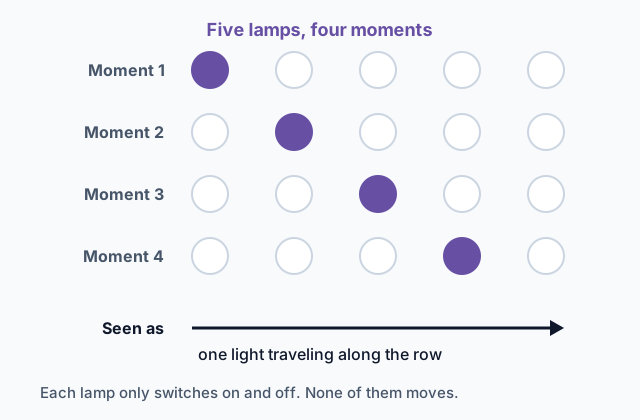
You can also see motion where there is none. In apparent movement, still images or lights in slightly different places, shown one after another in quick succession, are perceived as one thing moving. A movie is a series of still pictures.
Quick check · Match
Every person here is invented. Tap a term, then tap the example it explains best.
Part 3 Watch it done Reading the depth in a painting
Follow each step, then finish the last one yourself.
A painter wants a flat canvas of a city street to look deep. She paints the far buildings pale and hazy, lets a lamppost in front cover part of a doorway, and paints the people on the far sidewalk much smaller than the people in front. Which depth cue does each choice use?
Step 1 · Start with what a flat canvas allows
Every spot on a canvas is the same distance from the viewer, so the binocular cues have no real depth to report. Each of her choices must use a monocular cue.
Why this step?
Why rule out the binocular cues before looking at the painting's details?
Because retinal disparity and convergence come from two eyes looking at things at different real distances, and a canvas has none. Ruling them out first leaves only the five monocular cues to choose from.
Step 2 · Match the hazy buildings
Hazy, pale objects seem farther away than crisp ones, so the buildings use relative clarity.
Step 3 · Match the lamppost
The lamppost blocks part of the doorway, so it reads as nearer than the doorway. That is interposition.
Your step · Decide and justify
Finish it. A painter wants a flat canvas of a city street to look deep, and she paints the people on the far sidewalk much smaller than the people in front. Which depth cue does that choice use?
Which reason supports your answer?
Part 4 Try it Influences on perception, and a study to judge
First, sort five new cases by what is shaping the perception. Then read an illustrative study and judge a claim about it.
Try it · Sort it
Every person here is invented. Tap a card, then tap the influence it shows best.
Schema
Perceptual set
Context
Culture
Illustrative study (made up for practice, not a published study). Researchers recruited 80 high school students, and each student and a parent signed a consent form. A coin flip put each student in one of two groups. One group first looked through 10 photos of breakfast pastries; the other looked through 10 photos of seashells. Then every student saw the same line drawing for 2 seconds, a spiral that could be read as either a cinnamon roll or a snail shell, and wrote down what it was. In the pastry group, 31 of 40 students wrote a pastry; in the seashell group, 9 of 40 did. A statistical test showed the difference was statistically significant.
Try it · Decide and justify
In an illustrative experiment, a coin flip put 80 students into two groups. One group looked at photos of pastries and the other at photos of seashells. Then every student saw the same spiral drawing for 2 seconds and wrote what it was. In the pastry group, 31 of 40 wrote a pastry; in the seashell group, 9 of 40 did, a statistically significant difference. A classmate says the photos changed what the students' eyes sensed when they looked at the drawing. Does the study show that?
Which reason supports your answer?
Part 5 Explain it Write it the way the exam asks
Nothing you type leaves this page.
Free response is 33.3% of the exam score. This one is shaped like Question 2, Evidence-Based Question.
Free-response practice · Question 2 style
Read the three sources, then answer the question they share: do people perceive everything their senses take in? In parts B and C, cite the source you use, for example (Source 1).
Source 1. Illustrative study (made up for practice, not a published study). Researchers recruited 60 adult volunteers, and each signed a form saying they could stop at any time. A coin flip put each volunteer in one of two groups. Everyone watched the same 90-second video of three people passing a ball. Volunteers in the counting group were told to count the passes; volunteers in the watching group were told only to watch. Halfway through, a person carrying an open orange umbrella walked slowly across the scene. Afterward, 12 of the 30 volunteers in the counting group said they had noticed the umbrella, against 27 of the 30 in the watching group, and a statistical test showed the difference was statistically significant.
Source 2. Illustrative study (made up for practice, not a published study). Researchers recruited 36 adult volunteers, each of whom could stop at any time. On each trial, a volunteer watched a photo of a street scene switch back and forth with a copy in which one thing had changed, such as a missing mailbox, and pressed a key as soon as they spotted the change. On half the trials a brief gray screen appeared between the two photos each time they switched; on the other half it did not. Every volunteer did both kinds of trial, in a random order. With the gray screen, volunteers took a mean of 12.4 seconds to spot the change; without it, they took 1.6 seconds, and a statistical test showed the difference was statistically significant.
Source 3. Illustrative study (made up for practice, not a published study). Researchers recruited 30 college students, each of whom could stop at any time. Each student solved puzzles while headphones played a recording of loud cafeteria chatter, and was told to ignore it. Once, at a random moment, the recording included the student's own first name; at another random moment, it included an unfamiliar name of the same length. Afterward, 21 of the 30 students said they had heard their own name, and 4 of the 30 said they had heard the unfamiliar name. A statistical test showed the difference was statistically significant.
(A) Propose a specific and defensible claim, based in psychological science, that answers the question.
(B) (i) Support your claim using one piece of specific and relevant evidence from one of the sources. (ii) Explain how the evidence from part B (i) supports your claim, using a psychological perspective, theory, concept, or research finding.
(C) (i) Support your claim using a piece of specific and relevant evidence from a different source. (ii) Explain how the evidence from part C (i) supports your claim, using a different psychological perspective, theory, concept, or research finding from the one in part B (ii).
Model answer
(A) People do not perceive everything their senses take in. What gets perceived depends on attention, so things and changes in plain view can go unperceived when attention is elsewhere.
(B) (i) In Source 1, only 12 of 30 volunteers who counted passes noticed the person with the orange umbrella, against 27 of 30 who simply watched, though both groups saw the same video. (ii) This is inattentional blindness: failing to notice something in plain view because attention is on something else. The umbrella reached every volunteer's eyes in the same way, but counting passes held the counters' attention on the ball, and most of them never perceived the umbrella. A coin flip formed the groups and the difference was statistically significant, so the gap fits an effect of where attention was directed, which supports the claim that sensing something is not the same as perceiving it.
(C) (i) In Source 2, volunteers took a mean of 12.4 seconds to spot a change when a brief gray screen appeared between the photos, against 1.6 seconds with no gray screen. (ii) This is change blindness: failing to notice that something already in view has changed, because of inattention. Unlike the umbrella in Source 1, nothing new appeared here; what went unnoticed was a change to something already in view. Without the gray screen, the change shows up as a flicker at one spot that pulls attention to it. The gray screen hides that flicker, so nothing draws attention to the changed spot, and a change sitting in plain view went unperceived for many seconds. The changed photo reached the volunteers' eyes on every switch, so the delay supports the claim that people do not perceive all that their senses take in.
Score your own answer. This is a self-check, not a grade. Tick each point your answer makes.
Part 6 Check yourself Which rod is closer?
Exam multiple-choice questions sometimes share one table. These two questions share this one.
Illustrative study (made up for practice, not a published study). Researchers recruited 24 adult volunteers, each of whom could stop at any time. Each volunteer looked through a slot into a plain box holding two upright rods and said which rod was closer. So that size would not give the answer away, the rods' lengths were changed at random from trial to trial. Every volunteer did 40 trials in each of four conditions, in a random order: the real rods with both eyes open, the real rods with one eye covered, a flat photograph of the rods with both eyes open, and the photograph with one eye covered. Guessing would be right on 50% of trials. A statistical test showed that covering one eye made a statistically significant difference with the real rods but not with the photograph.
| What volunteers looked at | Eyes used | Mean percent correct |
|---|---|---|
| Real rods | Both eyes | 94 |
| Real rods | One eye covered | 63 |
| Photograph of the rods | Both eyes | 58 |
| Photograph of the rods | One eye covered | 57 |
Case question 1 · Multiple choice
In an illustrative study, volunteers looked into a plain box and judged which of two upright rods was closer, with the rods' lengths changed at random from trial to trial. Looking at the real rods, they were right on a mean of 94% of trials with both eyes open and 63% with one eye covered, a statistically significant difference. Which cues did covering one eye take away?
Case question 2 · Decide and justify
In an illustrative study, every volunteer judged which of two rods was closer in four conditions, in a random order. With the real rods, they were right on a mean of 94% of trials with both eyes open and 63% with one eye covered, a statistically significant difference. With a flat photograph of the rods, they were right on 58% with both eyes and 57% with one eye covered, a difference that was not statistically significant. A classmate concludes from the photograph results that having two eyes does not help people judge depth. Does the study support that conclusion?
Which reason supports your answer?
The rest stand on their own and do not use the case.
Check yourself · Spot the error
In a tourist photo, Jun, an invented student, seems to pinch the top of a far-off tower between two fingers. A classmate explains why the trick works. Tap the first line that goes wrong.
Check yourself · Fill the statement
Tap a blank, then tap a word.
Nadia, an invented student, watches her cousin's bus pull away. The bus's image on her retinas keeps shrinking, yet the bus does not seem to get any smaller, which is . At home she swings her bedroom door open, and the image it casts changes from a rectangle to a narrow slanted shape, yet she still sees a rectangular door, which is . Her white shirt looks white in the dim hallway and also beside the sunny window, which is .
Check yourself · Sort it
Every person here is invented. Tap a card, then tap what pulled the person's attention.
Outside: the stimulus itself
Inside: the person's goals or needs
Part 7 Keep it Two questions from earlier topics
Pulling older ideas back up now and then is what keeps them usable.
Bring it back · Multiple choice
Riding her bike, Sol, an invented student, comes up on a stop sign. Which of these steps is sensation rather than perception?
Bring it back · Fill the statement
Tap a blank, then tap a word.
Ines, an invented skateboarder, spots a crack in the path ahead, visual information that her process. A car horn honks behind her, and her process the sound. Through her shoes she feels the rough grip tape on the board, touch that her process.
In three lines
- Perception interprets what the senses detect, led by incoming details or by expectations, and filtered by schemas, sets, context and culture.
- Attention picks what is perceived, Gestalt principles group it into whole forms, and constancies keep objects stable as their images change.
- Binocular and monocular cues give depth, and apparent movement shows that perception can find motion in still images.
Vocabulary
- Perception
- The brain's processing of the neurochemical messages the senses send, organizing and interpreting them.
- Bottom-up processing
- Perception that relies primarily on external sensory information.
- Top-down processing
- Perception that relies primarily on internal prior expectations.
- Schema
- A mental framework of knowledge about something, an internal factor that filters perceptions of the world.
- Perceptual set
- A readiness to perceive something in a particular way, an internal factor that filters perceptions of the world.
- Context, experiences and culture
- External factors, including cultural experiences and expectations, that filter perceptions of the world.
- Gestalt principles
- Perceptual principles proposed by Gestalt psychology (closure, figure and ground, proximity and similarity) that help explain how humans organize their perceptual world.
- Attention
- An interaction of sensation and perception that is affected by internal and external processes.
- Cocktail party effect
- Selective attention in which people attend to mentions of their names or specific topics in loud or distracting environments.
- Inattentional blindness
- Failing to notice something in plain view because attention is on something else.
- Change blindness
- Failing to notice that something already in view has changed, because of inattention.
- Retinal disparity
- A binocular depth cue: the difference between the images projecting onto the two retinas.
- Convergence
- A binocular depth cue: the merging of the two retinal images by the brain.
- Monocular depth cues
- Cues (relative clarity, relative size, texture gradient, linear perspective and interposition) that give the illusion of depth on flat or two-dimensional surfaces.
- Perceptual constancy
- The maintained perception of an object even when the images of the object in the visual field change.
- Apparent movement
- Motion that is visually perceived even when objects are not actually moving.
Course alignment, for teachers
AP Psychology topic 2.1, Unit 2: Cognition.
- Skill 1.B: Explain how cultural norms, expectations, and circumstances, as well as cognitive biases apply to behavior and mental processes.
- Skill 3.A: Identify psychology-related concepts in descriptions or representations of data.
This lesson maps all 11 essential knowledge statements of the topic to the part that teaches each one: 11 are checked by a scored question. The map is in the lesson file.