Unit 2 · Topic 2.2 · about 30 minutes · 7 parts · 16 scored checks, 3 of them multiple choice
AP Psychology 2.2: Thinking, Problem-Solving, Judgments, and Decision-Making
Unit 2: 15 to 25% of the multiple-choice section
 Tap to open the picture full size
Part 1 Think first Paying without money
Make a guess first. Committing to an answer, even a wrong one, helps the real one stick.
Predict first
Mila is four. To her, paying means handing over coins or paper bills. At the grocery store she watches her dad hold his phone near the card reader, and they walk out with the bags. In the car she whispers, worried, "We didn't pay. You didn't give them any money." What is going on in Mila's thinking?
In short. Thinking runs on concepts and schemas, and solving a problem or making a decision means choosing between slow, sure methods and fast shortcuts that can mislead.
- Concepts group similar things around a prototype, the ideal example, and schemas either take in new information unchanged (assimilation) or change to fit it (accommodation).
- Algorithms try every possible solution until one works, while heuristics such as representativeness and availability are quick shortcuts that can lead to errors.
- Mental set, priming, framing, the gambler's fallacy and the sunk-cost fallacy can bend decisions; executive functions guide goal-directed behavior, and creative, divergent thinking is hindered by functional fixedness.
Part 2 Learn it Four ideas about how people think
2a. Concepts, prototypes and schemas
Thinking runs on concepts, mental groupings of similar objects, events, ideas or people. "Chair", "birthday" and "paying" are all concepts. Without them you would have to work out from scratch what every new thing is.
For each concept you hold a prototype, the ideal example, the one that best captures the concept. Prototypes grow out of the examples you have met, so they can differ from one person, or one place, to another. Something close to your prototype gets sorted into the concept almost at once. Something far from it takes longer and feels less certain, even when you know it belongs.
Concepts link up into schemas, frameworks for thinking about how something works and what to expect. Mila's schema of paying said that money is coins and bills that change hands. People form and modify schemas in two ways when new information arrives:
- Assimilation: you take in the new information but do not change the schema. Mila fit the tap into her old framework and decided no money had changed hands.
- Accommodation: you take in the new information and change the schema to make room for it. Once Mila learns a phone can send money from a bank, her schema of paying grows to include taps and cards.
To tell them apart, ask one question: did the framework change?
Quick check · Fill the statement
Tap a blank, then tap a word.
Ava's grandfather puts record players, radios and speakers under one word, "music players", a . When he pictures a music player, he pictures the record player he grew up with, his . His for listening to music says that songs come on discs you buy and keep. When Ava streams a song, he calls it "a radio that plays whatever you ask for", an example of . A month later he tells a friend that owning a record is no longer the point, since any song can be saved and played anytime, an example of .
2b. Algorithms and heuristics
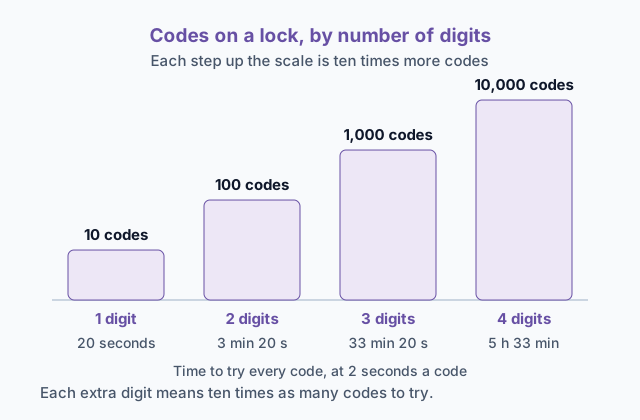
Faced with a problem, you can work it out in two broad ways. An algorithm attempts all possible solutions until the correct one is found. If you forget the three-digit code on a bike lock, trying 000, then 001, then 002 and on up to 999 is an algorithm. It is slow, but it cannot miss.
A heuristic is a mental shortcut for making a judgment. Heuristics are fast and often good enough, but they can lead to errors in judgment. The course names two:
- The representativeness heuristic judges something by how well it matches your prior expectations or stereotypes. Told that a new neighbor is tidy, quiet and loves spreadsheets, you might guess she is an accountant rather than a nurse, because she fits your picture of an accountant, even if you know far more nurses live nearby.
- The availability heuristic judges how likely or common something is by the first or most vivid example that comes to mind. After a friend's phone is stolen at a concert, you may decide phones get stolen at every concert, though you have been to a dozen without trouble.
Both produce a quick answer, so ask what the shortcut used. A match to a type is representativeness. An example that springs to mind is availability.
Quick check · Sort it
Tap a card, then tap the way of solving or judging it shows.
Algorithm
Representativeness heuristic
Availability heuristic
2c. What else bends a decision
Decisions also lean on past success and on the circumstances around the choice.
Mental set is approaching a problem the way that worked before. Usually experience helps, but a method that succeeded ten times can hide a quicker one the eleventh time.
Priming happens when something you met just before a decision activates related ideas and nudges the choice, often without your noticing. A shopper who walks past a poster of a snowy cabin may be a little more likely to pick the hot drink.
Framing is the way the choice itself is worded or presented. The same facts can lead to different decisions: one forecast sounds better as "a 90 percent chance of no rain" than as "a 10 percent chance of rain".
Two patterns of reasoning can hinder good decisions:
- The gambler's fallacy is believing that a chance outcome is "due" because it has not happened lately, or unlikely because it just did. A fair coin that lands heads five times still has the same chance of heads on the sixth flip.
- The sunk-cost fallacy is sticking with something because of the time, money or effort already spent, which cannot be recovered, instead of judging what lies ahead. Finishing a dull 600-page novel only because you are 300 pages in is one example.
Quick check · Match
Tap a term, then tap the decision it explains.
2d. Executive functions and creativity
Executive functions are cognitive processes that let you generate, organize, plan and carry out goal-directed behavior, and think critically along the way. Coming up with options for a weekend, putting them in some order, laying out the steps, getting started and noticing when a step goes wrong all draw on them.
Creativity is a way of thinking that produces novel ideas. It depends on divergent thinking, which spreads out from one starting point to many possible answers, such as listing every use you can think of for an old tire. Convergent thinking works the other way and narrows down to the single correct or best answer, such as working out which one solution meets every rule of a logic puzzle. Most real problems need both: divergent thinking to produce options, then convergent thinking to choose.
Creative thinking is hindered by functional fixedness, the tendency to see an object only in terms of its usual use. Someone who needs to prop a window open and has a hardcover book on the table may never think of the book as a wedge.
Functional fixedness is easy to confuse with mental set. Mental set is stuck on a method that worked before. Functional fixedness is stuck on an object's usual job.
Quick check · Sort it
Tap a card, then tap the kind of thinking it shows.
Divergent thinking
Convergent thinking
Functional fixedness
Part 3 Watch it done Naming the shortcut behind a snap judgment
Watch each step, then do the last one yourself.
Tess's school has 360 students in its general program and 40 in its robotics program. On the first day she meets Arlo, who spends lunch fixing a broken calculator and talking about circuits. She decides at once that he must be in the robotics program. What kind of thinking produced her judgment?
Step 1 · Ask whether she worked through every possibility
Tess did not check a list, ask anyone or test each program in turn. She reached her answer in a moment, so this is a mental shortcut, a heuristic, and not an algorithm.
Step 2 · Ask what the shortcut used
Nothing in the case says a particular robotics student came to her mind. What she used was Arlo himself: how closely his lunch and his talk matched her picture of a robotics student.
Why this step?
Why check whether an example came to mind, when the case never mentions one?
Because the two heuristics both give fast answers and differ only in what they lean on. A judgment drawn from a vivid example that springs to mind is availability; one drawn from how well a case fits an expectation is representativeness. Ruling one out by what the case says is how you name the other with confidence.
Step 3 · Weigh the judgment against the numbers
There are 360 general students and 40 robotics students, nine times as many. If even a small share of the general students tinker like Arlo, they could outnumber the robotics students who do. A guess based only on fit ignores that.
Your step · Decide and justify
Finish it. Tess's school has 360 students in its general program and 40 in its robotics program. She meets Arlo, who spends lunch fixing a calculator and talking about circuits, and decides at once that he must be in robotics. Which name fits her judgment?
Which reason supports your answer?
Part 4 Try it Priming, framing, sunk costs and a study
Try it · Sort it
Each card is a decision that shifted. Tap a card, then tap what shifted it.
Priming
Framing
Try it · Decide and justify
Wren has spent two years and 3,000 dollars restoring an old car. It now needs a repair that costs more than a reliable used car would, and she says she cannot stop now after everything she has already put in. Her friend says Wren is showing the gambler's fallacy. Is the friend right?
Which reason supports your answer?
Illustrative study (made up for practice, not a published study). Researchers wanted to know whether the wording of a choice changes what students choose. They recruited 160 students at one high school. A random number generator assigned each student to read one of two descriptions of the same free after-school tutoring program. One said, "Students who attend raise their test scores in 3 of every 4 cases." The other said, "Students who attend fail to raise their test scores in 1 of every 4 cases." Each student then marked on a form whether they would sign up. In the first group, 68 percent marked yes; in the second, 41 percent did, and a statistical test showed the difference was statistically significant. The researchers did not track who later attended.
Try it · Multiple choice
In an illustrative study, 160 students were randomly assigned to read that a tutoring program helps "in 3 of every 4 cases" or fails "in 1 of every 4 cases". Of the first group 68 percent marked that they would sign up, and of the second 41 percent, a statistically significant difference. Attendance was not tracked. Which conclusion does the study support best?
Part 5 Explain it Answer an article analysis question
Nothing you type leaves this page.
Free response is 33.3% of the exam score. This one is shaped like Question 1, Article Analysis Question.
Free-response practice · Question 1 style
Illustrative study (made up for practice, not a published study). Researchers wanted to know whether seeing an object doing its usual job makes people slower to find a new use for it. A review board approved the study. They recruited 60 adult volunteers at one university, and each volunteer signed a consent form that described the task and said they could stop at any time. A random number generator placed each volunteer in one of two groups of 30. Every volunteer sat at a desk with a phone, a mug of pens and a large binder clip, and was asked to stand the phone upright in the middle of the desk without holding it or leaning it on anything. The intended solution is to clamp the clip onto the bottom edge of the phone so that the clip acts as a stand. For one group, the clip was clamped onto a stack of papers. For the other, it lay loose and empty on the desk. A volunteer counted as solving the problem if the phone stood upright on its own, held by the clip, within five minutes. In the loose-clip group, 21 of 30 volunteers solved it; in the clamped-clip group, 9 of 30 did, and a statistical test showed the difference was statistically significant. After each session, the researchers told the volunteer the real purpose of the study.
(A) Identify the research method used in this study.
(B) State the operational definition of solving the problem in this study.
(C) Identify one ethical guideline described in the study. Describe one way the researchers applied it.
(D) Explain how the results support the idea of functional fixedness.
Model answer
(A) This is an experiment, because a random number generator assigned each volunteer to the clamped-clip group or the loose-clip group.
(B) A volunteer solved the problem if the phone stood upright on its own, held by the binder clip, within five minutes.
(C) Informed consent. Before taking part, each volunteer signed a form that described the task and said they could stop at any time.
(D) Functional fixedness is the tendency to see an object only in terms of its usual use, and it hinders creative problem solving. Volunteers who saw the clip clamped onto papers, doing its usual job, solved the problem far less often, 9 of 30 against 21 of 30, and the difference was statistically significant. Because the groups were formed at random, seeing the clip at work was the planned difference between them. The result fits the idea that seeing an object in its usual use makes it harder to think of it as something else, here a stand.
Score your own answer. This is a self-check, not a grade. Tick each point your answer makes.
Part 6 Check yourself How fast is a penguin a bird?
On the exam, a set of multiple-choice questions can share one set of data. The first three questions here share this table the same way.
Illustrative data (made up for practice). Researchers showed 40 adult volunteers from one city in the United States a series of words, one at a time, after the question "Is this a bird?" Volunteers pressed a key for yes or no as fast as they could, and every volunteer answered yes for all four birds below. A separate group of 30 adults rated how good an example of a bird each one is, from 1 (a poor example) to 7 (a very good example).
| Bird | Mean rating as an example of a bird (1 to 7) | Mean time to answer yes (milliseconds) |
|---|---|---|
| Robin | 6.8 | 540 |
| Sparrow | 6.5 | 565 |
| Chicken | 3.4 | 705 |
| Penguin | 2.6 | 780 |
Case question 1 · Multiple choice
In illustrative data, 40 volunteers all answered yes to "Is this a bird?" for robin, sparrow, chicken and penguin. A separate group rated each as an example of a bird, from 1 (poor) to 7 (very good): robin 6.8, sparrow 6.5, chicken 3.4 and penguin 2.6. Mean times to answer yes were 540, 565, 705 and 780 milliseconds. Which conclusion do these data best support?
Case question 2 · Decide and justify
In illustrative data from 40 volunteers in one city in the United States, robins (rated 6.8 of 7 as an example of a bird) were confirmed as birds faster than penguins (rated 2.6). A researcher writes that people everywhere in the world would confirm a robin as a bird faster than a penguin. Do these data support that claim?
Which reason supports your answer?
Case question 3 · Spot the error
In illustrative data, 40 volunteers all answered yes to "Is this a bird?" for robin, sparrow, chicken and penguin. A separate group rated each as an example of a bird, from 1 (poor) to 7 (very good): robin 6.8, sparrow 6.5, chicken 3.4 and penguin 2.6. Mean times to answer yes were 540, 565, 705 and 780 milliseconds. A student explains the data. Tap the first line that goes wrong.
The rest stand on their own and do not use the case.
Check yourself · Put it in order
Priya's robotics team needs to raise 500 dollars by the end of the month. Tap the steps she takes in the order they have to happen.
Check yourself · Sort it
Tap a card, then tap what is getting in the person's way.
Mental set
Functional fixedness
Check yourself · Fill the statement
Tap a blank, then tap a phrase.
At an invention fair, judges score each entry on how new and useful its idea is, which is a measure of . One team planned months ahead, split up the jobs and kept to its deadlines, steady use of its . Early on, the team let its thinking spread out from one goal to 50 possible gadgets instead of narrowing to one, the kind of thinking called . Its winning gadget used a shoelace as a drive belt, getting past the that keeps most people seeing a shoelace only as something for tying shoes.
Part 7 Keep it Bring back earlier ideas
Pulling an older idea back out of memory is what keeps it there.
Bring it back · Match
A game designer wants a flat screen to look deep. Tap a depth cue, then tap the choice that uses it.
Bring it back · Multiple choice
Kofi lives in Rome and flies to Chicago, where clocks are seven hours behind. For his first few days there, he can barely stay awake at 5 p.m. Chicago time, but he lies wide awake at 3 a.m. Which explanation fits this pattern best?
In three lines
- Concepts group similar things around a prototype; schemas take in new information unchanged (assimilation) or change to fit it (accommodation).
- Algorithms try every possible solution, while heuristics are fast shortcuts: representativeness judges by fit to an expectation, availability by the example that comes to mind.
- Mental set, priming, framing and the gambler's and sunk-cost fallacies can bend decisions; executive functions run goal-directed behavior, and divergent, creative thinking is hindered by functional fixedness.
Vocabulary
- Concept
- A mental grouping of similar objects, events, ideas or people; concepts form the basis of thought.
- Prototype
- The ideal example for any given concept.
- Schema
- A framework for thinking that people form and modify as new information arrives.
- Assimilation
- Taking in new information but not changing the schema in light of it.
- Accommodation
- Taking in new information and changing the schema to incorporate it.
- Algorithm
- A way of addressing a problem by attempting all possible solutions until the correct one is found.
- Heuristic
- A mental shortcut used to make judgments, which can lead to errors.
- Representativeness heuristic
- Judging according to prior expectations or stereotypes, such as how well a case fits a type.
- Availability heuristic
- Judging by recalling the first or most vivid example that comes to mind.
- Mental set
- Approaching a decision or problem the way that was successful in prior experiences.
- Priming
- An influence on a decision from something encountered just before it, which activates related ideas.
- Framing
- An influence on a decision from the way the choice is worded or presented.
- Gambler's fallacy
- The belief that a chance outcome is due, or less likely, because of what happened on earlier tries.
- Sunk-cost fallacy
- Continuing something because of what has already been spent on it rather than what lies ahead.
- Executive functions
- Cognitive processes that let a person generate, organize, plan and carry out goal-directed behavior and think critically.
- Creativity
- A way of thinking that includes generating novel ideas and engaging in divergent thinking.
- Divergent thinking
- Thinking that spreads out to many possible answers or ideas.
- Convergent thinking
- Thinking that narrows down to a single correct or best answer.
- Functional fixedness
- The tendency to see an object only in terms of its usual use, which hinders creative thinking.
Course alignment, for teachers
AP Psychology topic 2.2, Unit 2: Cognition.
- Skill 1.B: Explain how cultural norms, expectations, and circumstances, as well as cognitive biases apply to behavior and mental processes.
- Skill 2.C: Evaluate the appropriate use of research design elements in non-experimental methodologies.
This lesson maps all 8 essential knowledge statements of the topic to the part that teaches each one: 8 are checked by a scored question. The map is in the lesson file.