Unit 2 · Topic 2.4 · about 30 minutes · 7 parts · 14 scored checks, 3 of them multiple choice
AP Psychology 2.4: Encoding Memories
Unit 2: 15 to 25% of the multiple-choice section
 Tap to open the picture full size
Part 1 Think first Ten specials, read once
Guess before you learn. A wrong guess still makes the answer stick.
Predict first
A server at a busy restaurant reads out ten dinner specials, one after another, without writing any of them down for you. The moment she finishes, she asks what you would like to order. Which specials are you most likely to still have in your head?
In short. Encoding is the set of processes and strategies that get information into memory, and how something is encoded affects how well it is stored and later retrieved.
- Mnemonic devices, such as the method of loci, give new information a structure that is easier to encode.
- Grouping information into meaningful chunks, categories or hierarchies makes it easier to encode, and spreading practice over time encodes it more lastingly than massing it into one session.
- The order in which information arrives also changes how well each piece of it is encoded.
Part 2 Learn it Four ways to get information in
2a. Encoding, and devices that help it
Before you can remember anything, it has to get into memory. Encoding is the set of processes and strategies that get information into memory, and how you encode something decides a lot about how well it is stored and how easily you can retrieve it later.
Picture the remote for a TV you have used for years. Could you draw where every button sits? Most people could not. They encoded the three or four buttons they press and never took in the rest, and information that never got in cannot come back out, no matter how often it was in front of you.
Some strategies make encoding work better. Mnemonic devices are memory aids that hang new information on a structure that is easy to remember. A first-letter sentence is one: music students learn the notes on the lines of the treble clef, E, G, B, D and F, as "Every Good Boy Does Fine."
The method of loci is one of the oldest. You picture a route you know well, such as the walk through your home, and leave each item you need to remember at a spot along it, in order. To recall the list, you walk the route in your mind and pick up each item where you left it.
Quick check · Fill the statement
Tap a blank, then tap a word.
Malik has to remember five treaties, in order, for a history test. He pictures each treaty sitting at a different spot along the walk from his front door to his kitchen. Getting the treaties into memory is called . Placing each treaty along his walk through the house is the , one kind of device.
2b. Grouping: chunks, categories and hierarchies
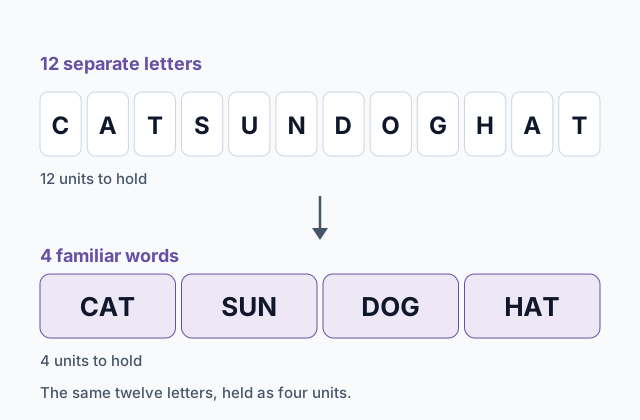
Information is easier to encode when it is grouped. Chunking combines small pieces into a larger, meaningful unit, so there are fewer units to hold. The digits 2 0 0 1 2 0 2 0 are eight separate pieces, but read as the years 2001 and 2020 they are two.
Categories group items by what kind of thing they are. A shopping list of 18 items is hard to hold as a jumble. Sorted under produce, dairy and snacks, it has three headings, and each one helps bring back the items under it.
The test that tells a chunk from a category: in a chunk, the pieces fuse into one familiar unit you hold as a single thing, like a year or a word. In a category, each item stays separate and you still remember it on its own; the heading just tells you where to look.
A hierarchy goes further: broad categories split into narrower ones, and those split again, like an outline. Notes on musical instruments might split into strings and brass, with violin and cello under strings and trumpet and tuba under brass. Plain categories are one level of groups. A hierarchy is groups inside groups, with several levels from broad to narrow.
All three work the same way. Grouping gives the information a meaningful structure, so encoding one piece of a group helps you encode, and later find, the rest of it.
Quick check · Sort it
Tap an example, then tap the kind of grouping it uses.
Chunking
Categories
Hierarchy
2c. Spacing practice out
Suppose you have three hours to learn 60 flashcards. You could spend all three hours in one sitting, or one hour on each of three different days. Packing the practice into one session is massed practice. Spreading the same practice across separate sessions over time is distributed practice.
The spacing effect is the finding that the schedule matters: information practiced in spaced sessions is remembered better, and for longer, than the same information practiced all at once, even when the total time is exactly the same. The schedule changes both how well the information is encoded and how well it goes through memory consolidation, the process by which a new memory becomes stable and lasting.
Massed practice often feels like it is working better. After three hours in a row the cards look familiar, and familiar feels like learned. The difference shows up later. Weeks after the last session, the student who spread the hours out remembers more of the cards than the student who crammed, though both put in the same time.
So the question to ask about a study plan is not only how many hours it has. It is how those hours are spread out.
Quick check · Match
Tap a term, then tap the example that shows it.
2d. Where an item sits in a list
When information arrives as a list, where an item sits changes how well it gets in. This is the serial position effect: items at the beginning and at the end of a list are more memorable than items in the middle.
The advantage for the first items is the primacy effect. Early items arrive while your attention is free, and you have a moment to go over them before more pile on. The advantage for the last items is the recency effect. When the list stops, they are the ones you just heard, so they are still at hand when you start to recall. Items in the middle get neither boost, and they are the ones most often lost.
You can put this to work. A speaker who wants one point remembered puts it first or last, never buried in the middle of ten. When you study a long list, start at a different place each time, so the same items are not always the ones stuck in the middle.
Quick check · Fill the statement
Tap a blank, then tap a word.
Right after his dad reads him a list of twelve errands, Kai writes down the ones he remembers. He gets the first two, which shows the effect, and the last two, which shows the effect, but misses most of the ones in between. The whole pattern is called the effect.
Part 3 Watch it done Planning how to learn an ordered list
Watch each step, then do the last one yourself.
Theo has to learn the eight steps of his school's lab safety procedure, in order, for a quiz on Friday, and he will need them in every lab for the rest of the year. It is Monday, and he can give it about two hours in all. How should he get the steps into memory?
Step 1 · Say exactly what has to get in
Eight separate steps, and the order they go in. A plan that gets every step in but scrambles the order still fails the quiz, so the strategy has to carry the order with it.
Step 2 · Pick a strategy that fits the material
A first-letter sentence is a mnemonic device that keeps order built in. Theo takes the first letter of each step and makes up an eight-word sentence whose words start with those letters, in the same order. Saying the sentence cues each step in turn.
Why this step?
Why a first-letter sentence, rather than sorting the eight steps into categories?
Categories group items by what kind of thing they are, which would pull the steps out of sequence. The sentence keeps the sequence, so recalling the sentence walks Theo through the steps in the right order.
Your step · Decide and justify
Finish the plan. Theo has about two hours to practice the eight lab safety steps before a quiz on Friday, and he will need the steps in every lab for the rest of the year. It is Monday. How should he schedule his practice?
Which reason supports your answer?
Part 4 Try it Read a study: do headings help a list stick?
Illustrative study (made up for practice, not a published study). Sixty students at one university volunteered. A coin flip decided which version of a 24-word list each student would study for two minutes. In the sorted version, the words were printed in four groups of six under the headings Fruits, Tools, Animals and Furniture. In the mixed version, the same 24 words were printed in a scrambled order with no headings. After a five-minute puzzle break, each student had three minutes to write down as many of the words as they could. The sorted group wrote down a mean of 17.4 words and the mixed group a mean of 11.9, and a statistical test showed the difference was statistically significant.
| Version studied | Students | Mean words written down |
|---|---|---|
| Sorted under headings | 30 | 17.4 |
| Mixed, no headings | 30 | 11.9 |
Try it · Multiple choice
In an illustrative study, a coin flip decided whether each of 60 university students studied a 24-word list printed in four groups under the headings Fruits, Tools, Animals and Furniture, or the same words in a scrambled order with no headings. After a five-minute puzzle break, each student wrote down as many words as they could in three minutes. What was the independent variable?
Try it · Decide and justify
In an illustrative study, 60 students at one university were assigned by coin flip to study 24 words either sorted under category headings or scrambled with no headings. The sorted group wrote down a mean of 17.4 words and the mixed group 11.9, and the difference was statistically significant. A classmate concludes that sorting words under headings improves memory for people of every age. Does the study support that conclusion?
Which reason supports your answer?
Part 5 Explain it Answer an article analysis question
This is a self-check. Nothing you type leaves this page.
Free response is 33.3% of the exam score. This one is shaped like Question 1, Article Analysis Question.
Free-response practice · Question 1 style
Illustrative study (made up for practice, not a published study). Researchers wanted to know whether the method of loci helps people remember a list. They recruited 70 students, aged 18 to 22, at one university. Before anything began, each student read a description of what they would be asked to do, was told they could stop at any point, and signed a form agreeing to take part. A coin flip then put each student in one of two groups. The loci group spent 10 minutes learning to picture items at ten spots along the route through their own home. The comparison group spent the same 10 minutes doing word puzzles. Next, every student studied the same list of 20 unrelated nouns for four minutes, the loci group using their route and the comparison group studying in whatever way they liked. After a 15-minute break, each student wrote down as many of the 20 nouns as they could in five minutes. The loci group wrote down a mean of 14.6 nouns and the comparison group a mean of 9.8. The difference was statistically significant.
(A) Identify the research method used in this study.
(B) State the operational definition of memory in this study.
(C) Identify one ethical guideline described in the study. Describe one way the researchers applied it.
(D) Explain the extent to which the findings may or may not be generalizable, using specific evidence from the study.
(E) Explain how the results support the idea that mnemonic devices, such as the method of loci, aid encoding.
Model answer
(A) This is an experiment, because a coin flip assigned each student at random to the loci group or the comparison group.
(B) Memory was measured as the number of the 20 nouns each student wrote down in five minutes, after a 15-minute break.
(C) Informed consent. Before anything began, each student read a description of what they would be asked to do and signed a form agreeing to take part.
(D) The findings may not generalize to all people, because every participant was a university student aged 18 to 22 at one university. Children or older adults, who were never tested, might not learn or use the route as easily.
(E) The method of loci is a mnemonic device: it gives a list a structure by placing each item at a spot along a familiar route. Both groups studied the same nouns for the same time and were tested the same way, and a coin flip decided who learned the route. The loci group wrote down a mean of 14.6 nouns against 9.8 for the comparison group, a statistically significant difference, so placing the nouns along a route got more of them into memory, which is what the idea that mnemonic devices aid encoding predicts.
Score your own answer. This is a self-check, not a grade. Tick each point your answer makes.
Part 6 Check yourself Read the list, find the pattern
On the exam, a set of multiple-choice questions can share one set of data. These three questions share this table the same way.
Illustrative data (made up for practice). Researchers read a list of 15 unrelated words aloud to 40 adults, one word every two seconds. Right after the last word, each adult wrote down as many of the words as they could, in any order. The order of the words was shuffled for each adult, so every word landed near the start, in the middle and near the end of the list about equally often. The table shows the percent of words recalled from each part of the list.
| Position in the list | Percent recalled |
|---|---|
| 1 to 3 | 70 |
| 4 to 6 | 45 |
| 7 to 9 | 38 |
| 10 to 12 | 47 |
| 13 to 15 | 81 |
Case question 1 · Multiple choice
Forty adults heard a list of 15 words and wrote down all they could right away. Words in positions 13 to 15 were recalled 81 percent of the time, more than any other part of the list. Which best explains that result?
Case question 2 · Calculate
In a table of recall by position in a 15-word list, words in positions 1 to 3 were recalled 70 percent of the time, positions 4 to 6 45 percent, positions 7 to 9 38 percent, positions 10 to 12 47 percent and positions 13 to 15 81 percent. How many percentage points higher was recall for positions 13 to 15 than for positions 7 to 9, the middle of the list?
Case question 3 · Decide and justify
Forty adults heard a list of 15 unrelated words and wrote down all they could right away. The word order was shuffled for each adult, so every word landed near the start, in the middle and near the end about equally often. Words in positions 7 to 9 were recalled least, 38 percent of the time. A classmate says those words were recalled least because they were harder words. Does the study support her explanation?
Which reason supports your answer?
The rest stand on their own and do not use the case.
Check yourself · Put it in order
Lucia organizes her astronomy notes as a hierarchy. Tap the levels from the broadest to the narrowest.
Check yourself · Spot the error
Jae has four hours to learn 80 vocabulary words for a test a month from now, and he writes out his reasoning about two study plans. Tap the first line that goes wrong.
Part 7 Keep it Bring back earlier ideas
Coming back to an older idea is what keeps it ready when you need it.
Bring it back · Multiple choice
Before leaving home, Nadia tells herself she has to drop her library book in the return slot on her way to first period. At 8:05 she walks past the slot and remembers to do it. Which type of memory let her remember to carry out the plan at the right moment?
Bring it back · Fill the statement
Tap a blank, then tap a depth cue.
In a painting of a country road, the two edges of the road draw closer together until they meet at the horizon, which is . A barn in the foreground hides part of a silo standing behind it, which is .
In three lines
- Encoding gets information into memory, and mnemonic devices such as the method of loci give it a structure that is easier to encode.
- Grouping information into chunks, categories or hierarchies helps it go in, and practice spread over time is remembered better and longer than the same practice massed together.
- Items at the beginning and end of a list are more memorable than those in the middle, through the primacy and recency effects.
Vocabulary
- Encoding
- The processes and strategies that get information into memory; how information is encoded affects how well it is stored and retrieved.
- Mnemonic device
- A process, such as the method of loci, that aids in encoding information into working and long-term memory.
- Method of loci
- A mnemonic device in which each item to remember is pictured at a spot along a familiar route, in order.
- Chunking
- Grouping pieces of information together into larger, meaningful units, which improves encoding.
- Categories and hierarchies
- Grouping information by kind (categories) or into groups inside groups from broad to narrow (hierarchies), which improves encoding.
- Massed practice
- Encoding information all at once, in one session.
- Distributed practice
- Encoding information over time, in sessions spread apart.
- Spacing effect
- The difference in encoding and memory consolidation between massed practice and distributed practice, with distributed practice remembered better and longer.
- Memory consolidation
- The process by which a newly encoded memory becomes stable and lasting.
- Serial position effect
- The effect of presentation order on encoding: information at the beginning or end of a list is more memorable than information in the middle.
- Primacy effect
- The greater memorability of information presented at the beginning of a list.
- Recency effect
- The greater memorability of information presented at the end of a list.
Course alignment, for teachers
AP Psychology topic 2.4, Unit 2: Cognition.
- Skill 1.A: Apply psychological perspectives, theories, concepts, and research findings to a scenario.
- Skill 2.B: Evaluate the appropriate use of research design elements in experimental methodology.
- Skill 3.B: Calculate and interpret measures of central tendency, variation, and percentile rank in a given data set.
This lesson maps all 5 essential knowledge statements of the topic to the part that teaches each one: 5 are checked by a scored question. The map is in the lesson file.