Unit 2 · Topic 2.5 · about 30 minutes · 7 parts · 14 scored checks, 3 of them multiple choice
AP Psychology 2.5: Storing Memories
Unit 2: 15 to 25% of the multiple-choice section
 Tap to open the picture full size
Part 1 Think first A code you only needed for a minute
Guess before you learn. A wrong guess still makes the answer stick.
Predict first
At a pharmacy counter, Sam reads a six-character pickup code, R7KM2T, off his phone. Then the phone dies. Before asking for the code, the pharmacist has him spell his street name, read out his birth date and confirm his insurance number, which takes about a minute. Sam never says the code to himself in that time. When she finally asks for it, how much of the code is Sam most likely to still have?
In short. Storing a memory means keeping information over time, and how long it lasts depends on which store holds it and what you do with it.
- Sensory, short-term, working and long-term memory differ in how long they keep information, how much they hold and what kind of content they hold; short-term and working memory are told apart by whether the information is only kept or also worked on.
- Repeating information keeps it available while you repeat it, and rehearsing it for meaning helps it last; memories tied to your own life tend to stick.
- Brain damage, disease and early development can limit what gets stored or what stays stored.
Part 2 Learn it Four short ideas, each checked as you go
2a. Four stores, three differences
Four storage processes differ in three ways: duration (how long information lasts), capacity (how much fits) and content (what kind of information is held).
- Sensory memory holds a brief, nearly complete copy of what your senses take in, before you pay attention to any of it. Its capacity is large, but a sight lasts under a second and a sound a few seconds. The content is raw: how something looked or sounded, not what it means.
- Short-term memory holds the few things you are paying attention to, about seven at once by the classic estimate. Without rehearsal they fade within about 20 to 30 seconds.
- Working memory is the workspace where you hold information and work on it at once: adding a bill in your head, or comparing two routes. Its capacity is small; its content is whatever you are using, new or from long-term memory.
- Long-term memory holds knowledge, events and skills for days or a lifetime, with no known limit on capacity. Much of it is stored by meaning, so you keep the gist of a conversation and lose the words.
Short-term and working memory both hold a few things for seconds. The test is what the person does with the information. Only keeping it in mind is short-term memory. Changing it, combining it or calculating with it is working memory. Repeating it under your breath uses working memory's phonological loop, from 2.3, to keep it in short-term storage unchanged.
Quick check · Sort it
Tap a moment, then tap the store that is holding the information.
Sensory memory
Short-term memory
Working memory
Long-term memory
2b. Keeping it: two kinds of rehearsal
Information in short-term memory fades fast unless you do something with it. The simplest move is maintenance rehearsal: repeating the information over and over, like saying a gate number to yourself all the way down an airport hallway. While you keep repeating it, it stays. Stop, and it fades on the usual schedule. Maintenance rehearsal prolongs storage, but repetition on its own adds no meaning, so it does much less for keeping information for weeks.
Elaborative rehearsal works with the meaning. You link the new information to something you already know, explain it in your own words, or make up an example of it. To learn that nocturnal means active at night, you might connect it to the owl you hear outside your window, or notice it shares a root with nocturne, a piece of night music. Rehearsing for meaning helps with memory retention: the information is much more likely to still be there next month.
What counts is what you do with the information, not how many times you do it. Reading a definition aloud twenty times is still maintenance rehearsal. Turning it into one example of your own is elaborative.
Quick check · Sort it
Tap a study habit, then tap the kind of rehearsal it is.
Maintenance rehearsal
Elaborative rehearsal
2c. Memories of your own life
Autobiographical memory is memory for the events and facts of your own life: your first day at a new school, the street you lived on at age eight, the day a sibling was born. Memories connected to our own lives or selves tend to be more memorable than ones that are not. A new idea you tie to yourself, such as noticing that a trait word in a lesson describes you, has an extra hook to hang on.
A few people go much further. People with highly superior autobiographical memory (HSAM) can be given a date from many years ago and say what weekday it was and what they did, often in vivid detail, for nearly every day since childhood. Their memory for ordinary word lists and school facts is often no better than anyone else's. What is superior is memory for their own lives.
Researchers who compared brain scans of people with HSAM with those of other adults found differences in some brain areas. That may indicate biological processes behind superior memory storage. It is not proof. Only a small number of people with HSAM have been studied, and a brain difference could be a cause of their memory or a result of years spent going over the past.
Quick check · Fill the statement
Tap a blank, then tap a word or phrase.
A researcher names a date from twelve years ago, and Noor gives the weekday, the weather and what she ate for lunch, as she can for almost every day since she was ten. Very few people can do this; it is called autobiographical memory. Her brother remembers far fewer days, but the day his family moved to a new town is still sharper for him than the history dates he studied that same year, because it belongs to his own memory.
2d. When storage breaks down
Storage can be harmed by physical impairment, and it is limited early in development.
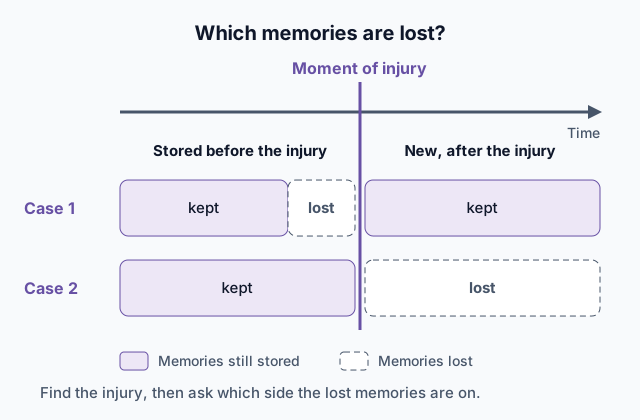
Amnesia is a loss of memory, often after a head injury, a stroke or an illness that damages the brain. It runs in two directions, measured from the moment of damage. In retrograde amnesia, memories stored before the damage are lost; a player knocked out in a game may never get back the minutes before the hit. In anterograde amnesia, the person cannot store new long-term memories after the damage. Older memories can be intact, and the person can follow a conversation in short-term memory, but an hour later it is gone. Some people have both.
Alzheimer's disease is a disease, not a single injury. It gradually destroys brain cells, so memory loss grows over years. Recent events usually go first, and older memories later, as the damage spreads.
Infantile amnesia is a developmental limitation, not damage. Most adults remember little or nothing from before about age 3, even though babies and toddlers learn all the time. Experiences from those years are rarely stored in a way that lasts into adulthood.
Quick check · Match
Tap a term, then tap the example that shows it.
Part 3 Watch it done Naming the store, one question at a time
Watch each step, then do the last one yourself.
At a farm stand, Asha has a $10 bill and no phone. She picks up honey for $4 and bread for $3 and adds them in her head, then looks at a jar of jam for $2 and works out whether she can still afford it. Which memory store is holding the running total while she decides?
Step 1 · Find what she is holding
Two prices and a total, $4, $3 and $7. That is only a handful of items, and she needs them for a few seconds.
Step 2 · Find what she is doing with it
She is not just keeping the numbers. She adds them, then compares the total with $10 to see whether $2 more fits, so the information changes as she works.
Why this step?
Why does the second step settle the question, when the first one does not?
Short-term and working memory both hold a handful of items for a few seconds, so how much and how long cannot tell them apart. Working on the information while holding it is what marks working memory.
Your step · Decide and justify
Finish the classification. At a farm stand, Asha has $10. She adds a $4 jar of honey and a $3 loaf of bread in her head, then works out whether a $2 jar of jam still fits. Which memory store is holding the running total while she decides?
Which reason supports your answer?
Part 4 Try it Read a study: does the way you rehearse change what stays?
Illustrative study (made up for practice, not a published study). A researcher asks 60 college students how they usually learn new words. Thirty say they mostly repeat each word and its meaning over and over. Thirty say they mostly link each new word to things they already know. All 60 study the same 20 unfamiliar words for ten minutes, each in their usual way. They write down every meaning they can recall right away, and again one week later without warning. The one-week difference between the groups was statistically significant.
| Usual method | Students | Mean recalled right away | Mean recalled after one week |
|---|---|---|---|
| Repeat the word | 30 | 14 | 5 |
| Link it to what they know | 30 | 15 | 12 |
Try it · Calculate
In an illustrative study, 30 students who usually learn words by linking them to what they already know studied 20 unfamiliar words. Right after studying they recalled a mean of 15 meanings, and one week later a mean of 12. The one-week mean is what percent of the right-away mean?
Try it · Decide and justify
In an illustrative study, 60 college students each learned the same 20 new words in their usual way: 30 repeated each word and its meaning over and over, and 30 linked each word to things they already knew. One week later the linking group recalled a mean of 12 meanings and the repeating group a mean of 5, and the difference was statistically significant. Can the researcher conclude that linking words to meaning caused the better recall?
Which reason supports your answer?
Part 5 Explain it Write it the way the exam asks
Nothing you type leaves this page.
Free response is 33.3% of the exam score. This one is shaped like Question 2, Evidence-Based Question.
Free-response practice · Question 2 style
Read the three sources, then answer the question they share: does the way people rehearse information affect how long they keep it? In parts B and C, cite the source you use, for example (Source 1).
Source 1. Illustrative study (made up for practice, not a published study). Researchers recruited 48 adult volunteers, and a random draw put each one in one of two groups of 24. Everyone heard the same 30 short facts about a made-up island nation, once each. After each fact, volunteers in the repeat group said it aloud three times. Volunteers in the explain group said, in their own words, how the fact connected to something they already knew. Two weeks later, without warning, everyone wrote down every fact they could remember. The repeat group recalled a mean of 6 facts and the explain group a mean of 14, and a statistical test showed the difference was statistically significant.
Source 2. Illustrative study (made up for practice, not a published study). Researchers surveyed 220 students at three high schools. Each student rated how often they connect what they learn in class to their own lives, from 1 (never) to 7 (almost always), and then took a test on material taught three months earlier. Students who connected material to their own lives more often tended to score higher, a positive correlation of r = +0.36.
Source 3. Illustrative study (made up for practice, not a published study). Researchers showed 40 adults a six-digit number once. A coin flip put half of them in a repeat group, who said the number over and over, and half in a counting group, who counted backward by threes out loud, which kept them from repeating it. After 20 seconds, 90% of the repeat group and 25% of the counting group recalled the number correctly, a statistically significant difference. One hour later, without warning, 10% of the repeat group and 5% of the counting group recalled it, a difference that was not statistically significant.
(A) Propose a specific and defensible claim, based in psychological science, that answers the question.
(B) (i) Support your claim using one piece of specific and relevant evidence from one of the sources. (ii) Explain how the evidence from part B (i) supports your claim, using a psychological perspective, theory, concept, or research finding.
(C) (i) Support your claim using a piece of specific and relevant evidence from a different source. (ii) Explain how the evidence from part C (i) supports your claim, using a different psychological perspective, theory, concept, or research finding from the one in part B (ii).
Model answer
(A) Rehearsing information by connecting it to its meaning keeps it stored much longer than repeating it, which holds information only while the repeating goes on.
(B) (i) In Source 1, volunteers who explained how each fact connected to something they already knew recalled a mean of 14 of 30 facts two weeks later, against 6 for volunteers who repeated each fact aloud. (ii) Explaining a fact and linking it to what you already know is elaborative rehearsal, rehearsal that works with meaning, which helps information stay in memory. A random draw formed the groups, so the way they rehearsed is the likely reason the explain group kept more than twice as many facts after two weeks, which supports the claim.
(C) (i) In Source 3, 90% of adults who repeated a six-digit number still had it after 20 seconds, against 25% of adults kept from repeating it, but one hour later only 10% of the repeaters could recall it. (ii) This fits the short duration of short-term memory, a different concept from part B: without rehearsal, information there fades within about 20 to 30 seconds. Repeating the number held it in short-term memory while the repeating went on, which is why the repeat group did so much better at 20 seconds, but repetition alone left almost nothing stored an hour later. That supports the claim that repeating keeps information only briefly.
Score your own answer. This is a self-check, not a grade. Tick each point your answer makes.
Part 6 Check yourself Read the test scores, name the loss
On the exam, several questions can share one set of data. These three share this table.
Illustrative data (made up for practice). A hospital team tests three adults a few weeks after each had a head injury, and 20 adults of the same ages with no head injury. One test asks about events from the year before the injury (for the comparison group, the year before testing), checked against family records. The other asks for details of a short story each person heard the day before testing.
| Person tested | Events from the year before | Story heard the day before |
|---|---|---|
| Patient P | 32 | 81 |
| Patient Q | 86 | 9 |
| Patient R | 30 | 12 |
| Comparison group (mean) | 89 | 84 |
Case question 1 · Multiple choice
A few weeks after a head injury, Patient Q recalled 86% of events from the year before the injury (adults with no injury, 89%) but only 9% of the details of a story heard the day before testing (adults with no injury, 84%). Which best describes Patient Q's pattern?
Case question 2 · Calculate
A few weeks after a head injury, Patient P recalled 32% of events from the year before the injury and 81% of the details of a story heard the day before testing. Adults of the same ages with no injury recalled 89% of events from the year before and 84% of the story details. By how many percentage points did Patient P fall below the no-injury group on events from the year before?
Case question 3 · Multiple choice
A hospital team tested three adults a few weeks after each had a head injury. It also tested 20 adults of the same ages with no head injury, who recalled 89% of events from the past year and 84% of the details of a story heard the day before. Why does the study need this second group?
The rest stand on their own and do not use the case.
Check yourself · Put it in order
Tap these in order, from the information that usually lasts the shortest time to the one that lasts the longest.
Check yourself · Spot the error
In an illustrative study (made up for practice, not a published study), researchers scanned the brains of 12 adults with highly superior autobiographical memory and 12 adults of the same ages without it, and found that several brain areas differed in size between the groups. A student writes a conclusion. Tap the first line that goes wrong.
Part 7 Keep it Bring back earlier ideas
Coming back to older ideas is how they stay usable on the exam.
Bring it back · Multiple choice
A camp counselor reads a list of 15 things to pack, once, and asks the campers to write down as many as they can right away. Which items are the campers most likely to leave off?
Bring it back · Fill the statement
Tap a blank, then a word.
After her neighbor's bike is stolen twice in one month, Lucia is sure bike theft is the most common crime in her town. She is using the heuristic. Callum meets a quiet new student who fills the margins of her notebook with poems, and decides she must plan to study literature in college rather than business, though far more students at their school go on to study business. Callum is using the heuristic.
In three lines
- Sensory, short-term, working and long-term memory differ in how long, how much and what kind of information they hold, and working memory is the one that also works on it.
- Maintenance rehearsal keeps information available while you repeat it, elaborative rehearsal works with meaning and helps it last, and memories tied to your own life tend to be more memorable.
- Retrograde amnesia loses memories from before damage, anterograde amnesia blocks new ones after it, Alzheimer's disease erodes memory over years, and infantile amnesia limits memories of the earliest years.
Vocabulary
- Sensory memory
- A very brief, large-capacity store that holds a raw copy of what the senses take in, for under a second for sights and a few seconds for sounds.
- Short-term memory
- A small-capacity store that keeps the few things you are attending to, without working on them, for about 20 to 30 seconds unless they are rehearsed.
- Working memory
- The active workspace where information is held and worked on at the same time, such as adding numbers in your head.
- Long-term memory
- The store that holds knowledge, events and skills for days to a lifetime, with no known limit on capacity.
- Maintenance rehearsal
- Rehearsing information over time by repeating it, which prolongs its storage.
- Elaborative rehearsal
- Rehearsing information over time in ways that promote meaning, which helps with memory retention.
- Autobiographical memory
- Memory for the events and facts of one's own life, which may explain why memories connected to ourselves are more memorable.
- Highly superior autobiographical memory
- A rare ability to recall the events of nearly every day of one's life in detail, which may indicate biological processes for superior memory storage.
- Retrograde amnesia
- Loss of memories that were stored before a brain injury or illness.
- Anterograde amnesia
- An inability to store new long-term memories after a brain injury or illness.
- Alzheimer's disease
- A disease that gradually destroys brain cells, so that memory storage worsens over years.
- Infantile amnesia
- The developmental limitation that leaves most adults with few or no memories from before about age 3.
Course alignment, for teachers
AP Psychology topic 2.5, Unit 2: Cognition.
- Skill 1.A: Apply psychological perspectives, theories, concepts, and research findings to a scenario.
- Skill 2.C: Evaluate the appropriate use of research design elements in non-experimental methodologies.
This lesson maps all 4 essential knowledge statements of the topic to the part that teaches each one: 4 are checked by a scored question. The map is in the lesson file.