Unit 2 · Topic 2.3 · about 30 minutes · 7 parts · 14 scored checks, 3 of them multiple choice
AP Psychology 2.3: Introduction to Memory
Unit 2: 15 to 25% of the multiple-choice section
 Tap to open the picture full size
Part 1 Think first A new seat and ten new words
Make a guess first. A wrong guess still helps the answer stick.
Predict first
Today at lunch you sat at a table you have never used before. In class that morning you also read a list of ten new vocabulary words once, with their meanings, and did nothing else with them. You did not try to remember either one. Tomorrow, which are you more likely to be able to recall?
In short. Memory is a set of systems that take in, hold and bring back information in different ways, and psychologists describe it with a few models, each answering a different question.
- Long-term memories come in types that differ in how easily they can be put into words: explicit memory for events and facts, implicit memory for skills, and prospective memory for things still to be done.
- The multi-store model passes information from sensory memory to short-term memory to long-term memory, and the working memory model splits the short-term workspace into parts that handle sounds, images and attention.
- How deeply information is processed affects how well it is remembered, and at the level of neurons, connections between them that are activated often grow stronger.
Part 2 Learn it Four short ideas, each checked as you go
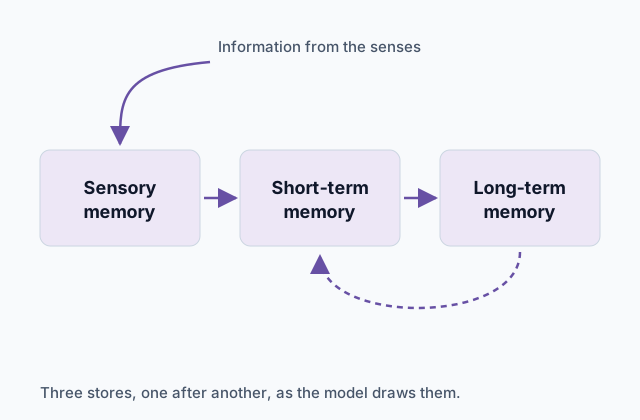
2a. Three stores, one after another
The multi-store model describes memory as three interacting systems that information must pass through to be remembered.
Sensory memory holds a brief, raw copy of what your senses take in. Its visual part is iconic memory: wave a sparkler in the dark and it seems to leave a trail, because each position lingers for an instant. Its sound part is echoic memory: a friend asks you something while you are reading, you say "what?", and then you answer anyway, because her last few words were still briefly held.
Most of what reaches sensory memory fades before you notice it. What you pay attention to moves into short-term memory, which holds what you are aware of right now, such as a price you keep in mind while you look for the same item on another shelf. From there, information can be encoded into long-term memory, the lasting store that holds everything from your birthday to how to swim, and brought back into short-term memory when you need it.
The model also asks how information gets in. Automatic processing takes in some information with no intention at all: where you parked, how many times you passed a friend in the hall, what order the morning went in. Effortful processing takes attention and work, as when you study the steps for balancing a chemical equation.
Quick check · Match
Every person here is invented. Tap a term, then tap the moment it explains best.
2b. Working memory has parts
The working memory model treats your primary memory system, working memory, as a workspace rather than a waiting room. Several parts work on information together while it is being processed into long-term memory.
- The phonological loop holds words and sounds in an inner voice. Rehearsing a sentence in your head before you say it out loud keeps it there.
- The visuospatial sketchpad holds images and positions. Picturing where the outlets are in your bedroom while you shop for a lamp uses it.
- The central executive directs attention and coordinates the other two. It decides what to focus on and switches between jobs, as when a driver stops talking in the middle of a sentence to concentrate on merging.
Because the loop and the sketchpad are separate, two tasks that need the same part get in each other's way, while two tasks that need different parts can run side by side much more easily. Holding a phone number in your head is hard while someone keeps talking to you, and much easier while you look at a map.
All three parts work in a dynamic interaction: the central executive keeps steering, and the loop and the sketchpad keep holding and refreshing what you are working with, so it has a chance to reach long-term memory.
Quick check · Sort it
Every person here is invented. Tap a card, then tap the part of working memory that does most of the work.
Central executive
Phonological loop
Visuospatial sketchpad
2c. How deeply was it processed?
The levels of processing model asks a different question: not where information is held, but how deeply it was processed when it was encoded. It names three levels, from shallowest to deepest.
- Structural processing attends to how something looks, such as noticing that a new word is long or printed in italics.
- Phonemic processing attends to how it sounds, such as noticing that candid rhymes with handed when you say it aloud.
- Semantic processing attends to what it means, such as deciding whether candid describes the way your grandmother gives advice.
The deeper the level, the better the information tends to be remembered. Depth is not the same as time. Staring at the letters of a word for a full minute is still structural processing, and a few seconds spent thinking about what the word means goes deeper.
The models in this lesson answer different questions, so they do not compete. The multi-store model asks where information is held on its way to being remembered. The working memory model asks how information is worked on in the moment. The levels of processing model asks how deeply it was processed.
Quick check · Fill the statement
Tap a blank, then tap a word.
Three invented classmates meet the new Spanish word madrugada. Iris notices that it has nine letters, three of them a's. That is processing. Theo says it aloud a few times and notices that its stress falls on the third syllable. That is processing. Kai learns that it means the early hours between midnight and dawn and decides it is when a baker starts work. That is processing, the deepest of the three.
2d. Kinds of memory, and what changes in the brain
Memories for learned knowledge, events and experiences are not all handled the same way. They differ in how the brain processes, stores and retrieves them.
Explicit memory is memory you can easily describe or explain to someone else. It has two types. Episodic memory holds events you lived through, tied to a time and a place: the afternoon you got your learner's permit. Semantic memory holds facts and general knowledge, without any memory of when you learned them: that a spider has eight legs.
Implicit memory is much harder to describe or explain. Procedural memory is a type of implicit memory for procedures and processes. You can float on your back in a pool, but try explaining exactly what your body does to stay up.
Prospective memory is memory for actions you plan to take in the future, such as remembering to return a library book on Friday.
All of these depend on connections between neurons. In long-term potentiation, synaptic connections between neurons become stronger with frequent activation, so a signal that once barely crossed a synapse later crosses it more easily. It is one biological process for memory.
Quick check · Sort it
Every person here is invented. Tap a memory, then tap the type it is.
Episodic
Semantic
Procedural
Prospective
Part 3 Watch it done Predicting which extra task gets in the way
Watch each step, then do the last one yourself.
Illustrative study (made up for practice, not a published study). Volunteers heard six letters read aloud, kept them in mind for 15 seconds, and then wrote them down. A coin flip put each volunteer in one of two groups. During the 15 seconds, one group said the word "the" aloud over and over. The other group tapped a fixed pattern on four keys arranged in a square, without looking at their hands. Which group would you expect to write down fewer of the letters correctly?
Step 1 · Find what differs between the groups
Both groups heard the same letters, waited the same 15 seconds, and did an extra task the whole time. The only difference is which extra task: one group used speech, the other used positions in space.
Why this step?
Why give both groups an extra task, instead of comparing one extra task with no task at all?
Because any extra task makes the central executive split attention between two jobs. A group with no extra task could do better for that reason alone. Giving both groups an extra task leaves the kind of task as the one difference.
Step 2 · Ask where the letters are held
Six letters heard aloud are sounds and words. Most people keep them by repeating them silently in an inner voice, so they are held in the phonological loop.
Your step · Decide and justify
Finish the prediction. In an illustrative study, a coin flip put volunteers into two groups. Both groups heard six letters and held them for 15 seconds before writing them down. During the wait, one group said the word "the" aloud over and over, and the other tapped a fixed pattern on four keys without looking. Which group would you expect to write down fewer letters correctly?
Which reason supports your answer?
Part 4 Try it Read a study: three ways to judge the same words
Illustrative study (made up for practice, not a published study). Researchers recruited 90 high school students, and a computer randomly assigned each one to one of three groups of 30. Every student saw the same 40 words, one at a time, and answered one yes-or-no question about each. Group A was asked whether the word was printed in capital letters. Group B was asked whether it rhymed with a given word. Group C was asked whether it fit into a given sentence. Nobody was told there would be a memory test. Ten minutes later, every student wrote down as many of the 40 words as they could. Group A recalled a mean of 7.4 words, Group B 12.1 and Group C 21.6. Each difference between groups was statistically significant.
Try it · Calculate
In an illustrative study, students randomly assigned to judge whether each of 40 words was in capital letters recalled a mean of 7.4 words, students who judged whether each word rhymed with a given word recalled 12.1, and students who judged whether each word fit into a sentence recalled 21.6. How many more words, on average, did the group that processed at the deepest level recall than the group that processed at the shallowest level?
Try it · Spot the error
In an illustrative study, a computer randomly assigned 90 students to judge 40 words by capital letters (Group A), by rhyme (Group B) or by whether each fit a sentence (Group C). On a surprise test, the groups recalled means of 7.4, 12.1 and 21.6 words, and each difference was statistically significant. A student writes up the results. Tap the first line that goes wrong.
Part 5 Explain it Write it the way the exam asks
Nothing you type leaves this page.
Free response is 33.3% of the exam score. This one is shaped like Question 2, Evidence-Based Question.
Free-response practice · Question 2 style
Read the three sources, then answer the question they share: is memory one single system, or is it made up of separate parts that work differently? In parts B and C, cite the source you use, for example (Source 1).
Source 1. Illustrative study (made up for practice, not a published study). Forty adults sat at a keyboard with four keys, each matching a light on a screen. When a light came on, they pressed its key as fast as they could. Without being told, the lights followed the same 12-step sequence over and over. Across six sessions, mean response time fell from 520 to 390 milliseconds. In a seventh session the lights came on in random order, and mean response time rose to 500 milliseconds. Afterward, 31 of the 40 said they had noticed no pattern, and when asked to write down the sequence, the group did no better than chance.
Source 2. Illustrative study (made up for practice, not a published study). Researchers flashed a grid of 12 letters, in three rows of four, for one twentieth of a second. When asked to write every letter they could, 30 adults wrote a mean of 4.2. On other trials, a tone played right after the flash told them which single row to write, and they wrote a mean of 3.3 of that row's 4 letters, whichever row was named. When the tone came one second after the flash, they wrote a mean of 1.4 of the 4.
Source 3. Illustrative study (made up for practice, not a published study). A coin flip put 60 adults into two groups. Everyone did two memory tasks: holding a string of 8 spoken digits, and holding the positions of 8 dots on a grid. During each task, one group said a word aloud over and over, and the other tapped a pattern on keys without looking. The word group recalled a mean of 4.1 digits and 6.5 dot positions. The tapping group recalled a mean of 6.9 digits and 3.8 dot positions. Both differences were statistically significant.
(A) Propose a specific and defensible claim, based in psychological science, that answers the question.
(B) (i) Support your claim using one piece of specific and relevant evidence from one of the sources. (ii) Explain how the evidence from part B (i) supports your claim, using a psychological perspective, theory, concept, or research finding.
(C) (i) Support your claim using a piece of specific and relevant evidence from a different source. (ii) Explain how the evidence from part C (i) supports your claim, using a different psychological perspective, theory, concept, or research finding from the one in part B (ii).
Model answer
(A) Memory is made up of separate systems that hold different kinds of information and work in different ways, not one single system.
(B) (i) In Source 1, response times fell from 520 to 390 milliseconds as the lights repeated a sequence, then rose to 500 when the order became random, yet 31 of 40 people said they had noticed no pattern and the group could not write the sequence down. (ii) This shows implicit memory working apart from explicit memory. The people had learned the sequence well enough to speed up and to slow down when it was taken away, but they could not describe or explain it, which is what marks implicit memory, such as procedural memory for a skill. A memory a person has but cannot put into words points to a system separate from the explicit memory used to describe what you know.
(C) (i) In Source 3, saying a word aloud cut digit recall to 4.1, against 6.9 for tapping, while tapping cut dot-position recall to 3.8, against 6.5 for saying a word. (ii) This fits the working memory model. Digits are held in the phonological loop and dot positions in the visuospatial sketchpad. Each extra task hurt only the memory task that needed the same part, so working memory itself has separate parts rather than being one store.
Score your own answer. This is a self-check, not a grade. Tick each point your answer makes.
Part 6 Check yourself Read a brain-tissue experiment
On the exam, some multiple-choice questions share one set of data. These three questions share this table the same way.
Illustrative study (made up for practice, not a published study). Researchers kept 12 thin slices of rat brain tissue alive in a dish. In each slice they recorded from receiving neurons that get input from two separate pathways, A and B. Every few minutes, each pathway was given one weak test pulse, and the researchers measured how strongly the receiving neurons responded. After a baseline period, pathway A was given a burst of rapid, repeated stimulation. Pathway B was given no burst, only the same test pulses as before. The rise in pathway A's response was statistically significant; pathway B showed no significant change.
| Time | Pathway A (burst) | Pathway B (no burst) |
|---|---|---|
| Before the burst | 2.0 | 2.0 |
| 30 minutes after | 3.2 | 2.1 |
| 60 minutes after | 3.1 | 2.0 |
| 120 minutes after | 3.0 | 2.0 |
Case question 1 · Multiple choice
In an illustrative study of rat brain tissue, pathway A was given a burst of rapid, repeated stimulation, and its receiving neurons' response to a weak test pulse rose from 2.0 to about 3.1 millivolts and stayed there for two hours. Pathway B, given no burst, stayed at about 2.0. Which process do pathway A's results show?
Case question 2 · Calculate
In an illustrative study of rat brain tissue, pathway A's mean response to a test pulse was 2.0 millivolts before a burst of repeated stimulation, 3.2 millivolts 30 minutes after it, 3.1 millivolts 60 minutes after it and 3.0 millivolts 120 minutes after it. By what percent did pathway A's response increase from before the burst to 60 minutes after it?
Case question 3 · Decide and justify
In an illustrative study of rat brain tissue, pathway A was given a burst of repeated stimulation and pathway B was not; both got the same weak test pulses throughout. Pathway A's response rose from 2.0 to about 3.1 millivolts, a statistically significant rise, while pathway B stayed at about 2.0. A student claims the burst, not the hours the tissue spent in the dish, made pathway A's connections stronger. Do pathway B's results support that claim?
Which reason supports your answer?
The rest stand on their own and do not use the case.
Check yourself · Sort it
Every person here is invented. Tap a memory, then tap the kind of memory it is.
Explicit memory
Implicit memory
Check yourself · Match
Each finding is illustrative, made up for practice. Tap a model, then tap the finding it explains best.
Part 7 Keep it Two questions from earlier topics
Older ideas stay usable when you pull them back up now and then.
Bring it back · Multiple choice
In a puzzle game, Ana, an invented player, has solved every level so far by moving the blue block first. On level 12 she tries blue-first again and again and keeps failing, though moving the red block first would solve it in two moves. Which term best names what is holding her back?
Bring it back · Multiple choice
Jo, an invented swimmer, jumps into a pool and gasps at how cold the water feels. Ten minutes later it feels comfortable, though a thermometer shows its temperature has not changed. Which term names what happened?
In three lines
- Explicit memory (episodic and semantic) can be described easily, implicit memory such as procedural memory cannot, and prospective memory holds actions planned for the future.
- The multi-store model passes information from sensory memory (iconic and echoic) to short-term and long-term memory, and the working memory model adds a central executive, a phonological loop and a visuospatial sketchpad.
- Information processed at a deeper level (semantic rather than phonemic or structural) is remembered better, and long-term potentiation strengthens synapses that are activated often.
Vocabulary
- Explicit memory
- A type of memory that is more easily described or explained to others; its types are episodic and semantic memory.
- Episodic memory
- Explicit memory for events a person has experienced, tied to a time and place.
- Semantic memory
- Explicit memory for facts and general knowledge.
- Implicit memory
- A type of memory that is more challenging to describe or explain to others.
- Procedural memory
- A type of implicit memory for procedures and processes.
- Prospective memory
- A type of memory related to future actions.
- Long-term potentiation
- A process by which synaptic connections between neurons become stronger with frequent activation; a biological process for memory.
- Working memory model
- A model in which working memory, the primary memory system, processes information into long-term memory through a dynamic interaction of the central executive, phonological loop and visuospatial sketchpad.
- Central executive
- The part of working memory that directs attention and coordinates the other parts.
- Phonological loop
- The part of working memory that holds words and sounds in an inner voice.
- Visuospatial sketchpad
- The part of working memory that holds images and positions in space.
- Multi-store model
- A model proposing three interacting systems, sensory memory, short-term memory and long-term memory, that information must pass through to be remembered.
- Sensory memory
- The first store of the multi-store model, a brief copy of what the senses take in; it includes iconic and echoic memory.
- Iconic memory
- Sensory memory for what is seen.
- Echoic memory
- Sensory memory for what is heard.
- Short-term memory
- The store in the multi-store model for the information a person is aware of and holding at the moment.
- Long-term memory
- The lasting store in the multi-store model.
- Automatic processing
- Encoding that happens without intention or effort.
- Effortful processing
- Encoding that takes attention and work.
- Levels of processing model
- A model proposing that memory is encoded on three levels, from shallowest to deepest: structural, phonemic and semantic.
- Structural, phonemic and semantic processing
- Encoding by how something looks, by how it sounds, and by what it means.
Course alignment, for teachers
AP Psychology topic 2.3, Unit 2: Cognition.
- Skill 1.A: Apply psychological perspectives, theories, concepts, and research findings to a scenario.
- Skill 2.A: Determine the type of research design(s) used in a given study.
This lesson maps all 8 essential knowledge statements of the topic to the part that teaches each one: 8 are checked by a scored question. The map is in the lesson file.