Unit 2 · Topic 2.6 · about 30 minutes · 7 parts · 15 scored checks, 3 of them multiple choice
AP Psychology 2.6: Retrieving Memories
Unit 2: 15 to 25% of the multiple-choice section
 Tap to open the picture full size
Part 1 Think first Five cousins, two names
Guess before you learn. A wrong guess still makes the answer stick.
Predict first
Leah met five new cousins at a family reunion last summer. This summer her aunt asks her to name them, and Leah can come up with only two of the names. Then her aunt writes ten names on a napkin and asks her to point to the five cousins she met. Leah points to all five, and she is right every time. What best explains the difference?
In short. Retrieval is getting stored information back out of memory, and how well it works depends on the cues available and on how often the memory has been pulled out before.
- Recall retrieves information without cues, while recognition relies on retrieval cues.
- Being in the same place, physical state or mood as when the information was learned can make it easier to retrieve.
- Retrieval practice, through the testing effect and metacognition, makes later retrieval more likely to succeed.
Part 2 Learn it Four short ideas, each checked as you go
2a. Recall and recognition
Getting a memory back out of storage is retrieval, and there are two main ways it happens.
Recall is retrieving information without cues. A fill-in-the-blank question, an essay prompt, or a friend asking "What was the name of that song?" all ask for recall. Nothing points you to the answer. You have to find the memory and produce it yourself.
Recognition is retrieving information by identifying it when it is in front of you, and it relies on retrieval cues: hints that lead you to a stored memory. On a multiple-choice question, the right answer is already on the screen. You only have to know it when you see it, and the choices are the cues. A familiar face, a smell, or the first few notes of a song can work as cues too.
Recognition is usually easier than recall. You might spot the right capital city among four choices even though the name would never have come to you on a blank line.
That gap teaches something worth keeping. Failing to recall a piece of information does not prove it was never stored. Often it is there, and what is missing is a cue that leads to it.
Quick check · Fill the statement
Tap a blank, then a word.
Ella's coach asks her to write down, from memory, the names of the twelve new players on her soccer team, and she manages seven. That task asks for . Then the coach hands her a list of twenty names and asks her to circle the twelve new players, and she gets eleven. That task is , and the names on the list work as .
2b. Back where you learned it
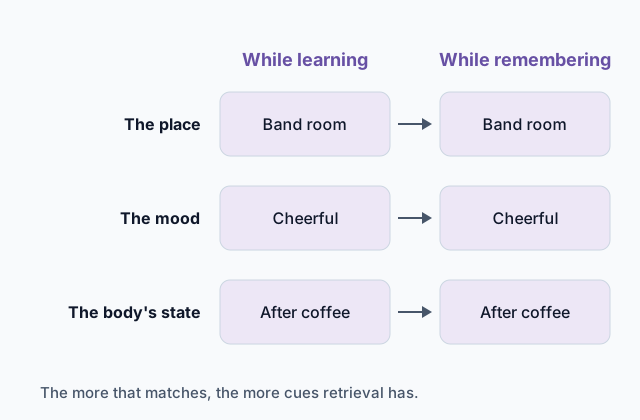
Cues do not only come from a test. Parts of the situation you were in while learning get stored along with the memory, and being back in that situation can help bring it out. Three kinds of match make retrieval easier.
- Context-dependent memory: retrieval is easier in the same environment, the same place, where you encoded the information. A trumpet player who cannot remember the fingering for a passage at home may find it comes back the moment she sits down in the band room.
- State-dependent memory: retrieval is easier in the same physical state. Something learned after a strong cup of coffee tends to come back more easily after coffee than without it.
- Mood-congruent memory: retrieval is easier in the same mood. Material learned while cheerful comes back more easily when you feel cheerful again, and a gloomy mood tends to bring other gloomy memories to mind more readily than happy ones, since those memories were stored in a gloomy mood too.
To tell them apart, ask what matched between learning and remembering. A place is context. The body, such as caffeine, hunger or a medicine's effects, is physical state. A feeling, such as cheerful, proud or sad, is mood.
None of these makes a memory impossible to reach anywhere else. You can still remember chemistry outside the chemistry room. The match adds cues.
Quick check · Sort it
Tap an example, then tap the effect it shows.
Context-dependent memory
Mood-congruent memory
State-dependent memory
2c. Pulling it out makes it stronger
Retrieval does more than show what you know. Each time you pull a piece of information out of memory, it becomes easier to pull out the next time. Doing that on purpose is retrieval practice, and the gain it produces is the testing effect: material you have been tested on, or have tested yourself on, is remembered better later than material you only studied again.
Picture two students with half an hour and a list of art history terms. One reads the list over and over. The other reads it once, covers the definitions, tries to write each one from memory, and then checks. The second student gets several wrong while studying, and the struggle can feel like failing. A week later, that student usually remembers more.
The test does not need a grade or a teacher. Flashcards you answer before flipping, a blank page you fill with everything you can remember about a chapter, explaining a process to a friend without your notes: each one is retrieval practice, because the answer comes out of your memory rather than off the page.
Rereading is not useless. But it mostly asks you to recognize what is already in front of you, and the testing effect comes from recalling.
Quick check · Decide and justify
Kai and Rosa each have 40 minutes to study the same chapter on the water cycle for a test next week. Kai reads the chapter, then reads it twice more, highlighting the key lines. Rosa reads it once, then closes the book, writes down everything she can remember, and checks what she wrote against the chapter. Who is likely to remember more of the chapter next week?
Which reason supports your answer?
2d. Knowing what you know
Metacognition is thinking about your own thinking: noticing what you know and what you do not, and changing how you study because of it. A student who stops halfway through a chapter and asks "Could I explain this without looking?" is using metacognition. So is one who notices she keeps mixing up two terms and makes a card that compares them.
The hard part is judging accurately. Rereading makes a page feel familiar, and familiar feels like knowing. But familiarity is recognition: you know the material when you see it. A quiz that asks you to produce it calls for recall, which is harder. That is why students who only reread often feel more ready than they are.
Retrieval practice repairs the judgment as well as the memory. When you cover the answers and try, the result tells you plainly what you can produce and what you cannot. Then you can spend the next session on what you missed rather than on what you already know.
So the two work together. Testing yourself strengthens the memory, and metacognition uses what the test showed to decide where the next round of studying goes.
Quick check · Spot the error
Jae's vocabulary quiz tomorrow asks him to write the meaning of each of 25 words from memory. Here is his thinking tonight. Tap the first line where it goes wrong.
Part 3 Watch it done Ruling out cues, one step at a time
Watch each step, then do the last one yourself.
For a week, Ruth had a bad cold. Each evening she took a cold medicine that made her drowsy, then learned her lines for the school play at the kitchen table. At Monday's rehearsal, onstage, her cold had cleared, she had taken no medicine, and she forgot half her lines. By Thursday's rehearsal, onstage again, the cold was back, she had taken the same medicine, and most of the lines came back. She felt in about the same mood at both rehearsals: cheerful and looking forward to the show. What best explains the difference between the two rehearsals?
Step 1 · List what stayed the same between the two rehearsals
Both rehearsals were onstage, so the place was the same. Her mood was about the same too. Anything that was the same at both rehearsals cannot explain why one went better than the other.
Why this step?
Why start with what stayed the same, rather than with what helped?
Because the question is about a difference between two rehearsals. The place and her mood were the same both times, so they are ruled out before you start, and you are left looking only at what changed.
Step 2 · Compare what changed with how she learned
What changed was her body: no cold and no medicine on Monday, the cold and the drowsy medicine on Thursday. She learned the lines while drowsy from that medicine. So Monday's state did not match her learning, and Thursday's did, and Thursday is when the lines came back.
Your step · Decide and justify
Finish the analysis. Ruth learned her lines each evening while drowsy from a cold medicine. At Monday's rehearsal, onstage, she had taken no medicine and forgot half her lines. At Thursday's rehearsal, onstage again, she had taken the same medicine and most of the lines came back. Her mood was about the same at both rehearsals. Which effect best explains the difference?
Which reason supports your answer?
Part 4 Try it Read a study: rereading or testing yourself?
Illustrative study (made up for practice, not a published study). A researcher worked with 96 ninth graders in four biology classes at one high school. Within each class, students were assigned at random to one of two ways of studying a short article on how vaccines work, with 20 minutes for each group. The rereading group read the article four times. The practice-test group read it once, then spent the rest of the time writing down everything they could remember on a blank page, without looking back. At the end of the session, every student predicted what percentage of the article's 40 main ideas they would be able to write down a week later. A week later, every student wrote down all the ideas they could remember. The difference in recall between the groups was statistically significant.
| Group | Students | Mean predicted recall | Mean actual recall |
|---|---|---|---|
| Rereading | 48 | 78% | 41% |
| Practice test | 48 | 63% | 58% |
Try it · Calculate
In an illustrative study, students who reread an article predicted they would recall a mean of 78% of its main ideas a week later and actually recalled 41%. Students who took a practice test predicted 63% and actually recalled 58%. How many percentage points higher was the practice-test group's mean actual recall than the rereading group's?
Try it · Multiple choice
In the illustrative study, students in each class were assigned at random to reread an article or to take a practice test on it, with 20 minutes for each group. A week later the practice-test group recalled a mean of 58% of the main ideas and the rereading group 41%, a statistically significant difference. Which statement about cause does the study support best?
Try it · Decide and justify
In the same illustrative study, the rereading group predicted it would recall a mean of 78% of the main ideas and recalled 41%. The practice-test group predicted 63% and recalled 58%. A classmate says the rereading group's higher predictions show that its students judged their own learning better. Do the results support that?
Which reason supports your answer?
Part 5 Explain it Write it the way the exam asks
Nothing you type leaves this page.
Free response is 33.3% of the exam score. This one is shaped like Question 1, Article Analysis Question.
Free-response practice · Question 1 style
Illustrative study (made up for practice, not a published study). Researchers wanted to know whether being in the same mood when learning and when remembering makes retrieval easier. They recruited 72 students from introductory psychology classes at one university. Each student signed a consent form that described the procedure and said they could stop at any time. On the first day, students were assigned at random to listen to 8 minutes of cheerful music or 8 minutes of slow, sad music, and then everyone studied a list of 30 everyday words, such as lamp and river, for 5 minutes. The next day, half of each group, again chosen at random, listened to a different cheerful piece and half to a different sad piece, so that no student heard the same music twice. Then each student had 5 minutes to write down as many of the 30 words as possible, with no hints. A short mood questionnaire after each piece of music confirmed that the sad music lowered students' mood. Before going home, every student who had just heard sad music listened to cheerful music, and every student was told the purpose of the study and why the music had been used.
Students who learned and remembered in a cheerful mood wrote down a mean of 14.2 words. Students who learned and remembered in a sad mood wrote down 13.5. Students who learned in a cheerful mood and remembered in a sad one wrote down 10.1, and students who learned in a sad mood and remembered in a cheerful one wrote down 10.6. Recall was significantly higher when the two moods matched than when they did not.
(A) Identify the research method used in this study.
(B) State the operational definition of memory retrieval in this study.
(C) Identify one ethical guideline described in the study. Describe one way the researchers applied it.
(D) Explain whether the results can be generalized to all adults.
(E) Explain how the results support the concept of mood-congruent memory.
Model answer
(A) This is an experiment.
(B) Memory retrieval was measured as the number of the 30 studied words a student wrote down in 5 minutes, with no hints, the day after studying them.
(C) Debriefing. Before going home, every student was told the purpose of the study and why the music had been used, and students who had just heard sad music listened to cheerful music first.
(D) The results may not generalize to all adults, because every participant was a university student from introductory psychology classes at one university, and older adults or people outside a university could respond differently. Moods set by music may also differ from moods in everyday life.
(E) Students whose mood matched at learning and remembering wrote down 14.2 and 13.5 words, against 10.1 and 10.6 when the moods did not match. Students who were sad at both times did nearly as well as students who were cheerful at both times, so sadness alone did not lower recall; what helped was the match. No one heard the same piece twice, so the music itself was not the cue; the mood was. Being in the same mood when retrieving as when encoding made retrieval easier, which is mood-congruent memory.
Score your own answer. This is a self-check, not a grade. Tick each point your answer makes.
Part 6 Check yourself Two tests, one set of words
On the exam, some multiple-choice questions share one set of data. These two questions share this table the same way.
Illustrative data (made up for practice). Fifty students in a Spanish class studied the same 40 new vocabulary words in one lesson. A week later, a computer chose 20 of the 40 words at random for Test 1 and used the other 20 for Test 2. Test 1 gave the English meaning of each of its 20 words and asked the student to write the Spanish word from memory. Test 2 showed each lesson word beside three Spanish words the class had never studied and asked the student to pick the one from the lesson. Test 1 came first, so that seeing the other lesson words on Test 2 could not remind students of the words Test 1 asked for. The difference in mean scores was statistically significant.
| Test | What the student saw | Mean correct (out of 20) |
|---|---|---|
| Test 1 | An English meaning and a blank | 7 |
| Test 2 | Each lesson word beside three new words | 16 |
Case question 1 · Calculate
In an illustrative study, students who had studied 40 Spanish words were tested a week later on 20 of them by writing each Spanish word from its English meaning (Test 1) and on the other 20 by picking each studied word from among three new ones (Test 2). The mean score was 7 out of 20 on Test 1 and 16 out of 20 on Test 2. Turning each mean into a percentage of 20, how many percentage points higher was the Test 2 mean than the Test 1 mean?
Case question 2 · Decide and justify
In the illustrative study, a computer split each student's 40 studied Spanish words at random between the two tests. Students averaged 7 of 20 words on Test 1, which asked them to write each Spanish word from its English meaning, and 16 of 20 on Test 2, which showed each studied word beside three new ones. A classmate says Test 1 proves the students had stored only about a third of the words. Do the results support that?
Which reason supports your answer?
The rest stand on their own and do not use the case.
Check yourself · Multiple choice
Ines memorized the order of the planets one evening on her porch, in a cheerful mood after hearing she had made the school play. A week later she is tested in a noisy classroom, and the list will not come. Then her teacher announces that the class trip is on, and once Ines feels just as cheerful again, still at her desk, the list comes back. Which effect best explains when the list came back?
Check yourself · Fill the statement
Tap a blank, then a word.
Before her biology test, Priya closes her notes, writes out the steps of each process from memory, and then checks them against the book. Bringing information out of memory on purpose like this is . A week later she remembers those steps better than the ones she only reread, which is the .
Check yourself · Multiple choice
Four students are getting ready for the same history test. Which student is using metacognition?
Part 7 Keep it Bring back earlier ideas
Coming back to older ideas is how they stay usable on the exam.
Bring it back · Sort it
Tap a study habit, then tap the kind of rehearsal it is.
Maintenance rehearsal
Elaborative rehearsal
Bring it back · Match
Tap a kind of memory, then tap the example of it.
In three lines
- Recall retrieves information with no cues; recognition relies on retrieval cues, so a memory you cannot recall may still be stored.
- Retrieval is easier in the same place (context-dependent), physical state (state-dependent) or mood (mood-congruent) as when the information was learned.
- Retrieval practice strengthens memory through the testing effect, and metacognition uses what you can and cannot recall to decide what to study next.
Vocabulary
- Recall
- Memory retrieval that happens without cues, as when you produce an answer on a blank line.
- Recognition
- Memory retrieval that relies on retrieval cues, as when you pick out a right answer from choices in front of you.
- Retrieval cue
- A hint, such as an answer choice, a face or a place, that leads you to a stored memory.
- Context-dependent memory
- Retrieval enhanced by being in the same environmental space as when the information was encoded.
- Mood-congruent memory
- Retrieval enhanced by being in the same mood as when the information was encoded.
- State-dependent memory
- Retrieval enhanced by being in the same physical state as when the information was encoded.
- Retrieval practice
- Deliberately bringing information out of memory, as with self-testing, to make later retrieval more likely to succeed.
- Testing effect
- The finding that information you have been tested on, or tested yourself on, is remembered better than information you only studied again.
- Metacognition
- Thinking about your own thinking, such as judging what you know and changing how you study because of it.
Course alignment, for teachers
AP Psychology topic 2.6, Unit 2: Cognition.
- Skill 1.A: Apply psychological perspectives, theories, concepts, and research findings to a scenario.
- Skill 3.A: Identify psychology-related concepts in descriptions or representations of data.
- Skill 3.C: Interpret quantitative or qualitative inferential data from a given table, graph, chart, figure, or diagram.
This lesson maps all 3 essential knowledge statements of the topic to the part that teaches each one: 3 are checked by a scored question. The map is in the lesson file.