Unit 2 · Topic 2.7 · about 30 minutes · 7 parts · 13 scored checks, 3 of them multiple choice
AP Psychology 2.7: Forgetting and Other Memory Challenges
Unit 2: 15 to 25% of the multiple-choice section
 Tap to open the picture full size
Part 1 Think first The microphone that never fell
Guess before you learn. A wrong guess still makes the answer stick.
Predict first
At a school assembly, the principal speaks for ten minutes. Afterward, Dani asks three friends, "Did you see him drop the microphone halfway through?" The school's video shows the microphone never left his hand. A week later, two of the friends describe the drop, and one adds that it made a loud thump. What best explains their memories?
In short. Memories fail when they fade with time, never get stored, are blocked by other learning, or are rebuilt with details that were never there.
- Forgetting is fastest soon after learning and then levels off, so time is a large part of why memories are lost.
- A memory can fail to come out because it was never encoded, because other learning interferes with it, or because retrieval falls short for the moment.
- Remembering is rebuilding, so a memory can feel certain and vivid and still be wrong about what happened or where it came from.
Part 2 Learn it Four short ideas, each checked as you go
2a. Forgetting is fastest at first
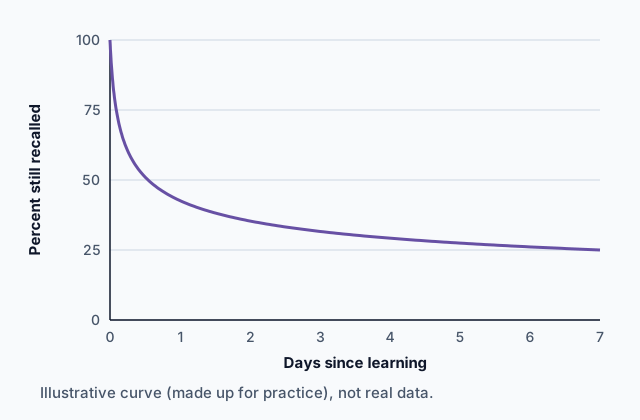
In the 1880s, Hermann Ebbinghaus memorized lists of nonsense syllables, made-up sounds with no meaning, so that nothing he already knew could help him. Then he tested how much of each list he still had after delays ranging from minutes to about a month. His results traced what is now called the forgetting curve.
The curve shows that time is a significant factor in forgetting, and that forgetting is not steady. It is fastest right after learning, then slows and levels off. Most of what you will lose from a new lesson goes in the first hours and the first day. What is still there after a week tends to stay for a long time.
Picture learning the names of 20 new teammates at a first practice. By the next day you might recall only about half of them. A week later you have lost only a few more, and a month later the names you know are mostly the ones you still knew at the end of that first week.
So when you read forgetting data, look at the rate, not just the total. A big drop between two early checks and small drops between later ones is the shape of the curve: steep, then nearly flat.
Quick check · Fill the statement
Tap a blank, then tap a word.
Ivy learns 30 new Spanish words on Monday. She can recall 17 of them on Tuesday and 14 on Friday. Most of her forgetting happened , and after that her forgetting . Plotted over the week, her scores follow the .
2b. When a memory will not come out
Sometimes the memory you want is not there to find. In encoding failure, the information never got into long-term memory, usually because you never paid attention to it. You may have walked past your school's front office for years and still not know what color its door is.
Other times the memory is stored, but other learning, usually similar learning, gets in the way. That is interference, and it runs in two directions:
- Proactive interference: older learning disrupts newer learning. After a move, you keep giving your old zip code. Pro means forward: the old memory acts forward in time.
- Retroactive interference: newer learning disrupts older learning. After a summer learning a new dance routine, you try to dance last year's routine and keep slipping in steps from the new one. Retro means backward.
To tell them apart, name the memory being reached for, then ask which of the two was learned first. If the older one is getting in the way, it is proactive. If the newer one is, it is retroactive.
A memory can also be stored and unblocked and still not come out right now, because retrieval falls short. The tip-of-the-tongue phenomenon is the clearest case. You are sure you know a word, you may even recall its first letter or how many syllables it has, but the word itself will not come, until a cue arrives or it pops into mind on its own later.
Quick check · Sort it
Tap an example, then tap the kind of memory failure it shows.
Encoding failure
Proactive interference
Retroactive interference
Tip-of-the-tongue
2c. Forgetting to avoid distress
Psychodynamic theorists, following Sigmund Freud, see some forgetting as having a purpose. In their view, a memory that would cause too much anxiety can be pushed out of conscious awareness to protect the person, in their terms the ego, from distress. They call this repression. On this view the memory is not erased. It stays in the unconscious, where it can still affect feelings and behavior.
Repression happens without the person knowing it. Someone who decides not to think about a bad day, and changes the subject when it comes up, is not repressing it, because they know the memory is there and are avoiding it on purpose. Repression also differs from encoding failure. The event was stored, and by this account it is kept out of reach because of what it means to the person.
Many memory researchers doubt that repression happens often. Frightening events are usually remembered all too well, and a repressed memory cannot be observed directly. So describe repression as what psychodynamic theorists believe, and use it when a question asks for their explanation of forgetting.
Quick check · Multiple choice
Illustrative case: Dana, now 30, was bitten by a neighbor's dog when she was 8 and needed stitches. Her parents describe the day in detail, but Dana says she has no memory of it, though she remembers other events from that summer well. Which explanation would a psychodynamic theorist give?
2d. Remembering what did not happen
Memory does not work like a video file. Each time you recall an event, you rebuild it from stored pieces plus what you know and expect. That is constructive memory. Memory consolidation, the process that settles a memory into long-term storage, takes time, and a recalled memory is stored again afterward. Details that arrive while a memory is first being settled, or while it is being stored again after a recall, can be kept with it and feel like part of the original.
Three errors come from this:
- Misinformation effect: misleading information received after an event gets worked into the memory of it. A witness who hears someone mention a dented bumper may later recall seeing the dent.
- Source amnesia: remembering information but forgetting where it came from, or crediting the wrong source. You are sure a friend told you how a movie ends, when you read it online.
- Imagination inflation: imagining an event that never happened makes people more confident that it did. Picturing it vividly creates images that can later feel like memories.
Source amnesia feeds the other two. Once you lose track of whether a detail came from the event, from someone else or from your own imagining, it feels as real as everything else you remember. A memory can be vivid and held with full confidence and still be wrong.
Quick check · Fill the statement
Tap a blank, then tap a term.
After a class trip to a science museum, Dev reads a classmate's post saying a fire alarm went off during the visit. No alarm went off, but Dev now recalls hearing it. Psychologists call this . Dev also remembers that octopuses have three hearts and is sure the tour guide said so, when he actually read it on a poster. Psychologists call this . And after picturing many times how funny it would have been if the class had been locked in the planetarium, Dev is starting to feel sure it really happened. Psychologists call this . All three show that memory is , not a recording played back.
Part 3 Watch it done Which way does the interference run?
Watch each step, then do the last one yourself.
Last year Noor's biology class wrote every lab report with its sections in one set order. This September her chemistry teacher taught a different order, and Noor has used it all fall. In November, helping a younger student with a biology lab report, she tries to recall the biology order and keeps listing the sections in the chemistry order. What kind of memory failure is this?
Step 1 · Rule out encoding failure
Noor wrote biology reports in that order all last year, so the order was encoded and stored. Her mistakes are not blanks, either. She fills the gaps with sections from the chemistry order, so something is getting in the way.
Step 2 · Name the memory she is reaching for, and what blocks it
She is reaching for the biology order, learned last year. The memory getting in the way is the chemistry order, learned this fall. So the memory doing the blocking is the newer one.
Why this step?
Why name which memory she is reaching for before naming the kind of interference?
Because the two kinds differ only in direction. The same two memories give proactive interference when the old one blocks the new, and retroactive interference when the new one blocks the old. Until you know which one she is trying to retrieve, you cannot tell which way the interference runs.
Your step · Decide and justify
Finish it. Noor learned one order of lab-report sections in biology last year, first, and a different order in chemistry this fall. In November, helping a younger student with a biology report, she tries to recall the biology order and keeps listing the chemistry order. Which memory failure is this?
Which reason supports your answer?
Part 4 Try it Read a study: does earlier learning block later learning?
Illustrative study (made up for practice, not a published study). A researcher asks whether studying one list makes a second, similar list harder to recall. She recruits 60 high school students, and a random draw puts each one in one of two groups of 30. Students in the two-lists group study List 1, 20 names of animals, for five minutes. Students in the puzzles group spend the same five minutes on puzzles with no words in them. Then every student studies List 2, 20 different animal names, for five minutes, and after a short break writes down as many List 2 names as possible. The difference between the groups was statistically significant.
| Group | Students | Mean List 2 names recalled, out of 20 |
|---|---|---|
| Two lists | 30 | 9.4 |
| Puzzles | 30 | 13.1 |
Try it · Fill the statement
Tap a blank, then tap a word.
In a study of two word lists, the variable is whether a student studied List 1 or did puzzles first. The variable is the number of List 2 names a student wrote down. List 1 was learned before List 2, so lower List 2 recall in the two-lists group would show interference.
Try it · Decide and justify
In an illustrative study, a random draw split 60 students into two groups of 30. One group studied a list of 20 animal names and the other did puzzles. Then everyone studied a second list of 20 animal names and wrote down as many as they could. The first group recalled a mean of 9.4 names from the second list and the puzzles group 13.1, and the difference was statistically significant. Can the researcher conclude that studying the first list caused the lower recall?
Which reason supports your answer?
Part 5 Explain it Write it the way the exam asks
Nothing you type leaves this page.
Free response is 33.3% of the exam score. This one is shaped like Question 2, Evidence-Based Question.
Free-response practice · Question 2 style
Read the three sources, then answer the question they share: can what people hear or imagine after the fact change what they remember or believe? In parts B and C, cite the source you use, for example (Source 1).
Source 1. Illustrative study (made up for practice, not a published study). Researchers showed 90 adults a two-minute video of a man taking a laptop from a table in a coffee shop. A random draw then put each adult in one of two groups of 45. Ten minutes later, one group read a summary of the video that said the man wore a baseball cap, which he did not. The other group read a summary with no mistakes. A day later, everyone was asked whether the man wore a hat. In the misleading-summary group, 20 of 45 said yes, compared with 4 of 45 in the accurate-summary group. The difference was statistically significant.
Source 2. Illustrative study (made up for practice, not a published study). Researchers asked 60 adults to rate how sure they were, from 1 (certainly did not happen) to 8 (certainly happened), that each of 20 childhood events had happened to them. Every adult had rated getting stuck in an elevator as a child at 3 or lower. A random draw put half of them in an imagining group, who spent two minutes on each of three days picturing in detail getting stuck in an elevator as a child. The other half spent the same time picturing an unrelated scene. Two weeks later, everyone rated the 20 events again. For the elevator event, the mean rating rose from 2.1 to 3.4 in the imagining group and from 2.0 to 2.2 in the other group. The difference was statistically significant.
Source 3. Illustrative study (made up for practice, not a published study). Researchers had 200 adults read 12 made-up health claims. Six were labeled as coming from a medical news site and six from an anonymous online comment. A week later, the adults were asked where each claim had come from and whether it was true. On average they credited 38% of the comment claims to the news site, but only 8% of the news-site claims to a comment. Adults who credited more of the comment claims to the news site also tended to rate more of those claims as true, a positive correlation of r = +0.35.
(A) Propose a specific and defensible claim, based in psychological science, that answers the question.
(B) (i) Support your claim using one piece of specific and relevant evidence from one of the sources. (ii) Explain how the evidence from part B (i) supports your claim, using a psychological perspective, theory, concept, or research finding.
(C) (i) Support your claim using a piece of specific and relevant evidence from a different source. (ii) Explain how the evidence from part C (i) supports your claim, using a different psychological perspective, theory, concept, or research finding from the one in part B (ii).
Model answer
(A) Hearing misleading information or imagining an event after the fact can change what people remember or believe, making them more likely to recall or accept something that did not happen or is not true.
(B) (i) In Source 1, 20 of 45 adults who read a summary mentioning a baseball cap later said the man wore a hat, compared with 4 of 45 who read an accurate summary. (ii) This is the misinformation effect: misleading information received after an event gets worked into the memory of that event. A random draw formed the groups and the only planned difference was the summary, so the false mention of a cap is the likely reason far more of that group remembered a hat that was never there, which supports the claim.
(C) (i) In Source 2, adults who repeatedly pictured getting stuck in an elevator as a child raised their rating that it had happened from 2.1 to 3.4, while the group that pictured something else moved only from 2.0 to 2.2. (ii) This is imagination inflation, a different concept from part B: imagining an event that never happened makes people more confident that it did. The groups were formed by a random draw and differed only in what they pictured, so imagining the elevator scene is the likely reason those adults became more sure it had happened, which supports the claim that imagining after the fact changes what people believe happened.
Score your own answer. This is a self-check, not a grade. Tick each point your answer makes.
Part 6 Check yourself Read a forgetting table
On the exam, some multiple-choice questions share one set of data. These two questions share this table the same way.
Illustrative data (made up for practice). A researcher has 120 students study a list of 40 made-up words for 15 minutes. A random draw then assigns each student to one delay, 24 students per delay, and each student is tested once, after that delay, by writing down as many of the words as possible.
| Delay before the test | Students | Mean words recalled |
|---|---|---|
| Right after learning | 24 | 34 |
| 1 hour | 24 | 26 |
| 1 day | 24 | 19 |
| 1 week | 24 | 15 |
| 1 month | 24 | 13 |
Case question 1 · Calculate
In a table of mean words recalled from a 40-word list, students tested right after learning recalled 34 words, after 1 hour 26, after 1 day 19, after 1 week 15 and after 1 month 13. By how many words did the mean drop more over the first day (from right after learning to 1 day) than over the rest of the month (from 1 day to 1 month)?
Case question 2 · Multiple choice
In a table of mean words recalled from a 40-word list, students tested right after learning recalled 34 words, after 1 hour 26, after 1 day 19, after 1 week 15 and after 1 month 13. Which conclusion does the table best support?
The rest stand on their own and do not use the case.
Check yourself · Spot the error
Omar learned his old school's 8:15 start time first. Since September he has gone to a new school that starts at 7:40, and when a new friend asks what time his new school starts, he says 8:15 before correcting himself. A student classifies this memory failure. Tap the first line that goes wrong.
Check yourself · Put it in order
Mila's cousin mentions that Mila may have ridden a pony at a birthday party when she was seven. It never happened. Tap the events in the order that turns the suggestion into something Mila believes she remembers.
Part 7 Keep it Bring back earlier ideas
Coming back to older ideas is how they stay usable on the exam.
Bring it back · Multiple choice
Ines studied which artist painted each of twelve paintings for art history. On a quiz, she cannot write the artist of one painting when the question simply asks for it. When the next question asks the same thing but lists four artists to choose from, she picks the right one at once. Which pair of ideas best explains the difference between the two questions?
Bring it back · Match
Tap a strategy, then tap the student using it.
In three lines
- Forgetting is fastest right after learning and then levels off, so time is a significant factor in forgetting.
- A memory may never have been encoded, may be blocked by older learning (proactive) or newer learning (retroactive), or may be stuck on the tip of the tongue; psychodynamic theorists add repression.
- Memory is constructive, so misinformation, source amnesia and imagination inflation can make a confident memory wrong.
Vocabulary
- Forgetting curve
- A curve showing that time is a significant factor in forgetting: forgetting occurs rapidly after initial learning and levels off over time.
- Encoding failure
- Being unable to retrieve information because it never got into memory in the first place.
- Interference
- Difficulty retrieving a memory because other learning gets in the way.
- Proactive interference
- Older learning disrupting the retrieval of newer learning.
- Retroactive interference
- Newer learning disrupting the retrieval of older learning.
- Tip-of-the-tongue phenomenon
- Inadequate retrieval in which a person is sure they know something, and may recall parts of it, but cannot bring it to mind.
- Repression
- In psychodynamic theory, forgetting information or memories to defend the ego from distress.
- Constructive memory
- Rebuilding a memory each time it is recalled; details taken in while the memory is consolidated, or imagined, can become part of what it contains.
- Misinformation effect
- Misleading information received after an event affecting the accuracy of the memory of that event.
- Source amnesia
- Remembering information but forgetting where it came from, or crediting it to the wrong source.
- Imagination inflation
- Imagining an event that never happened making a person more confident that it did.
Course alignment, for teachers
AP Psychology topic 2.7, Unit 2: Cognition.
- Skill 1.A: Apply psychological perspectives, theories, concepts, and research findings to a scenario.
- Skill 2.B: Evaluate the appropriate use of research design elements in experimental methodology.
- Skill 4.A: Propose a defensible claim.
This lesson maps all 4 essential knowledge statements of the topic to the part that teaches each one: 4 are checked by a scored question. The map is in the lesson file.