Unit 2 · Topic 2.8 · about 30 minutes · 7 parts · 14 scored checks, 3 of them multiple choice
AP Psychology 2.8: Intelligence and Achievement
Unit 2: 15 to 25% of the multiple-choice section
 Tap to open the picture full size
Part 1 Think first Two years ahead
Guess before you learn. A wrong guess still makes the answer stick.
Predict first
Two children take the same reasoning test. Ava is 4 and answers the questions that typical 6-year-olds answer. Ben is 12 and answers the questions that typical 14-year-olds answer. Each is two years ahead of their age. Whose result is further ahead for a child of that age?
In short. Psychologists still disagree about what intelligence is, so a test score is useful only when the test is sound and fair only when it is read with the test taker's circumstances in mind.
- Researchers debate whether intelligence is one general ability or several separate ones, and early tests turned performance into a single quotient.
- A useful test is standardized, valid and reliable, and the way a test is given can push scores down or up through stereotypes.
- IQ scores rise and fall with living conditions, vary more within groups than between them, and have been used to shut people out. Believing ability can grow can help a student achieve more.
Part 2 Learn it Four short ideas, each checked as you go
2a. One ability or many, and the first IQ
Psychologists have never fully agreed on what intelligence is or how to measure it, and the tests they built have carried the assumptions, and sometimes the biases, of the people who wrote them.
One long debate is about its shape. People who do well on one kind of mental task, such as defining words, tend to do well on others, such as number puzzles. Some researchers take that as evidence of a single general intelligence, called g, underneath every kind of thinking. Others point to people who are strong in one area and ordinary in another, and argue that intelligence is made of multiple abilities that can develop separately.
The first formal intelligence tests gave each child a mental age: the age of typical children who answer the same questions correctly. The intelligence quotient (IQ) divided mental age by chronological age, the child's actual age, and multiplied by 100. Today, IQ scores are often used to help identify students for educational services.
Those early scores were also used to shut people out. In the United States they were used to limit access to jobs, military ranks and places in schools and colleges, and to argue for limits on immigration. Some early test developers supported the eugenics movement described in 1.1 Interaction of Heredity and Environment.
Quick check · Sort it
Tap an observation, then tap the view of intelligence it fits better.
Fits one general ability (g)
Fits multiple separate abilities
2b. What makes a test worth using
Every psychological test, an intelligence test included, has to follow sound principles of measurement to be useful.
A test is standardized when it is given using the same procedures in the same kind of setting for everyone: the same instructions, the same time limit, a similar quiet room. Without that, a score might reflect the conditions rather than the person.
A test is valid if it measures what it is designed to measure. Construct validity asks whether it truly measures the quality it names; a "logic" test packed with long, tricky wording may really be measuring reading. Predictive validity asks whether scores forecast what the test is meant to predict, such as whether an entrance test score goes with grades a year later.
A test is reliable if it gives similar results each time it is given. Test-retest reliability is checked by giving the same people the test twice, some time apart, and comparing the scores. Split-half reliability compares each person's score on one half of the items, such as the odd-numbered ones, with their score on the other half.
Consistent is not the same as accurate. A bathroom scale that always reads five pounds heavy is reliable, and it is still wrong.
Quick check · Match
Tap a term, then tap the example that shows it.
2c. Fair tests, and fair readings of scores
How a test is given can change a score. Stereotype threat is the worry, during a test, of confirming a negative stereotype about a group you belong to. The worry takes up attention and can pull a score down. Stereotype lift pushes the other way: knowing that another group is negatively stereotyped can give your own score a small boost. Both make scores less fair, so researchers try to build socio-culturally responsive tests, whose questions, instructions and setting draw on experiences shared across backgrounds and avoid calling up stereotypes.
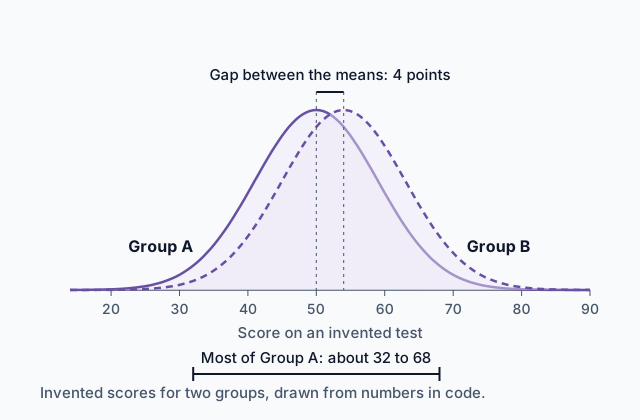
Reading a score needs the same care. IQ scores vary more within a group than between groups. Inside any group, scores spread from low to high, and that spread is far wider than the gap between two groups' averages, so a group's average says little about any one person in it.
Poverty, discrimination and unequal schooling can lower the scores of individuals and of whole groups, so a lower score can reflect a person's circumstances rather than what they could learn. And whoever reads a score brings their own personal and cultural biases, which can shape what they think the score means and what they expect it to predict.
Quick check · Spot the error
Illustrative data (made up for practice). On an invented reasoning test, Group A's scores ran from 22 to 68 with a mean of 44, and Group B's ran from 24 to 70 with a mean of 47. A student reasons about the results. Tap the first line that goes wrong.
2d. Scores that change, and tests of what you know
Average IQ scores have risen across much of the world over the past century, enough that test makers keep having to reset what counts as an average score. This is the Flynn effect. The rise came far too quickly to be genetic. It is linked to changes in how people live, such as higher socioeconomic status, better health care and better nutrition.
Not every test at school is an intelligence test. An achievement test measures what someone already knows, like a final exam on a history unit. An aptitude test tries to predict how someone will do in the future, like a test that forecasts who will succeed in a training course.
Beliefs matter too. A student with a fixed mindset believes intelligence is set from birth, so a low grade feels like proof of a limit and more effort seems pointless. A student with a growth mindset believes ability can grow with experience, so a low grade points to what to work on next. That difference can affect achievement: students who see ability as changeable tend to keep working after setbacks, and the extra work can show up in their grades.
Quick check · Fill the statement
Tap a blank, then tap a word.
Ms. Reyes gives her class a test at the end of a unit on cells to find out how much they learned. Tests like this are called tests. A flight school gives applicants a test to predict who will do well in its training. Tests like this are called tests. After a low quiz score, Owen says studying is pointless because people are either born smart or not, which shows a mindset. His friend Lia says she can get better at chemistry with practice and new strategies, which shows a mindset.
Part 3 Watch it done Working out an early IQ score
Watch each step, then do the last one yourself.
On an early intelligence test, Tomas is 8 years old and answers the questions that typical 10-year-olds answer. What was his IQ on that test?
Step 1 · Find the mental age
Mental age is the age of the typical children whose answers his match. He answers like a typical 10-year-old, so his mental age is 10.
Step 2 · Find the chronological age
That is his actual age, 8. Keep the two ages apart, because which one goes on top matters in the next step.
Step 3 · Set up the quotient
The quotient puts mental age on top and chronological age underneath: 10 divided by 8.
Why this step?
Why divide the two ages instead of subtracting one from the other?
A two-year lead means more for a young child than for an older one. Subtracting would score the same two years alike at any age, while dividing measures the lead against how long the child has been alive.
Your step · Calculate
Finish the calculation. On an early intelligence test, Tomas is 8 years old and answers the questions that typical 10-year-olds answer. On that test, IQ was mental age divided by chronological age, multiplied by 100. What was his IQ?
Part 4 Try it Read a study: does a news story change a test score?
Illustrative study (made up for practice, not a published study). A researcher worked with 60 students at Hillcrest High, a made-up school. Every student agreed to take part, with a parent's written permission. A coin flip put each student in one of two groups. Before a 30-question reasoning test, one group read a short news story, written for the study, claiming that Hillcrest students do poorly on reasoning tests. The other group read a story about Hillcrest's new cafeteria. Everyone then took the same test with the same instructions and time limit. Afterward, every student was told that the first story had been made up.
In a second round, the researcher repeated the study with 60 students at Westfield High, a made-up school nearby, with the same agreement from each student, the same written permission from a parent, and the same explanation afterward that the first story had been made up. A coin flip put half of them with the story about Hillcrest students and half with the cafeteria story. Both differences in the table were statistically significant.
| School | Read the story about Hillcrest students | Read the cafeteria story |
|---|---|---|
| Hillcrest High | 18.4 | 22.1 |
| Westfield High | 23.0 | 21.7 |
Try it · Decide and justify
In an illustrative study, a coin flip put 60 Hillcrest students into two groups. One group read a made-up news story claiming Hillcrest students do poorly on reasoning tests, and the other read a story about the cafeteria. On the same reasoning test, the first group averaged 18.4 correct out of 30 and the second 22.1, a statistically significant difference. A classmate says the study cannot show that the story caused the lower scores, because every student came from one school. Is the classmate right?
Which reason supports your answer?
Try it · Fill the statement
Tap a blank, then a word.
At Hillcrest, reading a story about a negative stereotype of their own school pulled students' scores down. That is stereotype . At Westfield, reading the same story about another school's students nudged scores up. That is stereotype . To reduce both effects, a test maker writes questions, instructions and settings that draw on experiences students from many backgrounds share and that do not call up stereotypes. That makes the test socio-culturally .
Part 5 Explain it Answer an article analysis question
Nothing you type leaves this page.
Free response is 33.3% of the exam score. This one is shaped like Question 1, Article Analysis Question.
Free-response practice · Question 1 style
Illustrative study (made up for practice, not a published study). Researchers wanted to know whether learning that ability can grow changes students' grades. They recruited 240 ninth graders from three high schools in one district. Each student agreed to take part, a parent signed a consent form, and students were told they could stop at any time. A computer randomly assigned each student to one of two online lessons, each given in two 25-minute sessions in September. The growth lesson taught that the brain forms new connections when a person works on hard problems, so ability can grow with effort. The comparison lesson taught how sleep helps the brain store memories. Right after the lessons, students rated the statement "You can greatly change how smart you are" from 1 (strongly disagree) to 6 (strongly agree). The growth group averaged 4.7 and the comparison group 3.6. In January the researchers collected each student's fall-semester math grade, on a 0 to 100 scale, from school records. The growth group averaged 78.6 and the comparison group 75.1. Both differences were statistically significant.
(A) Identify the research method used in this study.
(B) State the operational definition of academic achievement in this study.
(C) Identify one ethical guideline described in the study. Describe one way the researchers applied it.
(D) Explain how the results support the idea that a growth mindset can affect academic achievement.
Model answer
(A) This is an experiment, because a computer randomly assigned each student to the growth lesson or the comparison lesson.
(B) Academic achievement was measured as each student's fall-semester math grade, on a 0 to 100 scale, taken from school records.
(C) Informed consent. The students were minors, so a parent gave informed consent by signing a consent form before the study began, and each student also agreed to take part, which is called informed assent.
(D) The growth lesson moved students toward a growth mindset: they agreed more strongly that you can greatly change how smart you are, 4.7 against 3.6. The same group earned higher math grades, 78.6 against 75.1, and because students were randomly assigned, the lesson is the planned difference between the groups. A student who believes ability can grow treats hard problems and setbacks as chances to improve rather than proof of a limit, so the higher grades fit the idea that a growth mindset can raise achievement.
Score your own answer. This is a self-check, not a grade. Tick each point your answer makes.
Part 6 Check yourself Forty-five years of the same test
Some exam questions share one set of data, the way these two do.
Illustrative data (made up for practice). In one country, researchers gave the same reasoning test, with the same questions, instructions and scoring, to a large random sample of 16-year-olds in four different years. No student had seen the test before. Every mean is reported on a scale where the 1960 sample's mean is 100.
| Year tested | Mean score |
|---|---|
| 1960 | 100.0 |
| 1975 | 104.5 |
| 1990 | 109.0 |
| 2005 | 113.5 |
Case question 1 · Calculate
In illustrative data, the same reasoning test was given to random samples of 16-year-olds in one country in 1960, 1975, 1990 and 2005. The mean score rose from 100 in 1960 to 113.5 in 2005. On average, by how many points did the mean rise per decade?
Case question 2 · Multiple choice
In illustrative data, the same reasoning test, with the same questions and scoring, was given to random samples of 16-year-olds in one country who had never seen it. The mean rose from 100 in 1960 to 113.5 in 2005. Which explanation best fits a rise like this?
The rest stand on their own and do not use the case.
Check yourself · Decide and justify
Kai took an intelligence test at age 11. In the year before, he had changed schools three times, and two of those schools had no library. His score was lower than most of his classmates' scores. The school counselor says the score may understate what Kai can do. Is the counselor right?
Which reason supports your answer?
Check yourself · Sort it
Each test below has a problem. Tap a test, then tap the kind of problem it has.
Not standardized
Not valid
Not reliable
Check yourself · Decide and justify
A student writes, "Intelligence tests were neutral tools when they were first made. Only recently have scores been used to keep people out of anything." Is the student right?
Which reason supports your answer?
Part 7 Keep it Bring back earlier ideas
Coming back to older ideas is how they stay usable on the exam.
Bring it back · Multiple choice
Dara watched a video of a bike being stolen from a rack. The thief wore no gloves. Later a detective asked her, "Did the thief put his gloves on before or after he cut the lock?" A week later, Dara described the thief's gloves in detail. Which memory challenge does this show?
Bring it back · Multiple choice
Imani is learning the word "gregarious". She asks herself which of her friends it fits best and why, picturing how each one acts at a party. Which kind of rehearsal is she using, and what should it do for her memory of the word?
In three lines
- Psychologists still debate whether intelligence is one general ability or several, and the first IQ divided mental age by chronological age and multiplied by 100.
- A useful test is standardized, valid and reliable; scores have risen across generations, vary more within groups than between them, and have been used to shut people out.
- Achievement tests measure what you know, aptitude tests predict how you will do, and believing ability can grow can help achievement.
Vocabulary
- General intelligence (g)
- A single general ability that some researchers believe underlies performance on every kind of mental task.
- Multiple abilities
- The view that intelligence is made up of several separate abilities rather than one general ability.
- Intelligence quotient (IQ)
- On early intelligence tests, mental age divided by chronological age, multiplied by 100.
- Mental age
- The age of typical children whose test performance matches a given child's.
- Chronological age
- A person's actual age.
- Standardized test
- A test administered using consistent procedures and environments.
- Validity
- Whether a test measures what it is designed to measure.
- Construct validity
- Whether a test truly measures the quality it claims to measure.
- Predictive validity
- Whether a test's scores predict the later performance they are meant to predict.
- Reliability
- Whether a test yields similar results each time it is administered.
- Test-retest reliability
- How closely the same people's scores agree when they take the same test at two different times.
- Split-half reliability
- How closely a person's scores on two halves of one test agree, such as the odd-numbered and even-numbered items.
- Stereotype threat
- Worry about confirming a negative stereotype about your own group, which can lower performance.
- Stereotype lift
- A boost in performance that can come from knowing that another group is negatively stereotyped.
- Socio-culturally responsive assessment
- A test designed to be fair across social and cultural backgrounds, to reduce stereotype threat and the inequity stereotype lift can cause.
- Flynn effect
- The rise in IQ scores across much of the world over time, linked to societal factors such as higher socioeconomic status, better health care and better nutrition.
- Variation within and between groups
- IQ scores tend to vary more among the members of one group than between groups.
- Achievement test
- A test that attempts to measure what someone knows.
- Aptitude test
- A test that attempts to predict how someone will perform in the future.
- Fixed mindset
- The belief that intelligence is fixed from birth.
- Growth mindset
- The belief that intelligence is malleable and can change with experience.
Course alignment, for teachers
AP Psychology topic 2.8, Unit 2: Cognition.
- Skill 1.B: Explain how cultural norms, expectations, and circumstances, as well as cognitive biases apply to behavior and mental processes.
- Skill 2.D: Evaluate whether a psychological research scenario followed appropriate ethical procedures.
- Skill 4.B: Provide reasoning that is grounded in scientifically derived evidence to support, refute, or modify an established or provided claim, policy, or norm.
This lesson maps all 12 essential knowledge statements of the topic to the part that teaches each one: 12 are checked by a scored question. The map is in the lesson file.