Unit 3 · Topic 3.2 · about 30 minutes · 7 parts · 15 scored checks, 3 of them multiple choice
AP Psychology 3.2: Physical Development Across the Lifespan
Unit 3: 15 to 25% of the multiple-choice section
 Tap to open the picture full size
Part 1 Think first A baby at the edge of the glass
Guess before you learn. A wrong guess still makes the answer stick.
Predict first
A 9-month-old who has just learned to crawl is set on one end of a sturdy glass tabletop. Under the near half, a checkered cloth lies right beneath the glass. Under the far half, the same cloth lies on the floor several feet down, so that side looks like a drop. The glass is solid all the way across. His mother stands at the far end and calls him. What does he most likely do?
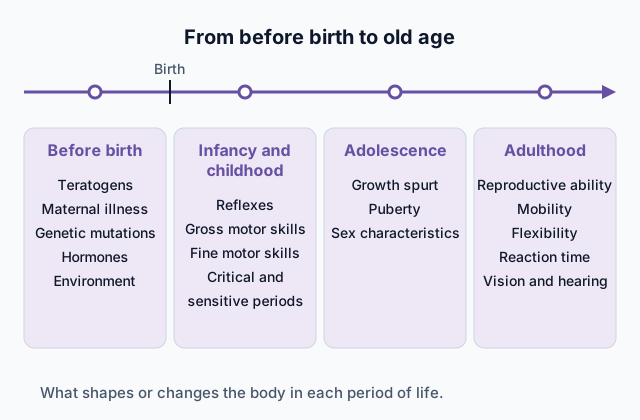
In short. Physical development is the growth and change of the body from before birth through old age, and at every stage it shapes how people think, feel and act.
- Before birth, substances, illness, genes, hormones and the surroundings can all affect later physical and psychological milestones.
- Infants and children gain reflexes and motor skills in a mostly fixed order but on their own timetables, and some skills, such as language, depend on experience during early windows.
- Puberty brings reproductive maturity in adolescence, and adulthood brings a leveling off and then a decline in physical abilities that differs from person to person.
Part 2 Learn it From before birth to old age, one stretch at a time
2a. Before birth: what reaches the baby
Long before a baby takes a first breath, its body and brain are being built, and what happens during pregnancy can change how that goes. The influences come in a few kinds.
- Teratogens are substances from outside the body that reach the developing baby, usually through the placenta, and can harm it. Alcohol, nicotine and some drugs are teratogens.
- Maternal illness is an infection or a long-term illness in the mother, such as rubella (German measles) early in pregnancy.
- Genetic mutations are changes in the baby's genes that can alter how the body and brain grow.
- Hormonal factors are the hormones the developing baby is exposed to, including the mother's stress hormones.
- Environmental factors are conditions around the mother, such as her nutrition and exposure to pollution.
These influences reach well past birth. They can affect physical milestones, such as birth weight and growth, and psychological ones, such as attention, learning and behavior years later.
Studying them is hard. No one may assign pregnant women to drink or smoke, so studies of people compare groups that already differ. Those are correlational studies. On their own they cannot show cause, because the groups may differ in other ways too.
Quick check · Decide and justify
Illustrative study (made up for practice, not a published study). Researchers followed 300 children from birth. Some of their mothers had smoked during pregnancy and some had not; the mothers chose, and no one was assigned. At age 8, the children whose mothers smoked scored lower on average on a test of attention, and the difference was statistically significant. Can the researchers conclude from this study alone that smoking during pregnancy caused the lower scores?
Which reason supports your answer?
2b. Infancy and childhood: reflexes and motor skills
A newborn arrives with reflexes, automatic responses that need no learning. Stroke a newborn's cheek and she turns her head toward the touch and opens her mouth, ready to feed. That is the rooting reflex. Put a finger in her palm and her fingers close tightly around it, which is the grasping reflex. Doctors check reflexes like these because their presence is a sign that development is on track. A missing one is a reason to look more closely.
Next come motor skills, which develop as the body and nervous system mature. Gross motor skills use the large muscles of the arms, legs and trunk: holding up the head, rolling over, sitting, crawling, walking, running. Fine motor skills use the small muscles of the hands and fingers: picking up a raisin between thumb and finger, holding a crayon, later buttoning a coat.
The order is nearly the same for every child. Babies hold up their heads before they sit, and sit before they walk. The timing is not. One baby walks before her first birthday and another a few months after it, and both can be developing normally.
Each new skill makes a child more independent. A baby who crawls can go after what she wants, and a child who can grip a spoon can feed herself.
Quick check · Sort it
Tap an example, then tap what it shows.
Reflex
Gross motor skill
Fine motor skill
2c. Seeing depth, and windows for learning
Infants cannot tell you what they see, so Eleanor Gibson and Richard Walk built the visual cliff: a glass tabletop with a checkerboard pattern right under the glass on one side and far below it on the other, so that side looks like a drop. Crawling infants placed in the middle and called by their mothers mostly crossed the shallow side but would not cross onto the deep side. So infants perceive depth by the time they crawl, and the researchers learned it from what the infants did, not from anything they said.
Some skills depend on experience at the right time. A critical period is an early window when certain experiences are needed for typical development. A sensitive period is a window when they have their strongest effect, though some learning is still possible later. Language is the clearest case in people: children who hear a language early pick up its grammar with ease, while people who first meet it as adults rarely master its grammar as fully.
Some animals show a sharp version. Shortly after hatching, ducklings and goslings imprint: they follow and attach to the first moving object they see, usually their mother, which keeps them close to safety.
Quick check · Fill the statement
Tap a blank, then tap a word.
Hours after hatching, a gosling starts following the first moving thing it saw, a farmer's boot, everywhere it goes. That is . Adults who learn a new language often keep grammar errors that children who learned it young do not make, which suggests language has a period. A crawling baby who will not crawl onto glass over an apparent drop is showing perception.
2d. Adolescence and adulthood
Adolescence opens with puberty, the period of sexual maturation in which the body becomes able to reproduce. It comes with the adolescent growth spurt, a fast gain in height and weight; for a year or two a teen can outgrow clothes within months.
Two kinds of body change happen. Primary sex characteristics are the body structures that make reproduction possible: the ovaries and uterus, or the testes. Secondary sex characteristics are changes not needed for reproduction: breasts and wider hips, or a deeper voice and facial hair, and body hair in everyone. Two landmarks mark the change: menarche, a girl's first menstrual period, and spermarche, a boy's first ejaculation. When puberty starts varies by several years from one teen to the next.
Adulthood spans most of the lifespan. Physical abilities generally level off in early adulthood and then decline, at rates that vary a lot from person to person. The decline shows in reproductive ability (menopause is when menstrual periods end for good), in mobility, flexibility and reaction time, and in how sharply people see and hear. These changes reach behavior. An older driver whose reactions have slowed may leave more space in traffic, and someone whose hearing has dulled may start avoiding noisy restaurants.
Quick check · Match
Tap a term, then tap the example that shows it.
Part 3 Watch it done Is a late walker behind?
Watch each step, then do the last one yourself.
Nora is 14 months old and not walking yet. Her cousin walked at 10 months, and her parents worry that Nora is behind. Nora held her head up, then sat without support, then crawled, and now she pulls herself up to stand while holding the couch. Does walking later than her cousin, by itself, show that Nora's motor development is off track?
Step 1 · Check the order
Nora has reached each earlier gross motor milestone in the usual order: head control, sitting, crawling, then pulling up to stand. Standing while holding on comes just before walking.
Why this step?
Why start with the order of her milestones rather than with her age?
Because the order is the part that is nearly the same for every child. Timing varies, so a child who is moving through the steps in order is following the usual path, whatever the calendar says.
Step 2 · Weigh the comparison
Her parents are comparing her with one other child. A gap of a few months between two children is well within the range that timing varies, so on its own it says little.
Your step · Decide and justify
Finish the reasoning. Nora is 14 months old and not walking yet, though her cousin walked at 10 months. She held her head up, then sat, then crawled, and now pulls herself up to stand at the couch. Does walking later than her cousin, by itself, show that her motor development is off track?
Which reason supports your answer?
Part 4 Try it Read a study: what does the visual cliff show?
Illustrative study (made up for practice, not a published study). A researcher builds a visual cliff: a glass-topped table with a checkerboard pattern just under the glass on one side and several feet below it on the other. She tests 36 infants aged 7 to 12 months, all of whom can already crawl. Each infant is placed on a board across the middle, and a parent calls first from one side and then from the other. The researcher records whether the infant crawls onto the glass within two minutes.
| Side the parent called from | Infants who crawled onto the glass |
|---|---|
| Shallow side | 33 of 36 |
| Deep side | 4 of 36 |
Try it · Multiple choice
In an illustrative visual cliff study, 36 crawling infants aged 7 to 12 months are placed one at a time on a glass-topped table that looks shallow on one side and like a drop on the other. A parent calls from each side in turn, and the researcher records whether the infant crawls onto the glass within two minutes. In this study, depth perception is operationally defined as
Try it · Decide and justify
In an illustrative visual cliff study, 36 infants aged 7 to 12 months, all already crawling, were called by a parent from each side of the table. 33 crawled onto the shallow side and 4 crawled onto the deep side. A classmate says the study shows that infants who can crawl perceive depth. Is the classmate right?
Which reason supports your answer?
Part 5 Explain it Write it the way the exam asks
Nothing you type leaves this page.
Free response is 33.3% of the exam score. This one is shaped like Question 2, Evidence-Based Question.
Free-response practice · Question 2 style
Illustrative sources (made up for practice, not published studies). Read all three sources, then answer. Cite the source you use in each part, for example (Source 1).
Source 1. Researchers tested 60 deaf adults who had used American Sign Language (ASL) every day for at least 20 years. They were grouped by when they first learned ASL, which they had not chosen for the study: from birth, between ages 4 and 6, or after age 12. On a test of ASL grammar, the from-birth group scored a mean of 94%, the ages 4 to 6 group 85% and the after-12 group 71%. The differences were statistically significant.
Source 2. Researchers tested 90 adults who had moved to the United States from other countries and had spoken English daily for at least 10 years. On a test of English grammar, those who arrived between ages 3 and 7 scored a mean of 97%, close to the 98% of a comparison group born in the United States. Those who arrived after age 17 scored a mean of 79%, and their scores varied far more. The difference between the two arrival groups was statistically significant.
Source 3. Researchers taught 40 teenagers and 40 adults in their thirties a list of 100 words in a language none of them knew. Two weeks later, the teenagers recalled a mean of 62 words and the adults 60. The difference was not statistically significant.
Using the sources, develop and justify an argument about how the age at which a person starts learning a language relates to how well they learn it.
(A) Propose a specific and defensible claim based in psychological science that responds to the question.
(B) Choose specific evidence from one source that supports your claim, and cite the source. Explain how that evidence supports your claim, using a psychological concept.
(C) Choose specific evidence from a different source than the one you used in part (B) that supports your claim, and cite the source. Explain how that evidence supports your claim, using a different psychological concept from the one you used in part (B).
Model answer
(A) People who start learning a language in early childhood master its grammar more fully than people who start later, because language learning has a sensitive period early in life.
(B) Deaf adults who learned ASL from birth scored 94% on a grammar test, while those who started after age 12 scored 71%, even though every group had used ASL daily for at least 20 years (Source 1). That fits a sensitive period for language: experience early in childhood has a stronger effect on learning grammar than the same experience later, so the late learners did not catch up despite decades of practice.
(C) Adults who arrived in the United States between ages 3 and 7 scored 97% on English grammar, close to native speakers' 98%, while those who arrived after 17 scored 79% (Source 2). That shows nature and nurture working together. Every group had at least 10 years of daily English, so nurture, the amount of experience, was similar. What differed was the age at which that experience met a still-maturing brain, which is nature's timetable, and the same experience produced better grammar when it came early.
Score your own answer. This is a self-check, not a grade. Tick each point your answer makes.
Part 6 Check yourself Read the table, then the rest of the lifespan
On the exam, some multiple-choice questions share one set of data, the way these do.
Illustrative data (made up for practice). A researcher measures simple reaction time, how fast a person presses a button after a light flashes, in 200 adults: 50 in each of four age groups, each person tested once. Lower times are faster. For each group the table shows the mean and the fastest and slowest person.
| Age group | Mean | Fastest person | Slowest person |
|---|---|---|---|
| 20 to 29 | 250 | 205 | 310 |
| 40 to 49 | 255 | 210 | 320 |
| 60 to 69 | 290 | 220 | 410 |
| 80 to 89 | 345 | 240 | 520 |
Case question 1 · Multiple choice
In an illustrative table of simple reaction times, the mean for adults aged 20 to 29 is 250 milliseconds, for 40 to 49 it is 255, for 60 to 69 it is 290 and for 80 to 89 it is 345. The gap between the fastest and slowest person grows from 105 milliseconds in the youngest group to 280 in the oldest. Which statement best describes the pattern?
Case question 2 · Decide and justify
In an illustrative table of reaction times, adults aged 20 to 29 ranged from 205 to 310 milliseconds and adults aged 80 to 89 from 240 to 520 milliseconds, with means of 250 and 345. Lower times are faster. A news story says this shows that everyone in their 80s reacts more slowly than everyone in their 20s. Is the story right?
Which reason supports your answer?
Case question 3 · Fill the statement
Tap a blank, then tap a word.
In a reaction time study, a researcher compares adults in four age groups, each person tested once. No one can be assigned an age, so this is a study, not an experiment. In the oldest group, people's reaction times were slower on average and also more from one person to the next.
The rest stand on their own and do not use the case.
Check yourself · Put it in order
Tap these gross motor milestones in the order most babies reach them, from first to last.
Check yourself · Spot the error
A student explains why doctors warn pregnant patients about alcohol. Tap the first line that goes wrong.
Check yourself · Sort it
Tap an example, then tap the kind of influence on development before birth that it shows.
Maternal illness
Genetic mutation
Hormonal factor
Environmental factor
Part 7 Keep it Bring back earlier ideas
Coming back to older ideas is how they stay usable on the exam.
Bring it back · Match
Tap a theme in developmental psychology, then tap the question that belongs to it.
Bring it back · Multiple choice
After a head injury, a skilled skateboarder can still describe every trick she knows, but she now stumbles and loses her balance on the simplest moves. Which brain structure was most likely damaged?
In three lines
- Teratogens, maternal illness, genetic mutations, hormones and the environment can shape development before birth, with effects on body and behavior.
- Reflexes such as rooting are present at birth, motor skills follow a nearly fixed order on varying timetables, and some skills such as language depend on early sensitive periods.
- Puberty brings the growth spurt and reproductive maturity, and adulthood brings a leveling off and then a decline that varies from person to person.
Vocabulary
- Teratogen
- A substance from outside the body, such as alcohol or nicotine, that can reach the developing baby before birth and harm its development.
- Rooting reflex
- A newborn's automatic turn of the head toward a touch on the cheek, with the mouth opening, which is a sign of on-track development.
- Gross and fine motor coordination
- Control of the large muscles for movements such as sitting and walking, and of the small muscles of the hands and fingers for movements such as grasping a crayon.
- Visual cliff
- An apparatus that looks like a drop but is covered by solid glass, used to show that infants perceive depth early and to read their responses from what they do.
- Critical or sensitive period
- A window early in life when certain experiences have strong developmental effects, especially for skills such as language.
- Imprinting
- The way some non-human animals attach to the first moving object they encounter after birth or hatching, as a means of survival.
- Adolescent growth spurt
- A fast gain in height and weight during adolescence.
- Puberty
- The period of sexual maturation in which reproductive ability develops.
- Primary sex characteristics
- The body structures, such as the ovaries and testes, that make reproduction possible.
- Secondary sex characteristics
- Sexual traits not needed for reproduction, such as breasts, a deeper voice and body hair.
- Menarche and spermarche
- The first menstrual period and the first ejaculation, landmarks of puberty.
- Menopause
- The end of menstrual periods in adulthood, part of the decline in reproductive ability.
Course alignment, for teachers
AP Psychology topic 3.2, Unit 3: Development and Learning.
- Skill 1.A: Apply psychological perspectives, theories, concepts, and research findings to a scenario.
- Skill 3.C: Interpret quantitative or qualitative inferential data from a given table, graph, chart, figure, or diagram.
- Skill 4.A: Propose a defensible claim.
This lesson maps all 7 essential knowledge statements of the topic to the part that teaches each one: 7 are checked by a scored question. The map is in the lesson file.