Unit 3 · Topic 3.3 · about 30 minutes · 7 parts · 14 scored checks, 3 of them multiple choice
AP Psychology 3.3: Gender and Sexual Orientation
Unit 3: 15 to 25% of the multiple-choice section
 Tap to open the picture full size
Part 1 Think first Who gets the practice
Guess before you learn. A wrong guess still makes the answer stick.
Predict first
In two villages, children start helping with family chores at about age 6. In Village A, boys and girls alike are expected to look after their younger brothers and sisters. In Village B, only girls are. By age 12, which boys are more likely to be good at calming a crying toddler?
In short. Sex is a person's biological characteristics, and gender is the roles and expectations a culture connects with being a woman, a man or another gender, along with a person's own sense of their gender.
- Children learn their culture's gender roles through socialization by parents, peers, schools and media, and cultures differ in what they expect.
- Gender identity, a person's inner sense of their own gender, and sexual orientation, a lasting pattern of attraction, are parts of the identity a person develops.
- Most research on gender cannot assign people to groups, so its correlations and observations show what goes together, not what causes what.
Part 2 Learn it Four short ideas, each checked as you go
2a. Sex and gender are different words
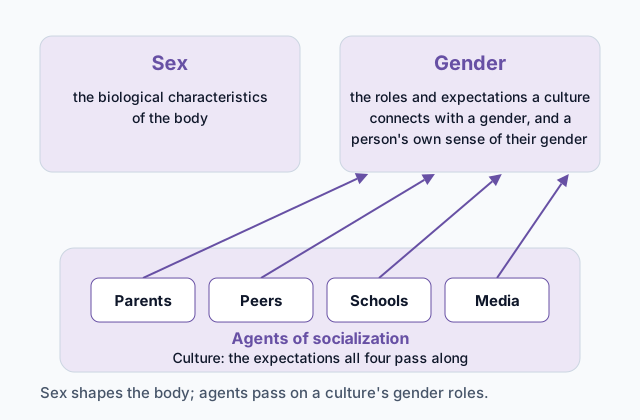
Psychologists keep two words apart in this topic. Sex refers to biological characteristics: chromosomes, hormones and the body's reproductive anatomy. A doctor records a newborn's sex from the body. Gender refers to the roles, expectations and behaviors a culture connects with being a girl or woman, a boy or man, or another gender, along with a person's own sense of their gender.
The expectations are called gender roles: a culture's shared ideas about how people of each gender should act, dress, work and show feelings. You can tell gender roles come from culture rather than from bodies, because they differ from place to place and change over time. In Scotland a kilt is traditional men's dress, while in the United States a skirt is usually thought of as women's clothing. In the 1800s most office clerks in the United States were men; a century later, clerical work was widely seen as women's work. The bodies did not change. The expectations did.
So when you meet a difference between girls and boys, ask which word it belongs to. Is it about the body, or about what a culture expects people to do?
Quick check · Sort it
Tap each item, then tap whether it belongs to sex or to gender.
Sex
Gender
2b. Socialization: how gender roles are learned
Nobody is born knowing their culture's gender roles. Children learn them through socialization, the process of learning the norms, roles and expectations of the groups you belong to. The people and institutions that do the teaching are called agents of socialization.
- Parents pick toys and clothes, hand out chores and react to what children do, sometimes treating a son and a daughter differently without noticing.
- Peers have rules of their own. By preschool, children often play mostly with children of their own gender, and a child who crosses a line may get teased for it.
- Schools teach through what teachers expect and how they group and call on students.
- Media, from cartoons to ads, show who fixes the car and who cooks dinner.
All of these pass along the expectations of the wider culture.
You can see socialization in development: in the games children pick, the interests they follow, the jobs they imagine for themselves and how openly they show feelings. Cultures expect different things, so the patterns differ from place to place, and within one culture children still vary a lot. Socialization pushes in a direction; it does not decide who a child becomes.
Sex matters too. The sex recorded at birth usually starts gendered treatment, from a baby's name to the first toys, and sex shapes the body's own development: puberty starts earlier in girls than in boys, on average. Biology and socialization work together.
Quick check · Match
Tap an agent of socialization, then tap the example that shows it teaching a gender role.
2c. Gender identity and sexual orientation
Gender roles are about what a culture expects. Two other ideas are about the person. Both are parts of the identity a person develops over time.
Gender identity is a person's inner sense of their own gender, as a woman, a man or another gender. For most people it matches the sex recorded at birth, and for some people it does not.
Sexual orientation is a person's lasting pattern of emotional, romantic or sexual attraction: to people of a different sex or gender, the same one, more than one, or none.
Keep these apart from gender roles and from each other. A boy who loves ballet and cooking is going against some gender roles in his culture, and you cannot tell his gender identity or his sexual orientation from that. Interests and activities are not a measure of either one.
That matters for research. Gender identity and sexual orientation are inner experiences, so researchers usually study them with self-report: surveys and interviews in which people describe themselves. Self-report has a known weak spot. People may give the answer they think is expected, especially on a personal topic, so researchers keep answers anonymous and word their questions carefully.
Quick check · Decide and justify
A research team wants to measure gender identity in a survey of adults. One member suggests asking how often each person does tasks their culture sees as typical for their gender, such as cooking or car repair, and using that as the measure. Is that a good way to measure gender identity?
Which reason supports your answer?
2d. Judging studies that cannot be experiments
Most research on gender cannot be an experiment. Nobody can randomly assign a child's sex or swap a family's culture, so researchers lean on non-experimental designs, each with a limit you should be able to name.
- A correlational study measures two variables and asks whether they go together. If parents who buy more toy trucks have children who play more with trucks, the link could run either way: the parents may shape the play, or children who already love trucks may ask for more of them. A third variable, such as an older brother's toys, could drive both. A correlation does not show cause.
- In naturalistic observation, researchers watch behavior in its normal setting, such as a playground, without changing anything. It shows real behavior, but observers who know each child's gender may see what they expect to see, which is observer bias. Observers who do not know the study's question, and clear rules for what counts, reduce it.
- A survey asks many people about themselves. It reaches a lot of people quickly, but its answers are only as good as people's honesty and memory.
- A case study looks at one person or a small group in depth. It gives rich detail but cannot be generalized to most people.
One more caution: a difference between two groups' averages describes the groups, not every person in them.
Quick check · Multiple choice
In an illustrative study, researchers asked 150 parents of 5-year-olds how many building sets they had bought for their child, then watched each child in a playroom for 20 minutes. Children with more building sets at home spent more time building in the playroom. Which is the best reason this study cannot show that buying building sets makes children build more?
Part 3 Watch it done Evaluating an observation study, one step at a time
Watch each step, then do the last one yourself.
Illustrative study (made up for practice, not a published study). Two observers spent three weeks in four preschool classrooms, writing down every time a teacher praised a child and what the praise was for. They did not talk to the children or change anything in the rooms. Their records showed teachers praising girls more often for tidy work and boys more often for speaking up. Both observers knew which children were girls and which were boys, and each decided for herself whether a comment counted as praise for tidiness. What kind of study is this, and what does its way of recording risk?
Step 1 · Name the design
The observers watched behavior where it normally happens, in real classrooms, and changed nothing. That is naturalistic observation.
Step 2 · Say what the design can and cannot show
It describes what teachers actually do in a real setting, which a laboratory could not. Because nothing was manipulated, it cannot show that the praise changed how any child behaves.
Why this step?
Why can't this study show that praise for tidiness makes girls work more tidily?
The direction is open. Teachers may praise tidy work because some children already work tidily, so the praise could be a result rather than a cause. Showing cause would take changing the praise on purpose and assigning children to it at random.
Your step · Decide and justify
Finish the evaluation. In an illustrative observation of four preschool classrooms, two observers recorded each time a teacher praised a child and what for. Both knew which children were girls and which were boys, and each decided for herself whether a comment counted as praise for tidiness. Which problem does that way of recording create?
Which reason supports your answer?
Part 4 Try it Read a survey about screens and careers
Illustrative study (made up for practice, not a published study). Researchers surveyed 400 ninth graders at four high schools. Each student answered two questions: how often the shows they watch include women working as engineers (rarely, sometimes or often), and whether they could see themselves becoming an engineer (yes or no).
| Shows include women engineers | Students | Answered yes |
|---|---|---|
| Rarely | 140 | 22% |
| Sometimes | 160 | 30% |
| Often | 100 | 41% |
Try it · Calculate
In an illustrative survey of 400 ninth graders, 22% of students who rarely see women engineers in their shows said they could see themselves as engineers, compared with 30% of those who sometimes do and 41% of those who often do. How many percentage points higher is the often group than the rarely group?
Try it · Sort it
Tap each claim about the screens and careers survey, then tap whether the survey supports it.
The survey supports this
The survey cannot show this
Part 5 Explain it Write it the way the exam asks
Nothing you type leaves this page.
Free response is 33.3% of the exam score. This one is shaped like Question 2, Evidence-Based Question.
Free-response practice · Question 2 style
Read the three sources, then answer the question they share: do the people and media around children shape how children play? In parts B and C, cite the source you use, for example (Source 1).
Source 1. Illustrative study (made up for practice, not a published study). Observers who did not know the study's purpose watched free play in eight preschools for six weeks. In four of the preschools, teachers often sorted children by gender, such as lining up boys and girls separately and naming teams "boys" and "girls." In the other four, teachers never sorted children by gender. The preschools were not assigned to either practice. Children in the four sorting preschools spent a mean of 74% of their free play in same-gender groups, compared with 52% in the other four. The difference was statistically significant.
Source 2. Illustrative study (made up for practice, not a published study). Researchers asked 180 parents of 4-year-olds how often they choose toys for their child by whether the toy is sold as being for boys or for girls, on a scale from 1 (never) to 5 (always). Observers then recorded each child's free play at home for 30 minutes. The more often parents chose toys this way, the larger the share of their child's play time spent with toys sold for the child's own gender (r = +0.41, statistically significant).
Source 3. Illustrative study (made up for practice, not a published study). Researchers randomly assigned 90 children aged 5 to 7 to watch one of two short videos about a puzzle box none of them had seen before. In one video, an adult called it "a great toy for girls" and only girls played with it. In the other, the adult called it "a great toy for kids" and girls and boys played with it. Afterward, each child spent 10 minutes alone in a room with several toys, including the puzzle box. Boys who saw the "for girls" video played with the box for a mean of 1.4 minutes, and boys who saw the "for kids" video for 4.6 minutes. Girls played with it for about 4.5 minutes after either video. The difference for boys was statistically significant.
(A) Propose a specific and defensible claim, based in psychological science, that answers the question.
(B) (i) Support your claim using one piece of specific and relevant evidence from one of the sources. (ii) Explain how the evidence from part B (i) supports your claim, using a psychological perspective, theory, concept, or research finding.
(C) (i) Support your claim using a piece of specific and relevant evidence from a different source. (ii) Explain how the evidence from part C (i) supports your claim, using a different psychological perspective, theory, concept, or research finding from the one in part B (ii).
Model answer
(A) The messages children get from adults and media about what is for boys and what is for girls shape how children play.
(B) (i) In Source 3, boys who watched a video calling the puzzle box "a great toy for girls" played with it for a mean of 1.4 minutes, compared with 4.6 minutes for boys told it was "a great toy for kids." (ii) The "for girls" video taught a gender role, an expectation about which toys suit which gender, and the boys who heard it acted on it by mostly leaving the box alone. Because the children were randomly assigned to the videos, the video's message, its label and who it showed playing, is what changed the boys' play, which supports the claim that media messages shape how children play.
(C) (i) In Source 1, children in preschools where teachers often sorted them by gender spent 74% of their free play in same-gender groups, compared with 52% in preschools where teachers never did. (ii) The sociocultural perspective, a different idea from part B, explains behavior through the social and cultural setting a person lives in. In the sorting preschools, the adults made gender a regular way of dividing up the day, and the children divided their own play the same way. The preschools were not assigned, so other differences between them could explain some or all of the gap, but the pattern fits the claim that the people around children shape how they play.
Score your own answer. This is a self-check, not a grade. Tick each point your answer makes.
Part 6 Check yourself Read the table, judge the conclusion
On the exam, some multiple-choice questions share one set of data, the way these do.
Illustrative data (made up for practice). Researchers surveyed 400 twelve-year-olds, 100 girls and 100 boys in each of two communities, and asked how many hours they had spent looking after younger children in the past week. The children were not assigned to communities; they already lived there. The difference between the boys in the two communities was statistically significant.
| Community | Girls | Boys |
|---|---|---|
| A | 5 | 4 |
| B | 7 | 1 |
Case question 1 · Multiple choice
In an illustrative survey of 12-year-olds in two communities, girls reported a mean of 5 hours of childcare a week in Community A and 7 in Community B, and boys reported 4 in Community A and 1 in Community B. Which conclusion do these data best support?
Case question 2 · Calculate
In an illustrative survey, girls in Community B reported a mean of 7 hours of childcare in a week and boys in Community B reported 1. Girls in Community A reported 5 and boys 4. In Community B, how many more hours did girls report than boys, on average?
Case question 3 · Decide and justify
In an illustrative survey of 12-year-olds who already lived in two communities, boys reported a mean of 4 hours of childcare a week in Community A and 1 hour in Community B, a statistically significant difference. A classmate says the two communities' different expectations for boys caused the difference. Can these data show that?
Which reason supports your answer?
The rest stand on their own and do not use the case.
Check yourself · Fill the statement
Tap a blank, then tap a word.
A survey asks adults which household jobs they think of as men's work and which as women's work, so it measures beliefs about . A second survey asks people to describe their own inner sense of their gender, so it measures . A hospital record lists a newborn's , based on the baby's body.
Check yourself · Spot the error
A researcher spends a year interviewing one 10-year-old, her parents and her teachers about how she learned which games count as being for girls and which for boys. A student evaluates the study. Tap the first line that goes wrong.
Part 7 Keep it Bring back earlier ideas
Coming back to older ideas is how they stay usable on the exam.
Bring it back · Fill the statement
Tap a blank, then tap a word.
During puberty the ovaries and testes mature, and because they are needed for reproduction they are sex characteristics. A deeper voice and new body hair, which are not needed for reproduction, are sex characteristics. A girl's first menstrual period is called .
Bring it back · Multiple choice
A school counselor wants to measure how much students worry about tests. Her questionnaire asks only how many hours each student studied in the past week. When she gives it to the same students twice, a week apart, they give nearly the same answers both times. Which best describes the questionnaire?
In three lines
- Sex is biological, and gender is the roles and expectations a culture connects with being a woman, a man or another gender, along with a person's own sense of their gender.
- Parents, peers, schools and media teach gender roles, and gender identity and sexual orientation are separate parts of who a person is.
- Correlational, observational, survey and case study research on gender can show what goes together but not what causes what.
Vocabulary
- Sex
- Biological characteristics such as chromosomes, hormones and reproductive anatomy.
- Gender
- The roles, expectations and behaviors a culture connects with being a woman, a man or another gender, along with a person's own sense of their gender.
- Gender roles
- A culture's expectations about how people of each gender should act.
- Socialization
- The process of learning the norms, roles and expectations of the groups a person belongs to.
- Agents of socialization
- The people and institutions that teach those norms and roles, such as parents, peers, schools and media.
- Gender identity
- A person's inner sense of their own gender.
- Sexual orientation
- A person's lasting pattern of emotional, romantic or sexual attraction.
- Correlational study
- A study that measures two variables to see whether they go together, without showing which one causes the other.
- Naturalistic observation
- Watching behavior in its normal setting without changing anything.
- Observer bias
- Observers' expectations shaping what they notice or record.
- Case study
- An in-depth study of one person or a small group, which cannot be generalized to most people.
Course alignment, for teachers
AP Psychology topic 3.3, Unit 3: Development and Learning.
- Skill 2.C: Evaluate the appropriate use of research design elements in non-experimental methodologies.
This lesson maps the topic's one learning objective, since the course framework gives it no essential knowledge statements, to the part that teaches each one: 1 is checked by a scored question. The map is in the lesson file.