Unit 3 · Topic 3.4 · about 30 minutes · 7 parts · 14 scored checks, 4 of them multiple choice
AP Psychology 3.4: Cognitive Development Across the Lifespan
Unit 3: 15 to 25% of the multiple-choice section
 Tap to open the picture full size
Part 1 Think first Two balls of clay
Guess before you learn. A wrong guess still makes the answer stick.
Predict first
You show a 4-year-old two balls of clay, and she agrees they have exactly the same amount. Then, while she watches, you roll one ball into a long, thin snake. Nothing is added and nothing is taken off. You ask her which one has more clay now. What does she most likely say?
In short. Cognitive development is how thinking changes across the lifespan, from the way young children build and revise their ideas about the world to the way different kinds of intelligence hold up in later adulthood.
- In Piaget's theory, children adjust their schemas a little at a time and also pass through four stages, each with its own kind of thinking.
- Vygotsky held that children learn through other people, best on tasks they can manage only with help, where support is given and then withdrawn.
- Knowledge built up over a lifetime stays relatively stable in adulthood while quick reasoning about new problems tends to wane, and dementia is a disorder rather than a normal part of aging.
Part 2 Learn it Four short ideas, each checked as you go
2a. Schemas, and the two ways they grow
Point at an airplane overhead and a toddler who has just learned the word bird may shout "bird!" Jean Piaget, who spent decades watching children reason, would say she is using a schema, a mental framework for organizing what she knows. Her bird schema says, roughly, that things flying in the sky are birds.
Piaget described two ways schemas develop. In assimilation, a child takes in new information by fitting it into a schema she already has, without changing the schema. Calling the airplane a bird is assimilation. In accommodation, the child changes the schema to fit the new information. When she learns that airplanes are machines that carry people, and starts sorting flying things into birds and planes, she has accommodated.
This kind of adjusting goes on all the time, a little at a time, so it is a continuous process. Piaget also saw moments when a child's whole way of thinking shifts, so that she reasons in a way she could not before. He called these stages, and the move from one stage to the next is discontinuous, a step rather than a slope. His theory needs both: steady adjustment of schemas within a stage, and a change in kind between stages.
Quick check · Sort it
Tap an example, then tap the process it shows.
Assimilation
Accommodation
2b. Piaget's four stages
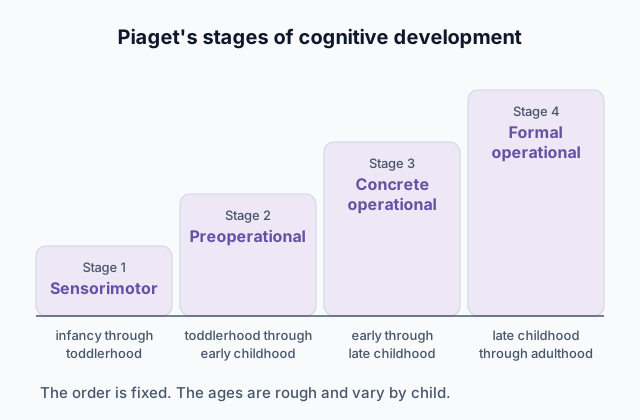
Piaget's stages come in the same order for every child, though the timing varies.
- Sensorimotor stage, from infancy through toddlerhood. Babies learn through their senses and their actions. The big gain is object permanence, knowing that things still exist when out of sight. Before it, a toy hidden under a blanket is simply gone.
- Preoperational stage, from toddlerhood through early childhood. Children get good at using mental symbols, such as words and drawings, and at pretend play, where a stick becomes a sword. The stage is known as much for what children cannot yet do. They fail at conservation, understanding that an amount stays the same when its shape changes, and at reversibility, running an action backward in their heads. They show animism, giving lifeless things feelings and intentions, and egocentrism, trouble taking another person's point of view. During this stage children also begin to develop a theory of mind, the understanding that other people have thoughts and beliefs that can differ from their own.
- Concrete operational stage, from early through late childhood. Children correct those errors and think logically and realistically about concrete things. They still struggle to think systematically, such as planning how to test every possibility in turn.
- Formal operational stage, from late childhood through adulthood. People can think abstractly and hypothetically, about ideas and about what could be. Piaget proposed that not everyone reaches this stage.
Quick check · Match
Tap a term, then tap the example that shows it.
2c. Vygotsky: learning with help
Piaget pictured a child working the world out largely on her own, like a small scientist. Lev Vygotsky, a psychologist working at about the same time, put other people at the center. To him, children are social learners. They learn by interacting with parents, teachers, older siblings and friends, inside a sociocultural context: the language, tools and customs of the community around them. A child in a fishing town and a child in a big city learn different skills, because the people around them know and teach different things.
Vygotsky's best-known idea is the zone of proximal development, the range between what a child can do alone and what she can do with help from someone more skilled. A task she can already do alone teaches her little. A task far beyond her is too hard even with help. Learning happens best in between, and Vygotsky held that this zone is where teaching should aim.
The help itself is called scaffolding. Like the scaffolding around a building under construction, it is support put up while it is needed and taken down bit by bit as the learner can stand on her own. A parent teaching a child to tie her shoes might first make the loops with her, then only say "now pull it through," then only watch.
Quick check · Multiple choice
Malik, 7, can add two-digit numbers on his own but gets stuck whenever he has to carry. When his older sister asks, "What do you do with the extra ten?" he carries correctly, and over the week she needs to ask less and less. Which idea names the range of tasks, like carrying, that Malik can do with help but not yet alone?
2d. Thinking in adulthood
Thinking keeps changing after childhood, though not in stages. Psychologists separate two kinds of intelligence that age differently.
Crystallized intelligence is the knowledge and skill you have built up: vocabulary, facts, how to do your job, how to handle familiar kinds of problems. It remains relatively stable through adulthood. Fluid intelligence is the ability to reason quickly about problems that are new to you, such as working out a kind of puzzle you have never seen. It tends to wane as people age.
So a 70-year-old may take longer than a 25-year-old to figure out a new phone app and still know as many words as ever and explain a complicated situation more clearly. Both of those are part of typical aging.
Some changes are not. Dementia is a cognitive disorder in which memory and other thinking abilities decline far enough to interfere with everyday life, such as handling money or finding the way along a familiar route. It is caused by disease or damage in the brain, and Alzheimer's disease, which you met in the memory topics, is its most common cause. Dementia is not a normal part of growing older, and most older adults do not have it. Forgetting a name and recalling it later is ordinary; dementia is a lasting decline that usually worsens over time.
Quick check · Fill the statement
Tap a blank, then tap a word.
At 72, Ray beats his grandchildren at word games and explains history as well as he ever did, which draws on intelligence. He takes far longer than they do to work out the rules of a video game he has never played, which draws on intelligence. A decline in memory and thinking caused by brain disease, severe enough to disrupt daily life and not part of typical aging, is called .
Part 3 Watch it done Placing a child in a stage
Watch each step, then do the last one yourself.
Priya, 10, is sure that water poured from a tall glass into a wide bowl is still the same amount, and she explains that pouring it back would make it look the same again. Then she is given four bottles of clear liquid and told that mixing some of them turns the liquid yellow. She mixes a few pairs at random, loses track of which she has tried, and gives up without testing every combination. Which of Piaget's stages does her thinking fit best?
Step 1 · Check what she can do
She knows the amount of water stays the same when its shape changes, which is conservation, and she can run the pouring backward in her head, which is reversibility. Children in the preoperational stage cannot yet do either, so she is past that stage.
Step 2 · Check what she struggles with
Faced with the bottles, she tries pairs at random instead of planning to test every combination in order. She has trouble thinking systematically.
Why this step?
Why look at what she struggles with, and not only at what she can do?
Because a stage is identified by both. Conserving rules out the preoperational stage, but a teenager in the formal operational stage conserves too. Only her trouble with the bottles can tell the two later stages apart.
Your step · Decide and justify
Finish the classification. Priya, 10, knows that water poured into a wide bowl is still the same amount and explains that pouring it back would undo the change. Given four bottles of clear liquid, some of which turn yellow when mixed, she mixes pairs at random, loses track, and gives up before testing every combination. Which of Piaget's stages does her thinking fit best?
Which reason supports your answer?
Part 4 Try it Read a study: where will the puppet look?
Illustrative study (made up for practice, not a published study). A researcher tests 30 children at each of three ages, 3, 4 and 5, once each, all in the same month. Each child watches a short puppet show. A puppet named Max puts his ball in a basket and leaves the room. While he is gone, a second puppet moves the ball into a box. The researcher then asks two questions: "Where did Max put his ball at the start?" and "When Max comes back, where will he look for his ball?" Every child answers the first question correctly. A child passes if she says Max will look in the basket.
| Age | Children tested | Children who passed |
|---|---|---|
| 3 | 30 | 9 |
| 4 | 30 | 16 |
| 5 | 30 | 26 |
Try it · Calculate
In an illustrative puppet study, 9 of 30 three-year-olds and 26 of 30 five-year-olds passed a task asking where a puppet would look for a ball that had been moved while he was away. How many percentage points higher was the five-year-olds' pass rate than the three-year-olds'? Round to one decimal place.
Try it · Decide and justify
In an illustrative study, children watched a puppet named Max put his ball in a basket and leave, and a second puppet move the ball into a box while he was away. Every child correctly said where Max put the ball at the start. Most of the 3-year-olds then said Max would look for it in the box. A classmate says the 3-year-olds simply forgot where Max put the ball. Is the classmate right?
Which reason supports your answer?
Part 5 Explain it Write it the way the exam asks
Nothing you type leaves this page.
Free response is 33.3% of the exam score. This one is shaped like Question 1, Article Analysis Question.
Free-response practice · Question 1 style
Illustrative study (made up for practice, not a published study). Researchers wanted to know whether help that adjusts to a child's progress improves what the child can later do alone. With written permission from their parents, 64 five-year-olds from four preschools in one city took part, and any child who wanted to stop could go back to class at any time. A coin flip put each child in one of two groups. Each child spent 15 minutes copying a model built from 20 blocks. In the guided group, an adult gave a hint only when the child got stuck, and gave fewer hints as the child improved. In the alone group, children worked with no help. One week later, every child worked alone to copy a new 20-block model, and the researchers counted how many blocks each child placed correctly in 10 minutes. The guided group placed a mean of 14.6 blocks correctly and the alone group a mean of 9.3. The difference was statistically significant.
(A) Identify the research method used in this study.
(B) State the operational definition of building skill in this study.
(C) Identify one ethical guideline described in the study. Describe one way the researchers applied it.
(D) Explain how the results support Vygotsky's idea of the zone of proximal development.
Model answer
(A) This is an experiment, because a coin flip assigned each child at random to the guided group or the alone group.
(B) Building skill was measured as the number of blocks a child placed correctly in 10 minutes while copying a new 20-block model alone, one week after the practice session.
(C) Informed consent. Five-year-olds cannot consent for themselves, so the researchers got written permission from each child's parents before the child took part.
(D) Copying a 20-block model was hard for five-year-olds alone, and the hints were aimed at the steps a child could not yet manage alone, which is work in the zone of proximal development. The guided group got help only when stuck and less help as they improved, which is scaffolding within that zone. A week later, working alone, the guided group placed 14.6 blocks correctly against 9.3 for the alone group. Learning with support in that zone left them able to do more on their own, which is what Vygotsky's idea predicts.
Score your own answer. This is a self-check, not a grade. Tick each point your answer makes.
Part 6 Check yourself Two tests across forty years of adulthood
On the exam, some multiple-choice questions share one set of data, the way these do.
Illustrative data (made up for practice). Researchers followed the same 150 adults for 40 years and tested them at ages 30, 50 and 70 on two tests. The vocabulary test asks what words mean and is scored from 0 to 60. The puzzle test gives patterns of a kind the person has never seen and asks for the next pattern in each, against the clock, and is scored from 0 to 40.
| Test | Age 30 | Age 50 | Age 70 |
|---|---|---|---|
| Vocabulary (0 to 60) | 41 | 44 | 43 |
| New puzzles (0 to 40) | 31 | 26 | 19 |
Case question 1 · Multiple choice
Researchers tested the same 150 adults at ages 30, 50 and 70. Their mean vocabulary scores were 41, 44 and 43, and their mean scores on a timed test of solving new kinds of puzzles were 31, 26 and 19. Which statement best fits these results?
Case question 2 · Calculate
The same 150 adults had a mean score of 31 on a test of solving new kinds of puzzles at age 30 and 19 at age 70. By what percent of their age-30 mean did the puzzle score fall? Round to one decimal place.
Case question 3 · Decide and justify
The same 150 adults were tested at 30 and again at 70. Their mean score on a timed test of solving new kinds of puzzles fell from 31 to 19, while their mean vocabulary score went from 41 to 43. A classmate says the falling puzzle scores show that these adults were developing dementia. Is the classmate right?
Which reason supports your answer?
The rest stand on their own and do not use the case.
Check yourself · Put it in order
Tap these achievements in the order Piaget's stages bring them, from earliest to latest.
Check yourself · Spot the error
A student summarizes how Piaget thought children's thinking develops. Tap the first line that goes wrong.
Part 7 Keep it Bring back earlier ideas
Coming back to older ideas is how they stay usable on the exam.
Bring it back · Multiple choice
In an illustrative study, young songbirds that heard adults of their species sing during their first weeks of life later sang the song correctly. Birds raised in silence that first heard the song as young adults never learned to sing it correctly, though they then heard it every day. This pattern is best explained by
Bring it back · Multiple choice
Ms. Ortiz reads her class a list of 15 new vocabulary words once, then right away asks students to write down as many as they can. Most students write down the last three words she read. Which effect best explains why those words were remembered?
In three lines
- Piaget's children build schemas by assimilation and accommodation and move through four stages: sensorimotor, preoperational, concrete operational and formal operational.
- Vygotsky's children learn through other people, best within the zone of proximal development, where scaffolding supports them until they can work alone.
- In adulthood crystallized intelligence stays relatively stable while fluid intelligence tends to wane, and dementia is a cognitive disorder, not typical aging.
Vocabulary
- Schema
- A mental framework for organizing and interpreting what a person knows.
- Assimilation
- Taking in new information by fitting it into an existing schema, without changing the schema.
- Accommodation
- Taking in new information by changing a schema to incorporate it.
- Sensorimotor stage
- Piaget's stage from infancy through toddlerhood, during which object permanence develops.
- Object permanence
- Understanding that objects still exist when they cannot be seen.
- Preoperational stage
- Piaget's stage from toddlerhood through early childhood, when children use mental symbols and pretend play but cannot yet conserve or reverse operations.
- Conservation
- Understanding that an amount stays the same when its shape or arrangement changes.
- Reversibility
- Understanding that an action can be mentally undone, returning things to how they were.
- Animism
- Believing that lifeless objects have feelings, thoughts or intentions.
- Egocentrism
- Difficulty seeing a situation from another person's point of view.
- Theory of mind
- Understanding that other people have thoughts and beliefs that can differ from one's own.
- Concrete operational stage
- Piaget's stage from early through late childhood, when children think logically about concrete things but struggle to think systematically.
- Formal operational stage
- Piaget's stage from late childhood through adulthood, when people can think abstractly and hypothetically, which Piaget proposed not everyone achieves.
- Scaffolding
- Support from a more skilled person that is reduced as the learner becomes able to work alone.
- Zone of proximal development
- The range between what a learner can do alone and what the learner can do with help, where Vygotsky held learning ideally occurs.
- Crystallized intelligence
- Accumulated knowledge and skills, which remain relatively stable through adulthood.
- Fluid intelligence
- The ability to reason quickly about new problems, which tends to wane as people age.
- Dementia
- A cognitive disorder in which memory and other thinking abilities decline enough to interfere with daily life.
Course alignment, for teachers
AP Psychology topic 3.4, Unit 3: Development and Learning.
- Skill 1.B: Explain how cultural norms, expectations, and circumstances, as well as cognitive biases apply to behavior and mental processes.
- Skill 2.C: Evaluate the appropriate use of research design elements in non-experimental methodologies.
- Skill 4.B: Provide reasoning that is grounded in scientifically derived evidence to support, refute, or modify an established or provided claim, policy, or norm.
This lesson maps all 7 essential knowledge statements of the topic to the part that teaches each one: 7 are checked by a scored question. The map is in the lesson file.