Unit 3 · Topic 3.5 · about 30 minutes · 7 parts · 14 scored checks, 3 of them multiple choice
AP Psychology 3.5: Communication and Language Development
Unit 3: 15 to 25% of the multiple-choice section
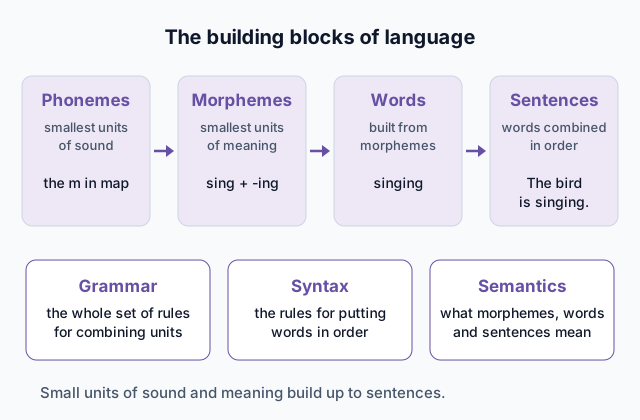 Tap to open the picture full size
Part 1 Think first Where did goed come from?
Guess before you learn. A wrong guess still makes the answer stick.
Predict first
Rosa is three. At dinner she announces, "I goed to the park and I seed two mouses!" Her parents always say went, saw and mice, and so does everyone else she spends time with. Where did goed most likely come from?
In short. Language is a shared system of arbitrary symbols, combined by rules, that lets people express an unlimited number of ideas, and children in every culture acquire it through the same stages.
- Phonemes are the smallest units of sound and morphemes the smallest units of meaning; semantics is meaning, and grammar, including syntax, is the set of rules for combining them.
- Before and alongside their first words, children communicate with gestures such as pointing, and their speech moves from cooing and babbling to single words and then telegraphic speech.
- Learners of any age make predictable errors along the way, and those errors show which rules they have picked up.
Part 2 Learn it Four short ideas, each checked as you go
2a. What makes something a language
Psychologists describe a language as a shared system of arbitrary symbols, combined by rules, that can express an unlimited number of ideas.
Shared. A word means something only because the people using it agree on what it means. When a new slang word catches on at one school, it works for the students who know it and confuses everyone else.
Arbitrary symbols. Nothing about the sound of a word has to match the thing it names. English says water and Spanish says agua. The liquid is the same, and neither sound is any wetter.
Rule-governed. Symbols are combined by rules, which together make up the language's grammar. You follow many of these rules every time you speak, even though you could not state most of them.
Generative. A limited set of words and rules can produce an endless number of sentences. Most of what you said today had never been said before in exactly that form, and the people listening understood you anyway, because they share your symbols and your rules.
Quick check · Match
Tap a feature of language, then tap the example that shows it.
2b. Sounds, meanings and rules
Language is built from small pieces.
A phoneme is the smallest unit of sound that can change a word. Swap the first sound of pat for the first sound of bat and you have a different word, so those two sounds are different phonemes. A phoneme carries no meaning of its own.
A morpheme is the smallest unit that carries meaning. Some morphemes are whole words, like cat or run. Others cannot stand alone: the -s in cats means more than one, and the un- in unfair means not. So cats has two morphemes, and unfairly has three: un-, fair and -ly.
Semantics is meaning: what morphemes, words and sentences mean. Grammar is the whole set of rules that lets speakers combine symbols and understand each other. One part of grammar, syntax, is the rules for putting words in order. The girl threw the ball is an English sentence. Threw ball girl the the uses the same words and breaks the syntax.
A sentence can follow the syntax and still make no sense, which is the easiest way to tell the two apart. The friendly rock sang a sandwich is correctly ordered English, and its meaning still falls apart.
Quick check · Sort it
Tap an example, then tap the piece of language it shows.
Phoneme
Morpheme
Syntax
Semantics
2c. Before words, and then the stages
Long before their first word, babies communicate. One of the earliest tools is a nonverbal gesture: a baby points at a dog and then looks at you to check that you saw it, or holds up both arms to be picked up. Children in every culture use gestures like pointing, and they keep using them as speech arrives.
Spoken language then develops through the same stages, in the same order, across cultures, though the timing varies from child to child.
- Cooing. In the first months, babies make soft vowel sounds like ooh and aah.
- Babbling. Starting at around four to six months and running to about the first birthday, babies string consonants and vowels together, like ba-ba-ba or da-da-da, without meaning anything by them.
- One-word stage. Around the first birthday, single words appear, and one word can stand for a whole idea. Juice! can mean "I want juice."
- Telegraphic speech. Around age two, children put two or more words together but leave out the small words, like an old telegram that cost money per word: Want milk, Go park now. The words that remain are the ones that carry meaning, and they usually come in the order the language uses.
Quick check · Put it in order
A parent noted four things her son did at different points in his first two years. Tap them in the order they appeared.
2d. Errors that show a rule at work
Children learning English often say things no adult around them says: I bringed it, three sheeps. This is overgeneralization: applying a grammar rule to words that are exceptions to it. The child has worked out that -ed marks the past and -s marks more than one, and now uses those rules on every word.
The error often appears after a child has already been using the correct form. A two-year-old may say brought, learned as a single word, then switch to bringed at three once the rule takes over, and sort out the exceptions later. So the mistake is a sign of progress: the child is no longer only repeating words but applying rules.
The same errors show up in anyone learning a language, not only in young children. An adult learning English as a second language may say she buyed it, putting the regular rule on an irregular verb.
Quick check · Multiple choice
At two and a half, Theo said "I ate it" and "My feet are cold." At three and a half, he says "I eated it" and "My foots are cold." What best explains the change?
Part 3 Watch it done Placing a child's speech in a stage
Watch each step, then do the last one yourself.
Nadia is two. Holding her mother's sock, she says "Mommy sock." When the dog runs past, she says "Doggy run." Which stage of language development do these show?
Step 1 · Count the words
Each utterance has two words, and each one is a real word rather than a string of repeated sounds.
Step 2 · Look at what is kept and what is missing
She keeps the words that carry the meaning, a person and a thing, an animal and an action. She drops the small words. The full sentences would be That is Mommy's sock and The doggy is running.
Step 3 · Check the order
The kept words come in English order: the one doing the action comes before the action, Doggy run, not Run doggy.
Why this step?
Why check the order of the words, not only which words she kept?
Because the order shows she is already following rules of syntax. Two words in the order the language uses are a short sentence, not two separate one-word ideas spoken close together.
Your step · Decide and justify
Finish the classification. Nadia, who is two, says "Mommy sock" while holding her mother's sock and "Doggy run" as the dog runs past. Which stage of language development do these show?
Which reason supports your answer?
Part 4 Try it Read a study: pointing and first words
Illustrative study (made up for practice, not a published study). A researcher visits 60 families when their babies are 14 months old. During 30 minutes of free play, she counts how many times each baby points at something. At the same visit, a parent fills out a checklist of the words the baby says. Afterward, the researcher sorts the babies into thirds by how often they pointed and compares the thirds.
| Pointing group | Babies | Mean points in 30 minutes | Mean words on the checklist |
|---|---|---|---|
| Lowest third | 20 | 3 | 6 |
| Middle third | 20 | 9 | 11 |
| Highest third | 20 | 18 | 19 |
Try it · Calculate
In an illustrative study of 60 babies at 14 months, the third who pointed most had a mean of 18 points and 19 words on a parent checklist, the middle third 9 points and 11 words, and the third who pointed least 3 points and 6 words. How many more words, on average, did the highest-pointing third have than the lowest-pointing third?
Try it · Decide and justify
In an illustrative study, a researcher counted how often each of 60 babies pointed during 30 minutes of play at 14 months, and a parent listed the words each baby said. The researcher sorted the babies into thirds by their own pointing; nobody was assigned to point more or less. The third who pointed most had a mean of 19 words and the third who pointed least had 6, and the difference was statistically significant. Can the researcher conclude that pointing more causes babies to learn more words?
Which reason supports your answer?
Part 5 Explain it Write it the way the exam asks
Nothing you type leaves this page.
Free response is 33.3% of the exam score. This one is shaped like Question 1, Article Analysis Question.
Free-response practice · Question 1 style
Illustrative study (made up for practice, not a published study). Researchers wanted to know whether young children's past-tense mistakes come from copying what they hear. They recruited 24 English-speaking families, each with a three-year-old child, from one city. The families were told only that the study was about how families talk at dinner. Each family set a voice recorder on the table during two ordinary dinners at home, with no researcher present. Afterward, the researchers listed every past-tense form of an irregular verb, such as went or held, that each child and each parent said. A form was counted as an overgeneralization when it gave an irregular verb the regular -ed ending, such as goed or holded. The children said 410 past-tense forms of irregular verbs, and 62 of them were overgeneralizations. The parents said 655, and none of them were. When the recordings were done, the researchers told each family the study's real purpose and answered their questions.
(A) Identify the research method used in this study.
(B) State the operational definition of overgeneralization in this study.
(C) Identify one ethical guideline described in the study. Describe one way the researchers applied it.
(D) Explain how the results support the idea that children learning a language overgeneralize its rules.
Model answer
(A) This is a naturalistic observation, because the researchers recorded the families' behavior in its usual setting, dinner at home, without manipulating any variable.
(B) Overgeneralization was measured as the number of irregular past-tense verbs a child said with the regular -ed ending, such as goed, in the recordings of two family dinners.
(C) Debriefing. The families were told only that the study was about dinner conversation, so when the recordings were done the researchers told each family the real purpose, counting the children's past-tense errors, and answered their questions.
(D) The children produced 62 overgeneralized forms out of 410, while their parents produced none out of 655. The children could not have been copying their parents' speech at these dinners, because the parents never said these forms. The errors fit overgeneralization: the children had learned that -ed marks the past and were applying that rule to irregular verbs it does not fit.
Score your own answer. This is a self-check, not a grade. Tick each point your answer makes.
Part 6 Check yourself Read one child's log, then a few more
On the exam, some multiple-choice questions share one set of data, the way these do.
Illustrative data (made up for practice). A parent kept a log of how her daughter, Lena, communicated as she grew.
| Age | What Lena did |
|---|---|
| 2 months | Made soft "ooh" and "aah" sounds when she was content |
| 7 months | Repeated strings like "ba-ba-ba" and "da-da-da" |
| 11 months | Before saying any words, pointed at a dog through the window, then looked back at her parent |
| 14 months | Said "Up!" with her arms held out to be lifted |
| 24 months | Said "Kitty eat fish" while watching the cat at its bowl |
| 4 years | Said "The moon is following our car" on a night drive |
Case question 1 · Fill the statement
Tap a blank, then a word.
In Lena's log, at 7 months she repeated strings like "ba-ba-ba," which shows . At 14 months she said "Up!" with her arms held out, which shows the stage. At 24 months she said "Kitty eat fish," which shows .
Case question 2 · Multiple choice
In a parent's log, at 11 months and before saying any words, Lena pointed at a dog through the window and then looked back at her parent. What does this entry best show?
Case question 3 · Decide and justify
At 4 years, Lena said "The moon is following our car" on a night drive. Her father says she could only have said it if she had heard someone else say it first. Is he right?
Which reason supports your answer?
The rest stand on their own and do not use the case.
Check yourself · Spot the error
A student analyzes the sentence "The purple silence ate a loud Tuesday." Tap the first line that goes wrong.
Check yourself · Calculate
How many morphemes are in the word "replayed"?
Part 7 Keep it Bring back earlier ideas
Coming back to older ideas is how they stay usable on the exam.
Bring it back · Multiple choice
After a stroke damages an area of his left frontal lobe, a man understands what people say to him, but he speaks slowly and with great effort, in short broken phrases. Which area was most likely damaged?
Bring it back · Fill the statement
Tap a blank, then a word.
Ms. Ortiz helps her son with a puzzle by turning pieces the right way and pointing to where the edges go, then gives less help as he improves. That support is called . The puzzle sits in his : too hard to finish alone, but possible with help.
In three lines
- Language is a shared system of arbitrary symbols, combined by rules, that can produce an unlimited number of new sentences.
- Phonemes are units of sound, morphemes are units of meaning, syntax orders the words, and semantics is what they mean.
- Children gesture before they speak, then move from cooing and babbling to one word and telegraphic speech, and errors like overgeneralization show rules being learned.
Vocabulary
- Language
- A shared system of arbitrary symbols, combined by rules, that can produce an unlimited number of ideas.
- Phoneme
- The smallest unit of sound in a language that can change a word.
- Morpheme
- The smallest unit of a language that carries meaning, such as a word, a prefix or an ending.
- Semantics
- The meaning of morphemes, words and sentences.
- Grammar
- The whole set of rules that lets speakers combine symbols and understand each other.
- Syntax
- The rules for putting words in order to make sentences.
- Generative
- Able to produce an endless number of new sentences from a limited set of words and rules.
- Nonverbal gesture
- A movement, such as pointing, that communicates without words.
- Cooing
- An infant's soft vowel sounds, such as ooh and aah, in the first months of life.
- Babbling
- An infant's strings of consonant and vowel sounds, such as ba-ba-ba, that carry no meaning yet.
- One-word stage
- The stage in which a child speaks in single words, each of which can stand for a whole idea.
- Telegraphic speech
- Speech of two or more meaningful words in order, with small words such as is and the left out.
- Overgeneralization
- Applying a grammar rule to words that are exceptions to it, such as saying goed for went.
Course alignment, for teachers
AP Psychology topic 3.5, Unit 3: Development and Learning.
- Skill 1.B: Explain how cultural norms, expectations, and circumstances, as well as cognitive biases apply to behavior and mental processes.
- Skill 2.D: Evaluate whether a psychological research scenario followed appropriate ethical procedures.
This lesson maps all 2 essential knowledge statements of the topic to the part that teaches each one: 2 are checked by a scored question. The map is in the lesson file.