Unit 3 · Topic 3.6 · about 30 minutes · 7 parts · 15 scored checks, 2 of them multiple choice
AP Psychology 3.6: Social-Emotional Development Across the Lifespan
Unit 3: 15 to 25% of the multiple-choice section
 Tap to open the picture full size
Part 1 Think first The first morning at daycare
Guess before you learn. A wrong guess still makes the answer stick.
Predict first
On her first morning at a new daycare, 14-month-old Lena cries hard when her dad says goodbye and walks out. Another parent says, "That crying means she isn't very attached to him." What do you think?
In short. Social-emotional development is how a person's relationships, and the sense of self built through them, change from infancy to old age.
- The first bonds with caregivers rest on comfort, are related to temperament and parenting, and can shape how a person attaches to others as an adult.
- A person grows up inside layers of social settings, from family and school out to the wider culture, and harmful experiences in childhood can affect relationships for life.
- Each period of life brings its own social task, from friendships and identity in adolescence to close relationships, giving back and looking back in adulthood.
Part 2 Learn it Four short ideas, each checked as you go
2a. The first bond
Attachment is the emotional bond between a young child and a caregiver. Psychologists once assumed babies bond with whoever feeds them. Harry Harlow tested that with infant monkeys raised apart from their mothers, each given two figures: a wire one that held a bottle and a soft cloth one that gave no food. The monkeys clung to the cloth figure, ran to it when frightened, and visited the wire one mainly to eat. Comfort, not food, built the bond.
In children, attachment shows most clearly at a separation. Separation anxiety is heightened fear or distress when a child is away from a caregiver or near a stranger. Mary Ainsworth's Strange Situation uses this: a child and caregiver play in an unfamiliar room, a stranger comes in, the caregiver leaves, and then the caregiver returns. The reunion tells the most.
- Secure: explores with the caregiver nearby, may cry at the separation, and is soon comforted on the return.
- Insecure avoidant: shows little distress, and ignores or avoids the caregiver on the return.
- Insecure anxious: is very upset at the separation, wants to be held on the return, yet stays upset and resists comfort.
- Insecure disorganized: has no consistent way of seeking comfort on the return, and may freeze or seem afraid of the caregiver.
A child's temperament, their inborn style of reacting, is related to how they attach. How common each style is also varies from culture to culture.
Quick check · Sort it
Each toddler is watched as a parent leaves an unfamiliar playroom and comes back. Tap a toddler, then the attachment style the behavior shows.
Secure
Insecure avoidant
Insecure anxious
Insecure disorganized
2b. Parents and the wider world
Parenting research looks at two things: how many rules and demands parents set, and how warm and responsive they are. Parenting styles describe how the two combine, and three are studied most.
- Authoritarian: strict rules, obedience expected, little warmth or explanation. "Because I said so."
- Authoritative: clear rules that are explained, with warmth and room to talk them over.
- Permissive: plenty of warmth, but few rules and little enforcement.
The outcomes tied to each style differ across cultures. A style linked with one outcome in one community can be linked with a different outcome in another.
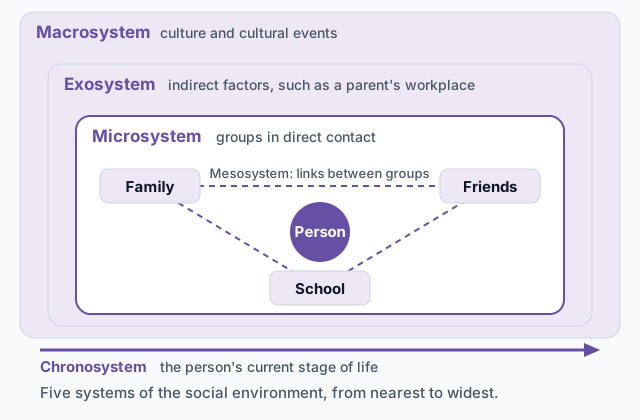
Parents are only part of a child's world. Urie Bronfenbrenner's ecological systems theory describes five systems in the social environment:
- Microsystem: groups in direct contact with the person, such as family, classmates or a team.
- Mesosystem: the relationships between those groups, such as parents talking with a teacher.
- Exosystem: indirect factors, settings the person is not in that still affect them, such as a parent's job.
- Macrosystem: the culture, and cultural events, that affect the person and everyone around them.
- Chronosystem: the person's current stage of life.
Some experiences in these settings leave lasting marks. Adverse childhood experiences (ACEs) are harmful or threatening events in childhood, such as abuse, neglect or violence at home. They affect the relationships people form across the lifespan. What counts as an ACE, and how ACEs affect people, differs across cultures.
Quick check · Match
Kai is 12. Tap a system, then the part of Kai's life that belongs to it.
2c. Peers and identity
Developmental psychologists study how peer relationships change over time, and children's play shows the change early. Toddlers often play side by side with similar toys, each in their own game: parallel play. Soon children add pretend play, taking on roles together, such as running a pretend restaurant.
Adolescents gradually rely more on peers, for advice, support and a sense of who they are. Around peers they show a kind of egocentrism in two familiar forms. The imaginary audience is the feeling that everyone is watching and judging you: one bad haircut, and surely the whole school noticed. The personal fable is the belief that you are unique, that no one could understand what you feel, and that bad things happen to other people.
Adolescence is also when people work out who they will be as adults. Two questions sort four identity statuses: has the person explored the options, and have they committed to one?
- Achievement: explored, then committed.
- Moratorium: exploring now, not yet committed.
- Foreclosure: committed without exploring, such as taking on a parent's plan.
- Diffusion: neither exploring nor committed.
Identity has many parts, including racial and ethnic, gender, sexual orientation, religious, occupational and family identities. Teens build them partly by imagining possible selves: the people they hope to become, and the ones they fear becoming.
Quick check · Fill the statement
Tap a blank, then a term.
In a sandbox, two 2-year-olds each fill their own bucket side by side, paying no attention to each other. That is play. A year later the same two run a make-believe restaurant together, one cooking and one ordering, which is play. Their 14-year-old cousins would rather spend Saturday with friends than with family. One skips a party over a single pimple, sure that everyone there would stare at it, which shows the . Another rides a bike down a steep hill with no helmet, sure that crashes only happen to other people, which shows the . A third pictures herself as a future vet, and also as someone stuck in a job she hates. She is thinking about her .
2d. Adulthood and the stages of a life
Social development does not stop at 18. Culture decides when adulthood begins and when major life events are expected, such as leaving home, marrying, having children or retiring. That expected timing is the social clock. Some cultures allow a time of emerging adulthood, a transition when people are no longer adolescents but do not yet feel fully adult.
Adults form families or family-like relationships, such as a close circle of friends, that should provide mutual support and care. The attachment style a person had as a child can affect how they attach to partners and friends as an adult.
Erik Erikson's stage theory of psychosocial development covers the whole lifespan. At each stage a person must resolve a social conflict:
- Trust versus mistrust (infancy): can I count on the people caring for me?
- Autonomy versus shame and doubt (toddlerhood): can I do things myself?
- Initiative versus guilt (preschool): can I start plans and carry them out?
- Industry versus inferiority (school age): am I good at the things I do?
- Identity versus role confusion (adolescence): who am I?
- Intimacy versus isolation (young adulthood): can I form close, lasting relationships?
- Generativity versus stagnation (middle adulthood): am I contributing to the next generation?
- Integrity versus despair (late adulthood): was my life worth living?
Quick check · Match
Tap a term, then the person who shows it.
Part 3 Watch it done Naming an identity status, one question at a time
Watch each step, then do the last one yourself.
Lucia, 17, has said she would be a nurse since she was small, because her mother and grandmother are nurses. She has never looked into any other career, and she has already chosen a nursing program. Which identity status describes her career identity?
Step 1 · Ask whether she has explored
She has never looked into another career. Taking on a family plan without trying out other options is not exploring, so the answer is no.
Step 2 · Ask whether she has committed
She has chosen a program and talks about nursing as settled, so the answer is yes.
Why this step?
Why ask about exploring and committing separately, instead of asking whether she seems sure of herself?
Because two statuses involve a firm commitment. A teen who explored first and a teen who never explored can sound equally sure. Only the exploring question tells them apart.
Your step · Decide and justify
Finish the classification. Lucia, 17, has said she would be a nurse since she was small, because her mother and grandmother are nurses. She has never looked into another career and has already chosen a nursing program. Which identity status describes her career identity?
Which reason supports your answer?
Part 4 Try it Read a study: does parenting style mean the same thing everywhere?
Illustrative study (made up for practice, not a published study). Researchers surveyed 600 high school students, 300 from each of two communities with different cultural traditions. Students answered questions about their parents' rules and warmth, and the researchers used the answers to classify each family's parenting style. Students also completed a school engagement scale scored from 1 to 10. In Community 1, the difference between teens with authoritative and authoritarian parents was statistically significant. In Community 2, it was not.
| Parenting style | Community 1 | Community 2 |
|---|---|---|
| Authoritative | 7.8 | 7.4 |
| Authoritarian | 5.9 | 7.3 |
| Permissive | 6.1 | 5.8 |
Try it · Sort it
Here is what five parents might say about rules. Tap a parent, then the parenting style the words show.
Authoritarian
Authoritative
Permissive
Try it · Multiple choice
In the illustrative study, researchers surveyed teens about their parents' rules and warmth, classified each family's parenting style, and compared school engagement scores across styles. Which research method did they use?
Try it · Decide and justify
In the illustrative study, teens with authoritative parents had mean engagement scores of 7.8 in Community 1 and 7.4 in Community 2, and teens with authoritarian parents had 5.9 and 7.3. The gap was statistically significant in Community 1 but not in Community 2. A reader concludes that in every culture, teens with authoritarian parents are less engaged than teens with authoritative parents. Do the data support that conclusion?
Which reason supports your answer?
Part 5 Explain it Write it the way the exam asks
Nothing you type leaves this page.
Free response is 33.3% of the exam score. This one is shaped like Question 2, Evidence-Based Question.
Free-response practice · Question 2 style
Illustrative sources (made up for practice, not published studies). Read all three sources, then answer.
Source 1. Researchers observed 120 one-year-olds with a parent in the Strange Situation and classified each child as securely or insecurely attached. Twenty years later, the same participants completed a questionnaire measuring how much they trust a romantic partner, scored from 1 to 10. Those classified as securely attached as infants scored a mean of 7.6, and those classified as insecurely attached scored 5.9. The difference was statistically significant.
Source 2. Researchers observed 90 families when the children were 10 and classified each parent's style as authoritative (clear rules that are explained, with warmth) or authoritarian (strict rules, little warmth or explanation). Fifteen years later, each participant kept a two-week diary of disagreements with a romantic partner, noting whether each one ended with both partners agreeing it was settled. Those raised by authoritative parents settled a mean of 70% of their disagreements, and those raised by authoritarian parents settled 52%. The difference was statistically significant.
Source 3. Researchers followed 70 adults who had been classified as insecurely attached as infants. Those who reported a close, lasting friendship during adolescence scored a mean of 7.2 on a measure of trust in a romantic partner, and those who did not scored 5.8. The difference was statistically significant.
Using the sources, develop and justify an argument about whether the relationships people have earlier in life relate to the close relationships they form as adults.
(A) Propose a specific and defensible claim based in psychological science that responds to the question.
(B) (i) Support your claim using at least one piece of specific and relevant evidence from one of the sources. Cite the source, for example (Source 1).
(ii) Explain how the evidence from (B)(i) supports your claim using a psychological perspective, theory, concept or research finding learned in AP Psychology.
(C) (i) Support your claim using an additional piece of specific and relevant evidence from a different source than the one you used in (B)(i). Cite the source.
(ii) Explain how the evidence from (C)(i) supports your claim using a different psychological perspective, theory, concept or research finding than the one you used in (B)(ii).
Model answer
(A) People whose earlier relationships were warm and secure tend to form more trusting, better-functioning close relationships as adults.
(B) (i) Adults who had been securely attached as one-year-olds scored 7.6 on trust in a romantic partner, against 5.9 for those who had been insecurely attached (Source 1).
(ii) Attachment style is the pattern of a child's first bond with a caregiver, and a securely attached child has learned that a close person can be counted on for comfort. Childhood attachment styles can affect how adults attach to other adults, so the securely attached infants grew into adults who trusted their partners more, which supports the claim.
(C) (i) Adults raised by authoritative parents settled 70% of their disagreements with a partner, against 52% for those raised by authoritarian parents (Source 2).
(ii) Parenting style is how much a parent pairs rules with warmth. Authoritative parents explain their rules and talk them over, so their children grow up practicing how to work out a disagreement with someone close. Those children grew into adults who settled more disagreements with their partners, which supports the claim that warmer, more open earlier relationships go with better adult ones.
Score your own answer. This is a self-check, not a grade. Tick each point your answer makes.
Part 6 Check yourself Read the survey, then judge the claims
On the exam, some multiple-choice questions share one set of data, the way these do.
Illustrative data (made up for practice). Researchers surveyed 800 adults, 400 in each of two countries. Each adult completed a checklist of adverse childhood experiences (ACEs) written for their own country, and said whether they have at least one close, supportive relationship now. Country Y's checklist leaves out two events that Country X's checklist counts, because people in Country Y do not regard those events as harmful.
| ACEs reported | Country X | Country Y |
|---|---|---|
| None | 86% | 84% |
| 1 or 2 | 78% | 80% |
| 3 or more | 61% | 72% |
Case question 1 · Decide and justify
In an illustrative survey of 800 adults in two countries, adults who reported three or more adverse childhood experiences (ACEs) were less likely than adults who reported none to have a close, supportive relationship now. A news story says the survey proves that ACEs cause adults to form fewer close relationships. Does the survey support that claim?
Which reason supports your answer?
Case question 2 · Calculate
In an illustrative survey, the percent of adults with a close, supportive relationship was 86% for those with no ACEs and 61% for those with three or more in Country X, and 84% and 72% in Country Y. In each country, find how many percentage points lower the three-or-more group is than the no-ACE group. How many points larger is Country X's gap than Country Y's?
Case question 3 · Decide and justify
In an illustrative survey of adults in two countries, Country Y's checklist of adverse childhood experiences (ACEs) left out two events that Country X's checklist counts, because people in Country Y do not regard those events as harmful. A classmate says the two countries' ACE counts should not be treated as measuring exactly the same thing. Is the classmate right?
Which reason supports your answer?
The rest stand on their own and do not use the case.
Check yourself · Spot the error
A student summarizes research on attachment. Tap the first line that goes wrong.
Check yourself · Multiple choice
As a one-year-old, Ellis showed insecure avoidant attachment: he showed little distress when his mother left and ignored her when she came back. Which adult pattern is most consistent with research on how childhood attachment affects adult relationships?
Part 7 Keep it Bring back earlier ideas
Coming back to older ideas is how they stay usable on the exam.
Bring it back · Fill the statement
Tap a blank, then a term.
Mia can almost solve two-digit subtraction problems on her own, and with a little help she gets them right. That makes the skill part of her . Her tutor gives hints at first and then gradually stops helping as Mia improves, a kind of support called .
Bring it back · Decide and justify
Ana and Ben each study the same vocabulary list for 60 minutes in all. Ana studies for 60 minutes the night before the quiz. Ben studies for 15 minutes on each of the four days before it. Who is likely to remember more of the list a month later?
Which reason supports your answer?
In three lines
- Attachment rests on comfort more than food, is shown most clearly at a reunion, and comes in secure and insecure (avoidant, anxious, disorganized) styles.
- Parenting styles, the five ecological systems and adverse childhood experiences all shape development, and culture changes how each one plays out.
- Peers and identity take center stage in adolescence, and Erikson's eight psychosocial stages carry social development through old age.
Vocabulary
- Ecological systems theory
- A theory of how the social environment influences development, through five systems: the microsystem, mesosystem, exosystem, macrosystem and chronosystem.
- Microsystem and mesosystem
- The groups that have direct contact with the individual, and the relationships between those groups.
- Exosystem, macrosystem and chronosystem
- Indirect factors in an individual's life, the cultural events that affect the individual and others around them, and the individual's current stage of life.
- Parenting styles
- Patterns of caregiving, including authoritarian, authoritative and permissive, whose effects on outcomes differ across cultures.
- Attachment styles
- Patterns of bonding with caregivers shown by infants and children: secure, or insecure (avoidant, anxious or disorganized).
- Temperament
- A child's inborn style of reacting, which is related to how the child attaches to caregivers.
- Separation anxiety
- Heightened anxiety or fear a child shows when away from a caregiver or in the presence of a stranger.
- Parallel and pretend play
- Playing side by side without interacting, and acting out imagined roles with others.
- Imaginary audience
- An adolescent's sense that others are constantly watching and judging them, a form of adolescent egocentrism.
- Personal fable
- An adolescent's belief that they are unique and that bad things happen only to others, a form of adolescent egocentrism.
- Social clock
- A culture's expected timing for when adulthood begins and when major life events occur.
- Emerging adulthood
- A time some cultures allow as a transition from adolescence to adulthood.
- Psychosocial stages
- Erikson's eight stages of the lifespan, at each of which a person must resolve a psychosocial conflict, from trust versus mistrust to integrity versus despair.
- Adverse childhood experiences (ACEs)
- Harmful or threatening events in childhood that affect the relationships people form throughout the lifespan.
- Identity statuses
- Achievement, moratorium, foreclosure and diffusion: the ways adolescents develop a sense of who they will be as adults, sorted by exploring and committing.
- Possible selves
- The people a person imagines they might become, or fear becoming, which help them form an identity.
Course alignment, for teachers
AP Psychology topic 3.6, Unit 3: Development and Learning.
- Skill 1.A: Apply psychological perspectives, theories, concepts, and research findings to a scenario.
- Skill 2.A: Determine the type of research design(s) used in a given study.
- Skill 2.B: Evaluate the appropriate use of research design elements in experimental methodology.
This lesson maps all 14 essential knowledge statements of the topic to the part that teaches each one: 14 are checked by a scored question. The map is in the lesson file.