Unit 3 · Topic 3.7 · about 30 minutes · 7 parts · 14 scored checks, 3 of them multiple choice
AP Psychology 3.7: Classical Conditioning
Unit 3: 15 to 25% of the multiple-choice section
 Tap to open the picture full size
Part 1 Think first Two words and a flinch
Guess before you learn. A wrong guess still makes the answer stick.
Predict first
For a month of allergy shots, Jordan's nurse always said "Okay, little pinch" right before the needle went in, and his shoulders tensed every time it did. A year later, a barber trimming the back of his neck jokes "Okay, little pinch," and Jordan's shoulders tense before anything touches him. What best explains the tensing?
In short. Classical conditioning is learning to associate one stimulus with another, so that a stimulus which once meant nothing comes to set off a response on its own.
- An unconditioned stimulus sets off a response with no learning; a neutral stimulus that comes just before it, usually over many pairings, becomes a conditioned stimulus.
- A conditioned response weakens when the conditioned stimulus keeps appearing alone, but the learning is not erased, and it can spread to similar stimuli.
- Emotions and taste aversions can be conditioned too, some pairings are learned far faster than others, and habituation is a fading response that needs no pairing.
Part 2 Learn it Four short ideas, each checked as you go
2a. One stimulus comes to signal another
Psychology's behavioral perspective grew out of research on learning by conditioning. Behaviorists study what an organism observably does, and they have traditionally left mental processes, such as thoughts and expectations, out of their explanations.
Ivan Pavlov was studying digestion in dogs when he noticed they began to drool before any food reached them. Food in the mouth makes a dog drool with no learning at all. Pavlov presented a neutral sound just before the food, many times over, and the dogs came to drool at the sound alone. That is classical conditioning: learning to associate one stimulus with another, so that the first comes to set off a response.
Four terms describe it:
- The unconditioned stimulus (UCS) sets off a response with no learning: the food.
- The unconditioned response (UCR) is that unlearned response: drooling at the food.
- The conditioned stimulus (CS) started out neutral and gets its power from the pairing: the sound.
- The conditioned response (CR) is the response the CS now sets off: drooling at the sound.
The UCR and the CR are often the same behavior. What separates them is what set the behavior off.
The stage when the pairing is learned is called acquisition, and the order of the pairing matters. Acquisition works when the CS comes first and so signals that the UCS is on its way.
Quick check · Sort it
Two examples. When Biscuit's family vacuums, they first open the hall closet, whose door squeaks. The roar of the vacuum makes Biscuit startle, and now he startles at the squeak alone. At Hill School, the principal always says "Attention, please" just before the loud fire-drill alarm, which makes students jump, and now students jump at "Attention, please" alone. Tap a card, then the part it plays.
Unconditioned stimulus (UCS)
Unconditioned response (UCR)
Conditioned stimulus (CS)
Conditioned response (CR)
2b. After the response is learned
A conditioned response does not stay fixed once it is learned.
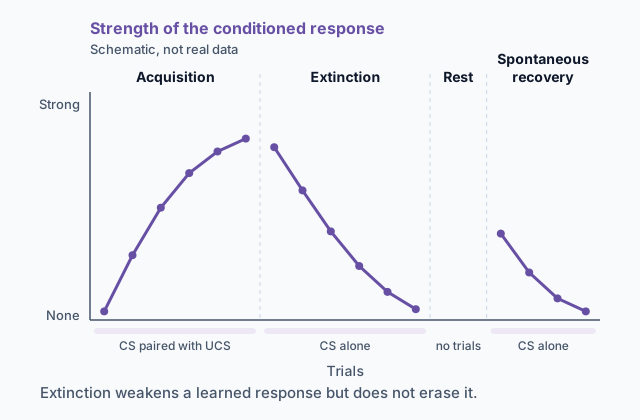
Extinction. When the CS keeps appearing without the UCS, the CR weakens and finally stops. Sound the tone again and again with no food, and the dog stops drooling at it.
Spontaneous recovery. Extinction does not erase the learning. After a rest, present the CS again and the extinct CR comes back, usually weaker than before. The dog whose drooling died out on Monday may drool a little at the tone on Tuesday morning.
Generalization. A CR can spread to stimuli similar to the CS. A dog conditioned to a high tone may also drool at a tone a little lower.
Discrimination. An organism can also learn to respond to the CS and not to similar stimuli, especially when those stimuli are never followed by the UCS. Pair a high tone with food and a low tone with nothing, and the dog comes to drool at the high tone only.
Higher-order conditioning. A well-learned CS can act as a UCS for a new stimulus. Once the tone reliably brings drooling, flash a light just before the tone, with no food at all. The light comes to bring drooling too, because it now signals the tone.
Quick check · Match
Tap a term, then tap the example that shows it.
2c. Fears and food aversions
Conditioning reaches emotions as well as reflexes. In a famous study, John Watson and Rosalie Rayner showed a baby known as Little Albert a white rat, which he did not fear. They then showed him the rat and, as he reached out to touch it, struck a steel bar loudly behind his head. After several pairings, Albert cried and pulled away from the rat alone, and his fear spread to other furry things. The noise was the UCS, and fear of the rat was a CR. A study like this would not be allowed today, because it frightened a baby on purpose.
If a fear can be conditioned, it can be reconditioned. In counterconditioning, the CS that triggers an unwanted response is paired with a stimulus that brings a different response, one that cannot exist alongside the old one. For a fear, that means something calming or enjoyable. Therapists build treatments on this idea.
Get sick once after eating a new dish and you may avoid it for years, even if the illness came hours later and had nothing to do with the food. That is a taste aversion, and it shows two things. It is one-trial learning: one pairing is enough, and further pairings do not strengthen it. And it shows biological preparedness: animals are predisposed to learn some pairings much faster than others. Linking a taste with illness comes easily. Linking a sound or a light with illness does not.
Quick check · Multiple choice
Mateo tries clam chowder for the first time at a dinner where a new song he has never heard is playing. That night he comes down with a stomach virus and is sick for a day. Years later, the smell of clam chowder makes him queasy, but the song does not. What best explains why the chowder, and not the song, became linked with being sick?
2d. A response that fades with no pairing at all
Not every response that fades is extinction. Habituation is a diminished response to a stimulus that is repeated or that goes on and on. The first time a phone buzzes on the desk beside you, you glance at it. By the twentieth buzz in a study session you hardly notice it.
Habituation needs no pairing at all. Nothing taught you that the buzz signals anything. You responded to the buzz itself, and the response shrank because the buzz kept coming.
Extinction is different. It needs a CS, a stimulus that was once paired with a UCS and is now appearing without it.
So when a response fades, ask one question. Was this stimulus ever paired with a UCS, so that it became a CS? If it was, the fading CR is extinction. If it never was, the response was to the stimulus itself, and its fading is habituation.
Quick check · Decide and justify
Ana's family moves into a house beside a rail line. The first week, every passing train makes her jump. By the second month she barely looks up when one goes by. Her brother says her jumping has gone through extinction. Is he right?
Which reason supports your answer?
Part 3 Watch it done Taking apart a conditioned fear
Watch each step, then do the last one yourself.
Noah, age 7, was knocked to the ground by a large dog that barked as it ran at him, and he was terrified. Now the sound of barking alone, even from a TV, makes him cry and freeze. His parents want to use counterconditioning to help. Work out the conditioning, then choose a plan.
Step 1 · Find what caused fear with no learning
Being knocked down by a charging dog frightens a child with no learning needed. So being knocked down is the UCS, and Noah's terror at it is the UCR.
Step 2 · Find the signal and the learned response
The barking came just before he was knocked down. Before that day, barking did not upset him. Now barking alone makes him cry and freeze, so barking is the CS and that fear is the CR, a conditioned emotional response.
Why this step?
Why is the barking the CS and not the UCS?
Because its power to frighten Noah was learned. Barking did not upset him until it was paired with being knocked down, and a UCS sets off its response with no learning at all.
Your step · Decide and justify
Finish the plan. Barking now makes Noah cry and freeze, because barking came just before a dog knocked him down. His parents want to use counterconditioning. Which plan is counterconditioning?
Which reason supports your answer?
Part 4 Try it Read a study: does a learned blink spread to new tones?
Illustrative study (made up for practice, not a published study). Researchers sat 24 adult volunteers in front of a speaker. A 1,000 Hz tone sounded, and half a second later a gentle puff of air hit one eye, which makes anyone blink. After 50 of these pairings, the puffs stopped. The researchers then played four tones on their own, 10 times each in random order: the 1,000 Hz tone and three higher tones that had never been paired with anything. A blink within half a second of a tone counted as a response. A statistical test showed that blinking differed significantly across the four tones.
| Tone | Paired with the puff? | Percent of tones followed by a blink |
|---|---|---|
| 1,000 Hz | Yes | 82 |
| 1,200 Hz | No | 61 |
| 1,500 Hz | No | 30 |
| 2,000 Hz | No | 9 |
Try it · Fill the statement
Tap a blank, then a term.
In a study where a 1,000 Hz tone was sounded just before a puff of air to the eye, the puff of air is the , and a blink to the 1,000 Hz tone on its own is the . Blinks to a 1,200 Hz tone, which was never paired with the puff, show .
Try it · Decide and justify
In an illustrative study, a 1,000 Hz tone was paired with a puff of air to the eye. Tested with tones alone, volunteers blinked after 82% of 1,000 Hz tones, and after 61%, 30% and 9% of 1,200, 1,500 and 2,000 Hz tones, which had never been paired with the puff. A statistical test showed blinking differed significantly across the tones. A classmate says the results show generalization and no discrimination at all. Is the classmate right?
Which reason supports your answer?
Part 5 Explain it Answer an article analysis question
Nothing you type leaves this page.
Free response is 33.3% of the exam score. This one is shaped like Question 1, Article Analysis Question.
Free-response practice · Question 1 style
Illustrative study (made up for practice, not a published study). Researchers wanted to know whether pairing a brand with pleasant images changes how much people like the brand. They recruited 80 students at one university and told them the study was about attention to photos. A coin flip put each student in one of two groups. Both groups watched a slideshow in which the logo of a made-up sports drink appeared 10 times. In the pleasant group, each time the logo appeared it was followed a second later by a pleasant photo, such as a puppy or a beach at sunset. In the neutral group, the logo was followed by a neutral photo, such as a stapler or a gray wall. Afterward, every student rated how much they liked the logo on a scale from 1 (dislike it a lot) to 7 (like it a lot). The pleasant group's mean rating was 5.4 and the neutral group's was 4.1, and a statistical test showed the difference was statistically significant. At the end, the researchers told every student the real purpose of the study.
(A) Identify the research method used in this study.
(B) State the operational definition of liking for the brand in this study.
(C) Identify one ethical guideline described in the study. Describe one way the researchers applied it.
(D) Explain how the results support the idea that emotional responses can be classically conditioned.
Model answer
(A) This is an experiment, because a coin flip assigned each student at random to the pleasant group or the neutral group.
(B) Liking was measured as each student's rating of the logo on the 1 to 7 scale.
(C) Debriefing. The students were told the study was about attention to photos, so at the end the researchers told every student the study's real purpose.
(D) The pleasant photos were an unconditioned stimulus, because they bring pleasant feelings with no learning. The logo came just before them again and again, so it became a conditioned stimulus, and liking the logo became a conditioned emotional response. The pleasant group rated the logo 5.4 against 4.1 for the neutral group, a statistically significant difference, so pairing the logo with pleasant photos made people like it more, which is what classical conditioning of emotion predicts.
Score your own answer. This is a self-check, not a grade. Tick each point your answer makes.
Part 6 Check yourself Read a taste aversion study
On the exam, some multiple-choice questions share one set of data, the way these do.
Illustrative study (made up for practice, not a published study). Researchers assigned 36 thirsty rats at random to three groups of 12. Each rat drank once from a water bottle. For Groups 1 and 3 the water was sweet. For Group 2 the water was plain, but each lick made a light flash and a click sound. An hour after drinking, rats in Groups 1 and 2 got an injection that made them ill for a short time, and rats in Group 3 got a harmless injection. Two days later, each rat was offered the same water it had drunk before, with the light and click again for Group 2, and the researchers measured how much it drank in 10 minutes. Group 1 drank significantly less than each of the other groups. Groups 2 and 3 did not differ significantly.
| Group | Water during training | Injection an hour later | Mean mL drunk on test day |
|---|---|---|---|
| 1 | Sweet | Causes brief illness | 3.1 |
| 2 | Plain, with light and click | Causes brief illness | 13.8 |
| 3 | Sweet | Harmless | 14.6 |
Case question 1 · Multiple choice
In an illustrative study, rats drank once and an hour later got an injection. Group 1 drank sweet water and got an injection that made them briefly ill. Group 2 drank plain water with a light and a click and got the same illness injection. Group 3 drank sweet water and got a harmless injection. Which comparison shows that pairing the sweet taste with illness, and not the sweet taste itself, cut how much the rats later drank?
Case question 2 · Decide and justify
In an illustrative study, rats drank once and were made briefly ill an hour later. Rats whose water was sweet later drank a mean of 3.1 mL of it. Rats whose plain water came with a flashing light and a click drank 13.8 mL. Rats given sweet water and a harmless injection drank 14.6 mL, which did not differ significantly from 13.8. The researchers conclude that rats link a taste with illness more readily than they link a light and a click with illness. Does the light-and-click group's result support this conclusion?
Which reason supports your answer?
Case question 3 · Fill the statement
Tap a blank, then a term.
Rats drank sweet water once, and an hour later got an injection that made them briefly ill. Two days later they barely drank the sweet water. The sweet taste is the , and the injection is the . Avoiding the water after a single pairing shows .
The rest stand on their own and do not use the case.
Check yourself · Spot the error
A student writes a plan to condition her dog to drool at the sound of a bell. Tap the first line that goes wrong.
Check yourself · Sort it
A researcher with a traditional behaviorist view is planning a study of a dog's conditioned fear of a tone. Tap each possible measure, then tap whether that researcher would use it.
Observable behavior to measure
Mental process to leave out
Part 7 Keep it Bring back earlier ideas
Coming back to older ideas is how they stay usable on the exam.
Bring it back · Sort it
Tap each example, then tap the kind of memory retrieval it shows.
Context-dependent memory
Mood-congruent memory
State-dependent memory
Bring it back · Multiple choice
A car horn blares behind Priya as she crosses a parking lot. Her heart pounds, her breathing speeds up and her pupils widen. Which part of the peripheral nervous system produces these involuntary changes?
In three lines
- In classical conditioning a neutral stimulus that comes just before a UCS becomes a CS, and the response it sets off is the CR.
- Extinction weakens a CR without erasing it, as spontaneous recovery shows; a CR can generalize, narrow by discrimination, or be passed on in higher-order conditioning.
- Emotions and taste aversions are conditioned too, some pairings come far more easily than others, and habituation is a fading response that needs no pairing.
Vocabulary
- Behavioral perspective
- The view that grew from research on learning by conditioning, which has traditionally focused on observable behavior to the exclusion of mental processes.
- Classical conditioning
- Learning to associate one stimulus with another stimulus, so that the first comes to elicit a response.
- Acquisition
- The stage in which the association between the conditioned stimulus and the unconditioned stimulus is learned.
- Unconditioned stimulus (UCS) and unconditioned response (UCR)
- A stimulus that elicits a response with no learning, and that unlearned response.
- Conditioned stimulus (CS) and conditioned response (CR)
- A once-neutral stimulus that elicits a response after being paired with the UCS, and the response it now elicits.
- Extinction
- The weakening and disappearance of a conditioned response when the CS is no longer paired with the UCS.
- Spontaneous recovery
- The return of an extinct conditioned response when the CS is presented again after extinction.
- Stimulus generalization and discrimination
- Responding to stimuli similar to the CS, or responding to the CS and not to similar stimuli.
- Higher-order conditioning
- Using a learned CS as the UCS for conditioning a new stimulus.
- Counterconditioning
- Pairing a CS with a stimulus that brings a response incompatible with the old one, used in therapy to replace unwanted emotional responses.
- Taste aversion
- A learned avoidance of a taste that was followed by illness, acquired through classical conditioning.
- One-trial learning
- An association acquired through one pairing of the stimulus and response, and not strengthened by further pairings.
- Biological preparedness
- The way animals are biologically predisposed to learn certain stimulus and response pairings more quickly than others.
- Habituation
- A diminished response to a repeated or enduring stimulus.
Course alignment, for teachers
AP Psychology topic 3.7, Unit 3: Development and Learning.
- Skill 1.A: Apply psychological perspectives, theories, concepts, and research findings to a scenario.
- Skill 2.D: Evaluate whether a psychological research scenario followed appropriate ethical procedures.
- Skill 3.A: Identify psychology-related concepts in descriptions or representations of data.
This lesson maps all 10 essential knowledge statements of the topic to the part that teaches each one: 10 are checked by a scored question. The map is in the lesson file.