Unit 3 · Topic 3.8 · about 30 minutes · 7 parts · 14 scored checks, 3 of them multiple choice
AP Psychology 3.8: Operant Conditioning
Unit 3: 15 to 25% of the multiple-choice section
 Tap to open the picture full size
Part 1 Think first Two machines stop paying
Guess before you learn. A wrong guess still makes the answer stick.
Predict first
Two machines in the same hallway break on the same night, and neither pays out again. Jordan uses the snack machine, which has dropped a snack every single time he paid. Riley plays the claw game, which has paid out a prize after an unpredictable number of plays. Who keeps putting money in longer after the payouts stop?
In short. Operant conditioning is learning to link a behavior with the consequence that follows it, so that reinforced behavior becomes more likely and punished behavior becomes less likely.
- Positive means something is added and negative means something is taken away; reinforcement raises a behavior and punishment lowers it.
- Shaping builds a new behavior by reinforcing each small step closer to it.
- A reinforcement schedule sets which responses earn reinforcement, by count or by time, fixed or varying, and each one leaves its own pattern on a graph.
Part 2 Learn it Four short ideas, each checked as you go
2a. Consequences change what you do
In classical conditioning (3.7) you learned to link two stimuli, and the response came on its own. Operant conditioning is learning to link a behavior with its consequence. You act first, something happens because of it, and that changes how likely you are to act that way again.
The rule is called the Law of Effect: behaviors followed by reinforcing consequences are more likely to be repeated, and behaviors followed by punishing consequences are less likely to be repeated. Reinforcement is any consequence that makes a behavior more likely. Punishment is any consequence that makes it less likely. Both are defined by what happens to the behavior afterward, not by whether the consequence feels pleasant.
Some reinforcers work with no learning at all, because they meet a biological need: food when you are hungry, water when you are thirsty. These are primary reinforcers. Others work only because they have been linked with something else, like money, grades, points in a game or a coach's praise. These are secondary reinforcers.
Quick check · Fill the statement
Tap a blank, then tap a word.
A hungry dog sits on command and gets a piece of chicken. The chicken is a reinforcer, because it meets a biological need. Later, the dog's owner pays a dog walker in cash, which works as a reinforcer for the walker. By the Law of Effect, the dog's sitting becomes likely.
2b. Positive and negative: added or taken away
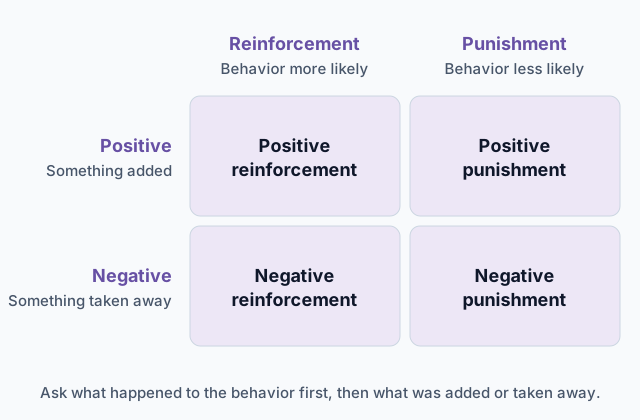
Here, positive and negative have nothing to do with good or bad. Read them as signs. Positive means something is added after the behavior. Negative means something is taken away. Cross that with reinforcement (the behavior increases) and punishment (the behavior decreases) and you get four kinds of consequence:
- Positive reinforcement: something is added, and the behavior increases. A server earns bigger tips after remembering regulars' names, so she keeps doing it.
- Negative reinforcement: something unpleasant is taken away, and the behavior increases. You take a pain reliever and your headache fades, so next time you reach for one sooner.
- Positive punishment: something unpleasant is added, and the behavior decreases. A driver gets a speeding ticket and slows down on that road.
- Negative punishment: something wanted is taken away, and the behavior decreases. A teen misses curfew, loses the car for a week, and comes home on time after that.
To classify an example, ask two questions in this order. Did the behavior become more likely or less likely? Then, was something added or taken away?
Quick check · Sort it
Tap an example, then tap the kind of consequence it shows.
Positive reinforcement
Negative reinforcement
Positive punishment
Negative punishment
2c. Building, spreading and breaking behavior
A complex behavior rarely happens on its own, so at first there is nothing to reinforce. Shaping solves that by reinforcing successive approximations, each one a little closer to the target. To teach a dog to ring a bell, a trainer rewards looking at the bell, then walking to it, then touching it, then ringing it.
Shaping has limits. Animal trainers have found that animals reinforced with food can slide back toward instinctive behavior: raccoons trained to drop coins in a box began rubbing the coins together, the way they handle food. This is instinctive drift, and it is why only some behaviors can be shaped.
A reinforced behavior can also spread or narrow. In generalization it spreads to similar situations: a child praised for saying please at home says it at a friend's house too. In discrimination it narrows to where it was reinforced: a dog begs at the dinner table, where it gets scraps, but not at the kitchen counter, where it never does.
Two patterns come from consequences that are not really tied to the behavior. Superstitious behavior forms when a reinforcer happens to follow an unrelated act. Learned helplessness forms when an organism learns it cannot control an unpleasant outcome, and it stops trying even after control becomes possible.
Quick check · Match
Tap a term, then tap the example that shows it.
2d. Schedules of reinforcement
How often a behavior is reinforced matters as much as whether it is. With continuous reinforcement, every correct response is reinforced. Learning is fastest this way, but the behavior also stops fastest once reinforcement ends. With partial reinforcement, only some responses are reinforced. Learning is slower, and the behavior lasts much longer after reinforcement stops.
Partial schedules come in four kinds. Ask two questions: is reinforcement based on the number of responses (ratio) or on time passing (interval), and is that number or time fixed or variable?
- Fixed ratio: after a set number of responses. A coffee card gives a free drink after every tenth purchase.
- Variable ratio: after an unpredictable number of responses. A slot machine pays on some pulls, and you never know which.
- Fixed interval: the first response after a set time. Checking for mail that always comes at 2 p.m.
- Variable interval: the first response after an unpredictable time. Checking for a reply from a friend who answers whenever she gets around to it.
Each schedule leaves a pattern on a graph of total responses over time. Ratio schedules give high, steady rates, with a short pause after each reinforcer on a fixed ratio. A variable interval gives a slower, steady rate. A fixed interval gives a scalloped graph: little responding just after a reinforcer, then faster and faster responding as the next one comes due.
Quick check · Multiple choice
A shopping app restocks every Monday at 9 a.m. The first time a user opens the app after each restock, a new deal is waiting. Which schedule reinforces opening the app?
Part 3 Watch it done Classifying a consequence, one question at a time
Watch each step, then do the last one yourself.
Every school morning, Maya's alarm beeps until she gets out of bed and switches it off. Over the year she gets up faster and faster once it starts. What kind of consequence keeps her getting up?
Step 1 · Find the behavior and its consequence
The behavior is getting out of bed and switching off the alarm. The consequence is what happens right after it: the beeping stops.
Step 2 · Ask what happened to the behavior
She gets up faster and faster, so the behavior became more likely. That makes the consequence reinforcement, however annoying the beeping is.
Why this step?
Why decide reinforcement or punishment before deciding positive or negative?
Because what happens to the behavior is the definition. Students who start from how a consequence feels see an unpleasant beep and jump to punishment, even though the behavior is increasing.
Your step · Decide and justify
Finish the classification. Every school morning, Maya's alarm beeps until she gets out of bed and switches it off, and over the year she gets up faster once it starts. What kind of consequence keeps her getting up?
Which reason supports your answer?
Part 4 Try it Read a study: does the schedule change how long behavior lasts?
Illustrative study (made up for practice, not a published study). A researcher recruits 40 college students to play a computer game in which clicking a target can earn points. A coin flip puts each student in one of two groups. In the every-click group, every click on the target earns a point. In the some-clicks group, a click earns a point after an unpredictable number of clicks, four on average. After ten minutes the game quietly stops giving points to everyone, and the researcher counts how many more times each student clicks before going 30 seconds without a click.
| Group | Students | Mean clicks after points stopped |
|---|---|---|
| Every click earns a point | 20 | 23 |
| Some clicks earn a point | 20 | 61 |
Try it · Fill the statement
Tap a blank, then a schedule.
In a points game, students in the every-click group earn a point for every click, which is a schedule. Students in the some-clicks group earn a point after an unpredictable number of clicks, which is a schedule.
Try it · Decide and justify
In an illustrative study, 40 college students played a clicking game and a coin flip put each one in one of two groups. One group earned a point for every click and the other earned points after an unpredictable number of clicks. When the points stopped, the second group clicked 61 more times on average and the first group 23, and a statistical test showed the difference was statistically significant. Can the researcher conclude that the schedule caused the difference?
Which reason supports your answer?
Part 5 Explain it Write it the way the exam asks
Nothing you type leaves this page.
Free response is 33.3% of the exam score. This one is shaped like Question 1, Article Analysis Question.
Free-response practice · Question 1 style
Illustrative study (made up for practice, not a published study). Researchers wanted to know whether earning points makes students read more. They recruited 120 ninth graders from one high school. Half, chosen at random, earned points in a reading app for every 20 minutes of reading they logged, and could trade the points for items at the school store. The other half used the same app with no points. Over four weeks, the points group logged a mean of 5.2 hours of reading and the no-points group a mean of 3.1 hours.
(A) Identify the research method used in this study.
(B) State the operational definition of reading in this study.
(C) Explain whether the results can be generalized to all high school students.
(D) Explain how the results support the Law of Effect.
Model answer
(A) This is an experiment, because the researchers assigned students at random to earn points or not. (B) Reading was measured as the number of hours of reading each student logged in the app. (C) The results may not generalize to all high school students, because every participant was a ninth grader at one school, and students in other grades or schools could respond to points differently. (D) The points were a secondary reinforcer that followed each 20 minutes of logged reading, and the group that earned them logged more reading, 5.2 hours against 3.1. Logging reading was the behavior that was reinforced, and it became more likely, which is what the Law of Effect predicts.
Score your own answer. This is a self-check, not a grade. Tick each point your answer makes.
Part 6 Check yourself Read the pattern, name the schedule
On the exam, some multiple-choice questions share one set of data, the way these do.
Illustrative data (made up for practice). Three pigeons each peck a key for food on a different reinforcement schedule. For each pigeon, the table shows the mean number of pecks in each 15-second stretch after it receives food.
| Pigeon | 0 to 15 s | 15 to 30 s | 30 to 45 s | 45 to 60 s |
|---|---|---|---|---|
| A | 1 | 3 | 9 | 21 |
| B | 14 | 15 | 13 | 14 |
| C | 0 | 26 | 27 | 25 |
Case question 1 · Multiple choice
In a table of pecks per 15 seconds after food, Pigeon A pecks 1, 3, 9 and 21 times in successive stretches. Which schedule best explains Pigeon A's pattern?
Case question 2 · Calculate
In a table of pecks per 15 seconds after food, Pigeon B pecks 14, 15, 13 and 14 times in the four stretches. What is Pigeon B's mean number of pecks per 15-second stretch?
Case question 3 · Decide and justify
In a table of pecks per 15 seconds after food, Pigeon C pecks 0 times in the first stretch, then 26, 27 and 25. A classmate says Pigeon C must be on a variable-ratio schedule. Is the classmate right?
Which reason supports your answer?
The rest stand on their own and do not use the case.
Check yourself · Put it in order
A trainer uses shaping to teach a parrot to say "hello." Tap the behaviors in the order the trainer reinforces them.
Check yourself · Spot the error
Whenever Sam cleans his room, his parents stop nagging him, and now Sam cleans his room more often. A student classifies this example. Tap the first line that goes wrong.
Part 7 Keep it Bring back earlier ideas
Coming back to older ideas is how they stay usable on the exam.
Bring it back · Multiple choice
Every evening a family's dog hears the pantry door creak just before it is fed, and it drools when the food arrives. After a few weeks, the dog drools at the creak alone. In this example, the creak of the pantry door is the
Bring it back · Fill the statement
Tap a blank, then a word.
Ana changed her locker combination in January, and now she cannot recall her old one, because the new learning gets in the way of the old memory. That is interference. Her brother keeps typing his old passcode into his new phone, because the old learning gets in the way of the new. That is interference.
In three lines
- Reinforcement makes a behavior more likely and punishment makes it less likely; positive adds something and negative takes something away.
- Shaping builds a behavior step by step, though instinct can pull trained behavior back, and consequences outside the learner's control can teach superstition or helplessness.
- Ratio schedules count responses and interval schedules count time; partial reinforcement makes a behavior last longer than continuous reinforcement does.
Vocabulary
- Operant conditioning
- Learning to link a behavior with the consequence that follows it.
- Law of Effect
- Behaviors with reinforcing consequences are more likely to be repeated, and behaviors with punishing consequences are less likely to be repeated.
- Reinforcement
- A consequence that makes the behavior before it more likely.
- Punishment
- A consequence that makes the behavior before it less likely.
- Positive and negative
- Whether something is added (positive) or taken away (negative) after a behavior.
- Primary reinforcer
- A reinforcer that works without learning because it meets a biological need, such as food or water.
- Secondary reinforcer
- A reinforcer that works because it has been linked with something else, such as money or grades.
- Discrimination and generalization
- A reinforced behavior narrowing to the situation where it was reinforced, or spreading to similar ones.
- Shaping
- Building a behavior by reinforcing successive approximations, each a little closer to the target.
- Instinctive drift
- A trained animal sliding back toward instinctive behavior, which limits what can be shaped.
- Superstitious behavior
- A behavior reinforced by a consequence that only happened to follow it.
- Learned helplessness
- Giving up after learning that you have no control over an unpleasant outcome.
- Continuous and partial reinforcement
- Reinforcing every correct response, or only some of them.
- Fixed and variable ratio
- Reinforcement after a set, or an unpredictable, number of responses.
- Fixed and variable interval
- Reinforcement for the first response after a set, or an unpredictable, amount of time.
Course alignment, for teachers
AP Psychology topic 3.8, Unit 3: Development and Learning.
- Skill 1.A: Apply psychological perspectives, theories, concepts, and research findings to a scenario.
- Skill 3.A: Identify psychology-related concepts in descriptions or representations of data.
- Skill 3.B: Calculate and interpret measures of central tendency, variation, and percentile rank in a given data set.
- Skill 4.A: Propose a defensible claim.
This lesson maps all 7 essential knowledge statements of the topic to the part that teaches each one: 7 are checked by a scored question. The map is in the lesson file.