Unit 3 · Topic 3.9 · about 30 minutes · 7 parts · 12 scored checks, 4 of them multiple choice, plus 1 from earlier lessons
AP Psychology 3.9: Social, Cognitive, and Neurological Factors in Learning
Unit 3: 15 to 25% of the multiple-choice section
 Tap to open the picture full size
Part 1 Think first Two friends at the arcade
Guess before you learn. A wrong guess still makes the answer stick.
Predict first
Mia, who is 12, has never played the arcade basketball game. She watches her friend Ava, also 12, bank every shot off the backboard and win a big stuffed bear. Nobody has ever rewarded Mia for any kind of shot. Then it is Mia's turn. What is she most likely to do?
In short. Social and cognitive factors in learning are the ways people learn beyond being conditioned directly, by watching others, by solving problems in their heads, and by storing knowledge they do not use yet.
- Social learning theory holds that learning can come from observing a model and the consequences the model receives, and the more similar the model, the more likely the behavior is learned.
- Insight learning is a solution to a problem that arrives without any association, consequence or model being present.
- Latent learning happens without reinforcement and stays out of sight until there is a reason to use it, often in the form of a cognitive map.
Part 2 Learn it Four short ideas, each checked as you go
2a. Learning by watching
Classical and operant conditioning both need the learner to go through something: a pairing of stimuli, or a consequence of their own behavior. Social learning theory says you can also learn by watching. You see someone act, you see what happens to them, and your own behavior changes, though nothing happened to you. Learning from a consequence someone else receives is called vicarious conditioning. A new cashier who sees a coworker praised for staying late starts staying late too. A boy who sees his sister lose her phone for lying stops lying, without ever losing his own phone.
The person you learn from is a model, and you can learn simply by copying a model's behavior. The best known demonstration is Albert Bandura's Bobo doll study. Children watched an adult hit and kick an inflatable clown doll. Later, left alone with the doll, children who had seen the aggressive adult were more likely to attack it, often with the same moves. Nobody had rewarded them for hitting anything. In a later version, children who saw the adult punished copied less than children who saw the adult rewarded, which is vicarious conditioning at work.
Quick check · Sort it
Tap an example, then tap where the learning came from.
Watching someone else
A consequence of the learner's own behavior
2b. Which models get copied
You see hundreds of people act every day, and you copy very few of them. One factor stands out: the more similar a model is to you, the more likely you are to learn the behavior. Similar can mean age, gender, background, interests or simply being in the same situation. A ninth grader working out how to act at a new school watches other ninth graders far more closely than the principal.
A rough way to see why: what happens to someone like you is a decent guide to what would happen to you. If a student your age gets laughed at for raising her hand, that tells you more about your own odds than watching a teacher do the same thing.
Models do not have to be in the room. Characters in shows, players in videos and people on social media all serve as models, and the same rule applies to them. This cuts both ways. A similar model can teach a helpful habit, like a peer who studies before every test, just as easily as a harmful one.
Quick check · Decide and justify
Lucia, a 10-year-old girl, wants to learn a new jump rope trick. She watches two videos of the trick, performed equally well. In one, the jumper is a 10-year-old girl from her school. In the other, the jumper is a 35-year-old man she has never met. Neither jumper is praised or rewarded. Whose way of doing the trick is Lucia more likely to copy?
Which reason supports your answer?
2c. Insight: the solution that arrives
Some learning involves no model and no consequence at all. In insight learning, the solution to a problem comes without any association, consequence or model being present. You are stuck, nothing you have been taught points the way, and then you see the answer, often all at once and often after you have stopped trying.
Wolfgang Köhler described this in chimpanzees about a century ago. A chimp with bananas hung out of reach and a box in its enclosure would jump for the fruit, give up and sit, and then suddenly drag the box under the bananas and climb up, as if it had seen the whole solution in one go.
Compare that with operant learning. A rat pressing a lever gets a little better with each reinforced press, so the learning is gradual. An insight solution is closer to all or nothing: before it, you cannot solve the problem, and after it, you can, and you can do it again right away. What marks it as insight is what is absent. No reward built the solution step by step, no pairing taught it, and nobody showed how.
Quick check · Multiple choice
Nadia spends twenty minutes on a logic puzzle her teacher handed out, trying the same few approaches with no luck. Nobody has shown her how to solve it, and there is no grade or prize for it. That night, while she is brushing her teeth, the answer suddenly comes to her, and she writes it out without a mistake. Which kind of learning does this show?
2d. Latent learning and cognitive maps
Sometimes you learn something and it does not show. Latent learning happens without reinforcement and is not immediately evident; it stays out of sight until there is a reason to use it.
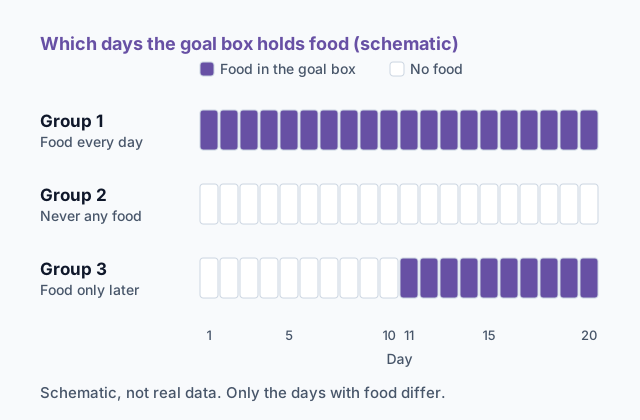
Edward Tolman showed this with rats in a maze. He compared three groups of rats in the same maze, like the ones in the picture at the top of this page: rats fed in the goal box every day, rats never fed there, and rats fed there only after many days without food. Before their food appeared, the rats in that last group made about as many wrong turns as rats that never found food at all, and far more than rats fed there every day. Once food was placed in the goal box, they were soon running the maze about as well as the rats fed from the start. They had been learning the maze all along. They just had no reason to show it.
Tolman said the rats had formed a cognitive map, a mental picture of the layout of a place. You carry cognitive maps of your school and your neighborhood. That is why you can take a new route when a hallway is blocked: you know the layout, and nobody had to reward you for each turn.
Latent means hidden. When behavior does not change, that does not prove nothing was learned. It may only mean the learner had no reason yet to use it.
Quick check · Fill the statement
Tap a blank, then tap a word.
Ellie rides her bike around a new neighborhood every weekend just for fun, never trying to get anywhere. A month later, a road on her way home is closed, and she takes side streets she has never ridden before and gets home without one wrong turn. She found her way by using a of the neighborhood. She learned its layout without reinforcement, and it did not show until she needed it, so this is learning.
Part 3 Watch it done Naming the kind of learning, one question at a time
Watch each step, then do the last one yourself.
Marco's family moves into a new apartment building. For three weeks he takes the stairs to the fourth floor and walks past the door to the laundry room every day, but he has never been inside it and has never seen anyone go in or out. Nobody gives him directions, and nothing he does on the stairs earns him anything. One evening his mother asks him to move the laundry to the dryer, and he walks straight to the laundry room without a wrong turn. What kind of learning explains this?
Step 1 · Name what was learned, where it came from, and when it showed
Marco learned where the laundry room is. He picked it up on his daily walks past the door. It did not show for three weeks. It showed the first evening he had a reason to go there.
Step 2 · Check for a model and for a consequence
Nobody showed him the way, and he never saw anyone use the room, so there was no model to copy. Nothing he did on the stairs was rewarded, so no consequence built the behavior.
Why this step?
Why ask where the knowledge came from, and not only when it showed?
Because a late answer fits both cognitive kinds. Latent learning was picked up earlier, here on three weeks of walks, and only shown later. Insight is a new solution worked out with no association, consequence or model, so there was nothing stored to show.
Your step · Decide and justify
Finish the classification. For three weeks Marco walks past the laundry room door in his new building every day, but he has never been inside and has never seen anyone use it, and nothing he does there is rewarded. When his mother asks him to move the laundry, he walks straight to the room without a wrong turn. What kind of learning explains this?
Which reason supports your answer?
Part 4 Try it Read a study: does it matter who the model is?
Illustrative study (made up for practice, not a published study). A researcher recruits 48 children, ages 5 and 6, from two preschools. A coin flip puts each child in one of two groups. Both groups watch a two-minute video of someone building a tower of blocks in an odd way: tapping each block twice on the table before stacking it. In one group's video the builder is a 6-year-old child. In the other group's video the builder is an adult. Nobody in either video is praised or rewarded, and no child is rewarded for anything. Each child is then left alone with the same blocks for five minutes while a camera records. A second researcher, who does not know which video each child saw, watches the recordings and notes whether the child tapped the blocks twice before stacking them. The difference between the groups was statistically significant.
| Video builder | Children | Children who tapped twice |
|---|---|---|
| A 6-year-old child | 24 | 17 |
| An adult | 24 | 8 |
Try it · Match
Tap a research term, then tap the part of the block-tower study that it names.
Try it · Multiple choice
In an illustrative study, a coin flip put 48 five- and six-year-olds into two groups. One group watched a 6-year-old build a block tower while tapping each block twice, and the other watched an adult do the same. No one was rewarded. Afterward, 17 of 24 children who saw the child builder tapped the blocks, compared with 8 of 24 who saw the adult, a statistically significant difference. Which conclusion does this study support?
Part 5 Explain it Write it the way the exam asks
Nothing you type leaves this page.
Free response is 33.3% of the exam score. This one is shaped like Question 2, Evidence-Based Question.
Free-response practice · Question 2 style
Read the three sources, then answer the question they share: can people learn without being reinforced for their own behavior? In parts B and C, cite the source you use, for example (Source 1).
Source 1. Illustrative study (made up for practice, not a published study). Researchers recruited 80 middle school students. A coin flip put half in a group that watched a three-minute video of a student their own age sorting lunch trash into recycling and compost bins and being thanked by a lunch aide. The other half watched a video of the same cafeteria with no one sorting. No student in either group was ever thanked or rewarded for sorting. A week later, observers who did not know the groups recorded each student's lunch: 23 of 40 students who saw the sorting video sorted their trash (58%), compared with 8 of 40 (20%) in the other group. The difference was statistically significant.
Source 2. Illustrative study (made up for practice, not a published study). Sixty college students were randomly assigned to explore a virtual town in a video game for 20 minutes with no task and no points, or to explore a different virtual town. Then both groups were placed in the first town and earned points for reaching the post office by the shortest route. Students who had explored that town made a mean of 2.1 wrong turns, and students who had explored the other town made a mean of 6.4. The difference was statistically significant.
Source 3. Illustrative study (made up for practice, not a published study). Forty adults worked alone on a matchstick puzzle for up to 15 minutes, with no hints, no examples and no feedback. Every 20 seconds they rated how close they felt to the solution from 1 (not close) to 10 (solved). Twenty-six people solved it. For most solvers, every rating up to and including the last one before the solution was 1 or 2, and the next rating was 10.
(A) Propose a specific and defensible claim, based in psychological science, that answers the question.
(B) (i) Support your claim using one piece of specific and relevant evidence from one of the sources. (ii) Explain how the evidence from part B (i) supports your claim, using a psychological perspective, theory, concept, or research finding.
(C) (i) Support your claim using a piece of specific and relevant evidence from a different source. (ii) Explain how the evidence from part C (i) supports your claim, using a different psychological perspective, theory, concept, or research finding from the one in part B (ii).
Model answer
(A) People can learn new behavior and new knowledge without ever being reinforced for their own behavior.
(B) (i) In Source 1, 58% of students who watched a peer being thanked for sorting trash sorted their own trash a week later, compared with 20% of students who saw no sorting, even though no student was ever thanked or rewarded for sorting. (ii) This is social learning. The students copied a model, a peer who was thanked for sorting, even though nobody ever rewarded them for it. Their sorting came from watching, not from any reinforcement of their own.
(C) (i) In Source 2, students who had explored the town with no task and no points made a mean of 2.1 wrong turns on the way to the post office, compared with 6.4 for students who had explored a different town. (ii) This is latent learning, a different concept from part B. While exploring, the students formed a cognitive map of the town without being reinforced, and that knowledge stayed hidden until the points gave them a reason to use it.
Score your own answer. This is a self-check, not a grade. Tick each point your answer makes.
Part 6 Check yourself Read the maze data
On the exam, some multiple-choice questions share one set of data, the way these do.
Illustrative data (made up for practice). A researcher randomly assigned 30 rats to two groups of 15. Rats in the explore group spent ten minutes a day for six days wandering a maze alone, with no food anywhere in it. Rats in the new group stayed in their home cages and never saw the maze. On day 7, food was placed in the goal box, and each rat ran the maze alone four times, each run ending when the rat reached the food. The table shows the mean number of wrong turns on each run. The difference between the groups on run 1 was not statistically significant; on runs 2, 3 and 4 it was.
| Group | Run 1 | Run 2 | Run 3 | Run 4 |
|---|---|---|---|---|
| Explore | 8 | 3 | 2 | 1 |
| New | 9 | 7 | 6 | 4 |
Case question 1 · Multiple choice
In a maze study, every rat ran a maze alone four times on day 7, finding food at the end of each run. Rats that had explored the maze for six days with no food made a mean of 8 wrong turns on run 1 and 3 on run 2. Rats new to the maze made 9 and then 7. The run 1 difference was not statistically significant, and the run 2 difference was. What best explains the explore rats' sharp drop from run 1 to run 2?
Case question 2 · Decide and justify
In a maze study, rats that had explored a maze for six days with no food made a mean of 8 wrong turns on their first run once food was added, while rats new to the maze made 9. On the next run the explore rats made 3 and the new rats 7. The run 1 difference was not statistically significant, and the run 2 difference was. A classmate looks only at the first run and says the six days of exploring taught the explore rats nothing. Is the classmate right?
Which reason supports your answer?
The rest stand on their own and do not use the case.
Check yourself · Spot the error
Ravi has been stuck on a riddle for a day. No one has hinted at the answer, he has not seen anyone solve it, and there is no prize for it. While he is shooting baskets, the answer suddenly comes to him. A student classifies this example. Tap the first line that goes wrong.
Check yourself · Fill the statement
Tap a blank, then tap a word.
A toddler watches her grandfather water his plants with a cup, then picks up her own cup and pours water into a flowerpot. Nobody rewards or punishes either of them. She learned by copying a , which is what learning theory predicts.
Part 7 Keep it Bring back earlier ideas
Coming back to older ideas is how they stay usable on the exam.
From 3.8 Operant Conditioning · Spot the error
Whenever Sam cleans his room, his parents stop nagging him, and now Sam cleans his room more often. A student classifies this example. Tap the first line that goes wrong.
Bring it back · Multiple choice
Lena needs to tighten a loose screw on her locker door and has no screwdriver. A coin sits in her pocket the whole time, but she never thinks of turning the screw with its edge, because to her a coin is only something you pay with. What is getting in the way of her solving the problem?
In three lines
- People can learn by watching a model and the consequences the model receives, and a more similar model is copied more.
- Insight learning is a solution that comes without any association, consequence or model being present.
- Latent learning is picked up without reinforcement and stays hidden, often as a cognitive map, until there is a reason to use it.
Vocabulary
- Social learning theory
- The theory that learning can occur by observation and does not have to involve personal experience with a consequence.
- Vicarious conditioning
- Learning from the consequences another person receives for a behavior, rather than from consequences of your own.
- Model
- A person whose behavior is observed and copied; the more similar a model is, the more likely the behavior is to be learned.
- Insight learning
- Learning in which the solution to a problem occurs without any association, consequence or model being present.
- Latent learning
- Learning that occurs without reinforcement but is not immediately evident.
- Cognitive map
- A mental picture of the layout of a place, often used to demonstrate latent learning.
Course alignment, for teachers
AP Psychology topic 3.9, Unit 3: Development and Learning.
- Skill 1.A: Apply psychological perspectives, theories, concepts, and research findings to a scenario.
- Skill 4.B: Provide reasoning that is grounded in scientifically derived evidence to support, refute, or modify an established or provided claim, policy, or norm.
This lesson maps all 3 essential knowledge statements of the topic to the part that teaches each one: 3 are checked by a scored question. The map is in the lesson file.