Unit 4 · Topic 4.7 · about 30 minutes · 7 parts · 15 scored checks, 4 of them multiple choice
AP Psychology 4.7: Emotion
Unit 4: 15 to 25% of the multiple-choice section
 Tap to open the picture full size
Part 1 Think first Same words, different evenings
Guess before you learn. A wrong guess still makes the answer stick.
Predict first
After a loss, the coach tells two players the same thing in the same flat voice: "That was sloppy." Tomas shrugs and heads for the bus. Ana stays furious for the rest of the evening. Ana had slept four hours the night before and skipped lunch; Tomas had done neither. What best explains why the same words left them feeling so differently?
In short. Emotion, or affect, is a complex psychological process, separate from reasoning or knowledge, that reflects factors inside and outside a person and has both a physiological side and a cognitive side.
- Early theories disagreed about how the body's response and the cognitive label relate: one after the other, at the same time, or with the label required, and tests of the facial-feedback hypothesis have produced mixed results.
- Positive emotions tend to broaden awareness and open up new actions and thoughts, while negative emotions tend to narrow them.
- Some emotions may be commonly experienced across cultures, though the evidence is mixed, and display rules and elicitors differ between cultures and within one.
Part 2 Learn it Four short ideas, each checked as you go
2a. What an emotion is made of
An emotion, which psychologists also call affect, is a complex psychological process, and it is a different thing from reasoning or knowledge. Knowing your driving test is on Friday is knowledge. Working out how many practice drives you can fit in before then is reasoning. The knot in your stomach when you remember the test is emotion.
Emotions reflect external factors, what is happening around you, and internal factors, what is going on inside you. A friend cancelling plans is external. Being exhausted, hungry or already worried is internal. That is why one event can leave two people feeling very different things.
Psychologists split an emotion into two sides. The physiological side is what your body does: a racing heart, faster breathing, a hot face, damp palms. The cognitive side is what your mind does with it: noticing the feeling and recognizing it as fear, joy or anger. That act of recognizing is often called the cognitive label or cognitive appraisal. Much of the early research on emotion was an argument about how these two sides fit together.
Quick check · Fill the statement
Tap a blank, then tap a word.
A teammate mocks Ravi after he misses a shot. Ravi's face gets hot and his heart pounds, the side of his anger, and he thinks "I am furious," the side. The mocking is one of the factors in his anger, and the three hours of sleep he got last night is one of the factors. Working out that the game has four minutes left is , which is not an emotion at all.
2b. Which comes first, the body or the feeling?
Early 20th century psychologists gave different answers about how the two sides of an emotion relate.
- One after the other. Some theories said the physiological and cognitive experiences happen in succession. In the best known version the body responds first and the feeling follows: you see a snake, your heart pounds, and noticing the pounding is the fear.
- At the same time. Other theories said the body's response and the feeling happen simultaneously, and neither causes the other.
- The label is required. Still other theories said arousal in the body is much the same for many emotions, so it is not enough on its own. You experience a particular emotion only once you explain the arousal with a cognitive label, such as deciding your pounding heart is about the person who just insulted you rather than the stairs you just climbed.
The facial-feedback hypothesis suggests that your facial expression can influence the emotion you experience, so that smiling might lift your mood a little and scowling might sour it. The face moves and the feeling follows, so the hypothesis supports theories in which the physiological experience comes before the cognitive appraisal. Research testing it has produced mixed results. Some studies find an effect and others find little or none, so treat it as an open question.
Quick check · Decide and justify
In an illustrative study (made up for practice, not a published study), a coin flip put each of 80 students in one of two groups. One group was asked to raise their cheeks and pull the corners of their mouths back, a smile-like position, and the other to press their lips together. Nobody mentioned smiling or mood. Holding the position, each student rated how funny a set of cartoons was, and the smile-position group rated them funnier, a statistically significant difference. Which view of emotion does this result fit best?
Which reason supports your answer?
2c. Emotions that widen or narrow your thinking
The broaden-and-build theory of emotion looks at what emotions do to awareness and thinking. Positive emotions such as joy, interest and contentment tend to broaden awareness. You take in more of what is around you, and you are more open to new actions and new thoughts: trying another approach, talking to someone you do not know, playing with an odd idea. Negative emotions such as fear and anger tend to do the reverse. They narrow awareness, so thinking and action close in on the problem in front of you.
Narrowing has its uses. If a car swerves toward you on your bike, you want every bit of attention on getting out of the way. A narrowed mind is a poor tool for an open problem, though. A student who walks into a group brainstorm still angry about an argument may lock onto one idea, while a classmate who has just been laughing at lunch throws out several.
The word tend matters. The theory describes a general pattern across many people and situations, not a promise that every cheerful person will be creative on every task.
Quick check · Multiple choice
Just before a planning meeting for the school fundraiser, Lia watches a clip that makes her laugh, and Nate has a bitter argument with his brother over the phone. Based on broaden-and-build theory, which prediction about the meeting is most likely?
2d. Emotion across cultures
Researchers have asked whether the expression of emotions is universally common. A typical study shows photos of posed facial expressions to people from different cultures and asks them to match each face with an emotion word. Strictly, this tests whether people read the faces the same way, which is close to, but not the same as, whether they make the same faces in everyday life. Some emotions may be commonly experienced across cultures: anger, disgust, sadness, happiness, surprise and fear. Research on universality shows mixed results, though. Agreement is often high, yet it varies from group to group and from one emotion to another.
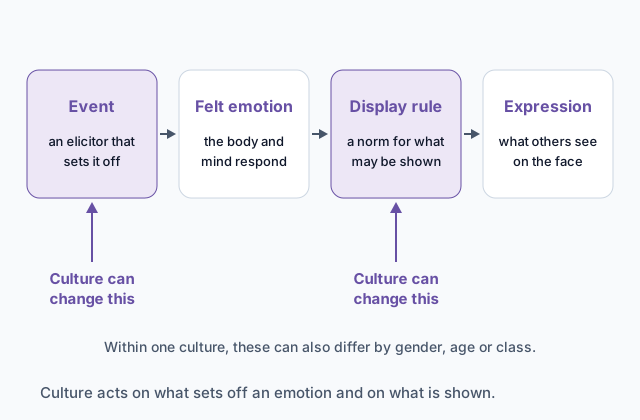
Two things clearly can differ. Elicitors are what sets an emotion off. A food that disgusts people in one culture can be a treat in another. Display rules are a group's norms for when and how an emotion may be shown. In some places mourners are expected to grieve loudly in public; in others, to stay composed until they are home.
Display rules and elicitors also vary within one culture. A group may expect different displays from people of different genders, ages or socioeconomic classes, and it may read the same display differently depending on who shows it. A tantrum that is excused in a toddler is judged harshly in an adult.
Quick check · Multiple choice
In one country, a dinner guest who eats every last bite leaves the host pleased. In another country, the same clean plate leaves the host embarrassed, because it suggests not enough food was served. Hosts in both countries show pleasure and embarrassment in much the same way. What does this difference show?
Part 3 Watch it done Telling a display rule from an elicitor
Watch each step, then do the last one yourself.
At their grandmother's 80th birthday, her speech about her late husband moves the whole family. Nine-year-old Eli cries openly, and an aunt pulls him into a hug. His brother Max, 17, is just as moved, but he blinks back his tears, because in their family older boys are expected not to cry in front of relatives. What explains the difference in what the brothers show?
Step 1 · Find the event and the feeling
The event is the grandmother's speech, and it reaches both brothers. The stem says Max is just as moved as Eli, so the speech set off the same strong feeling in each of them.
Step 2 · Find what is different
What differs is what each brother lets show. Eli cries openly and Max holds his tears back, and the reason given is a family expectation about older boys crying in front of relatives.
Why this step?
Why check whether the event set off the same feeling before deciding?
Because that is what separates the two ideas. If the same event set off different feelings, the difference would be in elicitors. When the feeling is the same and only what is shown differs, the difference lies in the rules for showing it.
Your step · Decide and justify
Finish the reasoning. At a family birthday, a speech moves nine-year-old Eli and his 17-year-old brother Max equally. Eli cries openly; Max blinks back his tears because in their family older boys are expected not to cry in front of relatives. What explains the difference in what the brothers show?
Which reason supports your answer?
Part 4 Try it Read a study: does a good mood open up thinking?
Illustrative study (made up for practice, not a published study). Researchers recruited 90 students at one university. A computer randomly assigned each student to watch one of three two-minute clips: a comedy sketch, calm footage of clouds, or a tense argument between two people. Right after the clip, each student had three minutes to write down as many things as they could that they would like to do right now. The researchers counted the different activities on each list. A statistical test showed that the three groups differed significantly.
| Clip watched | Students | Mean activities listed |
|---|---|---|
| Comedy sketch | 30 | 9.4 |
| Calm clouds | 30 | 7.1 |
| Tense argument | 30 | 4.8 |
Try it · Fill the statement
Tap a blank, then a phrase.
In a study where students watched a comedy, calm or tense clip and then listed things they would like to do, the independent variable is . The dependent variable is operationally defined as .
Try it · Decide and justify
In an illustrative study, a computer randomly assigned 90 students to watch a comedy sketch, calm footage of clouds or a tense argument. Right after the clip, they listed things they would like to do right now. The comedy group listed 9.4 activities on average, the calm group 7.1 and the argument group 4.8, and the groups differed significantly. A classmate says the study shows that positive emotions build lasting skills and friendships over months. Is that conclusion supported by this study?
Which reason supports your answer?
Part 5 Explain it Answer an article analysis question
Nothing you type leaves this page.
Free response is 33.3% of the exam score. This one is shaped like Question 1, Article Analysis Question.
Free-response practice · Question 1 style
Illustrative study (made up for practice, not a published study). Researchers wanted to know whether having an adult in the room changes how teenagers show disgust. They recruited 60 students, ages 15 to 17, from two high schools in one city. Each student's parent signed a permission form, and each student agreed to take part after being told they would be video recorded and could stop at any time without penalty. A coin flip put each student in one of two groups. In the alone group, students watched a 60-second clip of spoiled food being thrown out while sitting by themselves. In the observed group, students watched the same clip with an adult researcher sitting beside them. Two coders who did not know which group a student was in watched recordings that showed only each student's face, and counted the number of seconds each student showed a disgust face, a wrinkled nose with a raised upper lip. The alone group showed a disgust face for a mean of 14.2 seconds and the observed group for a mean of 6.1 seconds, a statistically significant difference. Afterward, students in both groups rated how disgusted they had felt on a scale from 1 (not at all) to 7 (extremely). The mean ratings, 5.8 for the alone group and 5.6 for the observed group, did not differ significantly. The recordings were stored under code numbers rather than names and were deleted once coding was finished.
(A) Identify the research method used in this study.
(B) State the operational definition of showing disgust in this study.
(C) Identify one ethical guideline described in the study. Describe one way the researchers applied it.
(D) Explain how the results support the idea that display rules regulate how people show emotions.
Model answer
(A) This is an experiment, because a coin flip assigned each student at random to the alone group or the observed group.
(B) Showing disgust was measured as the number of seconds a student showed a disgust face, a wrinkled nose with a raised upper lip, as counted by coders from the video recordings.
(C) Confidentiality. The researchers stored the recordings under code numbers rather than names and deleted them once coding was finished, so no student could be identified from them.
(D) The observed group showed a disgust face for 6.1 seconds against 14.2 seconds for the alone group, a significant difference, yet their ratings of how disgusted they felt, 5.6 against 5.8, did not differ significantly. So the adult in the room clearly changed how much disgust the students showed, while there is no sign it changed how much they felt. A display rule is a norm for when and how an emotion may be shown, and these teenagers held back the display in front of an adult with no sign of feeling less disgust.
Score your own answer. This is a self-check, not a grade. Tick each point your answer makes.
Part 6 Check yourself Read the faces data, then mix it up
On the exam, some multiple-choice questions share one set of data, the way these do.
Illustrative data (made up for practice). Researchers showed the same six photos of posed facial expressions to adults in three groups: residents of two large cities in different countries, and residents of a rural community with little exposure to film or television from either. The groups were not formed by random assignment; people were recruited where they lived. For each photo, a viewer chose one word from a list of six: anger, disgust, sadness, happiness, surprise or fear. A viewer guessing at random would pick the intended word about 1 time in 6, or about 17% of the time.
| Face | City A | City B | Rural community |
|---|---|---|---|
| Happiness | 96 | 94 | 90 |
| Surprise | 86 | 83 | 64 |
| Fear | 79 | 74 | 41 |
| Disgust | 83 | 80 | 52 |
| Anger | 81 | 78 | 55 |
| Sadness | 84 | 81 | 58 |
Case question 1 · Multiple choice
In a study where viewers matched six posed faces to six emotion words, 41% of rural community viewers chose "fear" for the fear face, against 79% and 74% in the two cities. Random guessing would match about 17% of the time. What does the rural result for the fear face show?
Case question 2 · Calculate
In a study of matching posed faces to emotion words, rural community viewers chose the intended word for the six faces 90%, 64%, 41%, 52%, 55% and 58% of the time. What is the mean percent across the six faces?
Case question 3 · Decide and justify
In a study where viewers in two cities and one rural community matched posed faces to emotion words, 96%, 94% and 90% of them matched the happiness face correctly. A classmate says this proves that people in every culture express happiness in exactly the same way. Is the classmate right?
Which reason supports your answer?
The rest stand on their own and do not use the case.
Check yourself · Match
Tap a view of emotion, then tap the example that fits it.
Check yourself · Spot the error
A student reads that one well-run study found holding a smile had no effect on mood, and writes about the facial-feedback hypothesis. Tap the first line that goes wrong.
Check yourself · Sort it
Tap an example, then tap what differs in it.
What sets the emotion off (elicitor)
How the emotion may be shown (display rule)
Part 7 Keep it Bring back earlier ideas
Coming back to older ideas is how they stay usable on the exam.
Bring it back · Multiple choice
Marcus is not hungry, tired or bored, but he signs up for extra Saturday shifts at the bike shop because each one comes with a 40 dollar bonus. Which theory of motivation best explains his choice?
Bring it back · Fill the statement
Tap a blank, then a phrase.
Rosa tells her aunt she has dropped her pre-med plans to study architecture. Her aunt says the news surprises her, and that Rosa is just as welcome at every family dinner whatever she studies. That acceptance is . With nobody's approval riding on it, Rosa sketches buildings late into the night, not for a grade or a prize but because she wants to become more fully herself, which humanistic psychology calls the .
In three lines
- An emotion has a physiological side and a cognitive side, and early theories argued about their order; tests of the facial-feedback hypothesis have produced mixed results.
- Positive emotions tend to broaden awareness and thinking, and negative emotions tend to narrow them.
- Some emotions may be shared across cultures, with mixed evidence, while elicitors and display rules differ between cultures and by gender, age and class within one.
Vocabulary
- Emotion (affect)
- A complex psychological process, distinguished from reasoning or knowledge, that reflects internal and external factors affecting a person.
- Physiological and cognitive experience of emotion
- What the body does during an emotion, and the mind's recognition or labeling of it.
- Cognitive label (cognitive appraisal)
- Recognizing and naming what you feel, which some theories say is required to experience an emotion.
- Facial-feedback hypothesis
- The idea that the experience of emotion is influenced by facial expressions; research testing it has produced mixed results.
- Broaden-and-build theory
- The theory that positive emotions tend to broaden awareness and encourage new actions and thoughts, while negative emotions tend to narrow thinking and action.
- Universality of emotion
- Whether the expression of emotions is common across cultures; research on it shows mixed results.
- Display rules
- A culture's norms for how and when emotions may be shown, which can differ between cultures and by gender, age or socioeconomic class.
- Elicitors
- The events or situations that set off an emotion, which can differ between cultures and within one.
Course alignment, for teachers
AP Psychology topic 4.7, Unit 4: Social Psychology and Personality.
- Skill 1.A: Apply psychological perspectives, theories, concepts, and research findings to a scenario.
- Skill 2.D: Evaluate whether a psychological research scenario followed appropriate ethical procedures.
- Skill 3.A: Identify psychology-related concepts in descriptions or representations of data.
- Skill 4.B: Provide reasoning that is grounded in scientifically derived evidence to support, refute, or modify an established or provided claim, policy, or norm.
This lesson maps all 4 essential knowledge statements of the topic to the part that teaches each one: 4 are checked by a scored question. The map is in the lesson file.