Unit 4 · Topic 4.6 · about 30 minutes · 7 parts · 14 scored checks, 4 of them multiple choice
AP Psychology 4.6: Motivation
Unit 4: 15 to 25% of the multiple-choice section
 Tap to open the picture full size
Part 1 Think first A Saturday with nothing missing
Guess before you learn. A wrong guess still makes the answer stick.
Predict first
It is Saturday afternoon. Jonah has eaten lunch, slept well the night before, and is warm and comfortable on the couch. Nothing he needs is missing, and nothing is bothering him. What is he most likely to do over the next hour?
In short. Motivation is what moves people and animals to act, and psychologists explain it through the body's needs, the level of arousal people look for, the rewards and reasons behind a choice, and the conflicts that choices create.
- Some theories start from the body's needs and its balance, and others from the level of arousal people seek or the rewards and inner reasons that steer them.
- Lewin's theory sorts the conflicts that choices create by whether each option attracts, repels, or does both.
- Eating is shaped by hormones inside the body and by cues outside it, such as the food in sight, the time of day and the people at the table.
Part 2 Learn it Four short ideas, each checked as you go
2a. Needs that push: drives and instincts
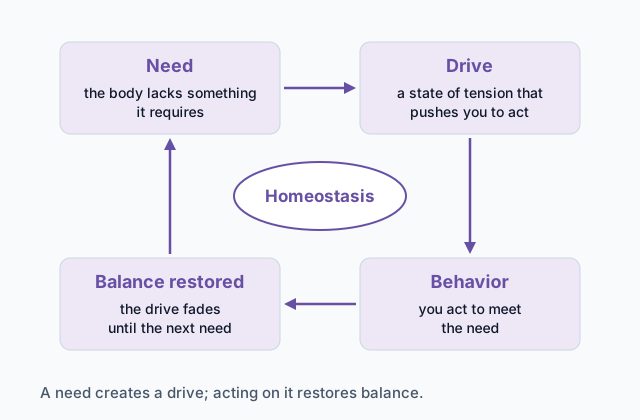
Your body works to keep conditions inside it steady, such as its temperature and how much water it holds. Keeping that balance is homeostasis. Drive-reduction theory says a physical need, such as a lack of water, creates a drive: an uncomfortable state of tension that pushes you to act. Acting reduces the drive and brings the body back toward balance. Thirst after a long run sends you to the fountain, and drinking makes the urge fade.
Drive reduction is one of the theories that start from the body's physical needs and desires. It explains a lot of eating, drinking and getting warm. It has trouble with behavior that raises tension instead of lowering it, such as riding a roller coaster on a full stomach.
Many animals are also moved by instincts: innate, typically fixed patterns of behavior that appear in response to certain stimuli, without being learned. A spider spins its species' web the first time it tries. Sea turtles crawl toward the ocean as soon as they hatch.
Humans do not seem to show instinctual behavior or mental processes in this sense. People are born with reflexes, such as a newborn's rooting reflex, but a reflex is one simple response to one stimulus, while an instinct is a whole pattern of behavior, like spinning a web. Even things that come easily to people, such as courting a partner or comforting a baby, differ across cultures and are shaped by learning.
Quick check · Sort it
Tap an example, then tap what best explains it.
Drive reduction
Instinct
2b. Arousal: looking for the right level
Drive reduction cannot explain someone with every need met who goes looking for something to do. Arousal theory says people seek an optimal level of arousal, a level of alertness and activation that is neither too low nor too high. When arousal is too low you feel bored and look for stimulation, and when it is too high you look for calm.
The Yerkes-Dodson law links arousal to performance. People perform best at a moderate level of arousal, and performance falls off when arousal is too low or too high, so a graph of it is an upside-down U. The best level depends on the task. An easy or well-practiced task holds up under more arousal, and a difficult task peaks at a lower level of arousal than an easy one does.
People also differ in how much stimulation they need. Sensation-seeking theory says a person's level of need for varied or novel experiences is the basis of their motivation. It names four types:
- Experience seeking: new experiences of the mind and senses, such as unfamiliar food, music or places.
- Thrill or adventure seeking: physically risky, exciting activities, such as skydiving.
- Disinhibition: seeking excitement by letting go of social restraint, such as at a wild party.
- Boredom susceptibility: a strong dislike of routine and repetition, and restlessness when things stay the same.
Quick check · Match
Tap a type of sensation seeking, then tap the example that shows it.
2c. Pulled by goals: rewards, reasons and conflicts
Some motivation comes from outside you. Incentive theory looks at how rewards motivate behavior: a paycheck, a prize, a good grade or praise pulls you toward whatever earns it. A reward is an extrinsic motivation, a reason that comes from outside the activity itself.
Self-determination theory says people are motivated by intrinsic or extrinsic motivations. Intrinsic motivation is internal: doing something for its own sake, because it is interesting or satisfying. Extrinsic motivation is external: doing it for something outside it, such as a reward. The same activity can rest on either. One student practices piano because she loves the sound, and another practices only because her parents pay her for each hour.
Goals can also collide. Lewin's motivational conflicts theory says choices create conflicts that you must resolve, and that this is the basis of motivation. Each option either attracts you (approach) or repels you (avoidance).
- Approach-approach: two options you want, and you can have only one. Two concerts you love on the same night.
- Avoidance-avoidance: two options you do not want, and you must take one. Cleaning the garage or weeding the yard.
- Approach-avoidance: one option that both attracts and repels. A job that pays well but starts at 5 a.m.
Quick check · Fill the statement
Tap a blank, then tap a word.
Lena writes short stories every evening because she loves inventing characters, so her writing rests on motivation. When the library offers a 50-dollar prize for the best story, her classmate Omar starts writing for the first time. For Omar, the prize is a source of motivation, and theory explains how a reward like that pulls behavior toward it.
2d. Eating: body and mind together
Eating is a complex motivated behavior, and it shows how physical and mental processes interact. Hunger looks like a simple drive, but when you eat, and how much, depends on signals from inside the body and cues from outside it.
Inside, hormones carry the signals. Ghrelin is a hormone that brings on feelings of hunger. Leptin is a hormone that brings on satiety, the feeling of having had enough. Both hormones carry their messages to the hypothalamus, the part of the brain that regulates hunger and fullness, which works closely with the pituitary gland.
Outside, the situation matters. The presence of food can start eating with no hunger at all: a plate of cookies on the counter gets eaten because it is there. The time of day sets off eating too, so people feel ready for lunch at noon partly because noon is when they usually eat. Social gatherings around meals, such as holiday dinners, birthday parties and team cookouts, lead people to eat when the group eats and as the group eats.
Those gatherings point to a second motive, the need to belong: to be accepted by and connected with other people. It moves behavior, as when a new student joins a club mainly to find friends, and it moves thinking, as when someone left out of a group chat keeps replaying it and wondering what they did. A shared meal often answers hunger and belonging at once.
Quick check · Multiple choice
Ana ate a large lunch at 1 p.m. and says she feels completely full. At 2 p.m. a coworker sets a box of fresh donuts on the table beside her desk, and Ana eats one. Which best explains why she ate the donut?
Part 3 Watch it done Naming a motivational conflict, one question at a time
Watch each step, then do the last one yourself.
Jada wants to join the school's varsity soccer team. To join, she has to run a timed mile in front of the whole team on the first day, and the thought of it terrifies her. What kind of motivational conflict is she facing?
Step 1 · Count the options she is choosing between
There is one decision on the table: whether to join the team. Joining is the option, and not joining just means passing on it.
Step 2 · Ask what about the option attracts her and what repels her
Playing on the varsity team attracts her, so there is an approach. The timed mile in front of everyone repels her, so there is an avoidance. Both come with the same option, joining.
Why this step?
Why look at where the pull and the push sit, instead of at how torn Jada feels?
Because all three conflicts can leave a person feeling torn, so the feeling cannot tell them apart. What decides the type is whether the attraction and the dread belong to two options or to one.
Your step · Decide and justify
Finish the classification. Jada wants to join the varsity soccer team, but joining means running a timed mile in front of the whole team on the first day, which terrifies her. What kind of motivational conflict is she facing?
Which reason supports your answer?
Part 4 Try it Read a study: who tries new things?
Illustrative study (made up for practice, not a published study). A researcher asked 150 college students who volunteered from an introductory course to fill out a sensation-seeking questionnaire, which gives a score from 0 to 40. Each student also checked off, on a list of 30 activities (such as eating a cuisine for the first time, rock climbing or traveling alone), how many they had done for the first time in the past year. Students with higher questionnaire scores tended to have tried more of the activities for the first time. The correlation was r = +0.42, and it was statistically significant.
Try it · Multiple choice
In an illustrative study, 150 college students filled out a sensation-seeking questionnaire scored from 0 to 40 and checked off which of 30 activities they had done for the first time in the past year. The study measured two variables: sensation seeking, and how many new activities each student had tried. How did it operationally define sensation seeking?
Try it · Decide and justify
In an illustrative study of 150 college students, higher scores on a sensation-seeking questionnaire went with trying more new activities in the past year, r = +0.42, and the correlation was statistically significant. A news site reports: "Being a sensation seeker makes people try more new things." Does this study support that cause-and-effect claim?
Which reason supports your answer?
Part 5 Explain it Write it the way the exam asks
Nothing you type leaves this page.
Free response is 33.3% of the exam score. This one is shaped like Question 2, Evidence-Based Question.
Free-response practice · Question 2 style
Read the three sources, then answer the question they share: what makes people eat more? In parts B and C, cite the source you use, for example (Source 1).
Source 1. Illustrative study (made up for practice, not a published study). Researchers recruited 96 college students who had eaten lunch two hours earlier. A coin flip decided whether each student watched a 40-minute film alone or with three other participants. Every student had a large bowl of popcorn. Students who watched with others ate a mean of 62 grams of popcorn, and students who watched alone ate a mean of 38 grams. The difference was statistically significant.
Source 2. Illustrative study (made up for practice, not a published study). Sixty adults each sat alone for 50 minutes, starting at 11:00 a.m., in a room with a bowl of crackers and a wall clock, and with no phone or watch. A coin flip decided which room each person sat in. In one room the clock ran fast, so that by the end it read 12:30, a usual lunchtime. In the other room the clock ran normally and read 11:50 at the end. People in the fast-clock room ate a mean of 14 crackers, and people in the normal-clock room ate a mean of 6. The difference was statistically significant.
Source 3. Illustrative study (made up for practice, not a published study). Twenty adults came to a lab on two mornings a week apart and ate the same breakfast each time. On one morning they were injected with ghrelin and on the other with salt water, in random order, and neither they nor the researchers knew which was which. Thirty minutes later each person rated their hunger from 1 to 10 and then ate from a lunch buffet. On the ghrelin morning, mean hunger was 7.1 and people ate a mean of 610 grams of food. On the salt-water morning, mean hunger was 4.2 and they ate a mean of 470 grams. Both differences were statistically significant.
(A) Propose a specific and defensible claim, based in psychological science, that answers the question.
(B) (i) Support your claim using one piece of specific and relevant evidence from one of the sources. (ii) Explain how the evidence from part B (i) supports your claim, using a psychological perspective, theory, concept, or research finding.
(C) (i) Support your claim using a piece of specific and relevant evidence from a different source. (ii) Explain how the evidence from part C (i) supports your claim, using a different psychological perspective, theory, concept, or research finding from the one in part B (ii).
Model answer
(A) Signals from inside the body and cues from outside it both increase how much people eat: more of the hunger hormone ghrelin leads people to eat more, and so does an outside cue such as a clock showing mealtime.
(B) (i) In Source 3, the same people rated their hunger at 7.1 and ate 610 grams of food on the morning they were given ghrelin, compared with a hunger rating of 4.2 and 470 grams on the salt-water morning. (ii) Ghrelin is a hormone that brings on feelings of hunger. Because each person ate the same breakfast on both mornings, the extra ghrelin is what raised their hunger and how much they ate, which shows a signal inside the body increasing eating.
(C) (i) In Source 2, people whose clock showed 12:30 ate a mean of 14 crackers, compared with 6 for people whose clock showed 11:50, though both groups had sat for the same 50 minutes. (ii) This is classical conditioning, a different concept from part B. A usual lunchtime has been paired with meals day after day, so a clock reading 12:30 had become a conditioned stimulus that brought on hunger, a conditioned response, and people ate more even though no more time had passed and the body needed no more food.
Score your own answer. This is a self-check, not a grade. Tick each point your answer makes.
Part 6 Check yourself Read the anagram data
On the exam, some multiple-choice questions share one set of data, the way these do.
Illustrative data (made up for practice). A researcher randomly assigned 90 college students to one of three conditions, 30 in each. In the low condition, students were told it was a practice round and nothing would be scored. In the moderate condition, they were told their score would count. In the high condition, they were told their score would count, a buzzer sounded every 30 seconds, and the researcher stood watching. A heart-rate monitor confirmed that arousal rose from the low to the moderate to the high condition. Every student got five minutes for 20 easy anagrams and five minutes for 20 hard ones. On the hard anagrams, both the rise from low to moderate and the drop from moderate to high were statistically significant.
| Condition | Easy anagrams | Hard anagrams |
|---|---|---|
| Low | 12 | 9 |
| Moderate | 16 | 13 |
| High | 17 | 7 |
Case question 1 · Multiple choice
In an illustrative study, students randomly assigned to low, moderate or high pressure solved a mean of 9, 13 and 7 hard anagrams, and a heart-rate monitor showed arousal rising from the low to the high condition. Both changes were statistically significant. Which best explains the pattern on the hard anagrams?
Case question 2 · Calculate
In an illustrative study, students under moderate pressure solved a mean of 16 easy and 13 hard anagrams, and students under high pressure solved a mean of 17 easy and 7 hard. By how many anagrams is the easy-minus-hard gap larger under high pressure than under moderate pressure?
Case question 3 · Spot the error
In an illustrative study, students randomly assigned to low, moderate or high arousal solved a mean of 9, 13 and 7 hard anagrams, and both changes were statistically significant. A student explains the pattern. Tap the first line that goes wrong.
The rest stand on their own and do not use the case.
Check yourself · Fill the statement
Tap a blank, then tap a word.
As dinnertime nears, the hormone brings on hunger. After the meal, the hormone signals that the body has had enough, which brings on .
Check yourself · Sort it
Tap a choice, then tap the kind of conflict it creates.
Approach-approach
Approach-avoidance
Avoidance-avoidance
Part 7 Keep it Bring back earlier ideas
Coming back to older ideas is how they stay usable on the exam.
Bring it back · Multiple choice
Before a chemistry lab practical, Rafael thinks, "I have practiced titrations enough that I know I can do this one." In social-cognitive theory, his belief that he can succeed at this particular task is his
Bring it back · Fill the statement
Tap a blank, then tap a word.
A school gives students a new typed spelling test twice, two weeks apart, and nearly every student gets about the same score both times, so the test is . Then teachers find that the scores mostly reflect how fast students type, not how well they spell, so the test is not .
In three lines
- Drive reduction explains acting to restore the body's balance, and arousal theory explains seeking a level of arousal that is neither too low nor too high.
- Rewards supply extrinsic motivation and interest in the activity supplies intrinsic motivation, while choices that attract, repel or do both create Lewin's three conflicts.
- Eating answers to hormones, ghrelin for hunger and leptin for satiety, and to outside cues such as food in sight, the time of day and company.
Vocabulary
- Drive-reduction theory
- A theory that certain behaviors reduce the drive created by a physical need and so help maintain homeostasis.
- Homeostasis
- The body's tendency to keep its internal conditions in balance.
- Arousal theory
- A theory that people are motivated to seek an optimal level of arousal when they behave.
- Yerkes-Dodson law
- Performance is best at a moderate level of arousal and falls when arousal is too low or too high.
- Self-determination theory
- A theory that people are motivated by intrinsic (internal) or extrinsic (external) motivations.
- Intrinsic and extrinsic motivation
- Doing something for its own sake, or doing it for something outside it, such as a reward.
- Incentive theory
- A theory that explores the role of rewards, an extrinsic motivation, in motivating behavior.
- Instinct
- An innate, typically fixed pattern of behavior in animals in response to certain stimuli.
- Lewin's motivational conflicts theory
- A theory that choices create conflicts one must resolve, and that resolving them is the basis of motivation.
- Approach-approach, approach-avoidance and avoidance-avoidance
- Choosing between two wanted options, facing one option that both attracts and repels, or choosing between two unwanted options.
- Sensation-seeking theory
- A theory that one's level of need for varied or novel experiences is the basis of motivation.
- Types of sensation seeking
- Experience seeking, thrill or adventure seeking, disinhibition, and boredom susceptibility.
- Ghrelin and leptin
- Hormones that regulate feelings of hunger (ghrelin) and satiety (leptin) by signaling the hypothalamus.
- Need to belong
- The need to be accepted by and connected with other people, which motivates behavior and mental processes.
Course alignment, for teachers
AP Psychology topic 4.6, Unit 4: Social Psychology and Personality.
- Skill 1.A: Apply psychological perspectives, theories, concepts, and research findings to a scenario.
- Skill 2.B: Evaluate the appropriate use of research design elements in experimental methodology.
- Skill 2.C: Evaluate the appropriate use of research design elements in non-experimental methodologies.
This lesson maps all 8 essential knowledge statements of the topic to the part that teaches each one: 8 are checked by a scored question. The map is in the lesson file.