Unit 5 · Topic 5.1 · about 30 minutes · 7 parts · 14 scored checks, 3 of them multiple choice
AP Psychology 5.1: Introduction to Health Psychology
Unit 5: 15 to 25% of the multiple-choice section
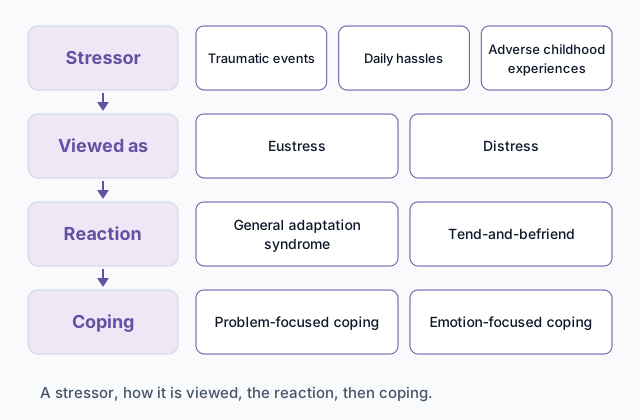 Tap to open the picture full size
Part 1 Think first Three hard weeks
Guess before you learn. A wrong guess still makes the answer stick.
Predict first
Nadia has three brutal weeks in a row: two final exams, the lead role in the spring play, and extra shifts at her job. She sleeps little, but she feels wired and keeps going the whole time. When is she most likely to come down with a cold?
In short. Health psychology studies how behavior and mental processes affect physical health and wellness, and much of its work is about stress: where it comes from, what it does to the body, and how people react to it and cope with it.
- Stress raises the risk of disease and has been linked to high blood pressure, headaches and a weakened immune system.
- Stressors range from traumatic events to daily hassles and adverse childhood experiences, and the same stressor can motivate one person and wear down another.
- People react to stress through the general adaptation syndrome or by tending and befriending, and they cope by working on the problem, by managing their emotions, or by doing both.
Part 2 Learn it Four short ideas, each checked as you go
2a. Health psychology, and what stress does to the body
Health psychology looks at how behavior and mental processes affect physical health and wellness. A health psychologist might ask why some patients keep taking their medicine and others quit, how sleep and daily habits relate to how often people get sick, or how worry shows up in the body. The questions always connect what people do and think with how well their bodies hold up.
A great deal of that work is about stress, your response when events put demands on you that feel threatening or challenging. The events themselves are stressors.
Stress is a factor in heightened susceptibility to disorders and disease. Put plainly, people under stress are more open to getting sick. Stress has been linked to physical problems such as:
- hypertension, or high blood pressure;
- headaches;
- immune suppression, a weakening of the immune system that makes it harder for the body to fight off infection.
Notice the word linked. A researcher cannot ethically assign people to months of serious stress, so much of this evidence comes from studies that measure stress and health as they happen. Those studies show the two go together, and a careful reader keeps that in mind.
Quick check · Multiple choice
A city clinic hires a psychologist for one project. Which project is the clearest example of health psychology?
2b. Not every stressor is the same
Stressors can be viewed as motivating or as debilitating. Eustress is stress a person experiences as motivating, a challenge that sharpens them, like nerves before a race you trained hard for. Distress is stress a person experiences as debilitating: it wears them down and gets in the way. The same event can be either one. Before a hard audition, one student sees a chance to show what she can do and practices with new energy; another sees a threat and can barely sleep. What decides it is how the person views the stressor, not the event alone.
Stressors also differ in size. A traumatic stressor is a severe, often sudden event, such as a serious car crash or a house fire. Daily hassles are small, everyday irritations: a late bus, a lost charger, a neighbor's barking dog. One hassle is minor, but hassles can build up over time.
Adverse childhood experiences (ACEs) are sources of stress in childhood, such as abuse, neglect or violence in the home. Their effects do not have to end when childhood does. ACEs can affect a person throughout the lifespan, so a health psychologist studying an adult's health may need to ask about that adult's early years.
Quick check · Sort it
Tap an example, then tap how the person is experiencing the stress.
Eustress
Distress
2c. How people react: three phases, and tend-and-befriend
The general adaptation syndrome (GAS) describes the process of experiencing stress in three phases.
- Alarm reaction. When the stress is first encountered, the body mobilizes through the fight-flight-freeze response. The heart races, breathing speeds up, and the person is ready to fight, run or go still.
- Resistance. As the stress is confronted, the body stays aroused and keeps coping.
- Exhaustion. This phase comes when the stress subsides or the body's resources are spent. The greatest susceptibility to illness comes here, not in the alarm reaction.
To place someone in a phase, ask where they are in their stress: just hit by it, still facing it with something left, or run down, either because it is over or because a stress that goes on has used up what they had. How tense they feel will not tell you, because tension shows up in every phase.
Not everyone reacts by bracing to fight or flee. The tend-and-befriend theory proposes that some people react to stress by tending to their own needs, the needs of others, or both, and by seeking connection with others. After a frightening storm, someone who makes sure the children have eaten, checks on the neighbors and calls a sister to talk is tending and befriending. This pattern seems to occur mostly in women, which describes a tendency, not a rule about every woman.
Quick check · Match
Tap a term, then tap the example that shows it.
2d. Coping: work the problem or manage the feelings
Problem-focused coping treats stress as a problem to be solved: you work on solutions until one works. A student with three tests on the same day who asks one teacher for a different date, makes a study schedule and borrows notes for the class she missed is working on the problem itself.
Emotion-focused coping manages your emotional reaction to the stress instead. Deep breathing, meditation, and taking medication aimed at reducing stressful emotional responses are all emotion-focused. The three tests are still on the calendar; what changes is how strongly you react to them.
To tell the two apart, ask what the strategy is aimed at. If it changes the situation, it is problem-focused. If it changes how you feel about the situation, it is emotion-focused. A strategy does not become problem-focused because it helps. Meditation can help a great deal and still leave the stressor exactly where it was.
Many people use both, one after the other. Before a tense talk with his coach about playing time, a player might take a few slow breaths to steady himself, which is emotion-focused, and then ask exactly what he needs to improve, which is problem-focused.
Quick check · Fill the statement
Tap a blank, then tap a word or phrase.
Two days before a paper is due, Kenji's laptop dies. He borrows his cousin's laptop and recovers his draft from his school account, which is coping. His roommate, worried about her own deadline, spends ten minutes doing deep breathing to calm down, which is coping. Her breathing eases her worry but leaves the itself unchanged.
Part 3 Watch it done Placing a stress reaction in its phase
Watch each step, then do the last one yourself.
On Monday, Tomas, a restaurant cook, learns that the kitchen will be inspected sometime in the next three weeks. For the first hour his heart pounds and he cannot sit still. In the second week he works steady extra hours, deep-cleaning and fixing problems, tense but still going. The inspection has not happened yet. Which phase of the general adaptation syndrome is he in during the second week?
Step 1 · Place the first hour
A pounding heart and being unable to sit still, right when he hears the news, is the fight-flight-freeze response. That first hour was the alarm reaction. The question asks about later, so keep going.
Step 2 · Check whether the stressor is still there, and whether he is
In the second week the inspection is still ahead, so the stress has not subsided. Tomas is working on the problem every day, so his resources are not spent. He is still confronting the stress.
Why this step?
Why check whether the stress is still going, instead of just asking how tense Tomas feels?
Because tension shows up in every phase, so it cannot tell them apart. What separates the phases is timing: alarm is the first response, resistance is confronting the stress while it lasts, and exhaustion comes when it subsides or resources run out.
Your step · Decide and justify
Finish the classification. On Monday, Tomas, a restaurant cook, learns the kitchen will be inspected sometime in the next three weeks, and for the first hour his heart pounds. In the second week he works steady extra hours, deep-cleaning and fixing problems, tense but still going, and the inspection has not happened yet. Which phase of the general adaptation syndrome is he in during the second week?
Which reason supports your answer?
Part 4 Try it Read a study: a few breaths before a speech
Illustrative study (made up for practice, not a published study). Researchers recruited 80 college students who volunteered from a psychology course. Each student was told they would give a three-minute speech to a panel of two judges. A coin flip decided what each student did in the ten minutes before the speech: half followed a recorded slow, deep-breathing exercise, and half read a magazine. Just before the speech, every student rated their anxiety from 1 to 10, and a cuff measured their systolic blood pressure (the top number of a blood pressure reading). The deep-breathing group rated their anxiety at a mean of 4.6, against 6.8 for the magazine group, and their mean systolic blood pressure was 116, against 125. Both differences were statistically significant.
Try it · Fill the statement
Tap a blank, then tap a phrase.
In an illustrative study, a coin flip decided whether each of 80 students did a deep-breathing exercise or read a magazine for ten minutes before giving a speech, and the researchers then measured each student's anxiety rating and blood pressure. The independent variable is . Anxiety ratings are one dependent variable, and is the other. The breathing exercise is an example of coping.
Try it · Decide and justify
In an illustrative study, a coin flip decided whether each of 80 volunteer college students did a deep-breathing exercise or read a magazine before giving a speech. The breathing group had lower mean anxiety (4.6 against 6.8) and lower mean systolic blood pressure (116 against 125), and both differences were statistically significant. Can the researchers conclude that the breathing exercise caused the lower anxiety, for students like these?
Which reason supports your answer?
Part 5 Explain it Write it the way the exam asks
Nothing you type leaves this page.
Free response is 33.3% of the exam score. This one is shaped like Question 2, Evidence-Based Question.
Free-response practice · Question 2 style
Read the three sources, then answer the question they share: how does stress affect physical health? In parts B and C, cite the source you use, for example (Source 1).
Source 1. Illustrative study (made up for practice, not a published study). Researchers asked 180 office workers to fill out a checklist of daily hassles, such as traffic, lost items and interruptions, every evening for eight weeks, and to record each day they had a headache. Workers in the top third for hassles reported a mean of 5.8 headache days a month, and workers in the bottom third reported a mean of 2.1. The difference was statistically significant.
Source 2. Illustrative study (made up for practice, not a published study). Forty college students each gave a saliva sample in a calm week early in the semester and again during final exams. Each sample was tested for an antibody that helps the body fight infections of the mouth and throat. The same students' mean antibody level was 31 percent lower during finals than in the calm week. The difference was statistically significant.
Source 3. Illustrative study (made up for practice, not a published study). Researchers surveyed 600 adults aged 40 to 60 about stressful experiences before age 18, such as neglect or violence in the home, and checked each person's medical record for hypertension (high blood pressure). Of the adults who reported four or more such experiences, 34 percent had hypertension, compared with 19 percent of the adults who reported none. The difference was statistically significant.
(A) Propose a specific and defensible claim, based in psychological science, that answers the question.
(B) (i) Support your claim using one piece of specific and relevant evidence from one of the sources. (ii) Explain how the evidence from part B (i) supports your claim, using a psychological perspective, theory, concept, or research finding.
(C) (i) Support your claim using a piece of specific and relevant evidence from a different source. (ii) Explain how the evidence from part C (i) supports your claim, using a different psychological perspective, theory, concept, or research finding from the one in part B (ii).
Model answer
(A) More stress goes with worse physical health: people under more stress show weaker defenses against infection and more high blood pressure, even when the stress came years earlier.
(B) (i) In Source 2, the same students' mean level of an infection-fighting antibody was 31 percent lower during final exams than in a calm week early in the semester. (ii) Stress has been linked to immune suppression, a weakening of the immune system that makes it harder to fight off infection. Finals were the stressful time, and the same students' defenses dropped then, which fits the claim that more stress goes with worse physical health. Because each student was compared with themselves, differences between students cannot explain the drop.
(C) (i) In Source 3, 34 percent of the adults who reported four or more stressful experiences before age 18 had hypertension, compared with 19 percent of the adults who reported none. (ii) This fits a different concept from part B: adverse childhood experiences, such as neglect or violence in the home, are sources of stress that can affect a person throughout the lifespan. Adults with more of them had more high blood pressure decades later, which supports the claim that more stress goes with worse physical health, here long after the stress itself. The study measured both variables rather than assigning anyone to them, so it shows a link rather than proving the childhood stress caused the hypertension.
Score your own answer. This is a self-check, not a grade. Tick each point your answer makes.
Part 6 Check yourself One team through a product launch
On the exam, some multiple-choice questions share one set of data, the way these do.
Illustrative data (made up for practice). A software company followed one team of 40 workers through a product launch. The launch date was announced at the start of week 1, the team worked long hours from week 2 through week 9, and the product launched at the end of week 9. Every week, each worker rated their tension from 1 to 10, and the company counted the sick days the team took. The table gives the weekly means for each stretch. The rise in sick days in weeks 10 and 11, compared with weeks 2 to 9, was statistically significant.
| Stretch | Weeks | Mean tension (1 to 10) | Sick days per week |
|---|---|---|---|
| Launch announced | 1 | 8.4 | 1 |
| Crunch | 2 to 9 | 6.7 | 2 |
| After launch | 10 and 11 | 3.2 | 7 |
Case question 1 · Multiple choice
In illustrative data on one team of 40 workers, mean tension was 8.4 in week 1, when a product launch was announced, 6.7 through the crunch in weeks 2 to 9, and 3.2 in weeks 10 and 11, after the launch. Sick days per week went from 1 to 2 to 7, and the last rise was statistically significant. Which best explains why sick days peaked after the launch?
Case question 2 · Spot the error
In illustrative data on one team of 40 workers, mean tension was 8.4 in week 1, when a launch was announced, 6.7 through the crunch in weeks 2 to 9, and 3.2 in weeks 10 and 11, after the launch. Sick days per week went from 1 to 2 to 7. A student explains the pattern. Tap the first line that goes wrong.
Case question 3 · Decide and justify
In illustrative data, one team of 40 workers took a mean of 2 sick days a week during an eight-week work crunch and 7 a week in the two weeks after it ended, a statistically significant rise. A manager says, "This proves the crunch caused the extra sick days." Does this data support that cause-and-effect claim?
Which reason supports your answer?
The rest stand on their own and do not use the case.
Check yourself · Sort it
Tap a stressor, then tap the kind it is.
Traumatic stressor
Daily hassle
Check yourself · Fill the statement
Tap a blank, then tap a word or phrase.
Rafael, now 50, grew up in a home where he faced years of neglect. Health psychologists call childhood sources of stress like that , and they can affect a person . At a checkup, Rafael's doctor finds that he has , or high blood pressure, one of the physical problems stress has been linked to.
Part 7 Keep it Bring back earlier ideas
Coming back to older ideas is how they stay usable on the exam.
Bring it back · Multiple choice
Chef Dani has just been shouted at by a furious customer. Ten minutes later, the owner asks her to come up with ideas for a new weekend dish. According to the broaden-and-build theory, what would you predict about her ideas right now?
Bring it back · Sort it
Tap an explanation, then tap the explanatory style it shows.
Optimistic explanatory style
Pessimistic explanatory style
In three lines
- Health psychology studies how behavior and mental processes affect physical health, and stress is linked to hypertension, headaches and immune suppression.
- A stressor can be felt as eustress or distress, can be traumatic or a pile of daily hassles, and adverse childhood experiences can affect a person throughout the lifespan.
- The general adaptation syndrome runs from alarm to resistance to exhaustion, when illness is likeliest; some people tend and befriend, and people cope by solving the problem or by managing their emotions.
Vocabulary
- Health psychology
- The study of how behavior and mental processes affect physical health and wellness.
- Stressor
- An event or situation that causes stress; stressors can be traumatic or daily hassles.
- Eustress and distress
- Stress that is viewed as motivating (eustress), or stress that is viewed as debilitating (distress).
- Daily hassles
- Small, everyday stressors that can build up over time.
- Adverse childhood experiences (ACEs)
- Sources of stress in childhood that can affect a person throughout the lifespan.
- Hypertension and immune suppression
- High blood pressure, and a weakening of the immune system, two physiological issues that stress has been linked to.
- General adaptation syndrome (GAS)
- The process of experiencing stress, in three phases: alarm reaction, resistance and exhaustion.
- Alarm reaction
- The first phase of the GAS, when the stress is encountered and the body responds with fight-flight-freeze.
- Resistance phase
- The second phase of the GAS, when the stress is confronted.
- Exhaustion phase
- The third phase of the GAS, when the stress subsides or resources are spent; susceptibility to illness is greatest here.
- Tend-and-befriend theory
- A theory that some people react to stress by tending to their own needs or the needs of others and by seeking connection with others.
- Problem-focused coping
- Seeing stress as a problem to be solved and working on solutions until one is found.
- Emotion-focused coping
- Managing emotional reactions to stress, for example through deep breathing, meditation or medication aimed at reducing stressful emotional responses.
Course alignment, for teachers
AP Psychology topic 5.1, Unit 5: Mental and Physical Health.
- Skill 1.B: Explain how cultural norms, expectations, and circumstances, as well as cognitive biases apply to behavior and mental processes.
- Skill 3.A: Identify psychology-related concepts in descriptions or representations of data.
- Skill 3.B: Calculate and interpret measures of central tendency, variation, and percentile rank in a given data set.
This lesson maps all 6 essential knowledge statements of the topic, and the one learning objective with none of its own, to the part that teaches each one: 7 are checked by a scored question. The map is in the lesson file.