Unit 5 · Topic 5.2 · about 30 minutes · 7 parts · 15 scored checks, 3 of them multiple choice
AP Psychology 5.2: Positive Psychology
Unit 5: 15 to 25% of the multiple-choice section
 Tap to open the picture full size
Part 1 Think first A letter that was never sent
Guess before you learn. A wrong guess still makes the answer stick.
Predict first
Picture an experiment. Adults are randomly split into two groups. One group writes a letter thanking someone they never properly thanked, such as a former teacher, and reads it to that person. The other group spends the same time writing about their earliest memories. A few weeks later, both groups answer questions about how happy and how satisfied with life they are. What do you predict?
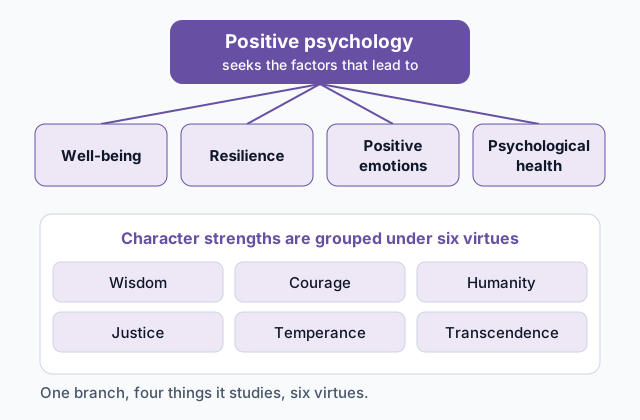
In short. Positive psychology is the branch of psychology that seeks to identify the factors that lead to well-being, resilience, positive emotions and psychological health.
- It studies positive subjective experiences, the ones a person feels and reports, and tests what changes subjective well-being with research rather than advice.
- Character strengths are classified under six virtues, and people who exercise their own signature strengths report higher happiness and subjective well-being.
- Positive change, called posttraumatic growth, may follow trauma or stress, though not for everyone and without erasing the hardship.
Part 2 Learn it Four short ideas, each checked as you go
2a. Asking what goes right
For much of its history, psychology spent most of its effort on what goes wrong, such as disorders and the damage stress does to the body. Positive psychology is the branch that asks the other question. It seeks to identify the factors that lead to:
- well-being, a life that is going well, in how a person feels and how they function;
- resilience, adapting well and recovering after hardship or stress;
- positive emotions, such as joy, interest and contentment;
- psychological health, a mind that is working well, which is more than the absence of a disorder.
Positive psychology is a science, not a list of tips. It asks a research question, measures and tests the answer, the same way the rest of the field does.
It does not ignore hardship, either. Resilience only makes sense after something hard has happened. What changes is the question. A study of 300 bus drivers could ask which drivers get the worst back pain, or which drivers stay satisfied with their work despite long shifts. The first question is about a problem. The second asks what leads to well-being, and that is the positive psychology question.
Much of the field studies positive subjective experiences, experiences as the person feels them, measured by asking the person. A common measure is subjective well-being: a person's own judgment of how happy they are and how satisfied they are with their life.
Quick check · Sort it
Tap a research question, then tap what it asks about.
What leads to well-being, resilience, positive emotions or psychological health
What causes a problem, an illness or a disorder
2b. Gratitude, and what it takes to show an effect
Gratitude is thankfulness for something good that another person, or life itself, has given you. Expressing it means putting the thanks into words or actions: telling a coach what her extra practices meant, writing a note to the neighbor who fed your cat, or listing each week a few things that went well and who made them happen.
Positive psychology treats expressing gratitude as a positive subjective experience, and research finds that it increases subjective well-being. People asked to express gratitude go on to report higher well-being than people who spent the same time on a neutral task.
Read that finding again, because increases is a claim about cause. A survey that finds grateful people tend to be happier cannot support it alone. Happy people might find more to be thankful for, or something else, such as a supportive family, might produce both. To show that expressing gratitude raises well-being, a researcher needs an experiment:
- Randomly assign people to a gratitude task or to a comparison task that takes the same time, such as describing their week's schedule.
- Measure subjective well-being in both groups the same way.
- Compare the groups, and test whether the difference is statistically significant.
Random assignment makes the groups alike in everything except the task, so a significant difference points to the task as the cause.
Quick check · Multiple choice
A researcher wants to test the claim that expressing gratitude increases subjective well-being. Which study could support that claim?
2c. Character strengths and six virtues
Psychologists have built a classification of character strengths, the good qualities of character people show, grouped around six categories of virtues:
- Wisdom: strengths of knowing and learning, such as curiosity, creativity and good judgment.
- Courage: acting in spite of fear or difficulty, such as bravery, honesty and perseverance.
- Humanity: caring for and befriending other people, such as kindness and love.
- Justice: strengths that make life in a group fair and working well, such as fairness, teamwork and leadership.
- Temperance: guarding against excess, such as self-control, forgiveness and humility.
- Transcendence: connecting to something larger than yourself, such as appreciation of beauty, hope and humor.
Everyone shows some of these. A person's signature strengths are the few most central to who they are, the ones that feel most like them and that they use most readily. One person's might be curiosity and humor; another's, fairness and perseverance.
People who exercise their signature strengths or virtues report higher levels of happiness and subjective well-being. Notice the verb: report. Well-being here is measured by asking people how their lives are going, so the finding is about what people say. Whether a particular study can show that using strengths causes those higher reports depends on its design, just as it did for gratitude.
Quick check · Match
Tap a virtue, then tap the example that shows a strength under it.
2d. Growth after hardship
Posttraumatic growth is positive psychological change that may result after a person goes through trauma or serious stress, such as a house fire, a serious injury or the death of someone close. Like gratitude, it is a positive subjective experience: the person is the one who notices and describes it. People who report it describe changes such as these:
- feeling closer to family or friends;
- seeing themselves as stronger than they knew;
- finding new priorities or new paths in life;
- appreciating everyday life more.
The word may matters. Growth does not follow for everyone, and nobody owes anyone growth after a hard experience.
Growth also does not mean the pain is gone. A person can feel real distress about what happened and still describe ways they have changed for the better. Researchers describe growth as coming from a person's struggle with what happened, not from the event itself, so growth never makes the trauma a good thing.
Posttraumatic growth sits close to resilience, but they differ. Resilience is adapting well and recovering. Growth describes coming out of the struggle changed in ways the person values, beyond where they were before.
Quick check · Spot the error
A student writes about an invented case: Lucia, whose family's apartment was destroyed in a fire a year ago. Tap the first line that goes wrong.
Part 3 Watch it done Judging what a strengths survey can show
Watch each step, then finish the last one yourself.
Illustrative study (made up for practice, not a published study). A researcher surveyed 300 adults who work full time. Each took a character strengths survey that named their signature strengths, then reported how many days in the past week they had used one of those strengths at work. Each also rated their satisfaction with life from 1 to 7. Adults who reported using their signature strengths on more days tended to rate their satisfaction higher, a statistically significant correlation. Nobody was assigned to use their strengths. A news site runs the headline "Using your strengths at work makes you happier." Does the study support that headline?
Step 1 · Find how the data were gathered
The researcher assigned no one to anything. She measured two things in each person and checked whether they go together, so this is a correlational study.
Step 2 · Find what was measured
Both variables came from the adults themselves: the days they reported using their strengths, and the satisfaction they rated. The finding fits what positive psychology describes, that people who exercise their signature strengths report higher well-being.
Why this step?
Why does it matter that no one was assigned to use their strengths?
Because without random assignment, the link could run the other way or come from something else. Adults who are already satisfied might find more chances to use their strengths, and a job that suits a person could raise both. Assigning some people to use their strengths and comparing them with people who did not is what could show cause.
Your step · Decide and justify
Finish the judgment. In an illustrative survey of 300 working adults, those who reported using their signature strengths on more days at work also rated their life satisfaction higher, a statistically significant correlation. Nobody was assigned to use their strengths. Does the study support the headline "Using your strengths at work makes you happier"?
Which reason supports your answer?
Part 4 Try it Read a study: who recovers after a flood?
Illustrative study (made up for practice, not a published study). A spring flood closed one town's high school for a semester, and its classes met in borrowed buildings across town. That fall, with a parent's permission and each student's agreement, researchers asked 240 of the school's students how many adults outside their family they could go to for help. A year after the flood, the researchers checked school records to see whether each student's grades and attendance were back to at least their level before the flood. No one was assigned to anything. A statistical test showed that the three groups differed significantly.
| Trusted adults outside the family | Students | Back to pre-flood level |
|---|---|---|
| None | 40 | 18 |
| One | 80 | 52 |
| Two or more | 120 | 99 |
Try it · Fill the statement
Tap a blank, then a phrase.
In the flood study, researchers counted each student's trusted adults outside the family and later checked school records, without assigning anyone to anything. This study's design is . Resilience was operationally defined as .
Try it · Calculate
In the illustrative flood study, 18 of 40 students with no trusted adult outside the family, 52 of 80 with one, and 99 of 120 with two or more were back to their pre-flood level a year later. What percent of all 240 students were back to their pre-flood level? Give your answer to the nearest tenth of a percent.
Try it · Decide and justify
In the illustrative flood study at one high school, students with two or more trusted adults outside the family were back to their pre-flood grades and attendance more often (82.5%) than students with none (45%), a statistically significant difference. No one was assigned to anything. A classmate concludes that after any disaster, in any community, students with two or more trusted adults will recover. Is that conclusion supported?
Which reason supports your answer?
Part 5 Explain it Answer an article analysis question
Nothing you type leaves this page.
Free response is 33.3% of the exam score. This one is shaped like Question 1, Article Analysis Question.
Free-response practice · Question 1 style
Illustrative study (made up for practice, not a published study). Researchers wanted to know whether using one's signature strengths in new ways raises subjective well-being. They recruited 120 adults through notices at three community centers in one city. Before anything began, each person read and signed a form that described the tasks and said they could leave the study at any time without penalty. Everyone took a character strengths survey that named their top five strengths. A computer then randomly assigned each person to one of two groups. For one week, the strengths group used one of their top five strengths in a new way each day, and the comparison group wrote each evening about an early memory. Everyone completed a life-satisfaction questionnaire scored from 5 to 35, with higher scores meaning greater satisfaction, once before the week began and again one month after it ended. Before the week, the two groups' mean scores were 22.1 for the strengths group and 22.3 for the comparison group. One month after, the strengths group's mean was 26.4 and the comparison group's was 22.8, a statistically significant difference. At the end, the researchers explained the purpose of the study to everyone and offered the comparison group the strengths exercise.
(A) Identify the research method used in this study.
(B) State the operational definition of subjective well-being in this study.
(C) Identify one ethical guideline described in the study. Describe one way the researchers applied it.
(D) Explain how the results support the idea that exercising signature strengths raises subjective well-being.
Model answer
(A) This is an experiment, because a computer randomly assigned each person to the strengths group or the comparison group.
(B) Subjective well-being was measured as each person's score on a life-satisfaction questionnaire, from 5 to 35 with higher scores meaning greater satisfaction, completed one month after the week of tasks.
(C) Informed consent. Before anything began, each person read and signed a form describing the tasks they would do.
(D) Before the week the two groups scored about the same, 22.1 and 22.3. One month after, the strengths group averaged 26.4 against 22.8 for the comparison group, a statistically significant difference. Because a computer assigned people at random, the groups should have been alike in everything except the task, so using signature strengths in new ways is the likely reason the strengths group reported higher satisfaction. That fits the finding that people who exercise their signature strengths report higher subjective well-being.
Score your own answer. This is a self-check, not a grade. Tick each point your answer makes.
Part 6 Check yourself Read the tornado survey, then mix it up
On the exam, some multiple-choice questions share one set of data, the way these do.
Illustrative data (made up for practice). Two years after a tornado, researchers surveyed 200 adults whose homes it had badly damaged. Each person read a list of changes and marked every one they had experienced since the tornado, or marked none of these. Many people marked more than one change. The researchers did not survey anyone who had not been through a tornado.
| Change since the tornado | Percent who marked it |
|---|---|
| Feel closer to family or friends | 58 |
| See themselves as stronger than before | 47 |
| Have new priorities in life | 41 |
| Appreciate everyday life more | 63 |
| None of these | 22 |
Case question 1 · Multiple choice
In an illustrative survey of 200 adults two years after a tornado badly damaged their homes, 22% marked none of the listed positive changes, and the rest marked one or more. Which conclusion does that result fit best?
Case question 2 · Calculate
In an illustrative survey, 200 adults whose homes a tornado had badly damaged each marked every positive change they had experienced since, or marked none of these. 22% marked none of these, and many marked more than one change. How many of the 200 adults marked at least one change?
Case question 3 · Decide and justify
In an illustrative survey, most of 200 adults whose homes a tornado had badly damaged marked at least one positive change since then, such as feeling closer to family. No one who had been spared a tornado was surveyed. A classmate says this shows that living through a tornado leaves people better off than people who never went through one. Is that conclusion supported?
Which reason supports your answer?
The rest stand on their own and do not use the case.
Check yourself · Put it in order
A researcher plans an experiment testing whether expressing gratitude increases subjective well-being. Tap the steps in the order they happen.
Check yourself · Fill the statement
Tap a blank, then a term.
A researcher asks what helps people adapt and recover after losing a job, so she is studying . Writing a letter to thank a former coach is a way of expressing . A woman who says a serious illness left her with new priorities, though she still worries about her health, is describing .
Part 7 Keep it Bring back earlier ideas
Coming back to older ideas is how they stay usable on the exam.
Bring it back · Multiple choice
Kai learns his family must move across the country in a month. That first night his heart races and he cannot sleep. For the next three weeks he packs, says his goodbyes and keeps up with school. After the move, with his energy spent, he comes down with a bad cold. Which best describes the point at which Kai catches the cold?
Bring it back · Decide and justify
Sofia is accepted to two summer programs she would love, a coding camp and a marine biology trip, but they run the same weeks, so she can go to only one. Which kind of motivational conflict does she face?
Which reason supports your answer?
In three lines
- Positive psychology seeks the factors that lead to well-being, resilience, positive emotions and psychological health, and it tests them with research.
- Expressing gratitude increases subjective well-being, and people who exercise their signature strengths report higher happiness and well-being.
- Character strengths are classified under six virtues, and posttraumatic growth may follow trauma or stress without erasing it.
Vocabulary
- Positive psychology
- The branch of psychology that seeks to identify factors that lead to well-being, resilience, positive emotions and psychological health.
- Resilience
- Adapting well and recovering after hardship, trauma or stress.
- Positive subjective experience
- A positive experience as the person feels and reports it, such as expressing gratitude or posttraumatic growth.
- Subjective well-being
- A person's own judgment of how happy they are and how satisfied they are with their life.
- Gratitude
- Thankfulness for something good; expressing gratitude, a positive subjective experience, increases subjective well-being.
- Signature strengths
- The character strengths most central to who a person is; people who exercise them report higher levels of happiness and subjective well-being.
- Virtues
- The six categories a classification of character strengths is built around: wisdom, courage, humanity, justice, temperance and transcendence.
- Posttraumatic growth
- A positive subjective experience, positive psychological change that may result after the experience of trauma or stress.
Course alignment, for teachers
AP Psychology topic 5.2, Unit 5: Mental and Physical Health.
- Skill 1.B: Explain how cultural norms, expectations, and circumstances, as well as cognitive biases apply to behavior and mental processes.
- Skill 2.C: Evaluate the appropriate use of research design elements in non-experimental methodologies.
- Skill 4.A: Propose a defensible claim.
This lesson maps all 4 essential knowledge statements of the topic to the part that teaches each one: 4 are checked by a scored question. The map is in the lesson file.