Unit 5 · Topic 5.3 · about 30 minutes · 7 parts · 14 scored checks, 3 of them multiple choice
AP Psychology 5.3: Explaining and Classifying Psychological Disorders
Unit 5: 15 to 25% of the multiple-choice section
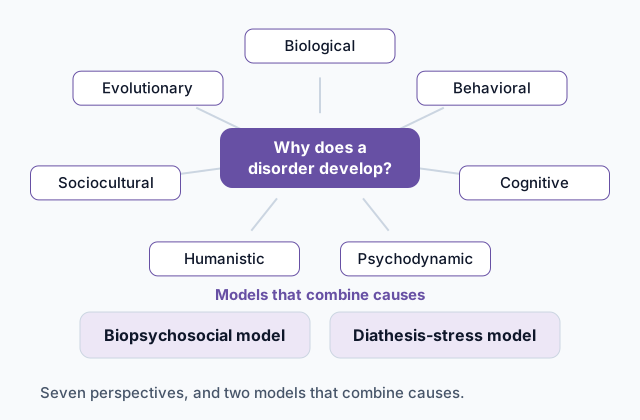 Tap to open the picture full size
Part 1 Think first A habit nobody else has
Guess before you learn. A wrong guess still makes the answer stick.
Predict first
Illustrative example. Every morning before work, Dana spends ten minutes talking out loud to her houseplants, asking how they slept and telling them about her day. Almost no one she knows does anything like it, and her friends tease her about it. Dana enjoys it, she is never late for work, and she sleeps well and keeps up with her friends. Would a psychologist call Dana's habit a psychological disorder?
In short. Psychologists use several factors to decide when a pattern of behavior and mental processes counts as a psychological disorder, and they explain where a disorder comes from through one or more psychological perspectives and through models that combine kinds of causes.
- Diagnosis takes specialized training and evidence-based tools, and the two classification systems clinicians use are revised as research and practice move on.
- A diagnosis can help or harm the person who receives it, depending on the disorder, the person and the culture around them.
- Each perspective points to a different kind of cause, and the biopsychosocial and diathesis-stress models build several causes in from the start.
Part 2 Learn it Four short ideas, each checked as you go
2a. When behavior counts as a disorder
Plenty of behavior is unusual without being a disorder. To decide whether a pattern of behavior and mental processes is a psychological disorder, psychologists weigh three factors.
- Dysfunction: how much the pattern gets in the way of daily life, such as going to work or school, taking care of yourself, or keeping up relationships.
- Distress: how much the person suffers, such as feeling constant worry or misery.
- Deviation from the social norm: how far the behavior departs from what the person's society expects.
No one factor settles it. A wingsuit flier who leaps off cliffs most weekends deviates from the norm and may be thriving. Norms also differ between cultures and change over time, so deviation alone is a weak guide.
Weighing these factors for a real person is not something a checklist can do. Diagnosing a psychological disorder requires specialized training and the use of evidence-based diagnostic tools. Clinicians classify disorders with two systems. The American Psychiatric Association developed the Diagnostic and Statistical Manual of Mental Disorders (DSM). The World Health Organization developed the ICD, its own classification of mental disorders. Both are updated regularly, so they respond to new research and to advances in practice.
Quick check · Sort it
Each note, from an illustrative case file, describes one factor a psychologist weighs. Tap a note, then tap the factor it describes.
Dysfunction
Distress
Deviation from the social norm
2b. What a diagnosis can do, for better and worse
Giving a person's struggles a diagnostic name has consequences, and they can run either way.
A diagnosis can help. It can open the door to treatment that has been studied for that disorder, and to support at school or work. It can give a person and their family a way to understand what has been happening. It also lets clinicians and researchers talk about the same problem in the same terms.
A diagnosis can also harm. A label can bring stigma: negative attitudes and beliefs that other people attach to anyone who carries it. Others may avoid the person, expect less of them, or treat them unfairly, which is discrimination. Bias can shape the diagnosis itself, too. Racism, sexism and ageism (bias against people because of their age) can lead a clinician to read the same signs differently in different people, so one person is diagnosed while another, with the same signs, is overlooked.
Which way it goes depends on three things: the nature of the disorder, the individual being diagnosed, and the culture around them, including its norms and how much stigma, racism, sexism, ageism and discrimination are present. The same diagnosis can bring one person relief and support and bring another person avoidance.
Quick check · Fill the statement
Tap a blank, then tap a word.
In an illustrative case, after months of struggling, Nadia is diagnosed with an anxiety disorder, and her school sets up the support she needs, a consequence of the diagnosis. When word of the diagnosis spreads, some classmates start avoiding her, which shows the that can attach to a label. Meanwhile, her grandfather has felt low for a year, but his doctor writes it off as a normal part of getting old and never assesses him, which is a sign of .
2c. Seven perspectives on where a disorder comes from
When psychologists ask why a disorder develops, each psychological perspective points to a different kind of cause.
- Biological: physiological or genetic issues, such as brain chemistry or inherited genes.
- Behavioral: maladaptive learned associations between or among responses and stimuli. A response that was once paired with a frightening event, or rewarded with relief, can become a habit that does harm.
- Cognitive: maladaptive thoughts, beliefs, attitudes or emotions, such as a belief that every setback proves you are worthless.
- Psychodynamic: unconscious thoughts and experiences, often developed during childhood, that shape feelings now without the person being aware of them.
- Humanistic: a lack of social support and being unable to fulfill one's potential.
- Sociocultural: maladaptive social and cultural relationships and dynamics, such as ongoing conflict in a family or a clash between a person's culture and the one around them.
- Evolutionary: behaviors and mental processes that reduce the likelihood of survival, such as a fear so strong that it cuts a person off from the people they depend on.
Each perspective catches something the others can miss. That is why most psychologists use an eclectic approach, drawing on more than one psychological perspective when they diagnose and treat a client.
Quick check · Match
In an illustrative case, Maya has had an intense, lasting fear of speaking in front of others. Tap a perspective, then tap the explanation it would give.
2d. Models that combine causes
Two models build more than one kind of cause in from the start.
The biopsychosocial model assumes that any psychological problem potentially involves a combination of biological, psychological and sociocultural factors. A clinician using it might note a medical condition that affects mood (biological), a habit of harsh self-criticism (psychological) and a recent breakup with a close friend group (sociocultural), and treat all three as part of the explanation.
The diathesis-stress model is narrower. It assumes that psychological disorders develop from a genetic vulnerability, the diathesis, in combination with stressful life experiences, the stress. Neither alone is expected to be enough. A person who carries the vulnerability but meets little stress may never develop the disorder, and a person without it may come through a very hard year. The risk climbs most when the two meet.
So the question that separates them is what the explanation needs. Diathesis-stress needs exactly two ingredients: an inherited vulnerability and stressful experiences. Biopsychosocial asks for no particular ingredient, only that biological, psychological and sociocultural factors are all considered together.
Quick check · Fill the statement
Tap a blank, then tap a word.
In an illustrative case, Dr. Price, a clinical psychologist, draws on ideas from several psychological perspectives with each client, so her approach is called . One client's mother and grandfather were both diagnosed with major depressive disorder, which suggests a possible genetic . His own first depressive episode began the month he lost his job, a stressful life experience. Dr. Price explains the episode with the model, which expects trouble when an inherited risk and stress combine.
Part 3 Watch it done Naming the model behind an explanation
Watch each step, then do the last one yourself.
Illustrative case notes (made up for practice). Lina, 34, has had months of low mood and has stopped doing things she used to enjoy. Her psychologist's notes say that blood tests found a hormone imbalance her doctor says can affect mood; that Lina keeps telling herself she ruins everything she touches; and that since moving for a new job she has lost touch with her friends and feels like an outsider in her new town. No one in her family has been diagnosed with a depressive or bipolar disorder. The psychologist explains Lina's low mood with all of these factors together. Which model is the psychologist using?
Step 1 · Sort each note by the kind of factor it names
The hormone imbalance is a biological factor, a physiological issue. Telling herself she ruins everything is a psychological factor, a maladaptive thought. Losing her friends and feeling like an outsider are sociocultural factors, about her social relationships.
Step 2 · Check what the explanation is built from
The psychologist's explanation uses all three kinds of factor together. The notes name no genetic vulnerability: no relative has been diagnosed, and nothing in the notes points to an inherited risk. The move was stressful, but stress is only one of the things the explanation draws on.
Why this step?
Why look for a genetic vulnerability before naming the model?
Because that is the ingredient that separates the two interaction models. One of them requires an inherited vulnerability paired with stress, and the other requires only that biological, psychological and sociocultural factors are weighed together.
Your step · Decide and justify
Finish the classification. In illustrative case notes, a psychologist explains Lina's months of low mood with a hormone imbalance, her habit of telling herself she ruins everything, and the friends she lost after moving to a new town. No relative has been diagnosed with a depressive or bipolar disorder. Which model is the psychologist using?
Which reason supports your answer?
Part 4 Try it Read a study: does a label change how people are treated?
Illustrative study (made up for practice, not a published study). Researchers recruited 120 adults online. A random-number generator assigned each adult to read one of two descriptions of a new coworker named Sam. The two descriptions gave the same work history and the same hobbies, except that one added a sentence: "Sam has been diagnosed with generalized anxiety disorder." Each adult then rated, from 1 to 7, how willing they would be to work on a project with Sam. Adults who read the version with the diagnosis gave a mean rating of 4.1, and adults who read the version without it gave a mean of 5.6. The difference was statistically significant.
Try it · Multiple choice
In an illustrative experiment, a random-number generator assigned 120 adults to read one of two descriptions of a new coworker, Sam. The descriptions were the same except that one added: "Sam has been diagnosed with generalized anxiety disorder." Each adult rated from 1 to 7 how willing they were to work on a project with Sam. What was the independent variable?
Try it · Decide and justify
In an illustrative experiment, 120 adults were randomly assigned to read one of two descriptions of a coworker, Sam, that were identical except that one said Sam had been diagnosed with generalized anxiety disorder. Readers of that version rated their willingness to work with Sam at a mean of 4.1 out of 7, against 5.6 for the other version, and the difference was statistically significant. A classmate concludes: "In this study, learning about the diagnosis made people less willing to work with Sam." Does the study support that cause-and-effect claim?
Which reason supports your answer?
Part 5 Explain it Write it the way the exam asks
Nothing you type leaves this page.
Free response is 33.3% of the exam score. This one is shaped like Question 2, Evidence-Based Question.
Free-response practice · Question 2 style
Read the three sources, then answer the question they share: what makes a person more likely to develop major depressive disorder? In parts B and C, cite the source you use, for example (Source 1).
Source 1. Illustrative study (made up for practice, not a published study). Researchers studied 200 pairs of identical twins and 200 pairs of fraternal twins. In every pair, one twin had been diagnosed with major depressive disorder by a clinician. Identical twins share nearly all their genes, and fraternal twins share about half. In 38 percent of the identical pairs the other twin had also been diagnosed, compared with 18 percent of the fraternal pairs. The difference was statistically significant.
Source 2. Illustrative study (made up for practice, not a published study). At the start of the school year, 300 first-year college students filled out a questionnaire about how they explain their own setbacks. Students in the top quarter of scores tended to blame themselves and to expect bad events to last. Over the year, 14 percent of the students in the top quarter were diagnosed with major depressive disorder by a clinician, compared with 5 percent of the students in the bottom quarter. The difference was statistically significant.
Source 3. Illustrative study (made up for practice, not a published study). Researchers followed 150 adults for one year after each had moved to a new country. At the start, each adult said how many people they could turn to for help. By the end of the year, 22 percent of the adults who named two people or fewer had been diagnosed with major depressive disorder by a clinician, compared with 8 percent of the adults who named five or more. The difference was statistically significant.
(A) Propose a specific and defensible claim, based in psychological science, that answers the question.
(B) (i) Support your claim using one piece of specific and relevant evidence from one of the sources. (ii) Explain how the evidence from part B (i) supports your claim, using a psychological perspective, theory, concept, or research finding.
(C) (i) Support your claim using a piece of specific and relevant evidence from a different source. (ii) Explain how the evidence from part C (i) supports your claim, using a different psychological perspective, theory, concept, or research finding from the one in part B (ii).
Model answer
(A) Major depressive disorder becomes more likely as biological and social risk factors increase: a person who shares more genes with someone who has the disorder, or who has fewer people to turn to for support, is more likely to develop it.
(B) (i) In Source 1, when one twin had been diagnosed with major depressive disorder, the other twin had also been diagnosed in 38 percent of identical pairs, compared with 18 percent of fraternal pairs. (ii) The biological perspective proposes that the causes of psychological disorders focus on physiological or genetic issues. Identical twins share nearly all their genes and fraternal twins share about half, so a match rate more than twice as high among identical twins fits a genetic influence on the disorder. That supports the claim that sharing more genes with someone who has the disorder makes a person more likely to develop it.
(C) (i) In Source 3, 22 percent of the adults who could turn to two people or fewer were diagnosed with major depressive disorder within a year of moving, compared with 8 percent of the adults who could turn to five or more. (ii) The humanistic perspective, a different perspective from part B, proposes that the causes of psychological disorders focus on a lack of social support and on being unable to fulfill one's potential. Adults with fewer people to turn to were diagnosed far more often, which fits the humanistic view that a lack of social support raises the risk, as the claim says. Because the researchers only measured support and did not assign it, the result shows a link, not proof that the lack of support came first.
Score your own answer. This is a self-check, not a grade. Tick each point your answer makes.
Part 6 Check yourself Read five years of illustrative data
On the exam, some multiple-choice questions share one set of data, the way these do.
Illustrative data (made up for practice). Researchers followed 800 adults for five years. At the start, they recorded whether each person had a parent or sibling who had been diagnosed with major depressive disorder, and they treated that as a sign of a possible genetic vulnerability. Over the five years, they counted each person's major stressful life events, such as losing a job or the death of someone close, and grouped people as having few events (0 or 1) or many (3 or more). People with exactly two events are left out of the table. Nobody was assigned to a group; the researchers only recorded what happened. The table shows the percent of each group diagnosed with major depressive disorder by a clinician during the five years. The rise from few to many events was statistically significantly larger for people with a diagnosed parent or sibling.
| Parent or sibling diagnosed? | Few stressful events | Many stressful events |
|---|---|---|
| No | 4% | 9% |
| Yes | 7% | 24% |
Case question 1 · Multiple choice
In an illustrative five-year study, adults with no parent or sibling diagnosed with major depressive disorder were diagnosed with it at rates of 4% with few stressful events and 9% with many. For adults with a diagnosed parent or sibling, which the researchers treated as a sign of a possible genetic vulnerability, the rates were 7% and 24%. Which best explains the pattern?
Case question 2 · Calculate
In an illustrative five-year study, adults with no parent or sibling diagnosed with major depressive disorder were diagnosed with it at rates of 4% with few stressful events and 9% with many. Adults with a diagnosed parent or sibling were diagnosed at rates of 7% with few events and 24% with many. How many percentage points larger is the rise from few to many events for adults with a diagnosed parent or sibling than for adults without one?
Case question 3 · Spot the error
In an illustrative five-year study, adults without a diagnosed parent or sibling were diagnosed with major depressive disorder at 4% with few stressful events and 9% with many, and adults with one at 7% and 24%. A student explains the table. Tap the first line that goes wrong.
The rest stand on their own and do not use the case.
Check yourself · Fill the statement
Tap a blank, then tap a word.
After years of specialized training, Dr. Boateng uses evidence-based diagnostic tools to learn about each client. To classify what she finds, she can use the , which the American Psychiatric Association developed, or the , which the World Health Organization developed. Both systems are regularly as research and practice advance, so a classification she learned in graduate school may have changed since.
Check yourself · Decide and justify
Illustrative example. A website offers a free ten-question quiz. When a user finishes it, the screen reads: "Result: you have generalized anxiety disorder." Does that result count as a diagnosis of a psychological disorder?
Which reason supports your answer?
Part 7 Keep it Bring back earlier ideas
Coming back to older ideas is how they stay usable on the exam.
Bring it back · Multiple choice
Two years after a fire destroyed her family's home, Keiko says the loss was terrible, but that she now feels closer to her sister, surer of what matters to her, and stronger than she was before the fire. Which idea from positive psychology best describes this change?
Bring it back · Decide and justify
On her first day at a new job, Wen sees every coworker drop their phone in a basket by the door before the morning meeting. No sign says to, and no one tells her to. She is not sure whether it is a rule, so she drops her phone in too. Is Wen showing normative or informational social influence?
Which reason supports your answer?
In three lines
- Psychologists weigh dysfunction, distress and deviation from the social norm, and only trained clinicians with evidence-based tools diagnose, using the DSM or the ICD.
- A diagnosis can bring treatment and understanding, or stigma and discrimination, depending on the disorder, the person and the culture.
- Seven perspectives each point to a kind of cause, and the biopsychosocial and diathesis-stress models combine causes, as an eclectic psychologist does.
Vocabulary
- Dysfunction, distress and deviation
- The level of dysfunction, the perception of distress and deviation from the social norm are all factors used to identify psychological disorders.
- Diagnostic and Statistical Manual of Mental Disorders (DSM)
- The system the American Psychiatric Association developed to classify mental disorders, updated regularly as research and practice advance.
- International Classification of Diseases (ICD)
- The system the World Health Organization developed to classify health conditions, mental disorders among them, also updated regularly. College Board's course framework calls it the International Classification of Mental Disorders; both names mean the same system.
- Stigma
- Negative attitudes and beliefs attached to people who carry a diagnosis, one of the factors that shapes whether a diagnosis helps or harms.
- Eclectic approach
- Using more than one psychological perspective when diagnosing and treating clients, as most psychologists do.
- Behavioral and cognitive perspectives
- The behavioral perspective looks for causes in maladaptive learned associations between responses and stimuli, and the cognitive perspective in maladaptive thoughts, beliefs, attitudes or emotions.
- Psychodynamic and humanistic perspectives
- The psychodynamic perspective looks for causes in unconscious thoughts and experiences, often from childhood, and the humanistic perspective in a lack of social support and being unable to fulfill one's potential.
- Biological, evolutionary and sociocultural perspectives
- These look for causes in physiological or genetic issues, in behaviors and mental processes that reduce the likelihood of survival, and in maladaptive social and cultural relationships and dynamics.
- Biopsychosocial model
- A model that assumes any psychological problem potentially involves a combination of biological, psychological and sociocultural factors.
- Diathesis-stress model
- A model that assumes psychological disorders develop from a genetic vulnerability (diathesis) in combination with stressful life experiences (stress).
Course alignment, for teachers
AP Psychology topic 5.3, Unit 5: Mental and Physical Health.
- Skill 1.B: Explain how cultural norms, expectations, and circumstances, as well as cognitive biases apply to behavior and mental processes.
- Skill 2.D: Evaluate whether a psychological research scenario followed appropriate ethical procedures.
- Skill 4.B: Provide reasoning that is grounded in scientifically derived evidence to support, refute, or modify an established or provided claim, policy, or norm.
This lesson maps all 13 essential knowledge statements of the topic to the part that teaches each one: 13 are checked by a scored question. The map is in the lesson file.