Unit 1 · Topic 1.2 · about 30 minutes · 7 parts · 10 scored checks, 2 of them multiple choice, plus 2 from earlier lessons
AP U.S. Government and Politics 1.2: Types of Democracy
Unit 1: 15 to 22% of the multiple-choice section
What you'll be able to do
- Explain how models of representative democracy are visible in major institutions, policies, events, or debates in the U.S.
Key vocabulary
| Term | What it means | The exam trap |
|---|---|---|
| Participatory democracy | Broad public involvement in politics and civil society. | Broad participation describes involvement, not direct voting on every law. |
| Pluralist democracy | Policy influence through competition among organized nongovernmental interests. | Group competition can involve unequal resources and influence. |
| Elite democracy | Influence centered on a comparatively restricted group of decision makers. | A small decision-making circle differs from the public simply losing a vote. |
 Tap to open the picture full size
Part 1 Think first Predict what the evidence supports
Track who has a route into the decision and how that route works.
Predict first
An open resident forum, a competition among associations, and a closed leadership negotiation all concern one proposal. Must only one model of democracy describe the entire process?
In short. Models of democracy differ in how people gain influence through broad participation, organized groups, and a more restricted circle of decision makers.
- Identify the route of participation before choosing a model.
- Constitutional arguments debate how representation can protect liberty and popular control.
- One institution can display several patterns of influence.
Part 2 Learn it Participation models
2a. Ask who participates and how
A representative democracy can contain several models of influence. Participatory democracy emphasizes broad public involvement in politics and civil society. A neighborhood meeting open to residents, volunteers organizing an issue forum, or people contacting representatives can illustrate that emphasis. Participation does not require unanimous agreement or direct public votes on every decision.
Pluralist democracy emphasizes competition among organized, nongovernmental interests. A labor association, a business coalition, and a neighborhood group may seek different policy outcomes. The relevant feature is organized group influence, not a guarantee that all groups possess equal resources.
Elite democracy emphasizes more limited participation in politics and civil society. A small circle of influential decision makers may shape choices available to the broader public. The model describes a pattern of influence; identifying it does not by itself establish that a particular outcome is desirable.
Primary texts: Federalist No. 10, extended-sphere discussion and Brutus No. 1, extensive-republic argument.
Quick check · Fill the statement
Apply the distinction in the completed statement.
An open civic forum inviting broad resident involvement most directly emphasizes .
2b. Find the tension in constitutional argument
The Constitution and the ratification debate combine broad participation with institutional filtering. Representatives act for a larger public, while different selection arrangements can place additional steps between public preferences and a decision.
In Federalist No. 10, Madison argues that representation and a large republic can reduce the danger posed by factions. Brutus No. 1 worries that an extensive republic makes representatives distant from citizens and threatens meaningful popular control. These are arguments about the conditions under which representative government can protect liberty, not a simple choice between elections and no elections.
Use the models to analyze a feature of an argument: does it emphasize broad engagement, organized interests, or a smaller group exercising influence? A document can contain more than one concern.
For example, election to the House gives the public a direct representative route, while presidential selection through electors adds an institutional step. The relevant point is how constitutional arrangements connect participation to public decisions, not whether a single model permanently describes the entire system.
Quick check · Fill the statement
Apply the distinction in the completed statement.
Madison’s defense of a large republic uses , while Brutus warns about distance from the .
2c. Use the models as lenses, not permanent labels
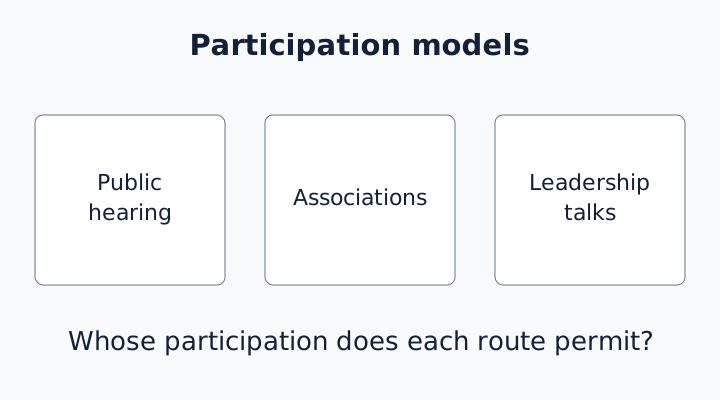
Contemporary institutions can display different models at different moments. An open hearing encourages broad public engagement; competing associations lobby the same committee; a small leadership group negotiates the final proposal. These observations can all concern one policymaking process.
A sound classification identifies the actor, the route of influence, and the evidence for that route. Do not infer elite influence merely because a proposal passes, pluralism merely because people disagree, or participation merely because officials describe a policy as popular. The model explains the observed pattern of involvement rather than predicting every policy outcome.
Quick check · Fill the statement
Apply the distinction in the completed statement.
An open forum, organized-group lobbying, and a restricted leadership negotiation display models within one process.
Part 3 Watch it done Read a hearing without assuming an outcome
A committee accepts written comments from individual residents, hears competing trade associations, and then lets a small leadership group negotiate its final proposal.
Step 1 · Read the institutional evidence
The process has three stages. Individual comments are open broadly; the hearing channels organized-interest competition; the final negotiation restricts who shapes the alternatives.
Why this step?
Why should each stage be examined separately?
The participants and route of influence change between stages even though the institution and policy remain the same.
Step 2 · Separate the competing explanations
Participation models describe the observed route of influence; the final stage does not relabel the people who took part earlier.
Your step · Decide and justify
Which model best describes the final negotiation?
Which reason supports this classification?
Second worked example: a warning about distance
A writer argues that a large territory makes representatives less familiar with residents’ concerns. First identify the concern: distance weakens popular control. Then connect it to the tension between broad participation and institutional filtering. This resembles Brutus’s concern, rather than Madison’s claim that a large republic can help control faction. Do not treat either writer as rejecting every form of representative government.
Part 4 Try it Classify new situations
Original teaching scenarios: Assign each situation to the concept it most directly illustrates.
Try it · Sort it
Assign each situation to the concept it most directly illustrates.
Participatory democracy
Pluralist democracy
Elite democracy
Try it · Fill the statement
Complete the analysis of this situation.
Two clearly labeled argument paraphrases: Madison defends a large republic because representation can control faction; Brutus warns that distant representatives weaken popular control. Their disagreement concerns , while presidential selection through electors illustrates participation.
Part 5 Explain it Write the causal or institutional connection
Free response is 50% of the exam score. This one is shaped like Question 1, Concept Application.
Free-response practice · Question 1 style
Original concept-application practice: a legislature holds an open public forum, hears competing organized associations, and leaves final negotiation to a small leadership group. (A) Identify the model emphasized by the forum. (B) Describe why the associations illustrate another model. (C) Explain why the final negotiation does not make the earlier observations disappear. (D) Compare the clearly labeled argument paraphrases: Madison defends representation in a large republic to control faction, while Brutus warns that distant representatives weaken popular control. Explain how the two arguments reflect a tension between broad participation and filtered representation, using a specific feature of each argument.
Model answer
The forum emphasizes participatory democracy because it invites broad public involvement. The associations illustrate pluralist democracy because organized nongovernmental interests compete to influence policy. The restricted negotiation can illustrate an elite pattern at another stage. The same process can contain these different routes of influence, so one observation does not erase the others. Madison treats elected representatives in a large republic as a useful filter against faction’s harmful effects; Brutus worries that the same distance weakens people’s meaningful participation and control. The difference concerns whether that institutional filtering protects liberty or makes representatives less responsive.
Score your own answer. This is a self-check, not a grade. Tick each point your answer makes.
Part 6 Check yourself Compare three routes of influence
A fictional legislature considers transportation rules. The table describes three events; it does not report which proposal wins.
| Event | Observed participation |
|---|---|
| Public forum | Many residents attend an open discussion |
| Committee hearing | Several organized associations lobby for competing proposals |
| Final negotiation | A small leadership circle settles the available alternatives |
Case question 1 · Multiple choice
Which event most directly illustrates pluralist democracy?
Case question 2 · Multiple choice
What can be concluded from the three events together?
The rest stand on their own and do not use the case.
Check yourself · Spot the error
Select the statement with a conceptual or factual error.
Check yourself · Match
Match each idea to the explanation that distinguishes it from the alternatives.
Part 7 Keep it Retrieve and connect
From 1.1 Ideals of Democracy · Fill the statement
Complete the distinction between rights and the source of public power.
Rights people possess apart from government permission are . The principle that public authority comes from the people is .
From 1.1 Ideals of Democracy · Match
Match each safeguard to the institutional arrangement it describes.
In three lines
- Identify the route of participation before choosing a model.
- Constitutional arguments debate how representation can protect liberty and popular control.
- One institution can display several patterns of influence.
Exam strategy for this topic
- Section I, Multiple Choice: 55 questions in 80 minutes.
- Section II, Free Response: 4 questions in 100 minutes.
- This lesson's Explain it is shaped like free-response question 1, Concept Application.
Track who has a route into the decision and how that route works. Support the connection with a specific fact from the prompt.
Questions students ask
Can one institution show more than one model?
Yes. A committee can invite the public, hear competing associations, and then negotiate through a restricted leadership group. Classify each observed route rather than assigning a permanent label to the committee.
How do Federalist No. 10 and Brutus No. 1 differ?
Madison defends representation and a large republic as means of controlling faction. Brutus emphasizes how distance in an extensive republic can weaken popular control. Their disagreement concerns the conditions for protecting liberty through representation.
Does pluralism require equal group resources?
No. The model identifies competition among organized nongovernmental interests. It does not establish equal access, funding, or success.
Is an open hearing evidence of elite influence?
An open hearing emphasizes broad participation. Evidence that a restricted circle shapes the available choices would support a distinct elite interpretation at that stage.
Course alignment, for teachers
AP U.S. Government and Politics topic 1.2, Unit 1: Foundations of American Democracy.
- Skill 4.A: Describe the argument, perspective, evidence, and reasoning presented in the source.
This lesson maps all 3 essential knowledge statements of the topic to the part that teaches each one: 3 are checked by a scored question. The map is in the lesson file.