Unit 1 · Topic 1.3 · about 30 minutes · 7 parts · 10 scored checks, 2 of them multiple choice, plus 2 from earlier lessons
AP U.S. Government and Politics 1.3: Government Power and Individual Rights
Unit 1: 15 to 22% of the multiple-choice section
What you'll be able to do
- Explain Federalist and Anti-Federalist views on central government and democracy.
Key vocabulary
| Term | What it means | The exam trap |
|---|---|---|
| Federalist argument | A defense of ratification and a stronger central government, including the large-republic response to faction. | Support for ratification does not require eliminating all state authority. |
| Anti-Federalist argument | A concern that a large, centralized republic could weaken popular control and threaten liberty. | Opposition to this Constitution does not mean opposition to every elected republic. |
| Faction | A group united by an impulse adverse to others’ rights or the community’s aggregate interests. | Ordinary disagreement is insufficient: the impulse must threaten others’ rights or the community’s aggregate interests. |
| Ratification | Formal approval of the proposed Constitution through the prescribed process. | Ratification approves a proposed constitutional arrangement; it is not the later amendment process. |
| Republic | A political system in which public decisions operate through representatives. | A republic uses representation; its size is a separate design choice. |
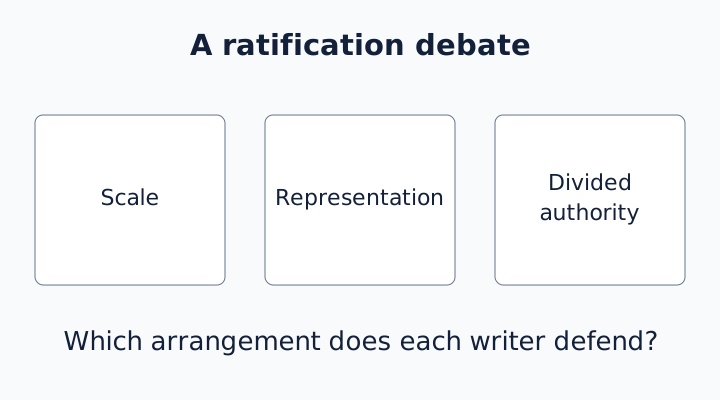 Tap to open the picture full size
Part 1 Think first Predict what the evidence supports
Compare each writer’s proposed safeguard and the causal reason offered for it.
Predict first
A proposed national legislature would govern a larger and more diverse territory. Can a supporter and a critic both argue that they are protecting liberty?
In short. Federalist and Anti-Federalist arguments disagree about how the scale and powers of a republic affect popular control, faction, and individual liberty.
- Compare the institutional mechanism, not just the political label.
- Federalist arguments defend scale and representation as responses to harmful faction.
- Anti-Federalist arguments emphasize the risks of distance and concentrated authority.
Part 2 Learn it A ratification debate
2a. Explain the Federalist case for a large republic
Federalists supported ratification and a stronger central government. In Federalist No. 10, Madison argues that a large republic can control the harmful effects of factions by bringing together many interests and delegating decisions to representatives. A majority pursuing a narrow interest is less likely to dominate a larger, more varied political community.
The claim is not that factions disappear or that representatives never pursue their own interests. It concerns arrangements that can make coordinated oppression harder. Distributing authority between state and national governments adds another division of power. Identify both the institutional feature and the problem the writer believes it can address.
Read the competing arguments in Federalist No. 10 and Brutus No. 1, original essay after the introduction.
Quick check · Fill the statement
Apply the distinction in the completed statement.
Madison argues that a republic and can help control faction’s harmful effects.
2b. Explain the Anti-Federalist concern about distance
Anti-Federalists opposed ratification as proposed and favored more power remaining with the states. Brutus No. 1 argues that a large, centralized republic can make representatives distant from the public and endanger personal liberty. A smaller, more decentralized republic can make popular participation and accountability more feasible.
This is a concern about the relationship between scale, representation, and power. Do not reduce it to hostility toward every form of government or to support for unlimited state authority. The writer asks whether the proposed national structure will remain meaningfully controlled by the people.
Quick check · Fill the statement
Apply the distinction in the completed statement.
Brutus’s concern links greater political to weaker popular .
2c. Compare reasoning rather than political labels
A comparison needs a common question: how can representative government preserve liberty? The Federalist response stresses the advantages of a large republic and divided authority in controlling faction. The Anti-Federalist response stresses the risk that distance and concentrated national power weaken public control.
Apply the arguments to a new scenario by identifying the proposed institutional change, the predicted consequence, and the reasoning connecting them. A writer predicting fewer oppressive majority coalitions is making a different claim from a writer predicting weaker accountability. Neither argument alone proves what will happen in every modern dispute.
Quick check · Fill the statement
Apply the distinction in the completed statement.
Madison’s broader republic disperses influence among competing interests; Brutus’s smaller republic seeks closer between representatives and residents.
Part 3 Watch it done Distinguish a mechanism from a prediction
Two original paraphrases of the ratification debate: Writer A favors a large republic with elected representatives and divided national/state authority. Writer B favors a smaller, decentralized republic because remote representatives may not know residents’ concerns.
Step 1 · Read the institutional evidence
Writer A combines scale, representation, and dispersed power. Writer B connects distance to weakened accountability. Both are proposing arrangements they believe protect liberty.
Why this step?
Why does identifying support for elections fail to settle the dispute?
Both positions use representative institutions. They disagree about which scale and allocation of authority best preserve popular control.
Step 2 · Separate the competing explanations
Classify the argument from its causal reasoning, rather than treating the word representative as uniquely Federalist.
Your step · Decide and justify
New proposal: elected national representatives would absorb the governing functions now exercised by the states. A critic says local elections do not resolve concerns about the scale and concentration of authority. Which ratification argument supplies the closer objection?
Which mechanism supports the inference in the new situation?
Second worked example: compare the missing assumption
Suppose an author claims that electing representatives will automatically eliminate every faction. Start with the claim’s scope: automatically and every make it absolute. Madison’s argument concerns controlling harmful effects through scale and representation, not eliminating differing interests. A sound response preserves the mechanism while rejecting the unsupported guarantee.
Part 4 Try it Classify new situations
Original teaching scenarios: Assign each situation to the concept it most directly illustrates.
Try it · Sort it
Assign each situation to the concept it most directly illustrates.
Federalist argument
Anti-Federalist argument
Faction
Try it · Fill the statement
Complete the analysis of this situation.
A Federalist defense combines elected , a large republic, and dispersion between governments, rather than concentrating each decision in one body.
Part 5 Explain it Write the causal or institutional connection
Free response is 50% of the exam score. This one is shaped like Question 1, Concept Application.
Free-response practice · Question 1 style
Original concept-application practice: a proposal transfers more authority to a large national legislature. One critic predicts distant representatives; one supporter predicts a broader mix of interests. (A) Identify the argument associated with the supporter. (B) Describe the critic’s concern about popular control. (C) Explain how the two arguments answer the same problem differently.
Model answer
The supporter uses a Federalist large-republic argument: more competing interests can make oppressive faction harder to coordinate. The critic uses an Anti-Federalist concern that distance and stronger central authority weaken citizens’ control over representatives. Both seek a form of republican government that preserves liberty, but they predict different effects from scale and centralization.
Score your own answer. This is a self-check, not a grade. Tick each point your answer makes.
Part 6 Check yourself Compare two constitutional arguments
Two fictional writers discuss a proposal to transfer additional decisions from regional assemblies to a national legislature.
| Writer | Reason offered |
|---|---|
| Writer A | A broader republic can bring more competing interests into public decisions |
| Writer B | More distant decision makers may be harder for residents to hold accountable |
Case question 1 · Multiple choice
Which interpretation most closely fits Writer A?
Case question 2 · Multiple choice
Which response best explains Writer B’s concern?
The rest stand on their own and do not use the case.
Check yourself · Spot the error
Select the statement with a conceptual or factual error.
Check yourself · Match
Match each idea to the explanation that distinguishes it from the alternatives.
Part 7 Keep it Retrieve and connect
From 1.1 Ideals of Democracy · Match
Match each idea to the question it answers.
From 1.2 Types of Democracy · Match
Match each idea to the explanation that distinguishes it from the alternatives.
In three lines
- Compare the institutional mechanism, not just the political label.
- Federalist arguments defend scale and representation as responses to harmful faction.
- Anti-Federalist arguments emphasize the risks of distance and concentrated authority.
Exam strategy for this topic
- Section I, Multiple Choice: 55 questions in 80 minutes.
- Section II, Free Response: 4 questions in 100 minutes.
- This lesson's Explain it is shaped like free-response question 1, Concept Application.
Compare each writer’s proposed safeguard and the causal reason offered for it. Support the connection with a specific fact from the prompt.
Questions students ask
Did Madison propose eliminating political disagreement?
No. Federalist No. 10 treats the causes of faction as difficult to remove without sacrificing liberty. Representation and a larger republic seek to control faction’s harmful effects rather than require agreement.
Why did Brutus favor a smaller republic?
Brutus worried that representatives in an extensive, centralized republic would be distant from the people and threaten liberty. A smaller, decentralized republic was a proposed safeguard for popular control.
How does dispersed authority fit the Federalist case?
Delegating authority to representatives and dividing power between national and state governments provide safeguards alongside the broader variety of interests in a large republic.
Is any group a faction in Madison’s sense?
The relevant shared impulse is adverse to others’ rights or the aggregate interests of the community. Mere organization or ordinary disagreement is not enough for that definition.
Course alignment, for teachers
AP U.S. Government and Politics topic 1.3, Unit 1: Foundations of American Democracy.
- Skill 1.A: Describe political principles, institutions, processes, policies, and behaviors.
This lesson maps all 2 essential knowledge statements of the topic to the part that teaches each one: 2 are checked by a scored question. The map is in the lesson file.