Unit 1 · Topic 1.9 · about 30 minutes · 7 parts · 9 scored checks, 2 of them multiple choice, plus 2 from earlier lessons
AP U.S. Government and Politics 1.9: Federalism in Action
Unit 1: 15 to 22% of the multiple-choice section
What you'll be able to do
- Explain how the distribution of powers between national and state governments impacts policymaking.
Key vocabulary
| Term | What it means | The exam trap |
|---|---|---|
| Access point | An institutional route through which a stakeholder can seek influence over a public decision. | Identify the official or institution receiving the request and the decision it can make. |
| Concurrent power | Authority that both national and state governments can exercise. | Concurrent authority differs from an exclusive power held by one level. |
| Policy constraint | A limit on an actor’s options arising from authority, institutions, or other governing conditions. | A constraint on implementation is not absence of every relevant power. |
| Federalism | The division and sharing of governmental authority between national and state levels. | Federalism divides authority between levels rather than between branches. |
| Stakeholder | A person, group, or institution with an interest in a public decision. | A stakeholder’s interests do not establish which institution has legal authority. |
 Tap to open the picture full size
Part 1 Think first Predict what the evidence supports
Follow an actual policy request through the institutions with relevant authority.
Predict first
A stakeholder can petition both national and state officials, but no institution promises to adopt the request. What is established?
In short. Divided national and state authority gives stakeholders several routes of influence while limiting what either level can accomplish acting alone.
- An access point is a route for seeking influence rather than a guarantee.
- Concurrent authority can constrain national policymaking without eliminating national power.
- Explain the specific institutions and mechanisms behind both opportunity and constraint.
Part 2 Learn it A shared road project
2a. Find the institutional route behind influence
Federalism creates access points at more than one level of government. A stakeholder concerned about a policy may work with national officials, state institutions, or both, depending on which powers are relevant. The same public issue can involve several institutional decisions rather than a single national instruction.
Explain the route of influence: name the stakeholder’s action, the institution approached, and the authority that could produce a response. Mere contact does not prove success, and a level of government cannot lawfully grant every request. Access points explain opportunities to seek change, not a guarantee that all participants have equal resources or prevail.
Quick check · Fill the statement
Apply the distinction in the completed statement.
A stakeholder approaching a relevant state institution is using an institutional .
2b. Explain how shared power constrains a national plan
Concurrent powers are exercised by national and state governments. Because both levels can act within shared fields, national policymaking must account for state institutions, decisions, and implementation. A national preference alone does not establish complete control over every related action.
For example, both levels may participate in road policy or taxation under their respective authority. A stakeholder may need decisions from more than one institution to accomplish a practical goal. Do not infer that a constraint means the national government has no relevant power; it means the distribution of authority affects the options and the path to implementation.
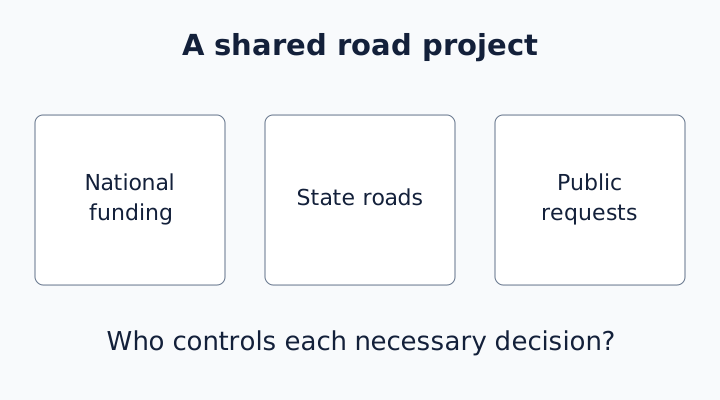
Consider an original shared road-safety project. National legislators may offer a grant, while state legislators decide the state road budget and officials plan state road construction. Both levels can tax and build roads within their authority. National funding does not itself appropriate the state contribution or complete the state planning decision. These separate decisions constrain implementation of that shared project, without creating a universal state veto over valid national action.
Quick check · Fill the statement
Apply the distinction in the completed statement.
When both national and state governments exercise a function, the power is rather than exclusive to one level.
2c. Connect the access opportunity to the constraint
The same distribution of power can create an opportunity and a limitation. More than one level gives stakeholders alternative routes for seeking action; more than one institution with relevant authority also means one actor cannot necessarily complete a plan alone.
Compare two claims carefully. The statement that a stakeholder can approach state officials identifies an access point. The statement that a national proposal must account for a lawful state decision identifies a constraint. Neither establishes that one level always wins, that every policy requires unanimity, or that divided government prevents all public action. The evidence must show the particular route and the particular limit.
Quick check · Fill the statement
Apply the distinction in the completed statement.
One distribution of authority can provide both an access for stakeholders and a on a policymaker’s options.
Part 3 Watch it done Separate an available route from a guaranteed result
A road-safety proposal uses a national grant and a state contribution. The state legislature has not approved its contribution. Residents petition national legislators about grant terms and state legislators about the state road budget.
Step 1 · Read the institutional evidence
The proposal depends on two separate budget decisions. A national grant decision does not itself appropriate the state contribution. The group addresses each institution about a decision within its authority.
Why this step?
Why is the missing state contribution a specific constraint rather than absence of national power?
National officials can act on the grant, but this proposal also requires a separate state appropriation. The incomplete state decision limits implementation of this arrangement.
Step 2 · Separate the competing explanations
Explain the particular decision needed; a state role here does not prove that states can veto valid national action generally.
Your step · Decide and justify
New condition: the state approves its contribution, but the proposed project does not meet the national grant’s stated eligibility condition. What remains to be addressed before this funding arrangement can proceed?
Which mechanism supports the inference in the new situation?
Second worked example: use both sides of divided authority
Residents want safer crossings on a state road. They petition state legislators to fund construction and national legislators to change grant eligibility. The state budget request and the national grant request concern distinct decisions by institutions with relevant road and taxation powers. This is evidence of multiple access points. If the state declines the contribution required by this proposal, implementation may be constrained, but that result does not erase the national grant power or prove that every shared project fails.
Part 4 Try it Classify new situations
Original teaching scenarios: Assign each situation to the concept it most directly illustrates.
Try it · Sort it
Assign each situation to the concept it most directly illustrates.
Access point
Concurrent power
Policy constraint
Part 5 Explain it Support a claim with institutional evidence
Free response is 50% of the exam score. This one is shaped like Question 1, Concept Application.
Free-response practice · Question 1 style
Original concept-application practice: a road-safety project combines a national grant with a state contribution. The state legislature has not approved its share. Residents petition national legislators about grant eligibility and state legislators about the road budget. (A) Make a claim about how federalism affects opportunities for influence. (B) Support it with the two specific institutions and decisions. (C) Explain how concurrent authority constrains implementation here without establishing a universal state veto.
Model answer
Federalism creates multiple access points because residents can seek changes to national grant terms from national legislators and a state appropriation from state legislators. Those institutions control different decisions involving their road and budget authority. The proposed project also depends on the state contribution; national grant approval cannot itself complete the state appropriation. That constrains this arrangement without establishing a general state veto over valid national action.
Score your own answer. This is a self-check, not a grade. Tick each point your answer makes.
Part 6 Check yourself Explain opportunity and constraint together
An original transportation-policy exercise records several lawful institutional actions; no action is assumed to guarantee the final plan.
| Actor | Observed action or condition |
|---|---|
| Residents’ group | Petitions state legislators and a national agency |
| National institution | Has relevant authority but must account for lawful state decisions |
| State institution | Exercises authority in the same general policy field |
Case question 1 · Multiple choice
What does the residents’ group’s action establish?
Case question 2 · Multiple choice
Which explanation best connects the national institution’s authority with the stated constraint?
The rest stand on their own and do not use the case.
Check yourself · Spot the error
Select the statement with a conceptual or factual error.
Check yourself · Match
Match each idea to the explanation that distinguishes it from the alternatives.
Part 7 Keep it Retrieve and connect
From 1.6 Principles of American Government · Match
Match each idea to the explanation that distinguishes it from the alternatives.
From 1.4 Challenges of the Articles of Confederation · Fill the statement
Recall the governing arrangement and the mechanism behind its revenue weakness.
The first national framework, the , relied on state legislatures to supply the common treasury. Its national revenue therefore depended on state .
In three lines
- An access point is a route for seeking influence rather than a guarantee.
- Concurrent authority can constrain national policymaking without eliminating national power.
- Explain the specific institutions and mechanisms behind both opportunity and constraint.
Exam strategy for this topic
- Section I, Multiple Choice: 55 questions in 80 minutes.
- Section II, Free Response: 4 questions in 100 minutes.
- This lesson's Explain it is shaped like free-response question 1, Concept Application.
Follow an actual policy request through the institutions with relevant authority. Support the connection with a specific fact from the prompt.
Questions students ask
Why can federalism create several access points?
National and state institutions exercise relevant powers. A group seeking safer roads can approach national legislators about grants and state legislators about the state road budget. Those requests address different decisions.
Does a state role create a universal veto?
No. A state’s lawful role can constrain one project’s implementation without displacing valid national authority in other settings. Explain the particular power and decision that matter.
What is the evidence for a constraint in the road example?
The shared proposal requires a state contribution that the state legislature has not appropriated. National grant approval does not itself complete that separate budget decision.
How should an explanation use evidence?
Name the institution, the power, and the requested decision. For example, distinguish a request to national legislators about grant terms from a request to state legislators about the road budget.
Course alignment, for teachers
AP U.S. Government and Politics topic 1.9, Unit 1: Foundations of American Democracy.
- Skill 5.B: Support an argument or claim/thesis using relevant evidence.
This lesson maps all 2 essential knowledge statements of the topic to the part that teaches each one: 2 are checked by a scored question. The map is in the lesson file.