Unit 2 · Topic 2.1 · about 30 minutes · 7 parts · 14 scored checks, 2 of them multiple choice, plus 2 from earlier lessons
AP U.S. Government and Politics 2.1: Congress: The Senate and the House of Representatives
Unit 2: 25 to 36% of the multiple-choice section
What you'll be able to do
- Describe the different structures, powers, and functions of each house of Congress.
Key vocabulary
| Term | What it means | The exam trap |
|---|---|---|
| Bicameralism | A legislature organized into two chambers. | Two chambers are not two levels of federal government. |
| Republicanism | Public decisions made through representatives of the people. | Representative action does not require direct popular voting on each bill. |
| Congressional oversight | Legislative review and monitoring of executive implementation. | Reviewing agency conduct is different from an agency implementing a law. |
| Enumerated power | A power expressly assigned in the Constitution. | A policy goal alone does not identify the constitutional power. |
| Implied power | A means inferred for carrying out an enumerated power. | Implied does not mean unlimited or detached from enumerated authority. |
| Naturalization | The process by which a person can become a U.S. citizen under legally established rules. | Identify the institution setting the citizenship rules, rather than one individual application. |
| Jurisdiction | A court’s legal authority to hear and decide specified types of cases. | Distinguish defining a court’s authority from deciding the merits of a case. |
| Necessary and Proper Clause | Congressional authority to legislate means for carrying out enumerated powers. | Identify the enumerated power and how the proposed means carries it out. |
 Tap to open the picture full size
Part 1 Think first Predict the institutional consequence
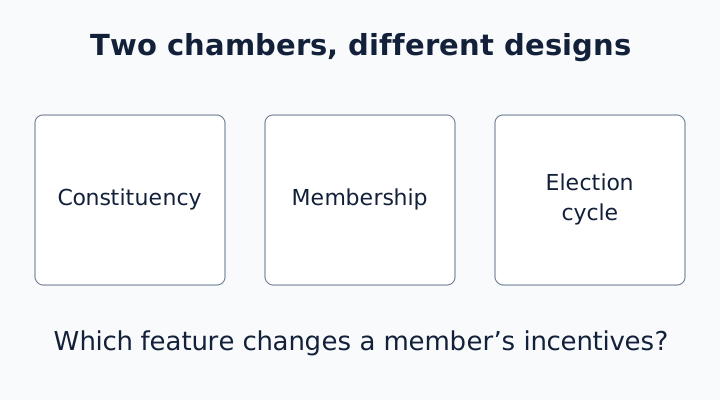
Use membership, constituency, and election rules to explain institutional incentives without predicting a party outcome.
Predict first
A national issue dominates a regular congressional election. Is every seat in both chambers scheduled for election?
In short. Congress combines population-based and equal-state representation with distinct election cycles, debate practices, and powers that shape national policy.
- Distinguish population-based and equal-state representation.
- Connect membership size and term lengths to procedure and electoral exposure.
- Identify the actual congressional power used in a policy action.
Part 2 Learn it Two chambers represent different constituencies
2a. Two chambers represent different constituencies
Congress is bicameral: its two chambers are the House of Representatives and the Senate. The House is designed to represent people through population-based representation; the Senate represents states equally. Both embody republicanism, in which representatives reflect the people’s will through debate and decisions. Equal-state representation does not mean the populations of the states are equal.
A policy may attract a majority among House members without attracting the needed support in the Senate. The representation arrangements give the same proposal two distinct institutional settings. Distinguish the constitutional basis of representation from a claim that one chamber alone represents democracy.
Quick check · Fill the statement
Apply the representation rule.
The House uses representation, while the Senate gives states representation.
2b. Size and elections shape the work
The House has 435 members, and the Senate has 100. Debate in the larger House is more formal. Its larger membership makes structured debate important for conducting collective business. The Senate’s smaller membership permits a less formal pattern of debate; that comparison does not mean senators operate without procedures.
All House members face election every two years. Senate terms are six years, with one-third of the Senate elected every two years, making the Senate a continuous legislative body. Thus, an election exposes the entire House and only a portion of the Senate to the same electoral moment. Party competition and these different electoral cycles affect interactions and incentives in Congress.
The two-party system also organizes congressional interactions. Members generally work within majority and minority party groups, which coordinate positions and compete over the legislative agenda. A member’s need to face voters can interact with those party priorities. House members confront a complete chamber election every two years, while staggered Senate terms leave many senators outside the next scheduled election. These institutional incentives can differ without determining how a particular member must vote.
Quick check · Fill the statement
Compare election exposure.
At a regular two-year election, House seats and roughly Senate seats are scheduled for election.
2c. Follow the power used, not just the policy subject
Congress participates in policy through enumerated and implied powers. It passes a federal budget; raises revenue through taxes; borrows and coins money; declares war and funds the armed forces; establishes naturalization rules; regulates interstate commerce; and creates federal courts and their jurisdictions. The Necessary and Proper Clause authorizes legislation carrying out enumerated powers.
Congress also conducts oversight of the executive branch, including agencies. Appropriating defense funds is an exercise of congressional budget authority, while commanding forces is a different institutional function. Creating a federal court and defining its jurisdiction is different from deciding a case in that court. A strong explanation identifies both the relevant congressional power and how using it affects the policy process.
Quick check · Fill the statement
Identify the power.
When Congress questions an agency about how a law is implemented, it is conducting , rather than deciding an individual case through .
Part 3 Watch it done Use the election calendar
An original teaching scenario: a national issue becomes salient before a regular congressional election. A student predicts that every seat in both chambers will face voters at that election.
Step 1 · Identify each term
House members have two-year terms. Senators have six-year terms, arranged in staggered classes.
Why this step?
Why is a six-year term different from holding all Senate elections once every six years?
Staggering means different senators face election in different two-year cycles. The Senate remains continuous while portions change.
Step 2 · Apply the calendar, not a party prediction
The election schedule identifies exposure to voters. It does not establish which party will gain seats or whether a bill will pass.
Your step · Decide and justify
Does every Senate seat face voters at this regular election?
Which institutional reason supports the decision?
A contrasting worked example
Congress creates a federal court and establishes the types of cases it may hear. This uses legislative authority to establish courts and jurisdiction. A later judge’s ruling in a particular dispute is adjudication. The institutions can address the same legal subject through different functions.
Part 4 Try it Classify the institutional action
Original teaching situations: distinguish what each institution can do.
Try it · Sort it
Choose the congressional function most directly described.
Fiscal authority
Lawmaking authority
Oversight
Try it · Fill the statement
Apply the institutional distinction.
The chamber with members uses more formal debate than the chamber with members.
Try it · Fill the statement
Apply the institutional distinction.
Congress declaring war differs from executive command. It can also the armed forces, regulate , and establish the process for .
Try it · Fill the statement
Apply the congressional power or incentive.
Members of two major parties coordinate competing positions on a bill. This illustrates the system. A House member facing the next full-chamber election and a senator whose term continues can have different incentives.
Try it · Fill the statement
Apply the congressional power or incentive.
Congress sets a national tax to raise revenue, using its power. Establishing rules for national currency uses authority. A separate congressional decision to enter a war uses its power to .
Try it · Fill the statement
Apply the congressional power or incentive.
Congress regulates interstate trade and establishes a recordkeeping system to carry that regulation out. The system is proposed as an means related to an power under the Necessary and Proper Clause.
Part 5 Explain it Connect congressional design to policy
Free response is 50% of the exam score. This one is shaped like Question 1, Concept Application.
Free-response practice · Question 1 style
Original concept-application practice: a proposal funds a new federal program. The House majority supports it, while senators question implementation. (A) Describe one representation difference. (B) Explain how election cycles give the chambers different exposure to voters. (C) Identify a congressional power that can address the implementation concern and explain its policy role. (D) Explain how competition between the two major party groups and the different election cycles can affect members’ interactions without determining a particular vote. (E) Give a concrete implied legislative means connected to one enumerated congressional power.
Model answer
The House represents people through population-based allocation, while the Senate represents states equally. All House members face election every two years, compared with one-third of senators, so the chambers experience different electoral renewal. Congress can conduct oversight by questioning agency officials about implementation or use budget authority to fund and condition the program. Naming oversight and its monitoring role explains the connection rather than assuming House support completes the policy process. Majority and minority party groups coordinate competing agenda positions, while different election schedules affect when members next face voters. These incentives interact without determining each vote. For instance, Congress can establish recordkeeping needed to administer interstate-commerce rules: the recordkeeping is a proposed implied means connected to the enumerated commerce power.
Score your own answer. This is a self-check, not a grade. Tick each point your answer makes.
Part 6 Check yourself Read a hypothetical institutional comparison
The table presents design features. It does not predict an election result.
| Feature | House | Senate |
|---|---|---|
| Representation | Population-based | Equal by state |
| Membership | 435 | 100 |
| Regular election exposure | All seats every two years | One-third every two years |
Case question 1 · Multiple choice
If a state gains population relative to other states, which representation feature distinguishes the chambers?
Case question 2 · Multiple choice
Which explanation connects size to procedure?
The rest stand on their own and do not use the case.
Check yourself · Spot the error
Select the statement that makes an institutional error.
Check yourself · Match
Match each term to its distinguishing institutional feature.
Part 7 Keep it Retrieve and connect
From 1.5 Ratification of the U.S. Constitution · Fill the statement
Apply the distinction in the completed statement.
The Great Compromise tied House representation to and gave states representation in the Senate.
From 1.6 Principles of American Government · Fill the statement
Apply the distinction in the completed statement.
In an attributed paraphrase of Federalist No. 51, one branch’s institutional interest can restrain another through , limiting the concentration of power and possible abuse.
In three lines
- Distinguish population-based and equal-state representation.
- Connect membership size and term lengths to procedure and electoral exposure.
- Identify the actual congressional power used in a policy action.
Exam strategy for this topic
- Section I, Multiple Choice: 55 questions in 80 minutes.
- Section II, Free Response: 4 questions in 100 minutes.
- This lesson's Explain it is shaped like free-response question 1, Concept Application.
Use membership, constituency, and election rules to explain institutional incentives without predicting a party outcome.
Questions students ask
Why is the Senate a continuous body?
Only one-third of senators face regular election every two years. Six-year staggered terms maintain continuity while allowing electoral renewal.
Does the House alone represent the people?
Both chambers are representative. Their design differs: population-based representation in the House and equal representation of states in the Senate.
Does creating a court decide its cases?
No. Congress establishes courts and their jurisdictions through legislation. Courts later adjudicate particular legal disputes.
Does a six-year Senate term mean no election occurs for six years?
No. Senate terms are staggered, with one-third scheduled for election every two years.
Course alignment, for teachers
AP U.S. Government and Politics topic 2.1, Unit 2: Interactions Among Branches of Government.
- Skill 1.C: Compare political principles, institutions, processes, policies, and behaviors.
This lesson maps all 4 essential knowledge statements of the topic to the part that teaches each one: 4 are checked by a scored question. The map is in the lesson file.