Unit 2 · Topic 2.14 · about 30 minutes · 7 parts · 9 scored checks, 1 of them multiple choice, plus 2 from earlier lessons
AP U.S. Government and Politics 2.14: Holding the Bureaucracy Accountable
Unit 2: 25 to 36% of the multiple-choice section
What you'll be able to do
- Explain how Congress uses its oversight power in its relationship with the executive branch.
- Explain how the president ensures that executive branch agencies and departments carry out their responsibilities in concert with the goals of the administration.
Key vocabulary
| Term | What it means | The exam trap |
|---|---|---|
| Congressional oversight | Congressional review, monitoring, and supervision of executive and agency implementation. | Identify how information about implementation is examined. |
| Power of the purse | Congress’s ability to check administrative work by appropriating or withholding funds through its legal process. | Distinguish a resource decision from a question or public statement. |
| Committee hearing | A legislative proceeding for receiving testimony and investigating relevant activity. | Identify who supplies information and who exercises oversight. |
| Presidential ideology | Views about government’s role and the policy priorities an administration emphasizes. | Use a stated policy perspective rather than inferring it from an unrelated count. |
| Presidential authority | Powers available to the president under constitutional or statutory law. | Identify the legal source rather than treating preference as a new grant. |
| Presidential influence | Leadership or persuasion affecting how officials coordinate and pursue goals. | Locate the interaction and its effect on administrative priorities. |
| Compliance monitoring | Checking proper use of funds and whether applicable regulations are followed. | Identify what is checked and the resources needed to do it. |
 Tap to open the picture full size
Part 1 Think first Predict the institutional consequence
Commit to a starting question, then use the data and institutional context to evaluate it.
Predict first
An agency faces more reporting requirements with the same staff. Which evidence would you investigate first?
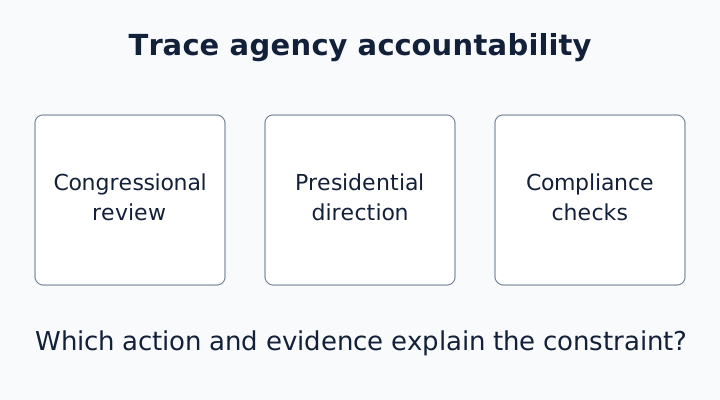
In short. Congressional oversight, presidential direction, and compliance monitoring hold agencies accountable while creating distinct demands on administrative work.
- Explain review and funding as distinct congressional checks.
- Connect presidential goals to lawful direction and influence.
- Interpret monitoring workload without treating counts as proof of outcomes.
Part 2 Learn it Explain how congressional oversight checks executive action
2a. Explain how congressional oversight checks executive action
Congressional oversight reviews, monitors, and supervises administrative work. Investigations and committee hearings let lawmakers question agency officials and examine whether implementation follows legislative intent. This checks how the executive uses its authorization rather than merely providing another public speech.
Congress also uses the power of the purse by appropriating or withholding funds through the applicable legislative process. Resources and funding conditions can constrain what an agency can carry out. A committee’s question at a hearing and a legally enacted appropriation are different tools; the question alone does not rewrite a spending law.
For an original example, Congress reviews records showing how an agency used an authorized program’s funds. A hearing can expose problems, and a later funding decision can alter available resources. The connection between review, information, and resource control explains how oversight can curtail the use of presidential power.
Quick check · Fill the statement
Identify the congressional tool.
Congress reviews implementation through ; changing an appropriation uses its .
2b. Trace presidential goals through agency direction
Presidential ideology, authority, and influence affect how executive agencies carry out an administration’s goals. Ideology concerns views about government’s role and priorities. Authority concerns powers available under law. Influence includes leadership and persuasion that help coordinate administrative action.
Consider an original president who favors a more active federal role in helping eligible people reach a public service. Within an existing legal grant, the president directs an agency to emphasize outreach. The policy view helps explain the priority; the directive uses available authority; leadership can help officials organize the work.
These links explain alignment with administration goals without making preference a new legal power. A president cannot simply remove a retained statutory condition by declaring that another goal is more important. Career staff can follow lawful priorities while still applying neutral professional criteria.
Quick check · Fill the statement
Relate a policy view to administration.
A president favors greater federal outreach and lawfully directs an agency to emphasize it. This illustrates presidential affecting agency priorities.
2c. Read monitoring as both a safeguard and a task
Compliance monitoring checks whether funds are used properly and regulations are followed. Reviewing expenditures and checking conduct against applicable rules can reveal failures in implementation. Monitoring itself also requires time, staff, and administrative attention.
The original teaching table holds staff constant while comparable reports due increase. For this exercise, reports require equivalent review time; the data are not a record of any real agency. Increasing reports per staff member therefore increases the reporting load in this simplified setting. That can compete with other implementation work or create a capacity challenge.
Do not infer more than the data supply. Report counts alone do not establish that the program is fully compliant, that its services improved, or which political ideology caused a directive. Describe the pattern, explain the relevant mechanism, and identify the evidence needed for a further conclusion.
Quick check · Fill the statement
Identify the monitoring purpose.
Checks on proper fund use and whether regulations are followed are .
Part 3 Watch it done Identify the resource-control mechanism
Congress receives evidence that an agency did not use program funds as intended. A committee conducts a hearing, and Congress considers a funding change through its applicable legislative process.
Step 1 · Separate information and resources
The hearing investigates implementation. A funding law changes the resources or conditions under which the agency acts.
Why this step?
Why distinguish the two congressional steps?
Questions can expose information without themselves changing appropriations. The resource decision uses a separate legal mechanism.
Step 2 · Name the action by its immediate effect
Compare requesting an explanation with legally changing the funds available to the program.
Your step · Decide and justify
Which action illustrates the power of the purse?
Which institutional reason supports the decision?
A contrasting worked example
An original administration favors outreach in an existing service program. The president uses a lawful directive and coordination to emphasize that priority. The policy view, legal authority, and influence help explain how agency goals align with the administration. They do not make a retained statutory eligibility rule disappear.
Part 4 Try it Classify the institutional action
Original teaching situations: distinguish what each institution can do.
| Teaching period | Program staff | Comparable reports due |
|---|---|---|
| 1 | 5 | 10 |
| 2 | 5 | 15 |
| 3 | 5 | 20 |
Try it · Sort it
Which mechanism is directly described?
Review and supervision
Funding decision
Presidential administrative direction
Part 5 Explain it Use data to explain monitoring and direction
Free response is 50% of the exam score. This one is shaped like Question 2, Quantitative Analysis.
Free-response practice · Question 2 style
Original quantitative-analysis practice: use the fictional reporting table above. (A) Identify reports due in the third period. (B) Describe the trend and calculate reports per staff member in the first and third periods; divide reports by staff for the calculation. (C) Explain a monitoring-capacity challenge and how review can check the executive’s use of authorization. (D) In a separate original scenario, a president favors outreach and uses lawful direction and leadership to emphasize it. Explain the roles of ideology, authority, and influence.
Model answer
The third period requires 20 reports. Reports increase from 10 to 20 while staff stay at 5, so reports per staff member rise from 10 ÷ 5 = 2 to 20 ÷ 5 = 4. With equivalent review time, the greater load can strain monitoring capacity or compete with implementation work. Reviewing proper fund use and regulatory compliance supplies information for congressional oversight of executive authorization; funding decisions can also constrain resources. In the separate outreach scenario, the president’s view about government’s role explains the priority, lawful authority permits direction, and leadership helps coordinate officials. None of those counts alone demonstrates a particular ideology or a program outcome.
Score your own answer. This is a self-check, not a grade. Tick each point your answer makes.
Part 6 Check yourself Explain an original monitoring-load pattern
These are fictional separate teaching periods. Each report requires equivalent review time in this simplified exercise; staff remain constant. The counts measure reporting requirements, not program quality.
| Teaching period | Program staff | Comparable reports due |
|---|---|---|
| 1 | 5 | 10 |
| 2 | 5 | 15 |
| 3 | 5 | 20 |
Case question 1 · Calculate
How many reports are due per staff member in the third period?
Case question 2 · Multiple choice
Which conclusion is supported by the pattern and stated assumptions?
The rest stand on their own and do not use the case.
Check yourself · Spot the error
Select the statement that makes an institutional error.
Check yourself · Match
Match each term to its distinguishing institutional feature.
Part 7 Keep it Retrieve and connect
From 2.12 The Bureaucracy · Fill the statement
Compare selection criteria.
Career hiring emphasizing relevant expertise and neutral job criteria illustrates a ; hiring primarily for political sponsorship illustrates .
From 2.5 Checks on the Presidency · Fill the statement
Connect conflict and a lawful response.
If Congress does not advance a proposed program, a president may instead use an available executive to improve an existing program, but still needs legal .
In three lines
- Explain review and funding as distinct congressional checks.
- Connect presidential goals to lawful direction and influence.
- Interpret monitoring workload without treating counts as proof of outcomes.
Exam strategy for this topic
- Section I, Multiple Choice: 55 questions in 80 minutes.
- Section II, Free Response: 4 questions in 100 minutes.
- This lesson's Explain it is shaped like free-response question 2, Quantitative Analysis.
Commit to a starting question, then use the data and institutional context to evaluate it.
Questions students ask
Does a hearing itself change an appropriation?
No. A hearing obtains information and investigates implementation. Changing funds uses the applicable appropriation process.
How can presidential ideology affect an agency?
A view about government’s role can shape priorities, while lawful authority and influence help direct and coordinate the agency’s work.
What does compliance monitoring check?
It checks proper use of funds and whether regulations are followed. Carrying out those checks also uses administrative resources.
Do more reports prove better policy outcomes?
Not by themselves. The teaching counts establish a workload pattern under stated assumptions; outcomes require additional evidence.
Course alignment, for teachers
AP U.S. Government and Politics topic 2.14, Unit 2: Interactions Among Branches of Government.
- Skill 3.C: Explain patterns and trends in data to draw conclusions.
This lesson maps all 4 essential knowledge statements of the topic to the part that teaches each one: 3 are checked by a scored question and 1 by the written response. The map is in the lesson file.