Unit 2 · Topic 2.15 · about 30 minutes · 7 parts · 9 scored checks, 2 of them multiple choice, plus 2 from earlier lessons
AP U.S. Government and Politics 2.15: Policy and the Branches of Government
Unit 2: 25 to 36% of the multiple-choice section
What you'll be able to do
- Explain the extent to which governmental branches can hold the bureaucracy accountable given the competing interests of Congress, the president, and the federal courts.
- Explain how the distribution of powers among the three branches of government impacts policymaking.
Key vocabulary
| Term | What it means | The exam trap |
|---|---|---|
| Congressional oversight | Legislative review of executive and agency implementation. | Identify the information or resource decision Congress is actually making. |
| Executive direction | Lawful presidential management and influence over executive implementation. | Identify the legal source and the administrative priority. |
| Judicial review | Constitutional or legal assessment of challenged government action in an appropriate case. | Check that a judicial case and legal question are supplied. |
| Access point | An institutional route for seeking influence over a policy decision. | Identify which institution receives the request and what it can decide. |
| Stakeholder | A person or group with an interest in a policy’s design or effects. | An interest in an outcome does not itself establish power to decide it. |
| Shared powers | Distribution of relevant policymaking authority among different institutions. | Identify the particular decisions rather than assuming one actor can supply them all. |
| Policy constraint | A legal or institutional limit affecting available policy action. | Describe the actual missing authority or decision in the scenario. |
 Tap to open the picture full size
Part 1 Think first Predict the institutional consequence
Commit to a starting question, then compare the institutions and the decisions they control.
Predict first
A group pursues several routes for a policy change. Which evidence would you investigate first?
In short. The branches hold agencies accountable through different powers, creating multiple routes for influence and constraints on how national policy is made.
- Connect accountability tools to the branch using them.
- Interpret multiple access points without promising an outcome.
- Explain the specific legal or institutional constraint in a policy sequence.
Part 2 Learn it Compare the branches’ accountability tools
2a. Compare the branches’ accountability tools
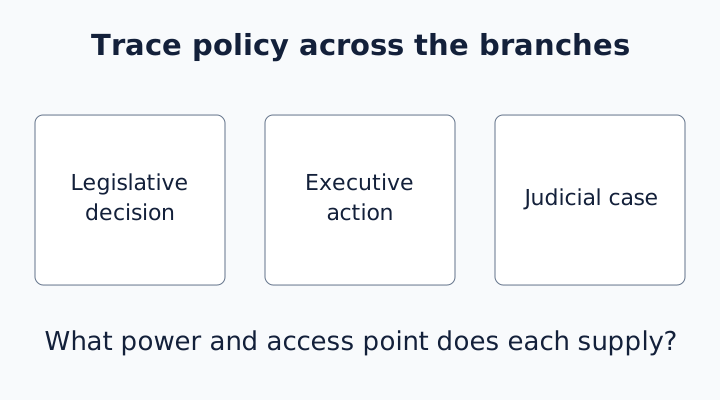
Congress, the president, and the federal courts bring different powers to administrative policy. Congress uses legislation, appropriations, and oversight. The president uses lawful management authority and political influence to direct executive work. Courts assess legal challenges to agency action in cases within their authority.
Formal legal tools and informal influence are not interchangeable. Oversight conversations and presidential persuasion can affect priorities without themselves becoming a new statute. A court’s legal judgment is not ordinary agency program management. Describe the actor, power, and action rather than saying that one branch controls every aspect of bureaucracy.
Competing institutional interests can make accountability demanding. A president may prefer one administrative priority, legislators may emphasize a funding condition, and a court may identify a legal boundary. Each can affect agency conduct through its own role. Political preference alone does not remove the other institutions’ lawful powers.
Quick check · Fill the statement
Locate the branch’s tool.
Congress examines implementation through , while courts assess an appropriate legal challenge through .
2b. Identify multiple access points without promising success
The distribution of authority creates access points through which stakeholders can seek policy influence. A group can ask legislators to change a statute or funding, submit a comment or request to an executive agency, or pursue an available legal challenge in a proper case. Those routes request different institutional actions.
The fictional table records routes pursued in separate advocacy efforts. An effort can use more than one route, so the row counts are not mutually exclusive categories. The numbers describe attempts to use access points, not unique people, favorable decisions, or the legal importance of each branch.
The route with the largest count does not thereby hold all constitutional authority. Explain what the action requests and which power the recipient can use. Judicial access, in particular, requires an appropriate legal case; a general policy preference does not turn a court into an advisory committee.
Quick check · Fill the statement
Identify the opportunity.
A group contacting legislators and separately submitting an agency comment uses multiple institutional .
2c. Explain a particular constraint rather than universal paralysis
National policymaking is constrained by shared powers among the branches. In an original program example, Congress supplies funding conditions, executive officials implement the program, and a proper legal challenge can bring judicial review of agency compliance. A presidential directive cannot itself supply a missing appropriation or erase a constitutional requirement.
The constraint must be specific. Not every policy requires a new decision from every branch, and every court does not preapprove each administrative step. Identify the decision or legal boundary that matters in the given setting.
For example, an agency wants to add a program activity for which the supplied statute and appropriation provide no authority. Administrative preference cannot alone complete those missing legislative steps. If a court later reviews a valid challenge, its legal decision can further constrain the action. The sequence illustrates shared power without implying that policy is impossible or that a stakeholder’s preferred outcome is guaranteed.
Quick check · Fill the statement
Identify the missing authority.
An agency preference does not itself supply a missing congressional for a program.
Part 3 Watch it done Follow the missing decision
In an original scenario, an agency wants an activity that the supplied program statute and appropriation do not authorize. The president favors the activity, and stakeholders contact legislators about changing the law.
Step 1 · Separate support from available power
The president’s support is a policy preference. The scenario supplies neither the statutory scope nor the appropriation for the additional activity.
Why this step?
Why identify the requested legislative action?
The stakeholder is seeking a decision controlled by a different institution, rather than treating administrative preference as the missing legal grant.
Step 2 · Explain the institutional limit
Compare what the executive wants to do with the specific authority Congress would need to supply.
Your step · Decide and justify
What does the need for a legislative change illustrate?
Which institutional reason supports the decision?
A contrasting worked example
A different agency action already has statutory and spending authority. A stakeholder files a proper legal challenge alleging noncompliance, and a court assesses the claim. This is a judicial access point and a legal accountability route. It does not mean that every program needs a new court ruling before any implementation or that the claimant must win.
Part 4 Try it Classify the institutional action
Original teaching situations: distinguish what each institution can do.
| Route pursued | Fictional efforts using it |
|---|---|
| Request to congressional offices | 8 |
| Comment or request to an executive agency | 10 |
| Legal challenge filed in a proper judicial case | 3 |
Try it · Sort it
Which institutional action is the stakeholder seeking?
Congressional action
Executive implementation
Judicial legal review
Part 5 Explain it Explain what the route data illustrate
Free response is 50% of the exam score. This one is shaped like Question 2, Quantitative Analysis.
Free-response practice · Question 2 style
Original quantitative-analysis practice: use the fictional route table above. (A) Identify the route with the largest count. (B) Explain what the three rows illustrate about access points created by shared powers. (C) Explain why counts of routes pursued do not establish favorable outcomes or unique-person totals. (D) In a separate program scenario, Congress favors the existing narrow scope and declines new authority and funding, while the president favors expansion; a proper case may bring legal review. Explain the limits of one branch imposing its preferred agency choice given the other branches’ relevant powers.
Model answer
The agency route has the largest listed count. The rows illustrate different access points: legislative requests can seek law or funding changes, agency comments concern executive implementation, and proper judicial cases seek legal review. Different powers make these routes relevant to different decisions. Because an effort can use more than one route, counts are not unique people; the table also supplies no outcomes. In the separate program scenario, Congress’s decision to retain the scope and withhold expansion funding constrains the president’s preferred administrative choice. Executive preference cannot itself create the missing statute or appropriation, and a proper case can bring judicial review of an agency’s legal compliance. Shared institutional powers therefore create both opportunities to seek influence and constraints on unilateral action.
Score your own answer. This is a self-check, not a grade. Tick each point your answer makes.
Part 6 Check yourself Interpret routes pursued, not decisions won
Original dataset: 12 fictional advocacy efforts could use more than one route. Counts are not mutually exclusive and do not measure success, unique people, or constitutional importance.
| Route pursued | Fictional efforts using it |
|---|---|
| Request to congressional offices | 8 |
| Comment or request to an executive agency | 10 |
| Legal challenge filed in a proper judicial case | 3 |
Case question 1 · Multiple choice
What does the presence of counts in all three rows illustrate?
Case question 2 · Multiple choice
Which interpretation of the largest row is supported?
The rest stand on their own and do not use the case.
Check yourself · Spot the error
Select the statement that makes an institutional error.
Check yourself · Match
Match each term to its distinguishing institutional feature.
Part 7 Keep it Retrieve and connect
From 2.13 Discretionary and Rulemaking Authority · Fill the statement
Distinguish creating and applying a rule.
Adopting a general regulation under an agency’s grant is ; applying that regulation to a violation is .
From 2.11 Checks on the Judicial Branch · Fill the statement
Identify which legal rule changes.
Congress revising a program statute uses ; changing constitutional text through Article V uses a .
In three lines
- Connect accountability tools to the branch using them.
- Interpret multiple access points without promising an outcome.
- Explain the specific legal or institutional constraint in a policy sequence.
Exam strategy for this topic
- Section I, Multiple Choice: 55 questions in 80 minutes.
- Section II, Free Response: 4 questions in 100 minutes.
- This lesson's Explain it is shaped like free-response question 2, Quantitative Analysis.
Commit to a starting question, then compare the institutions and the decisions they control.
Questions students ask
Does access mean a stakeholder wins?
No. It identifies a route for seeking a decision. A request, comment, or legal filing does not itself supply a favorable result.
Does every administrative step require three new branch approvals?
No. Explain the specific legislative, executive, or judicial decision relevant to the scenario instead of inventing a universal approval sequence.
Why cannot the route counts be added as unique people?
One effort can use several routes, and the table records efforts using channels rather than people. Outcomes and participant totals require different evidence.
How can the branches constrain one another’s policy preferences?
Each controls relevant powers. For example, executive implementation may depend on a statutory grant and appropriation, while a proper case can bring legal review of an agency’s conduct.
Course alignment, for teachers
AP U.S. Government and Politics topic 2.15, Unit 2: Interactions Among Branches of Government.
- Skill 3.D: Explain what the data implies or illustrates about political principles, institutions, processes, policies, and behaviors.
This lesson maps all 3 essential knowledge statements of the topic to the part that teaches each one: 3 are checked by a scored question. The map is in the lesson file.