Unit 3 · Topic 3.1 · about 30 minutes · 7 parts · 11 scored checks, 3 of them multiple choice, plus 2 from earlier lessons
AP U.S. Government and Politics 3.1: The Bill of Rights
Unit 3: 13 to 18% of the multiple-choice section
What you'll be able to do
- Explain how the U.S. Constitution protects individual liberties and rights.
- Describe the rights protected in the Bill of Rights.
Key vocabulary
| Term | What it means | The exam trap |
|---|---|---|
| Bill of Rights | The first ten amendments to the Constitution, identifying rights and limits on government. | A constitutional guarantee must still be connected to the facts of a dispute. |
| Civil liberty | A constitutionally established freedom or protection against arbitrary government interference. | A restriction and an unconstitutional restriction are different conclusions. |
| Judicial interpretation | A court’s explanation of the meaning and application of a legal provision. | Applying existing text is a different process from formally amending it. |
| Due process | Constitutional protection against deprivation of life, liberty, or property without lawful process. | Identify which government actor and amendment are involved. |
| Enumerated right | A right expressly listed in a written legal text. | A written list can contain protections with different purposes. |
| Self-incrimination | Providing evidence against oneself in a criminal matter. | Distinguish compelled testimony from every kind of evidence collection. |
| Reserved power | Authority retained by states or the people when not delegated to the nation or prohibited to states. | A reservation of powers is different from a grant of unlimited power. |
| Double jeopardy | A second prosecution or punishment for the same offense, subject to constitutional rules. | Identify the same offense and the prosecuting sovereign rather than assuming every later proceeding is identical. |
| Grand jury | A body that evaluates whether charges should proceed in specified criminal cases. | Charging and deciding guilt are separate functions. |
| Taking | Government acquisition of private property for public use subject to constitutional compensation requirements. | Compensation and search justification concern different property issues. |
| Right to counsel | The constitutional protection for assistance of an attorney in criminal proceedings. | Criminal defense assistance differs from a civil jury guarantee. |
| Freedom of assembly | Protection for people to gather peaceably. | Assembly and expression may overlap but identify the actual activity. |
| Right to petition | Protection for requesting action or redress from government. | A right to ask does not guarantee the requested policy result. |
 Tap to open the picture full size
Part 1 Think first Predict the institutional consequence
Describe a constitutional principle in the specific scenario, rather than listing amendment numbers.
Predict first
A newly elected federal official says a large victory permits closing a newspaper that criticizes the office. What fact would you investigate first?
In short. The Bill of Rights protects individual freedoms against arbitrary government action; courts interpret how its guarantees apply to concrete disputes.
- Constitutional guarantees constrain government power.
- Civil liberties protect people, opinions, and property against arbitrary interference.
- Courts continually interpret the listed protections.
Part 2 Learn it A constitutional restraint on government
2a. A constitutional restraint on government
The Constitution creates a government with power to make and enforce law. Its Bill of Rights also sets boundaries on that power. A guarantee written into the Constitution is a legal restraint, rather than a promise that officials may withdraw whenever it is inconvenient. A person challenging government action must connect the action to a constitutional protection. Winning an election does not free officials from those protections.
For example, a federal official who orders a newspaper to obtain permission before publishing faces a constitutional challenge about freedom of the press. The official’s popularity does not answer the challenge. Neither does calling the policy efficient. The relevant question is whether the action fits the Constitution’s limits. The Bill of Rights was specifically designed to protect individual liberties and rights while government exercises its powers. It does not remove every public responsibility or settle every conflict on its own.
Quick check · Fill the statement
Complete the distinction in this situation.
A federal rule must comply with constitutional even after an election.
2b. Civil liberties protect against arbitrary interference
Civil liberties are constitutional guarantees and freedoms protecting people, their opinions, and their property against arbitrary government interference. Look for both the protected interest and the government action. If federal agents search a home, the Fourth Amendment supplies a constitutional framework for evaluating that government intrusion. A private disagreement with a neighbor does not automatically become the same constitutional issue.
Civil liberties include freedoms such as religious exercise and expression, as well as protections connected with criminal proceedings. A restriction can implicate a liberty without being unconstitutional in every circumstance. The constitutional analysis considers the guarantee and the relevant facts. For instance, identifying a search issue does not by itself establish that a particular search was unreasonable.
Background distinction: civil rights concern equal treatment and protection against discrimination. Civil liberties concern protected freedoms and restraints on government. The ideas can overlap in a case, but the question being asked tells you which principle is doing the work.
Quick check · Fill the statement
Complete the distinction in this situation.
Government interference with a protected freedom raises a issue.
2c. Courts interpret what a guarantee requires
The Bill of Rights uses general language, including freedom of speech and unreasonable searches. New disputes require courts to interpret that language. Judicial interpretation determines how a constitutional guarantee applies to the facts before the court. A decision can protect a liberty, allow a restriction, or distinguish a new dispute from an earlier one.
Suppose a court considers whether accessing records created by a new communications technology is a search. The constitutional text need not name the technology for the court to evaluate the government’s conduct. The court connects the protection to the facts and explains its reasoning. Interpretation is continuous because disputes, technologies, and legal arguments change. It is different from amending the Constitution: a court decision applying an existing amendment does not add a new numbered amendment.
When describing a scenario, name what the court does. It interprets a constitutional guarantee and evaluates government action. Do not infer that every decision expands a right or that a court simply replaces the written protection with personal preference.
Quick check · Fill the statement
Complete the distinction in this situation.
A court applying an existing search protection to new technology performs .
2d. Read the ten amendments by what they protect
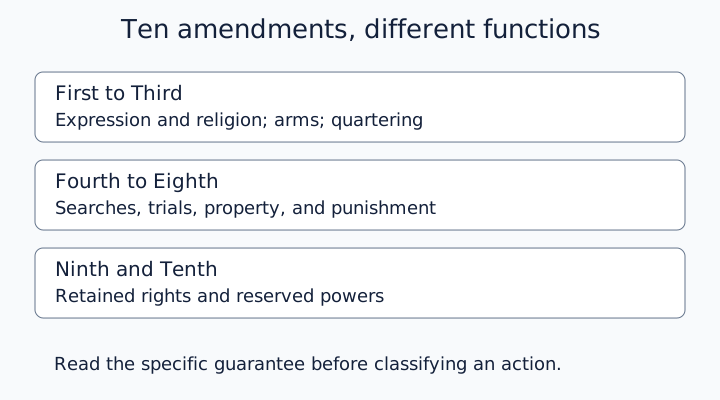
The Bill of Rights consists of the first ten amendments. The First protects religion, speech, press, assembly, and petition. The Second concerns keeping and bearing arms; the Third restricts quartering soldiers in private homes. The Fourth protects against unreasonable searches and seizures and sets warrant requirements.
The Fifth includes grand jury protection for federal serious charges, double jeopardy, self-incrimination, due process, and compensation for public takings. The Sixth protects criminal-trial rights, including a speedy public trial, an impartial jury, notice, confrontation, compulsory process, and assistance of counsel. The Seventh preserves a jury in specified civil cases. The Eighth addresses excessive bail, excessive fines, and cruel and unusual punishments.
The Ninth says enumerating certain rights does not deny or disparage other rights retained by the people. The Tenth reserves undelegated, unprohibited powers to states or the people. These last two caution against treating a list of guarantees as a list of every right or every national power. Read National Archives, Bill of Rights transcript for the actual clauses. Later lessons distinguish which protections apply to state government through incorporation.
Quick check · Fill the statement
Complete the distinction in this situation.
Assistance of counsel in a criminal prosecution is in the Amendment; excessive fines are addressed by the .
Part 3 Watch it done Trace a claim from action to guarantee
Original scenario: federal agents seek to inspect a warehouse owner’s private office without identifying any legal basis.
Step 1 · Identify the actor
Federal agents exercise government power; this is not simply a disagreement among private owners.
Step 2 · Locate the protected interest
The inspection raises a search issue involving protected property and privacy.
Why this step?
Why identify the specific action before naming an amendment?
The protection must address the conduct being challenged; different guarantees govern speech, searches, and criminal trials.
Your step · Decide and justify
If a court decides whether the inspection is an unreasonable search, what is the court doing?
Which institutional reason supports the decision?
A second worked example
A federal judge denies a request for an excessive bail amount. Identify the Eighth Amendment issue, then distinguish it from the Sixth Amendment right to counsel. Both concern criminal justice, but bail and legal assistance are different protections.
Part 4 Try it Apply the rights distinction
Original teaching situations: distinguish what each institution can do.
Try it · Sort it
Classify each government action by the protection it most directly implicates.
Expression and religious liberty
Search and property protections
Criminal trial and punishment protections
| Dispute | Government action |
|---|---|
| A | A federal agency bans criticism of its director. |
| B | A court applies an existing constitutional guarantee to encrypted records. |
| C | A federal prosecutor compels a defendant to testify against herself. |
Part 5 Explain it Concept application: a rights claim
Free response is 50% of the exam score. This one is shaped like Question 1, Concept Application.
Free-response practice · Question 1 style
Original scenario: a federal department confiscates a publisher’s printing equipment because it dislikes criticism. A court agrees to hear a constitutional challenge. (A) Describe the civil liberty implicated. (B) Explain how a written constitutional guarantee limits the department. (C) Describe what the court does when it interprets that guarantee in this dispute.
Model answer
The confiscation targets freedom of expression and the press. The First Amendment restrains government power even when officials favor suppressing criticism, so the department’s authority remains bounded by a constitutional protection. The court determines how the existing guarantee applies to the department’s conduct; that is interpretation rather than the creation of a new amendment.
Score your own answer. This is a self-check, not a grade. Tick each point your answer makes.
Part 6 Check yourself Identify the freedom in each dispute
Original scenarios. Describe the constitutional principle illustrated in each context before selecting an answer.
| Dispute | Government action |
|---|---|
| A | A federal agency bans criticism of its director. |
| B | A court applies an existing constitutional guarantee to encrypted records. |
| C | A federal prosecutor compels a defendant to testify against herself. |
Case question 1 · Multiple choice
Which principle is most directly implicated in dispute A?
Case question 2 · Multiple choice
What does dispute B illustrate about the Bill of Rights?
Case question 3 · Multiple choice
Which amendment most directly addresses the compelled testimony in dispute C?
The rest stand on their own and do not use the case.
Check yourself · Spot the error
Select the statement that makes an institutional error.
Check yourself · Match
Match each of the first ten amendments to its distinctive protection or reservation.
Part 7 Keep it Retrieve and connect
From 2.15 Policy and the Branches of Government · Fill the statement
Locate the branch’s tool.
Congress examines implementation through , while courts assess an appropriate legal challenge through .
From 2.12 The Bureaucracy · Fill the statement
Identify the administrative function.
An agency writes a rule under statutory authority, creating a ; an authorized monetary penalty for violating it is a .
In three lines
- Constitutional guarantees constrain government power.
- Civil liberties protect people, opinions, and property against arbitrary interference.
- Courts continually interpret the listed protections.
Exam strategy for this topic
- Section I, Multiple Choice: 55 questions in 80 minutes.
- Section II, Free Response: 4 questions in 100 minutes.
- This lesson's Explain it is shaped like free-response question 1, Concept Application.
Describe the freedom and government conduct in each scenario before naming the constitutional principle.
Questions students ask
Does the Bill of Rights create the entire national government?
No. The Constitution establishes the governmental framework. Its first ten amendments specify protections and limits that operate within that framework.
Is every unwelcome government action a civil liberty violation?
No. Identify a protected interest and then evaluate the government action under the relevant constitutional rule. Disliking a policy does not establish a violation.
Does a court need a new amendment for every new technology?
No. Courts interpret existing guarantees in new disputes. A formal amendment changes constitutional text through a separate process.
Do all ten amendments address criminal defendants?
No. Some protect expression, religion, property, or civil juries. Others concern retained rights and reserved powers. Several, but not all, address criminal justice.
Course alignment, for teachers
AP U.S. Government and Politics topic 3.1, Unit 3: Civil Liberties and Civil Rights.
- Skill 1.D: Describe political principles, institutions, processes, policies, and behaviors illustrated in different scenarios in context.
This lesson maps all 4 essential knowledge statements of the topic to the part that teaches each one: 4 are checked by a scored question. The map is in the lesson file.