Unit 2 · Topic 2.2 · about 30 minutes · 7 parts · 12 scored checks, 1 of them multiple choice, plus 2 from earlier lessons
AP U.S. Government and Politics 2.2: Structures, Powers, and Functions of Congress
Unit 2: 25 to 36% of the multiple-choice section
What you'll be able to do
- Explain how the structure, powers, and functions of both houses of Congress affect the policymaking process.
Key vocabulary
| Term | What it means | The exam trap |
|---|---|---|
| Markup | Committee revision of a bill’s text. | A hearing gathers testimony; check whether the text actually changes. |
| Cloture | A Senate procedure to end debate. | Identify the question the motion asks senators to decide. |
| Logrolling | An exchange of political favors among legislators, such as traded votes. | A shared vote without evidence of an exchange does not establish a bargain. |
| Mandatory spending | Spending required by existing law for entitlement programs. | Required under law does not mean no law can ever change the program. |
| Discretionary spending | Spending approved through annual budget choices. | Annual approval differs from an entitlement obligation. |
| Pork-barrel legislation | Funding for a local project in a larger appropriation bill. | A local project alone does not establish a traded-vote agreement. |
| Discharge petition | A rarely used House procedure to bring a bill to the floor despite committee inaction. | A petition and final passage are different stages. |
| Conference committee | A committee that reconciles differences between House and Senate versions. | Reconciliation of wording is different from Senate cloture. |
| Filibuster | A Senate tactic that prolongs debate to delay or prevent a vote. | A hold concerns getting a bill to the floor; identify the stage first. |
| Hold | A senator’s request that can prevent a bill from reaching the floor for a vote. | Scheduling and ongoing debate are different stages. |
| Committee of the Whole | A House arrangement that expedites debate and consideration. | Expedited consideration does not eliminate the legislative process. |
| Rules Committee | The House committee that establishes terms for debate on a bill. | Do not assign House debate rules to the Senate. |
| Speaker of the House | The House leader elected by a majority of members to preside over legislative work. | Identify the chamber and leadership decision rather than the final vote on a bill. |
| Unanimous consent | An agreement to proceed without an objection, commonly used to bring Senate business forward. | Identify the proposed procedural agreement and whether an objection is raised. |
| Entitlement | A program that provides benefits to people meeting legal eligibility requirements. | Find the legal eligibility rule rather than assuming a benefit is an annual discretionary choice. |
| Budget deficit | The amount by which spending exceeds revenue during a budget period. | Distinguish the flow during one period from accumulated debt. |
 Tap to open the picture full size
Part 1 Think first Predict the institutional consequence
Identify the chamber, stage, and specific procedure before explaining how it affects a bill.
Predict first
Senators end debate on a proposal. Has that procedural decision by itself passed the proposal into law?
In short. Chamber rules, committees, budget commitments, and bargaining shape which proposals advance through Congress and what a final bill contains.
- Separate committee work, chamber debate, and reconciling versions.
- Explain budget tradeoffs using the stated financing assumptions.
- Distinguish a local appropriation from exchanged legislative support.
Part 2 Learn it Trace a bill through institutions and procedures
2a. Trace a bill through institutions and procedures
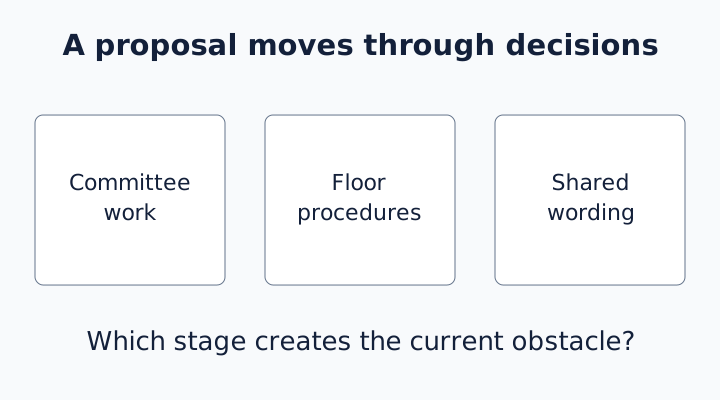
Both chambers send bills to committees for hearings, debate, and markup, when members revise the text. The majority party determines committee leadership, so party control affects which proposals receive attention and how they develop. A hearing gathers evidence and views; markup changes the proposed language. Neither is the same as final passage.
House procedures reflect its size and design. Members elect the Speaker by majority vote to preside over legislative work. Revenue bills must originate in the House. The Rules Committee sets terms for debating a bill. The Committee of the Whole expedites consideration; it does not eliminate the need for House action. A discharge petition is a rarely used route for bringing a bill to the floor despite committee inaction.
In the Senate, unanimous consent commonly brings a bill to the floor, while a hold can prevent scheduling. A filibuster prolongs debate to delay or prevent a vote, and cloture is a procedure to end debate. Ending debate is different from passing the bill. When the chambers pass different wording on the same subject, a conference committee can reconcile the differences. A final proposal must clear the remaining legislative steps; reconciling text is not itself enactment.
Unanimous consent means proceeding without an objection to a proposed arrangement. It can organize consideration, but does not replace every remaining decision needed for enactment.
Quick check · Fill the statement
Follow the bill’s stage.
A committee hears witnesses and then revises the proposed text through . If the chambers pass different wording, a can reconcile it.
2b. Distinguish budget commitments from annual choices
Congress must address mandatory spending and discretionary spending in the budget. Mandatory spending is required by law for entitlement programs such as Social Security, Medicare, and Medicaid. Discretionary spending is approved annually for areas such as defense, education, and infrastructure. Calling spending mandatory does not mean it is beyond the lawmaking process; it identifies obligations under existing law.
Growing entitlement costs narrow discretionary opportunities unless tax revenue or the deficit increases. This is a constraint among revenue, borrowing, and spending, not a claim that Congress lacks budget authority. For example, in a fictional budget with fixed revenue and deficit, a larger mandatory commitment leaves less room for annual choices. To analyze a proposed change, identify which totals are held constant before concluding what must adjust.
An entitlement gives benefits to people meeting legal eligibility rules. A deficit is spending above revenue during a budget period; it is not the total debt accumulated over many periods.
Quick check · Fill the statement
Classify the budget obligation.
Existing-law Social Security benefits illustrate spending; an annual infrastructure appropriation illustrates spending.
2c. Explain how bargaining builds support
A legislator may seek a local project within a larger appropriation bill. This is pork-barrel legislation: its distinguishing feature is funding for a local project in the broader measure. Logrolling is an exchange of political favors, such as one legislator supporting a colleague’s proposal in return for support on another. Both can affect legislation in either chamber.
A local project alone does not establish that votes were exchanged. Evidence of an agreement between legislators is needed to identify logrolling. Conversely, an exchange need not involve a local construction project. The same bill can contain a local appropriation and result from exchanged support, but the mechanisms remain distinct. Explain the behavior from concrete evidence rather than treating a policy you dislike as proof of either practice.
Quick check · Fill the statement
Read the bargaining evidence.
Two legislators agree to support each other’s proposals. The exchange is , while a separately described local project in a larger appropriation is .
Part 3 Watch it done Distinguish ending debate from passage
A Senate proposal is on the floor. Debate is prolonged, and senators consider a motion for cloture. A commentator reports that adopting the motion would itself enact the proposal.
Step 1 · Locate the procedural stage
The proposal is already on the floor, and the immediate dispute concerns how long debate continues.
Why this step?
Why is a hold not the best description here?
A hold concerns preventing a proposal from reaching the floor; these facts describe a bill already under debate.
Step 2 · Separate procedure and substance
Identify what a cloture motion asks senators to decide. Compare that with the decision described by final passage.
Your step · Decide and justify
Would adopting cloture itself pass the proposal?
Which institutional reason supports the decision?
A contrasting worked example
A House bill remains in committee without action. An individual representative pursues a discharge petition to bring it to the floor. The obstacle is committee inaction, so this is a different procedural route from ending Senate debate. The petition is rarely used and does not by itself approve the bill’s substance.
Part 4 Try it Classify the institutional action
Original teaching situations: distinguish what each institution can do.
Try it · Sort it
Which procedural stage is being described?
Committee development
Floor consideration
Reconciling versions
Try it · Fill the statement
Apply the institutional distinction.
A revenue bill must originate in the . The House presides over legislative work after election by a majority of members, while the sets debate terms for a bill.
Try it · Fill the statement
Apply the institutional distinction.
The party determines committee leadership. The House Committee of the expedites consideration; in the Senate, a bill is commonly brought to the floor through .
Try it · Fill the statement
Independent procedural scenarios, separate from the budget data for the written task: match each obstacle to its chamber and procedural stage.
A senator blocks scheduling through a ; prolonged Senate debate is a ; a representative seeks to bypass House committee inaction through a .
| Category | Initial proposal | Revised proposal |
|---|---|---|
| Revenue | 90 | 90 |
| Deficit | 10 | 10 |
| Mandatory spending | 60 | 70 |
| Discretionary room | 40 | To be determined |
Part 5 Explain it Read a budget and explain its constraint
Free response is 50% of the exam score. This one is shaped like Question 2, Quantitative Analysis.
Free-response practice · Question 2 style
Original quantitative-analysis practice: use the fictional budget table. (A) Identify the initial discretionary amount. (B) Describe how the mandatory amount changes. (C) Calculate the revised discretionary room if revenue and deficit stay fixed. (D) Explain how this relationship illustrates a constraint on annual spending choices.
Model answer
Initial discretionary room is 40 units. Mandatory spending rises from 60 to 70, an increase of 10. Fixed revenue of 90 plus a deficit of 10 permits total spending of 100; subtracting mandatory spending of 70 leaves 30. Growing required commitments therefore reduce the room for discretionary spending under these fixed assumptions. More revenue, a larger deficit, or a legal change to obligations would alter the constraint.
Score your own answer. This is a self-check, not a grade. Tick each point your answer makes.
Part 6 Check yourself Analyze a constrained teaching budget
All figures are fictional budget units, not U.S. financial data. Receipts and the deficit are held fixed in the two proposals.
| Category | Initial proposal | Revised proposal |
|---|---|---|
| Revenue | 90 | 90 |
| Deficit | 10 | 10 |
| Mandatory spending | 60 | 70 |
| Discretionary room | 40 | To be determined |
Case question 1 · Calculate
What discretionary amount preserves the stated revenue and deficit in the revised proposal?
Case question 2 · Multiple choice
If Congress instead preserves the original discretionary amount and the revised mandatory amount, which financing assumption must change?
The rest stand on their own and do not use the case.
Check yourself · Spot the error
Select the statement that makes an institutional error.
Check yourself · Match
Match each term to its distinguishing institutional feature.
Part 7 Keep it Retrieve and connect
From 1.5 Ratification of the U.S. Constitution · Fill the statement
Apply the distinction in the completed statement.
The Great Compromise tied House representation to and gave states representation in the Senate.
From 1.7 Relationship Between the States and National Government · Fill the statement
Recall the mixed structure in Madison’s Federalist No. 39.
Using Madison’s distinctions in Federalist No. 39, ratification through the states is a feature, while the government’s operation on individual citizens is a feature.
In three lines
- Separate committee work, chamber debate, and reconciling versions.
- Explain budget tradeoffs using the stated financing assumptions.
- Distinguish a local appropriation from exchanged legislative support.
Exam strategy for this topic
- Section I, Multiple Choice: 55 questions in 80 minutes.
- Section II, Free Response: 4 questions in 100 minutes.
- This lesson's Explain it is shaped like free-response question 2, Quantitative Analysis.
Identify the chamber, stage, and specific procedure before explaining how it affects a bill.
Questions students ask
What does the House Rules Committee do?
It establishes terms for debate on a House bill. This is a chamber-specific procedural role, distinct from committee markup and final passage.
How does a hold differ from a filibuster?
A hold can prevent a Senate bill from reaching the floor. A filibuster prolongs debate to delay or prevent a vote once the proposal is under consideration.
Does a larger mandatory commitment force a particular policy choice?
It constrains the budget. If revenue and the deficit remain fixed, less room remains for discretionary choices. Changing those assumptions changes the available options.
Can a bill involve both pork-barrel funding and logrolling?
Yes, if it includes a local project in a larger appropriation and legislators also exchange support. Each label requires its own evidence.
Course alignment, for teachers
AP U.S. Government and Politics topic 2.2, Unit 2: Interactions Among Branches of Government.
- Skill 3.A: Describe the data presented.
This lesson maps all 5 essential knowledge statements of the topic to the part that teaches each one: 5 are checked by a scored question. The map is in the lesson file.