Unit 2 · Topic 2.6 · about 30 minutes · 7 parts · 11 scored checks, 3 of them multiple choice, plus 2 from earlier lessons
AP U.S. Government and Politics 2.6: Expansion of Presidential Power
Unit 2: 25 to 36% of the multiple-choice section
What you'll be able to do
- Explain how presidents have interpreted and justified their use of formal and informal powers.
Key vocabulary
| Term | What it means | The exam trap |
|---|---|---|
| Energetic executive | An executive with capacity for effective and decisive execution of government. | Identify the public purpose and mechanism offered for energy. |
| Executive unity | A single executive head rather than divided executive leadership. | Ask how the arrangement affects action and responsibility. |
| Republican responsibility | Accountability of public officeholders within a republican system. | Look for who can be held answerable for an executive choice. |
| Twenty-Second Amendment | The constitutional amendment establishing limits on repeated election to the presidency, including a partial-term rule. | Identify the election and service facts before applying a term rule. |
| Limited interpretation | A narrower reading of the scope of presidential authority. | Classify the position on authority rather than whether its policy goal is popular. |
| Expansive interpretation | A broader reading of the scope of presidential authority. | Identify the specific action and legal text the writer is interpreting. |
| Claim | The position an argument seeks to establish. | Distinguish the conclusion from the example offered to support it. |
| Reasoning | The connection explaining why evidence supports a claim. | A repeated claim does not by itself explain the causal connection. |
 Tap to open the picture full size
Part 1 Think first Predict the institutional consequence
Read the argument and make an initial interpretation before examining the specific institutional limits.
Predict first
Does a writer’s defense of energetic government by itself settle whether a particular later directive is constitutional?
In short. Arguments for an energetic executive, constitutional term limits, and competing interpretations frame continuing debates about presidential power.
- Connect Hamilton’s claim to its institutional reasoning.
- Distinguish an election limit from a scope-of-power dispute.
- Describe competing interpretations using evidence rather than policy preference.
Part 2 Learn it Read the argument for energy and unity
2a. Read the argument for energy and unity
In Federalist No. 70, Hamilton defends a single, energetic executive. Effective execution is necessary for protection against foreign attacks, steady administration of laws, protection of property, and security of liberty. The argument connects governing capacity to public purposes; it is not simply that a stronger officeholder deserves power.
Unity supplies part of the proposed mechanism. A single executive can act decisively, while divided executive responsibility can produce conflict and make it harder to identify who is accountable. Hamilton also identifies dependence on the people and responsibility as conditions of republican safety. Describe both the claimed benefit and the reasoning connecting the institutional design to that benefit.
For source analysis, separate the claim being defended, the perspective on executive design, the supporting evidence or examples, and the reasoning that links them. The source’s defense of energy does not itself decide whether a particular later presidential action has constitutional authority. Primary text: Library of Congress transcription, Federalist No. 70.
Quick check · Fill the statement
Complete the source’s institutional link.
Hamilton connects unity to execution and also identifies public dependence and as conditions of republican safety.
2b. Term limits place a constitutional boundary
The Twenty-Second Amendment demonstrates concern about the expansion of presidential power by establishing presidential term limits. It generally bars election to the presidency more than twice. It also contains a separate rule for a person who serves more than two years of a term to which someone else was elected: that person may be elected only once.
Distinguish a constitutional limit on repeated election from an argument that every energetic use of executive power is invalid. The amendment addresses tenure and electoral succession; it does not resolve every dispute about the scope of a directive, foreign-policy action, or other presidential tool.
For example, a person already elected president twice cannot obtain another election to the office under this rule merely by arguing that decisive leadership would be useful. A policy justification does not repeal a constitutional restriction. Primary text: National Archives, Twenty-Second Amendment.
Quick check · Fill the statement
Apply the election limit.
For a person already elected president twice, a third election conflicts with the , not merely an informal disagreement over policy.
2c. Compare interpretations without turning preference into law
Presidents and observers debate limited and expansive interpretations of formal and informal powers. A limited interpretation reads authority narrowly; an expansive interpretation claims broader scope. These are positions about authority, not labels for whether a student likes a policy.
A concrete modern dispute involved Proclamation 9844 in 2019. President Trump asserted statutory emergency authority for military support and construction at the southern border, justifying action through a claimed security emergency. Congress’s enrolled H.J. Res. 46 sought termination through the National Emergencies Act. The proclamation shows the president’s claimed authority and justification; the resolution shows a statutory route of institutional opposition, not every legislator’s reasoning.
These historical texts illustrate an executive-power dispute. They do not establish the policy’s present status or every later judicial outcome. To compare interpretations, ask whether a writer reads the asserted authority broadly or argues it reaches only narrower action. Opposition to a policy alone does not prove a particular legal interpretation.
Quick check · Fill the statement
Compare the interpretations.
A narrow reading of available authority is a interpretation; a broader claimed scope is an interpretation.
Part 3 Watch it done Connect unity to accountability
An original paraphrase of Federalist No. 70 compares one executive with several executive heads who can blame one another after a failed decision.
Step 1 · Identify the design contrast
The contrast is one executive head versus divided executive leadership, not national versus state government.
Why this step?
Why is the ability to identify responsibility relevant to the argument?
Public accountability depends on being able to determine who made the decision. Mutual blame can obscure that connection.
Step 2 · Apply the mechanism
Compare which arrangement makes a decision easier to trace to a responsible official, then connect that to the claimed republican benefit.
Your step · Decide and justify
Which inference best fits the accountability reasoning?
Which institutional reason supports the decision?
A contrasting worked example
A person already elected president twice argues that a national problem requires another election to the office. First distinguish usefulness from authority: a defense of decisive leadership is a policy argument, while the Twenty-Second Amendment supplies the constitutional election rule. The argument for usefulness does not remove that rule.
Part 4 Try it Classify the institutional action
Original teaching situations: distinguish what each institution can do.
Modern source context
Historical source summaries: Proclamation 9844 asserted statutory emergency authority for military support and construction at the southern border in 2019. The enrolled H.J. Res. 46 sought to terminate that emergency using the National Emergencies Act. These are evidence of the claimed authority and institutional opposition; the summaries do not supply a complete record of legislators’ motives or later litigation.
Try it · Sort it
Which purpose is central to the stated argument or rule?
Single-executive justification
Constitutional tenure limit
Scope-of-power interpretation
Try it · Fill the statement
Apply the institutional distinction.
Federalist No. 70 connects energetic execution to protection against , steady administration of , protection of property, and security of liberty.
Try it · Multiple choice
What institutional mechanism does the enrolled resolution in the modern source summaries illustrate?
Source at hand for the written task
Hamilton writes in Federalist No. 70: “A feeble Executive implies a feeble execution of the government.” He connects executive unity to decisive action and identifiable responsibility, while naming dependence on the people and responsibility as republican safeguards. Use this passage and the modern historical sources above for the written response.
Part 5 Explain it Explain an argument and a constitutional boundary
Free response is 50% of the exam score. This one is shaped like Question 1, Concept Application.
Free-response practice · Question 1 style
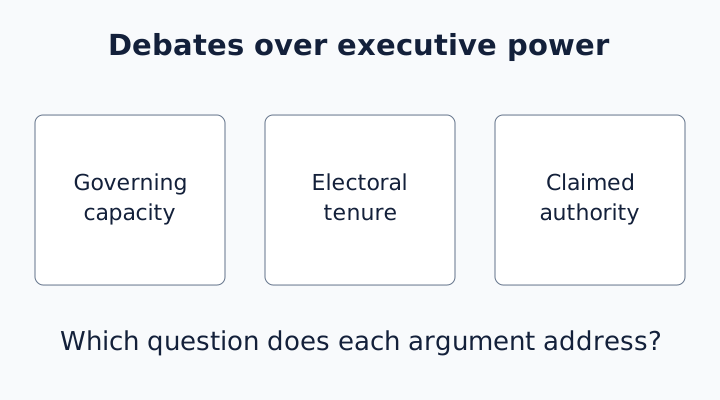
Original source-based concept-application practice: use the Federalist No. 70 passage and the historical source summaries above. (A) Describe Hamilton’s executive-design position and explain one mechanism supporting a stated public purpose. (B) Explain how Proclamation 9844 justified its use of asserted authority and identify the statutory institutional response in the enrolled H.J. Res. 46. (C) Explain why an argument for energy does not erase the separate presidential election limit in the Twenty-Second Amendment.
Model answer
Hamilton favors a single energetic executive. Unity can support decisive execution and clearer responsibility, serving purposes such as protection against foreign attack or steady administration of laws. In 2019, Proclamation 9844 asserted statutory emergency powers and justified military support and construction through a claimed security emergency. The enrolled H.J. Res. 46 sought termination under the National Emergencies Act, showing institutional opposition through a statutory route without explaining every legislator’s motive. A general defense of executive energy does not remove the Twenty-Second Amendment’s separate election limits. The claimed power, institutional response, and constitutional tenure rule address different questions.
Score your own answer. This is a self-check, not a grade. Tick each point your answer makes.
Part 6 Check yourself Read the components of an executive-power argument
Federalist No. 70 states: “A feeble Executive implies a feeble execution of the government.” The table paraphrases related parts of Hamilton’s argument. It is a source-analysis aid, not a quotation of the table’s wording.
| Source element | Paraphrased content |
|---|---|
| Assessment of weak execution | Weak implementation makes government perform badly in practice |
| Proposed design | A single executive can act decisively |
| Republican safety | Dependence on the people and responsibility still matter |
Case question 1 · Multiple choice
Which reasoning connects the proposed design to the defended benefit?
Case question 2 · Multiple choice
Which interpretation preserves the argument’s republican qualification?
The rest stand on their own and do not use the case.
Check yourself · Spot the error
Select the statement that makes an institutional error.
Check yourself · Match
Match each term to its distinguishing institutional feature.
Part 7 Keep it Retrieve and connect
From 2.4 Roles and Powers of the President · Fill the statement
Identify the legal effect.
An order directs federal management under executive or delegated authority; a communicates the president’s interpretation when signing a law.
From 2.5 Checks on the Presidency · Fill the statement
Explain the time horizon.
A confirmed federal judge may remain after the president leaves office because judicial is not a fixed term.
In three lines
- Connect Hamilton’s claim to its institutional reasoning.
- Distinguish an election limit from a scope-of-power dispute.
- Describe competing interpretations using evidence rather than policy preference.
Exam strategy for this topic
- Section I, Multiple Choice: 55 questions in 80 minutes.
- Section II, Free Response: 4 questions in 100 minutes.
- This lesson's Explain it is shaped like free-response question 1, Concept Application.
Read the argument and make an initial interpretation before examining the specific institutional limits.
Questions students ask
Why does Federalist No. 70 favor one executive?
Hamilton links unity to decisive action and clearer responsibility. These mechanisms support effective execution, while dependence on the people and accountability remain conditions of republican safety.
What public purposes support the energy argument?
The stated purposes include protection against foreign attacks, steady administration of laws, protection of property, and security of liberty. Explain the link from executive capacity to a purpose rather than merely listing it.
Does the Twenty-Second Amendment decide the legality of every order?
No. It establishes presidential election limits, including a partial-term rule. A dispute about a directive’s scope concerns a different constitutional or statutory boundary.
Can a student describe competing interpretations without choosing a policy side?
Yes. Identify each position’s claim about authority, its reasoning, and the institution whose decision matters. Do not invent a court ruling that the scenario does not provide.
Course alignment, for teachers
AP U.S. Government and Politics topic 2.6, Unit 2: Interactions Among Branches of Government.
- Skill 4.A: Describe the argument, perspective, evidence, and reasoning presented in the source.
This lesson maps all 3 essential knowledge statements of the topic to the part that teaches each one: 3 are checked by a scored question. The map is in the lesson file.