Unit 2 · Topic 2.7 · about 30 minutes · 7 parts · 9 scored checks, 2 of them multiple choice, plus 2 from earlier lessons
AP U.S. Government and Politics 2.7: Presidential Communication
Unit 2: 25 to 36% of the multiple-choice section
What you'll be able to do
- Explain how communication technology has changed the president’s relationship with the national constituency and the other branches.
Key vocabulary
| Term | What it means | The exam trap |
|---|---|---|
| Agenda setting | Influencing which policies the public perceives as most important. | Identify the subject emphasized and the observation about its public priority. |
| Bully pulpit | The presidency’s prominent communication platform for advancing priorities. | Identify the speaker’s platform and the audience being addressed. |
| State of the Union | A presidential message to Congress on the nation and the administration’s priorities, commonly nationally broadcast. | Separate the immediate congressional audience from the wider broadcast audience. |
| National constituency | The national public whose concerns and responses form part of a president’s political relationship. | Identify which audience the scenario actually describes. |
| Social media | Digital communication channels that can allow rapid public messages and responses. | Look for the channel used rather than assuming a particular audience response. |
| Policy enactment | The formal institutional process that makes a proposal effective as policy or law. | Track which official action actually occurs after the message. |
 Tap to open the picture full size
Part 1 Think first Predict the institutional consequence
Consider the sequence of messages and reactions, then commit to a starting hypothesis.
Predict first
A president can respond online while an event unfolds. Which relationship would you investigate first?
In short. Modern communication lets presidents respond quickly and shape public priorities while influencing relationships with the public and other branches.
- Identify the channel, audience, and timing of a response.
- Explain how presidential prominence can shape the public agenda.
- Keep communication, public attention, and formal policy decisions distinct.
Part 2 Learn it Speed changes the sequence of political response
2a. Speed changes the sequence of political response
Advances in communication technology increase the reach and speed of presidential communication. Social media can permit a rapid response to an event rather than waiting for a scheduled address or broadcast. Other officials, news organizations, and members of the public can react while the issue is still developing.
For an original example, imagine a president posting a response immediately after a major storm. Legislators receive questions about that response while agencies continue their existing work. The communication changes when audiences hear the president’s position and when other institutions face public questions. It does not by itself show that an agency has completed a program or Congress has passed a new law.
Identify the channel, audience, and observed response. Technology creates opportunities for rapid engagement, but different audiences may encounter different messages. The ability to publish quickly is not itself evidence that everyone heard, believed, or supported the message.
Quick check · Fill the statement
Trace the communication effect.
The difference between posting immediately after an event and waiting for a later scheduled broadcast concerns communication .
2b. Use prominence to shape the public agenda
Agenda setting concerns which policies the public perceives as important. The president’s bully pulpit is the office’s prominent platform for drawing attention to issues and priorities. It is a tool of public influence rather than a separate constitutional power to compel a legislative vote.
The State of the Union message addresses Congress about the nation and presidential priorities. National broadcasting also reaches an audience beyond the legislators in the room. Emphasizing education, infrastructure, or another issue can encourage public discussion about which problem deserves attention. Social media can reinforce or challenge the timing of that discussion through rapid follow-up messages.
Agenda setting and policy enactment are distinct observations. A public survey showing increased concern about an issue is evidence about priority. A congressional vote approving a measure is evidence about a formal policy decision. A strong explanation connects the communication channel to public attention and then identifies any separate institutional action.
Quick check · Fill the statement
Identify the public-influence role.
A president uses the office’s prominent to influence which issues the public views as important through .
2c. Explain relationships through a sequence of effects
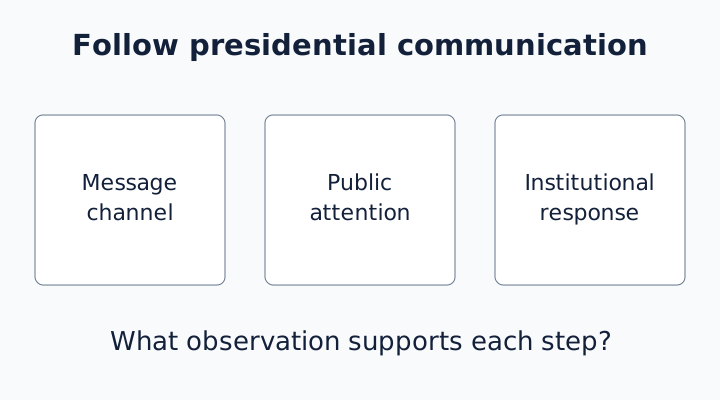
Presidential communication can reach the national constituency directly and through news coverage. A message may prompt public questions, organized advocacy, or responses from members of Congress. These reactions can alter the political setting in which another branch makes its decisions.
Consider a fictional nationally broadcast message about bridge safety. News coverage emphasizes the issue, residents contact representatives, and a committee schedules discussion. The steps show a route from presidential emphasis to attention and institutional response. They do not establish what the committee ultimately recommends or how every member votes.
Use the sequence rather than jumping from a presidential message to an assumed law. Compare a rapid post, a national address, and the resulting public or legislative reaction. Describe how the relationship changes: who receives the message, how quickly they respond, and which decisions remain with other institutions.
Quick check · Fill the statement
Follow the institutions.
After a televised priority message, residents contact legislators. That sequence can affect the political setting for , while the message alone does not supply the legislators’ .
Part 3 Watch it done Choose evidence for a communication effect
A fictional president posts about bridge safety, news organizations emphasize the issue, and legislators receive new questions about it. The next task is to identify evidence of agenda setting.
Step 1 · Separate the stages
The sequence includes a presidential message, coverage, and questions to legislators. These are observations about communication and reaction.
Why this step?
Why should a measure of public attention be separated from an agency action?
They answer different questions: one concerns which issue people prioritize, while the other concerns implementation by an institution.
Step 2 · Choose a matching observation
Identify which additional observation measures the effect under discussion instead of substituting a different stage of policymaking.
Your step · Decide and justify
Which additional observation would most directly show agenda setting?
Which institutional reason supports the decision?
A contrasting worked example
A president uses a nationally broadcast State of the Union message to emphasize education. People beyond Congress encounter that priority through the broadcast and related coverage. This uses the presidency’s bully pulpit to affect the public agenda. Whether legislators approve a related proposal remains a distinct institutional decision.
Part 4 Try it Classify the institutional action
Original teaching situations: distinguish what each institution can do.
Try it · Sort it
Which immediate feature does the evidence establish?
Rapid communication
Public issue priority
Formal policy decision
Part 5 Explain it Explain the chain from a message to political reaction
Free response is 50% of the exam score. This one is shaped like Question 1, Concept Application.
Free-response practice · Question 1 style
Original concept-application practice: a president posts rapidly about bridge safety, the media emphasize it, residents contact legislators, and a committee discusses possible action. (A) Explain how technology changes the timing of the president’s relationship with the public or Congress. (B) Identify and explain the agenda-setting mechanism. (C) Explain why the committee discussion does not establish that the proposed policy has been enacted.
Model answer
Rapid publication lets audiences and legislators respond before a later scheduled address, changing the timing of political interaction. The president uses the office’s prominent platform to draw attention to bridge safety; media emphasis and public contacts illustrate agenda setting by elevating the issue’s priority. Committee discussion is a separate institutional response. Without evidence of the needed formal decisions, it does not establish enactment of the proposal. The sequence links communication to attention and reaction while preserving the distinct institutional steps.
Score your own answer. This is a self-check, not a grade. Tick each point your answer makes.
Part 6 Check yourself Compare messages and institutional responses
An original teaching scenario contrasts two communication opportunities. No historical response counts or election results are claimed.
| Communication | Observed reaction |
|---|---|
| Rapid online post about bridge safety | Reporters and legislators respond before the next scheduled address |
| Nationally broadcast State of the Union message | Audiences beyond Congress discuss the highlighted education priority |
| Later committee meeting | Legislators consider possible action without a stated final vote |
Case question 1 · Multiple choice
What does the online-post row most directly illustrate?
Case question 2 · Multiple choice
How does national broadcasting extend the State of the Union’s communication role?
The rest stand on their own and do not use the case.
Check yourself · Spot the error
Select the statement that makes an institutional error.
Check yourself · Match
Match each term to its distinguishing institutional feature.
Part 7 Keep it Retrieve and connect
From 1.9 Federalism in Action · Fill the statement
Apply the distinction in the completed statement.
When both national and state governments exercise a function, the power is rather than exclusive to one level.
Original teaching situations: distinguish what each institution can do.
Modern source context
Historical source summaries: Proclamation 9844 asserted statutory emergency authority for military support and construction at the southern border in 2019. The enrolled H.J. Res. 46 sought to terminate that emergency using the National Emergencies Act. These are evidence of the claimed authority and institutional opposition; the summaries do not supply a complete record of legislators’ motives or later litigation.
Source at hand for the written task
Hamilton writes in Federalist No. 70: “A feeble Executive implies a feeble execution of the government.” He connects executive unity to decisive action and identifiable responsibility, while naming dependence on the people and responsibility as republican safeguards. Use this passage and the modern historical sources above for the written response.
From 2.6 Expansion of Presidential Power · Fill the statement
Apply the institutional distinction.
Federalist No. 70 connects energetic execution to protection against , steady administration of , protection of property, and security of liberty.
In three lines
- Identify the channel, audience, and timing of a response.
- Explain how presidential prominence can shape the public agenda.
- Keep communication, public attention, and formal policy decisions distinct.
Exam strategy for this topic
- Section I, Multiple Choice: 55 questions in 80 minutes.
- Section II, Free Response: 4 questions in 100 minutes.
- This lesson's Explain it is shaped like free-response question 1, Concept Application.
Consider the sequence of messages and reactions, then commit to a starting hypothesis.
Questions students ask
What does the bully pulpit describe?
The president’s prominent platform for drawing public attention to priorities. Its influence is different from a formal power that directly enacts a proposal.
How does social media change political timing?
A president can respond rapidly, and other actors can react before a scheduled speech or broadcast. Identify the reaction actually described rather than assuming universal reach or agreement.
Why does national broadcasting matter for the State of the Union?
The message reaches audiences beyond Congress. Coverage and discussion can influence which issues the wider public considers important.
What distinguishes agenda setting from implementation?
Agenda setting concerns perceived importance. Implementation concerns an institution carrying out policy. A survey about priorities and an agency action therefore supply evidence about different effects.
Course alignment, for teachers
AP U.S. Government and Politics topic 2.7, Unit 2: Interactions Among Branches of Government.
- Skill 1.E: Explain how political principles, institutions, processes, policies, and behaviors apply to different scenarios in context.
This lesson maps the one essential knowledge statement of the topic to the part that teaches each one: 1 is checked by a scored question. The map is in the lesson file.