Unit 2 · Topic 2.8 · about 30 minutes · 7 parts · 9 scored checks, 2 of them multiple choice, plus 2 from earlier lessons
AP U.S. Government and Politics 2.8: The Judicial Branch
Unit 2: 25 to 36% of the multiple-choice section
What you'll be able to do
- Explain the principle of judicial review and how it checks the power of other branches.
Key vocabulary
| Term | What it means | The exam trap |
|---|---|---|
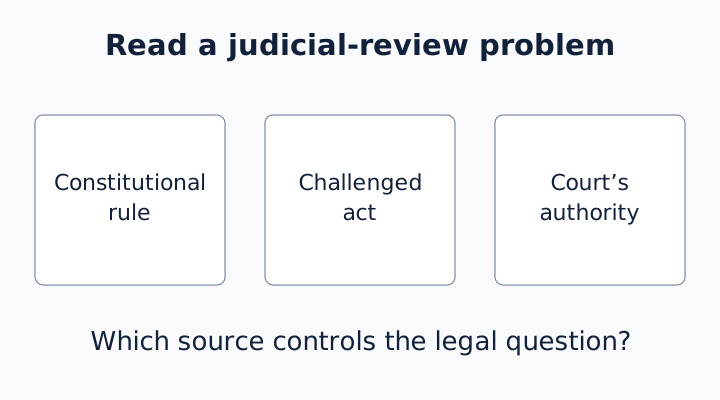
| Judicial review | A court’s constitutional assessment that can deny effect to a conflicting legislative or executive act in a case within its authority. | Identify the act, constitutional rule, and case before naming the check. |
| Article III | The Constitution’s foundation for the federal judiciary and its jurisdictional structure. | Separate constitutional text from a later opinion interpreting it. |
| Federalist No. 78 | Hamilton’s argument connecting judicial independence and constitutional judgment. | Identify the reasoning offered rather than treating the essay as a court ruling. |
| Original jurisdiction | Authority to hear a case when it begins in that court. | Identify how the case reached the court and the source of its authority. |
| Appellate jurisdiction | Authority to review a lower court’s decision. | A review of an earlier decision differs from a case beginning in that court. |
| Commission | An official document recording an appointment. | In this case the term concerns an appointment, not a financial payment. |
| Writ of mandamus | A court order directing performance of a legal duty. | Identify the requested duty and the court’s power to issue the order. |
| Judicial independence | Institutional ability to exercise legal judgment without dependence on immediate political demands. | Independence describes safeguards rather than a guarantee about every decision. |
 Tap to open the picture full size
Part 1 Think first Predict the institutional consequence
Consider the requested order and the Court’s role before committing to an interpretation.
Predict first
An applicant has a valid legal claim. Does that fact alone establish that the Supreme Court can issue any requested order?
In short. Article III, Federalist No. 78, and Marbury explain judicial independence and review as checks grounded in the Constitution rather than judicial preference.
- Distinguish an applicant’s right from a particular court’s jurisdiction.
- Relate Marbury’s reasoning to Article III’s constitutional allocation.
- Connect judicial independence to constitutional judgment rather than personal policy choice.
Part 2 Learn it Locate the constitutional institution
2a. Locate the constitutional institution
Article III vests the judicial power in one Supreme Court and lower courts Congress establishes. It provides service during good behavior and protection against reducing judicial compensation while in office. These arrangements support independence from immediate political pressure; they do not give judges every power held by other branches.
Jurisdiction is a court’s legal authority to hear a case. Original jurisdiction concerns a case beginning in that court; appellate jurisdiction concerns review of a lower-court decision. A valid individual claim and a particular court’s authority to grant the requested remedy are different questions.
Article III supplies the institutional foundation. The required case Marbury v. Madison explains the principle of judicial review, through which a court can refuse effect to a legislative or executive act that conflicts with the Constitution in a case within its authority. The Constitution’s text and a court’s interpretation should not be treated as identical documents. Primary text: National Archives, Article III.
Quick check · Fill the statement
Identify the constitutional check.
A court refuses effect to a statute because it conflicts with the Constitution. This illustrates .
2b. Follow the facts, issue, reasoning, and result
In Marbury v. Madison (1803), an outgoing administration completed a commission appointing Marbury a justice of the peace. It was not delivered, and Marbury sought a writ of mandamus directing Secretary of State Madison to provide it. A commission records an appointment; a writ of mandamus directs performance of a legal duty.
The Court recognized Marbury’s right to the completed commission and the availability of a legal remedy in principle. But could the Supreme Court issue the requested order in this original proceeding? The Court read the statutory authorization as extending its original jurisdiction beyond Article III’s specified categories.
The majority reasoned that the Constitution is higher law, so an ordinary statute cannot override its limits. The Court therefore denied the requested writ rather than ordering delivery through that proceeding. The decision established judicial review while also applying a jurisdictional limit to the Court itself. Do not replace this sequence with the claim that recognizing a right guarantees any requested court order. Primary opinion: Marbury v. Madison, U.S. Reports.
Quick check · Fill the statement
Separate the right from the forum’s power.
Marbury’s recognized right did not itself expand the Supreme Court’s beyond Article III.
2c. Connect the case to the argument for independence
In Federalist No. 78, Hamilton argues that courts exercise judgment rather than the executive’s force or the legislature’s control of funds. Stable service during good behavior helps courts withstand pressure and apply the Constitution. This is an argument for independence, not evidence that every judge is automatically impartial.
Hamilton treats the Constitution as fundamental law expressing the people’s higher authority. When an ordinary legislative act conflicts with it, judges should prefer the Constitution. That reasoning connects to Marbury: the Court declined to apply a statutory jurisdictional expansion that conflicted with Article III.
The relationship is specific. Article III establishes the institution and jurisdictional structure; Federalist No. 78 explains why independent constitutional judgment matters; Marbury applies constitutional priority in a case. Judicial review can check other branches without making judges legislators or giving courts unrestricted original jurisdiction. Primary text: Library of Congress transcription, Federalist No. 78.
Quick check · Fill the statement
Connect the source and case.
Hamilton treats the Constitution as law, so independent judicial should prefer it over a conflicting ordinary statute.
Part 3 Watch it done Compare constitutional and statutory authority
In an original teaching scenario, Congress passes a statute purporting to add an original-jurisdiction category to the Supreme Court beyond Article III’s allocation. Both texts bear on a requested order.
Step 1 · Identify the two sources
One rule is constitutional; the other is an ordinary congressional statute. The dispute concerns the Court’s authority to act, not just whether an applicant has a legal grievance.
Why this step?
Why is identifying a valid grievance not enough?
The Court must also have jurisdiction to grant the requested relief through this proceeding.
Step 2 · Compare the governing norms
Determine which source has higher authority, then ask whether the proposed statutory addition fits the constitutional allocation.
Your step · Decide and justify
Which approach follows Marbury’s constitutional-priority reasoning?
Which institutional reason supports the decision?
A contrasting worked example
An original example places a judge under pressure from a current legislative majority to apply a statute despite a constitutional conflict. Service during good behavior means the judge need not seek a new appointment from that majority after each ruling. Hamilton’s argument connects this stability to independent judgment applying fundamental law. That safeguard supports a checking role; it does not prove every judge’s conclusion is correct.
Part 4 Try it Classify the institutional action
Original teaching situations: distinguish what each institution can do.
Try it · Sort it
Which aspect of the judiciary does the situation most directly illustrate?
Constitutional structure
Review in a case
Argument for independence
Part 5 Explain it Explain the case’s relationship to its foundations
Free response is 50% of the exam score. This one is shaped like Question 1, Concept Application.
Free-response practice · Question 1 style
Original concept-application practice: Congress passes a statute claiming to expand the Supreme Court’s original jurisdiction beyond Article III, and an applicant seeks an order under it. A lawyer also cites Federalist No. 78. (A) Explain how Marbury v. Madison relates to the statutory claim. (B) Explain the relationship between the case and Article III. (C) Explain how Federalist No. 78’s reasoning supports a judicial check without turning independence into unlimited power.
Model answer
Marbury denied the requested writ because the statutory original-jurisdiction expansion conflicted with the Constitution. It therefore supports examining the hypothetical statute against Article III rather than assuming an applicant’s right supplies jurisdiction. Article III is the constitutional source of the allocation that the case applied. Federalist No. 78 argues that independent judgment should prefer the people’s fundamental law over a conflicting ordinary act; stable tenure helps judges withstand pressure to do otherwise. That reasoning supports judicial review as a check on Congress, while the case also demonstrates that the Court remains bound by constitutional limits on its own authority.
Score your own answer. This is a self-check, not a grade. Tick each point your answer makes.
Part 6 Check yourself Relate constitutional text, source argument, and a case
The table summarizes three required sources. These are paraphrases, not invented quotations.
| Source | Relevant feature |
|---|---|
| Article III | Constitutional foundation and allocation of judicial authority |
| Federalist No. 78 | Independent judgment should prefer the Constitution over a conflicting ordinary act |
| Marbury v. Madison | The Court refused a statutory expansion beyond its constitutional original jurisdiction |
Case question 1 · Multiple choice
Which relationship connects the case to Article III?
Case question 2 · Multiple choice
Which reading of Federalist No. 78 best supports that relationship?
The rest stand on their own and do not use the case.
Check yourself · Spot the error
Select the statement that makes an institutional error.
Check yourself · Match
Match each term to its distinguishing institutional feature.
Part 7 Keep it Retrieve and connect
From 2.5 Checks on the Presidency · Fill the statement
Explain the time horizon.
A confirmed federal judge may remain after the president leaves office because judicial is not a fixed term.
Original teaching scenarios: Assign each situation to the concept it most directly illustrates.
From 1.8 Constitutional Interpretations of Federalism · Fill the statement
Complete the analysis of this situation.
In McCulloch, a bank was upheld as an means related to enumerated powers; Maryland’s tax could not control the valid national instrument. In Lopez, the Court found the school-zone possession law exceeded the asserted power.
In three lines
- Distinguish an applicant’s right from a particular court’s jurisdiction.
- Relate Marbury’s reasoning to Article III’s constitutional allocation.
- Connect judicial independence to constitutional judgment rather than personal policy choice.
Exam strategy for this topic
- Section I, Multiple Choice: 55 questions in 80 minutes.
- Section II, Free Response: 4 questions in 100 minutes.
- This lesson's Explain it is shaped like free-response question 1, Concept Application.
Consider the requested order and the Court’s role before committing to an interpretation.
Questions students ask
Did Marbury obtain the requested writ from the Supreme Court?
No. The Court recognized his right but held that the statutory original-jurisdiction authorization conflicted with Article III, so it denied the writ through that proceeding.
How does Article III differ from Marbury?
Article III is constitutional text establishing the judicial institution and jurisdictional structure. Marbury is a later decision applying constitutional priority and establishing judicial review.
Why does Federalist No. 78 defend judicial independence?
Hamilton argues that courts need stability to exercise judgment according to fundamental constitutional law rather than immediate political pressure. This is an institutional justification, not proof that every decision is correct.
Does judicial review make the Court’s authority unlimited?
No. The same case that established review also applied a constitutional limit to the Court’s ability to issue the requested order. Independent judgment operates within legal authority.
Course alignment, for teachers
AP U.S. Government and Politics topic 2.8, Unit 2: Interactions Among Branches of Government.
- Skill 2.B: Explain how a required Supreme Court case relates to a foundational document or to other primary or secondary sources.
This lesson maps the one essential knowledge statement of the topic to the part that teaches each one: 1 is checked by a scored question. The map is in the lesson file.