Unit 3 · Topic 3.2 · about 30 minutes · 7 parts · 10 scored checks, 3 of them multiple choice, plus 2 from earlier lessons
AP U.S. Government and Politics 3.2: First Amendment: Freedom of Religion
Unit 3: 13 to 18% of the multiple-choice section
What you'll be able to do
- Explain the extent to which the Supreme Court’s interpretation of the First Amendment reflects a commitment to religious liberty.
Key vocabulary
| Term | What it means | The exam trap |
|---|---|---|
| Establishment Clause | The First Amendment provision barring government establishment of religion. | Identify government sponsorship rather than assuming every religious act is official. |
| Free Exercise Clause | The First Amendment provision protecting the exercise of religion. | A religious claim requires attention to the actual burden and context. |
| Religious liberty | Constitutional freedom concerning religious belief and practice, protected through both religion clauses. | The two clauses ask different questions about government action. |
| Holding | A court’s legal resolution of the issue necessary to decide a case. | A party’s argument is not automatically the Court’s ruling. |
| Majority opinion | An opinion joined by enough justices to state the Court’s controlling reasoning. | Separate opinions must not be presented as majority reasoning. |
 Tap to open the picture full size
Part 1 Think first Predict the institutional consequence
Describe each required case using facts, issue, holding, and majority reasoning.
Predict first
A school board faces two complaints: officials lead a prayer, and an individual student is barred from praying privately. What should the board compare?
In short. Religious liberty involves both limiting government sponsorship of religion and protecting religious exercise against unjustified government burdens.
- The Establishment Clause limits government religious sponsorship.
- The Free Exercise Clause protects religious exercise from unjustified burdens.
- Case reasoning depends on the actual government action and relevant facts.
Part 2 Learn it Two clauses create distinct questions
2a. Two clauses create distinct questions
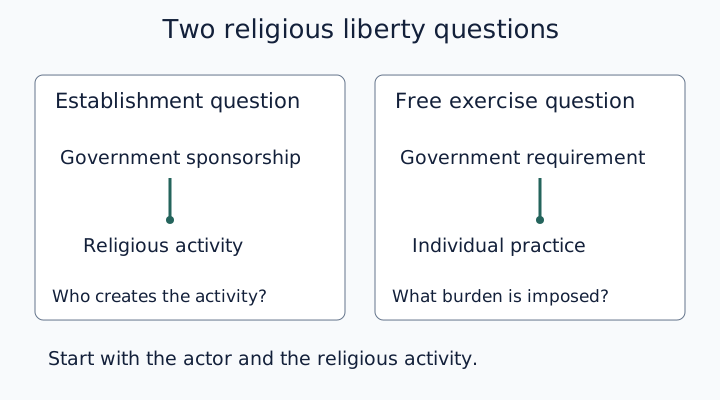
The First Amendment bars government establishment of religion and protects the free exercise of religion. The Establishment Clause asks whether government sponsors or establishes religion. The Free Exercise Clause asks whether government improperly interferes with religious belief or practice. A government can violate religious liberty by promoting an official religious activity or by burdening a person’s religious exercise. These are related protections, but identifying one does not automatically answer the other.
In a public school dispute, identify who creates or organizes the religious activity. A state-composed prayer delivered as part of the school program raises a different question from a student’s own prayer. School sponsorship is government action. Individual religious expression is not automatically government establishment merely because it occurs at school.
The tension concerns both government power to make laws and the individual’s religious freedom. A helpful explanation states the government’s action, the relevant clause, and the reasoning connecting them. Saying only that religion is protected leaves the central constitutional question unanswered. Source: National Archives, Bill of Rights transcript.
Quick check · Fill the statement
Complete the distinction in this situation.
A government-written prayer raises an question; a restriction on religious practice raises a question.
2b. Engel: government sponsorship is the issue
In Engel v. Vitale (1962), New York’s Board of Regents composed a short, nominally nondenominational prayer. A public school district directed that it be recited at the beginning of the school day. Students could remain silent or be excused. Parents challenged the official prayer under the Establishment Clause.
Justice Black’s majority opinion held that the state-composed, school-sponsored prayer violated that clause. The Court reversed the state judgment upholding the practice. Government had composed and sponsored a religious activity. Its reasoning did not depend on proof that every student was forced to participate, nor did describing the prayer as nondenominational cure the constitutional problem.
The majority distinguished official prayer from individual religious freedom. The case did not forbid private belief or decide that all student prayer is unconstitutional. Its constitutional question concerned a government program of prayer in public schools. When describing the holding, retain that actor and activity. Removing them turns a specific limit on government sponsorship into an inaccurate claim about religion generally. Read the original majority, especially pages 424-425 and 430-435: Engel v. Vitale, 370 U.S. 421, 422-436 (1962).
Quick check · Fill the statement
Complete the distinction in this situation.
In Engel, the constitutional problem was state of prayer, even though participation was .
2c. Yoder: evaluate the burden and the state’s interest
In Wisconsin v. Yoder (1972), Amish parents were convicted for refusing to send their children to school after eighth grade, although Wisconsin required attendance until age sixteen. The parents argued that high school attendance conflicted with their sincere religious way of life. They provided evidence of a longstanding religious community and continuing vocational education.
Chief Justice Burger’s majority opinion held that applying the attendance requirement to these parents violated the Free Exercise Clause. The Court affirmed the Wisconsin Supreme Court’s judgment setting aside their convictions. It weighed the severe burden on religious exercise against the state’s education interest, concluding that the state had not justified this additional schooling requirement under these facts.
The decision did not establish that any religious objection defeats any law. Its reasoning depended on the demonstrated religious burden and evidence addressing the state’s concern for education and self-sufficiency. Compare Engel: one limits government promotion of religion; the other protects religious exercise against a particular state requirement. Both apply constitutional limits to government, but through different clauses. Read pages 215-219 and 228-236: Wisconsin v. Yoder, 406 U.S. 205, 207-236 (1972).
Quick check · Fill the statement
Complete the distinction in this situation.
Yoder concerned a burden on religious , weighed against the state’s interest in .
Part 3 Watch it done Describe Engel without changing its holding
Source facts from Engel: officials composed a prayer, a public school used it in the school day, and participation could be excused.
Step 1 · State the issue
Ask whether the government’s composition and sponsorship of school prayer violated the Establishment Clause.
Step 2 · Separate a party claim from the majority’s reasoning
The availability of an opt-out was offered in defense of the program. The majority concluded that official religious sponsorship remained a problem.
Why this step?
Why does voluntary participation fail to resolve the majority’s concern?
The Establishment Clause limits government sponsorship itself; the prayer remains state-composed and school-sponsored even if a child may opt out.
Your step · Decide and justify
A district defends the same state-composed prayer only by making it optional. Which comparison is most faithful to Engel?
Which institutional reason supports the decision?
A second worked example
For Yoder, begin with the attendance law and the parents’ religious conflict. Add the evidence of continuing education and the state’s education interest. The majority held the requirement unconstitutional as applied under these facts; it did not grant a universal exemption from all school rules.
Part 4 Try it Apply the rights distinction
Original teaching situations: distinguish what each institution can do.
Try it · Sort it
Which clause supplies the central question in each original scenario?
Government sponsorship: Establishment Clause
Burden on practice: Free Exercise Clause
| Feature | Engel | Yoder |
|---|---|---|
| Government action | Official school prayer | Compulsory attendance after eighth grade |
| Claim | Government sponsorship of religion | Burden on Amish religious exercise |
| Result | Prayer program unconstitutional | Attendance requirement unconstitutional as applied |
Part 5 Explain it SCOTUS comparison: sponsorship and exercise
Free response is 50% of the exam score. This one is shaped like Question 3, SCOTUS Comparison.
Free-response practice · Question 3 style
Use the comparison table above. Describe the facts, issue, holding, and reasoning of Engel. Then explain why a religious family’s challenge to compelled schooling, like Yoder, raises a different First Amendment question.
Model answer
Engel involved a state-composed prayer used in public schools despite an opt-out. The issue was official religious sponsorship. The Court held the program unconstitutional under the Establishment Clause because the state’s composition and sponsorship of prayer remained an establishment concern even without compulsory participation. Yoder involved a burden on Amish religious exercise caused by required high school attendance. Its free exercise reasoning examined that burden and the state’s educational justification, rather than whether the state sponsored a religious program.
Score your own answer. This is a self-check, not a grade. Tick each point your answer makes.
Part 6 Check yourself Distinguish the two required cases
Case comparison based on the cited majority opinions. Use both the action and the constitutional reason.
| Feature | Engel | Yoder |
|---|---|---|
| Government action | Official school prayer | Compulsory attendance after eighth grade |
| Claim | Government sponsorship of religion | Burden on Amish religious exercise |
| Result | Prayer program unconstitutional | Attendance requirement unconstitutional as applied |
Case question 1 · Multiple choice
Which description accurately states the issue in Engel?
Case question 2 · Multiple choice
Which fact most directly supported the religious-exercise claim in Yoder?
Case question 3 · Multiple choice
What shared principle is illustrated by the different outcomes?
The rest stand on their own and do not use the case.
Check yourself · Spot the error
Select the statement that makes an institutional error.
Check yourself · Match
Match each constitutional term to its defining feature.
Part 7 Keep it Retrieve and connect
From 3.1 The Bill of Rights · Fill the statement
Complete the distinction in this situation.
A federal rule must comply with constitutional even after an election.
From 2.14 Holding the Bureaucracy Accountable · Fill the statement
Identify the congressional tool.
Congress reviews implementation through ; changing an appropriation uses its .
In three lines
- The Establishment Clause limits government religious sponsorship.
- The Free Exercise Clause protects religious exercise from unjustified burdens.
- Case reasoning depends on the actual government action and relevant facts.
Exam strategy for this topic
- Section I, Multiple Choice: 55 questions in 80 minutes.
- Section II, Free Response: 4 questions in 100 minutes.
- This lesson's Explain it is shaped like free-response question 3, SCOTUS Comparison.
Describe the required cases’ actual facts, issue, holding, decision, and majority reasoning.
Questions students ask
Did Engel ban religion in public schools?
It invalidated official composition and sponsorship of a school prayer. It did not hold that students lose the ability to hold beliefs or engage in private religious expression.
Why did an opt-out fail in Engel?
The majority treated government sponsorship of prayer as the constitutional problem. Letting a student abstain did not stop the government from composing and sponsoring the activity.
Did Yoder eliminate compulsory education?
No. The holding addressed required attendance after eighth grade for the Amish parents in the record, including evidence of religious burden and continued education outside high school.
Can the same policy raise both clauses?
A policy can create more than one religious liberty question. Analyze who acts, what the government sponsors, and what individual practice it burdens, rather than assuming one clause answers everything.
Course alignment, for teachers
AP U.S. Government and Politics topic 3.2, Unit 3: Civil Liberties and Civil Rights.
- Skill 2.A: Describe the facts, issue, holding, reasoning, decision, and majority opinion of required Supreme Court cases.
This lesson maps the one essential knowledge statement of the topic to the part that teaches each one: 1 is checked by a scored question. The map is in the lesson file.