Unit 3 · Topic 3.3 · about 30 minutes · 7 parts · 13 scored checks, 3 of them multiple choice, plus 2 from earlier lessons
AP U.S. Government and Politics 3.3: First Amendment: Freedom of Speech
Unit 3: 13 to 18% of the multiple-choice section
What you'll be able to do
- Explain the extent to which the Supreme Court’s interpretation of the First Amendment reflects a commitment to free speech.
Key vocabulary
| Term | What it means | The exam trap |
|---|---|---|
| Symbolic speech | Nonverbal action communicating an idea or belief. | Expressive conduct still requires attention to the setting and justification. |
| Time, place, and manner regulation | A restriction on when, where, or how expression occurs. | The rule’s label does not establish that it meets constitutional requirements. |
| Defamation | False factual communication that harms reputation under the applicable legal standard. | Criticism and an actionable false statement are different. |
| Libel | Written defamation. | Identify the medium as well as the alleged harm. |
| Slander | Oral defamation. | A spoken accusation and a published text use different media. |
| Obscenity | A legally defined category of sexual material receiving no First Amendment protection. | Ordinary offensiveness alone does not establish this legal category. |
| Clear and present danger | A historical speech restriction formulation examining danger in the circumstances. | Historical judicial language must be distinguished from later refinements. |
| Incitement | Speech directed toward producing unlawful action, subject to a specific constitutional standard. | Advocacy and imminent unlawful action require careful distinction. |
 Tap to open the picture full size
Part 1 Think first Predict the institutional consequence
Articulate a defensible thesis with a clear boundary; avoid claims that all expression is immune or all offense is unprotected.
Predict first
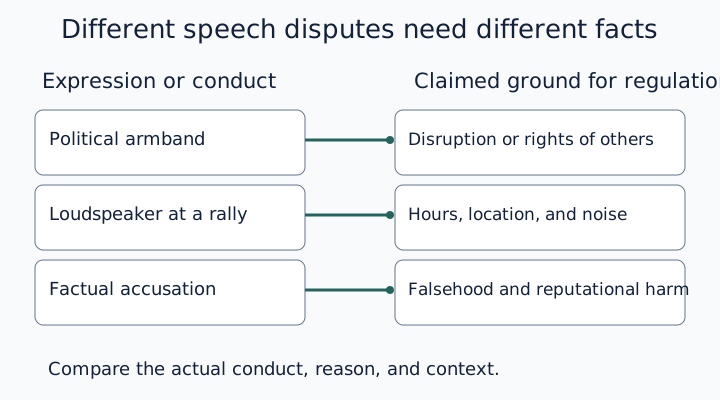
A city hears three complaints: a silent political ribbon, late-night amplified sound, and a printed false accusation. What would make one rule for all three difficult?
In short. Free speech protects expression and symbolic action, while courts evaluate specific restrictions against concerns for order, reputation, and safety.
- Speech includes nonverbal communication of ideas.
- Different restrictions require different constitutional explanations.
- A defensible claim distinguishes historical rules and current refinements.
Part 2 Learn it An idea can be expressed without words
2a. An idea can be expressed without words
Freedom of speech protects expression of ideas, including symbolic speech: nonverbal action communicating a belief or idea. Identify both the conduct and its expressive meaning. A protest armband communicates a political position even though the wearer says nothing. Calling an act symbolic does not answer every question about its regulation; context and the government’s justification still matter.
In Tinker v. Des Moines (1969), public-school students wore black armbands to protest the Vietnam War. School officials adopted a prohibition and suspended students who refused to remove them. Justice Fortas’s majority opinion held that the prohibition violated the students’ First Amendment rights. The Court reversed and remanded. The record did not establish substantial disruption or invasion of others’ rights. Undifferentiated fear of disturbance was insufficient.
The majority did not say that school officials can never regulate expression. It distinguished protected political expression from conduct that materially and substantially disrupts school or invades others’ rights. A defensible claim must preserve that distinction. Source: Tinker v. Des Moines, 393 U.S. 503, 504-514 (1969).
Quick check · Fill the statement
Complete the distinction in this situation.
A silent protest armband communicates an idea through .
2b. Time, place, and manner differ from viewpoint
Government can regulate when, where, and how expression occurs through time, place, and manner rules. Examples include limits on late-night noise, use of particular locations, or sound amplification. For a constitutional evaluation, consider the rule’s justification, neutrality, scope, and available alternatives. A city’s desire for quiet can support a different kind of argument from hostility to a speaker’s political view.
Original example: a park permits rallies but restricts amplified sound late at night under a rule applying regardless of viewpoint. This is a time and noise regulation. A rule that bars only criticism of city officials targets a message instead. Labeling either rule a permit requirement does not eliminate that distinction.
Background legal principle: a content-neutral regulation must meet applicable constitutional standards; saying time, place, and manner does not automatically make any restriction valid. For this lesson, explain how the government tries to preserve order while expression remains possible. Do not assume that every limit on a loudspeaker is a ban on political ideas.
Quick check · Fill the statement
Complete the distinction in this situation.
The hours when a rally occurs concern ; limits on amplifier volume concern .
2c. Offense and reputational harm require distinctions
Speech protections do not make every form of communication immune from regulation. Courts recognize limits involving legally obscene material and certain offensive communication in specific contexts. But ordinary offensiveness is not a general license to suppress unpopular ideas. Distinguish the legal category and context from an official’s dislike of a message.
Defamation is communication harming another’s reputation through false factual statements under the applicable legal standard. Libel is written defamation; slander is oral defamation. A false accusation in a printed newspaper raises a different issue from a spoken accusation at a meeting. The medium helps identify the category, while the facts and legal requirements determine liability.
Background boundary: criticism, disagreement, and an unflattering opinion are not automatically actionable defamation. The standard varies with the plaintiff and context; public officials face additional constitutional protections for criticism. A strong explanation therefore says what kind of statement and harm are alleged rather than treating any injured feelings as proof. This separates reputational protection from a general government power to ban offense.
Quick check · Fill the statement
Complete the distinction in this situation.
Written defamatory accusations are ; oral defamatory accusations are .
2d. Read Schenck as a historical rule, then track refinement
In Schenck v. United States (1919), defendants distributed leaflets to men called for military service during World War I. Their convictions concerned an attempt to obstruct recruiting under the Espionage Act. Justice Holmes’s unanimous opinion upheld the convictions. It evaluated the words in their wartime circumstances and used the clear and present danger formulation, asking whether they created a danger of substantive harms Congress could prevent. Source: Schenck v. United States, 249 U.S. 47, 48-53 (1919).
The case illustrates a historical balance favoring government’s wartime enforcement interest. Do not describe the leaflets as simply an ordinary school protest; the facts and legal context differ from Tinker. Do not treat a quotation from Schenck as the complete rule governing speech today. Subsequent interpretations refined speech restrictions.
Background current distinction: under the later Brandenburg incitement standard, advocacy may be punished when directed to inciting imminent lawless action and likely to produce it. General advocacy and an imminent, likely incitement are different. A defensible thesis about free speech can recognize constitutional protection while explaining that the permitted limits depend on legal category, context, and the Court’s interpretation. Source for the later refinement: Brandenburg v. Ohio, 395 U.S. 444, 447-449 (1969).
Quick check · Fill the statement
Complete the distinction in this situation.
Schenck upheld wartime convictions using a formulation; later incitement doctrine requires attention to .
Part 3 Watch it done Build a bounded claim from Tinker
Use Tinker’s facts: peaceful antiwar armbands, suspensions under a targeted ban, and no showing of substantial interference.
Step 1 · Identify the expression
The armbands communicated opposition to the Vietnam War without speech or classroom interruption.
Step 2 · Identify the government’s justification
School officials feared disruption. The majority required evidence supporting substantial interference, rather than undifferentiated fear.
Why this step?
Why does the absence of demonstrated disruption matter?
The majority’s reasoning connects protection to the record; it does not grant immunity to conduct that materially disrupts school or invades others’ rights.
Your step · Decide and justify
Which claim best captures the protection shown by Tinker?
Which institutional reason supports the decision?
A second worked example
Contrast Schenck: leaflets reached men called for wartime service, and convictions concerned obstruction of recruitment. The Court upheld them using a danger analysis. A comparison must identify that factual and historical context, then note that later incitement doctrine refined speech restrictions.
Part 4 Try it Apply the rights distinction
Original teaching situations: distinguish what each institution can do.
Try it · Sort it
Classify the feature the hypothetical rule targets, without assuming every rule is valid.
Time, place, or manner
Message or viewpoint
Reputational harm
Try it · Fill the statement
Distinguish a legal speech category from ordinary dislike.
A legally defined category of unprotected sexual material is ; mere does not establish that category.
| Scenario | Relevant facts |
|---|---|
| A | A student quietly wears a protest ribbon; the school shows no substantial interference. |
| B | A city applies the same late-night loudspeaker rule to every rally. |
| C | A complaint alleges that a newspaper knowingly published a false factual accusation harming a person’s reputation. |
Part 5 Explain it Argument essay practice: articulate a defensible claim
Free response is 50% of the exam score. This one is shaped like Question 4, Argument Essay.
Free-response practice · Question 4 style
Using the scenario table above, articulate a defensible thesis about whether speech protections can coexist with public-order rules. Support the thesis with Tinker and one category of regulation from the lesson. Explain why a claim of unlimited speech immunity would be too broad.
Model answer
Speech protection can coexist with public-order rules when the constitutional justification depends on the conduct and context rather than simple hostility to ideas. Tinker protected peaceful political armbands because the school did not show substantial interference or invasion of others’ rights. Neutral restrictions on rally hours or volume concern time and manner, although they must still satisfy constitutional standards. A claim of unlimited immunity goes too far because protected expression does not erase every valid regulation or the specific limits recognized by courts.
Score your own answer. This is a self-check, not a grade. Tick each point your answer makes.
Part 6 Check yourself Evaluate original speech disputes
Original scenarios for applying the distinctions, not summaries of additional Court cases.
| Scenario | Relevant facts |
|---|---|
| A | A student quietly wears a protest ribbon; the school shows no substantial interference. |
| B | A city applies the same late-night loudspeaker rule to every rally. |
| C | A complaint alleges that a newspaper knowingly published a false factual accusation harming a person’s reputation. |
Case question 1 · Multiple choice
Which claim is most defensible using scenario A and Tinker?
Case question 2 · Multiple choice
Which distinction best explains scenario B?
Case question 3 · Multiple choice
Which concept most directly describes the alleged harm and medium in scenario C?
The rest stand on their own and do not use the case.
Check yourself · Spot the error
Select the statement that makes an institutional error.
Check yourself · Match
Match each constitutional term to its defining feature.
Check yourself · Fill the statement
Recall the expression and legal distinction in Tinker v. Des Moines.
In Tinker, students used black armbands to oppose a war. Their nonverbal expression was . The Court distinguished unsupported fear of disturbance from facts supporting a forecast of .
Part 7 Keep it Retrieve and connect
From 3.2 First Amendment: Freedom of Religion · Fill the statement
Complete the distinction in this situation.
A government-written prayer raises an question; a restriction on religious practice raises a question.
From 3.1 The Bill of Rights · Fill the statement
Complete the distinction in this situation.
Government interference with a protected freedom raises a issue.
In three lines
- Speech includes nonverbal communication of ideas.
- Different restrictions require different constitutional explanations.
- A defensible claim distinguishes historical rules and current refinements.
Exam strategy for this topic
- Section I, Multiple Choice: 55 questions in 80 minutes.
- Section II, Free Response: 4 questions in 100 minutes.
- This lesson's Explain it is shaped like free-response question 4, Argument Essay.
Articulate a claim that answers the question and identifies the relevant boundary or condition.
Questions students ask
Does symbolic speech mean any physical action is protected?
No. The action must communicate an idea, and regulation still depends on context and the relevant constitutional standard.
Did Tinker remove school authority to maintain order?
No. The majority distinguished the peaceful expression in the record from material and substantial disruption or invasion of others’ rights.
Is every false statement automatically libel?
No. Libel is written defamation, and legal liability requires the applicable elements. Oral defamation is slander; opinion and mere disagreement require different analysis.
Is Schenck the complete current incitement rule?
No. It is a required historical case. Later decisions refined speech restrictions, including the requirement of directed, likely, imminent lawless action for incitement.
Course alignment, for teachers
AP U.S. Government and Politics topic 3.3, Unit 3: Civil Liberties and Civil Rights.
- Skill 5.A: Articulate a defensible claim/thesis.
This lesson maps all 2 essential knowledge statements of the topic to the part that teaches each one: 2 are checked by a scored question. The map is in the lesson file.