Unit 3 · Topic 3.4 · about 30 minutes · 7 parts · 9 scored checks, 2 of them multiple choice, plus 2 from earlier lessons
AP U.S. Government and Politics 3.4: First Amendment: Freedom of the Press
Unit 3: 13 to 18% of the multiple-choice section
What you'll be able to do
- Explain the extent to which the Supreme Court’s interpretation of the First Amendment reflects a commitment to individual liberty.
Key vocabulary
| Term | What it means | The exam trap |
|---|---|---|
| Freedom of the press | Constitutional protection for publishing and distributing information and ideas. | Identify the particular government restriction rather than assuming all press disputes are alike. |
| Prior restraint | Government action preventing publication before it occurs. | Timing distinguishes this restriction from consequences after publication. |
| Injunction | A court order requiring or forbidding specified conduct. | An injunction’s constitutional significance depends on the conduct it restrains. |
| Presumption | A starting legal position that assigns the burden of overcoming it. | A demanding presumption still requires attention to the actual claim. |
| Per curiam opinion | An opinion issued in the name of the Court rather than attributed to a named author. | Separate justices may give additional reasons that do not all become the Court’s reasoning. |
| National security | Protection of the nation against threats, often invoked to justify secrecy or government action. | An asserted interest and a demonstrated constitutional justification are different. |
 Tap to open the picture full size
Part 1 Think first Predict the institutional consequence
Explain how the placement, symbols, and arrows of a visual communicate a constitutional relationship.
Predict first
An official wants a judge to stop an unpublished security report. An editor argues that readers should see it. What would you need to evaluate?
In short. Freedom of the press includes a heavy presumption against government attempts to restrain publication, even when officials invoke national security.
- Prior restraint acts before publication.
- Government faces a heavy burden in seeking a preventive order.
- Visual design must be connected to a supported constitutional claim.
Part 2 Learn it A restraint before publication
2a. A restraint before publication
Prior restraint means a government restriction that prevents publication before the public can receive the material. An injunction ordering a newspaper to stop a story is a prior restraint. It differs from a lawsuit or penalty imposed after publication. Timing matters because stopping publication prevents the information from entering public debate at all.
The First Amendment’s press protection places a heavy presumption against prior restraint. That language means the government faces a demanding burden when it asks a court to prevent publication. It does not mean a newspaper wins every possible legal dispute or that no legal responsibilities apply after publication.
Original comparison: an executive official asks a court to halt tomorrow’s report about a classified study. Another person sues after an article appears, alleging a defamatory factual accusation. Both involve a newspaper, but only the first asks government to prevent publication. Identify the government action and its timing before using the term prior restraint. Otherwise you can mistake every newspaper lawsuit for the same constitutional issue.
Quick check · Fill the statement
Complete the distinction in this situation.
An order stopping tomorrow’s publication is ; a damages suit filed afterward is a .
2b. The Pentagon Papers dispute and the narrow holding
In New York Times Co. v. United States (1971), the federal government sought to stop the New York Times and Washington Post from publishing material from a classified study of U.S. decision making in Vietnam, commonly called the Pentagon Papers. Officials invoked national security. The issue was whether the government had met the constitutional burden for a court order stopping publication.
The Court’s short per curiam opinion stated that any system of prior restraint bears a heavy presumption against its constitutional validity. The government carried a heavy burden of justification and had not met it in these cases. Publication could proceed. The Court affirmed the judgment favoring the Washington Post and reversed the judgment imposing restraint on the New York Times.
The justices wrote separate opinions with differing reasoning. Do not treat a sentence from one justice’s concurrence as a rule accepted by the whole Court. The shared disposition and per curiam reasoning establish the demanding presumption and the government’s failure to meet its burden here. Source: New York Times Co. v. United States, 403 U.S. 713, 714 (1971).
Quick check · Fill the statement
Complete the distinction in this situation.
In the Pentagon Papers cases, the government failed to meet its for stopping .
2c. Read what a visual claims about government power
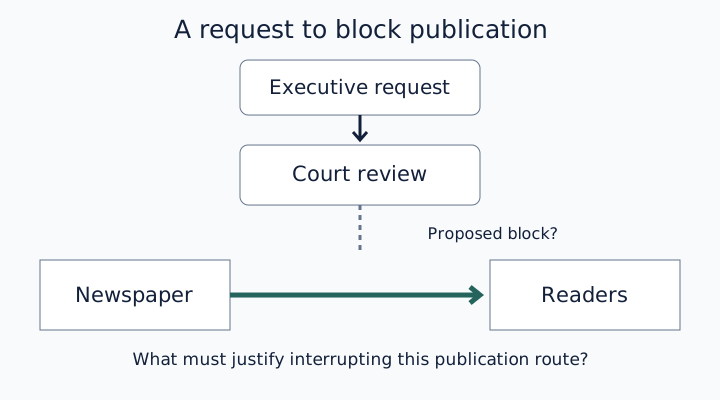
A visual can communicate an argument about press freedom through position, size, arrows, and symbols. In the original infographic used below, an executive request reaches a court before it can stop the route from newspaper to readers. The court box represents constitutional review, while the uninterrupted publication arrow represents the strong presumption against stopping publication.
To analyze the source, identify the visual element and then explain the constitutional relationship it represents. Saying that the image contains a newspaper is only identification. Explaining that a court stands between an official request and a blocked publication connects the design to a limit on government power.
The image is an original teaching interpretation, not a photograph or a historical cartoon from 1971. Its simplified arrangement cannot establish that prior restraint is impossible or describe every justice’s reasoning. Pair it with the per curiam opinion’s actual standard. A careful interpretation distinguishes a demanding burden on government from an absolute press exemption from all law. Visual evidence supports an argument only to the extent that the visual actually depicts the relationship claimed.
Quick check · Fill the statement
Complete the distinction in this situation.
A court placed between an executive request and a newspaper illustrates ; an open arrow to readers depicts .
Part 3 Watch it done Follow the burden in the Pentagon Papers cases
An official argues that labeling a study classified automatically entitles the government to stop a newspaper from publishing it. Compare that argument with the Court’s per curiam opinion.
Step 1 · Identify the requested remedy
The government asks to prevent publication through a court order, so the requested remedy is prior restraint.
Step 2 · Apply the starting position
The Court applies a heavy presumption against prior restraint. Government must justify the restriction; classification alone is not the Court’s stated conclusion.
Why this step?
Why separate the national security claim from the Court’s conclusion?
The claim states the government’s justification; the conclusion states that its burden was not met in these cases.
Your step · Decide and justify
Which conclusion follows from the Court’s actual disposition?
Which institutional reason supports the decision?
A second worked example
Original contrast: a newspaper publishes a knowingly false factual accusation, and the target brings a libel claim. The claim addresses an alleged injury after publication. Identifying that difference does not decide who wins the lawsuit, but it explains why the claim is not an order preventing the initial publication.
Part 4 Try it Apply the rights distinction
Original teaching situations: distinguish what each institution can do.
Try it · Sort it
Classify the timing and actor in each original press dispute.
Government restraint before publication
Legal consequence after publication
Private editorial choice
Tap to open the picture full size| Feature | Description |
|---|---|
| Timing | The report has not reached readers. |
| Actor | A federal official requests a court order. |
| Justification | The request asserts a national security interest. |
Part 5 Explain it Concept application through a visual source
Free response is 50% of the exam score. This one is shaped like Question 1, Concept Application.
Free-response practice · Question 1 style
Study the original infographic immediately above. (A) Describe the constitutional issue raised by the executive request. (B) Explain how the placement of the court and the open publication arrow depict the press protection in New York Times Co. v. United States. (C) Explain one limit on what the visual establishes.
Model answer
The request seeks prior restraint because it aims to stop information before publication. The court between the official’s request and a restriction depicts constitutional review; the open newspaper-to-reader arrow depicts the heavy presumption against stopping publication. In the Pentagon Papers cases, the government failed to meet its heavy burden. The simplified visual cannot establish that every prior restraint is impossible or that the press has immunity from all later legal claims.
Score your own answer. This is a self-check, not a grade. Tick each point your answer makes.
Part 6 Check yourself A request to stop an investigation
Original scenario: a federal official asks a judge to stop an unpublished report about a classified defense study, asserting national security without further evidence. The earlier visual source represents constitutional review, not the facts of a new Court case.
| Feature | Description |
|---|---|
| Timing | The report has not reached readers. |
| Actor | A federal official requests a court order. |
| Justification | The request asserts a national security interest. |
Case question 1 · Multiple choice
Which feature makes the requested remedy a prior restraint?
Case question 2 · Multiple choice
Which inference is best supported by the Pentagon Papers decision?
The rest stand on their own and do not use the case.
Check yourself · Spot the error
Select the statement that makes an institutional error.
Check yourself · Match
Match each constitutional term to its defining feature.
Part 7 Keep it Retrieve and connect
From 3.1 The Bill of Rights · Fill the statement
Complete the distinction in this situation.
A court applying an existing search protection to new technology performs .
From 3.2 First Amendment: Freedom of Religion · Fill the statement
Complete the distinction in this situation.
Yoder concerned a burden on religious , weighed against the state’s interest in .
In three lines
- Prior restraint acts before publication.
- Government faces a heavy burden in seeking a preventive order.
- Visual design must be connected to a supported constitutional claim.
Exam strategy for this topic
- Section I, Multiple Choice: 55 questions in 80 minutes.
- Section II, Free Response: 4 questions in 100 minutes.
- This lesson's Explain it is shaped like free-response question 1, Concept Application.
Explain how specific visual elements represent government power, judicial review, and press protection.
Questions students ask
Does prior restraint mean any criticism of the press?
No. It is a government action preventing publication, such as an injunction. Criticism by itself does not stop publication.
Did the Pentagon Papers decision make classification meaningless?
No. It resolved the government’s attempt to restrain these publications and found its heavy burden unmet. It did not erase all classification rules.
Can one concurrence stand for the whole Court?
Only reasoning joined by the necessary justices establishes the Court’s controlling rationale. Distinguish separate opinions from the short shared per curiam holding here.
What is a useful visual-source explanation?
Name a specific design choice, such as a barrier or an arrow, and explain how it represents a political principle. Merely listing objects leaves the relationship unexplained.
Course alignment, for teachers
AP U.S. Government and Politics topic 3.4, Unit 3: Civil Liberties and Civil Rights.
- Skill 4.D: Explain how the visual elements of the source (a cartoon, map, or infographic) illustrate or relate to political principles, institutions, processes, policies, and behaviors.
This lesson maps the one essential knowledge statement of the topic to the part that teaches each one: 1 is checked by a scored question. The map is in the lesson file.