Unit 3 · Topic 3.5 · about 30 minutes · 7 parts · 10 scored checks, 3 of them multiple choice, plus 2 from earlier lessons
AP U.S. Government and Politics 3.5: Second Amendment: Right to Bear Arms
Unit 3: 13 to 18% of the multiple-choice section
What you'll be able to do
- Explain the extent to which the Supreme Court’s interpretation of the Second Amendment reflects a commitment to individual liberty.
Key vocabulary
| Term | What it means | The exam trap |
|---|---|---|
| Second Amendment | The constitutional provision protecting the right to keep and bear arms. | The existence of a right and the validity of a particular regulation require separate analysis. |
| Individual right | A constitutional protection held by persons rather than only by an institution. | An individual right can still have constitutional limits. |
| Militia | A body of citizens organized for military service. | Identify how an opinion relates the militia reference to the protected right. |
| Self-defense | Protection of oneself against threatened harm. | The setting and lawful purpose matter when describing a particular holding. |
| Incorporation | Application of a Bill of Rights protection to states through the Fourteenth Amendment. | Distinguish the substantive right from the route applying it to state action. |
| Fundamental right | A right recognized as basic to the constitutional system of liberty. | A fundamental status does not remove all questions about regulation. |
| Prefatory clause | Language introducing a purpose or context for a provision. | An introductory purpose and an operative command perform different textual roles. |
| Operative clause | The portion of a legal provision that states the rule or protection. | Describe how an opinion connects the provision’s parts rather than assuming a connection. |
 Tap to open the picture full size
Part 1 Think first Predict the institutional consequence
Describe the source’s argument, perspective, evidence, and reasoning as distinct elements.
Predict first
Two analysts read the Second Amendment. One emphasizes militia language, the other individual self-defense. What would help compare their interpretations?
In short. The Supreme Court interprets the Second Amendment as protecting an individual right to possess arms, while distinguishing that right from unlimited immunity.
- Identify the individual-right interpretation.
- Separate the protected interest from the government bound.
- Describe the source’s argument with its evidence and limits.
Part 2 Learn it Read the text and identify the interpretive issue
2a. Read the text and identify the interpretive issue
The Second Amendment refers to a well-regulated militia and the right of the people to keep and bear arms. Its constitutional interpretation concerns the relationship between those clauses and the right protected. Read the source before deciding what a writer argues: National Archives, Bill of Rights transcript. The existence of a militia reference does not by itself describe every conclusion a court will draw about individual possession.
The Supreme Court’s decisions on this amendment rest on its interpretation of the constitutional right. In an analysis of a judicial source, separate the claim, the evidence used to support it, and the reasoning connecting the evidence to the result. Together these form the source’s argument. The text, history, and earlier decisions can play different roles in that argument.
Original example: one reader emphasizes the militia language; another emphasizes the phrase referring to the people. Describing those perspectives is different from declaring that either reader’s preferred policy is already the Court’s holding. To explain a decision faithfully, identify the actual majority’s conclusion and preserve its stated limits.
Quick check · Fill the statement
Complete the distinction in this situation.
A source’s position to be established is its ; supporting facts or text serve as .
2b. Heller: an individual right and a specific restriction
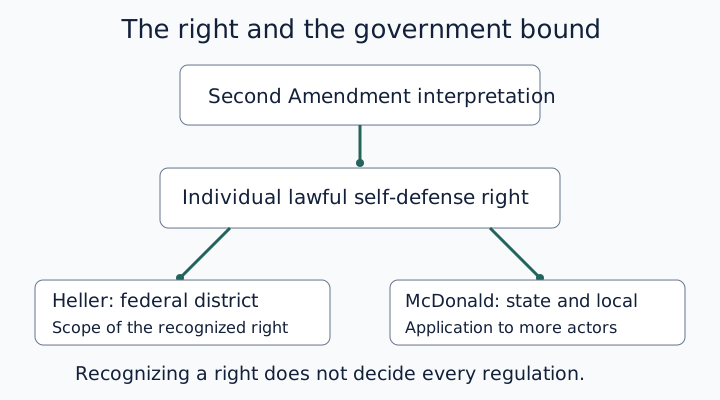
Background case: District of Columbia v. Heller (2008) concerned federal District of Columbia restrictions, including a ban on handgun possession in the home and a requirement that lawful firearms be kept inoperable. Justice Scalia’s majority opinion interpreted the Second Amendment to protect an individual right to possess a firearm unconnected with militia service and to use it for traditionally lawful purposes, including self-defense in the home.
The Court held the handgun ban and the inoperability requirement unconstitutional as applied to lawful home self-defense. The majority reasoned from constitutional language and history, distinguishing a prefatory militia clause from the operative protection of the people’s right.
The opinion also said the right is not unlimited. It identified longstanding restrictions and conditions that its opinion did not cast doubt on. Thus, neither a requirement of actual militia service for all protection nor a claim of immunity from all firearm regulation describes the majority’s interpretation. For this lesson, Heller supplies the interpretive background for the required McDonald case. Source: District of Columbia v. Heller, 554 U.S. 570, 628-636 (2008).
Quick check · Fill the statement
Complete the distinction in this situation.
Heller treated the right as and identified lawful home as a protected purpose.
2c. McDonald: the right binds state and local government
In McDonald v. Chicago (2010), residents challenged Chicago and Oak Park handgun restrictions after Heller had recognized the right against the federal District of Columbia. The issue was whether the Second Amendment right recognized in Heller also applied to state and local governments through the Fourteenth Amendment.
The Court held that it did. Justice Alito’s controlling majority portions described the self-defense right as fundamental to the American scheme of ordered liberty and deeply rooted in the nation’s history and tradition. The judgment below was reversed and the case remanded. The decision extended the constitutional protection to state and local action; it did not decide that all firearm regulations are unconstitutional.
Be precise about agreement among justices. Four justices used the Fourteenth Amendment’s Due Process Clause as the route; Justice Thomas agreed with the result through the Privileges or Immunities Clause. The course’s incorporation framework uses due process, but describing the opinion should not claim five justices joined that route. Interpret the source’s argument about a fundamental right, not an imagined universal exemption. Source: McDonald v. Chicago, 561 U.S. 742 (2010).
Quick check · Fill the statement
Complete the distinction in this situation.
McDonald applied the recognized right to governments through the .
Part 3 Watch it done Describe the majority’s argument from the source
Source paraphrase of McDonald’s controlling portions: the self-defense right recognized in Heller is fundamental to ordered liberty and deeply rooted in American history and tradition.
Step 1 · State the argument
The recognized right is sufficiently fundamental to bind state and local governments.
Step 2 · Identify evidence and reasoning
The opinion discusses history and the constitutional tradition of self-defense, using that evidence to justify the right’s fundamental character.
Why this step?
Why does the historical discussion matter to the argument?
It supports the conclusion that the recognized right is fundamental, which helps justify applying it against state action.
Your step · Decide and justify
Which description faithfully states the argument’s implication?
Which institutional reason supports the decision?
A second worked example
Original contrast: an analyst says Heller already involved a state restriction. Correct the actor: the District of Columbia is the federal district. McDonald then answered the separate question of application to state and local governments. The protected right and the government bound are different parts of the analysis.
Part 4 Try it Apply the rights distinction
Original teaching situations: distinguish what each institution can do.
Try it · Sort it
Classify each proposition by what it addresses.
Content of the right
Application to state action
Limit of the claimed holding
| Source feature | Paraphrased content |
|---|---|
| Heller interpretation | The operative text and history support an individual right for lawful purposes including home self-defense. |
| McDonald reasoning | The recognized right is fundamental to ordered liberty and rooted in American history and tradition. |
| Stated boundary | Recognition of the right does not mean every firearm restriction is unconstitutional. |
Part 5 Explain it Concept application: describe a source’s reasoning
Free response is 50% of the exam score. This one is shaped like Question 1, Concept Application.
Free-response practice · Question 1 style
Use the source table immediately above. (A) Describe Heller’s argument and its individual-right perspective. (B) Describe the evidence and reasoning supporting McDonald’s application of that right to state government. (C) Explain why the stated boundary matters to a city considering a new rule.
Model answer
Heller takes an individual-right perspective, interpreting text and history to protect an individual right to lawful possession, including self-defense in the home, without requiring actual militia service. McDonald uses the right’s place in American history and tradition to support its fundamental status and application to state and local action. The boundary matters because a city must respect the right, but recognizing that right does not itself resolve every proposed regulation; the specific rule still needs constitutional analysis.
Score your own answer. This is a self-check, not a grade. Tick each point your answer makes.
Part 6 Check yourself Read the constitutional argument
Original paraphrase of the cited opinions, not a quotation. Describe each source’s argument, perspective, evidence, and reasoning.
| Source feature | Paraphrased content |
|---|---|
| Heller interpretation | The operative text and history support an individual right for lawful purposes including home self-defense. |
| McDonald reasoning | The recognized right is fundamental to ordered liberty and rooted in American history and tradition. |
| Stated boundary | Recognition of the right does not mean every firearm restriction is unconstitutional. |
Case question 1 · Multiple choice
Which description best identifies the argument in the Heller row?
Case question 2 · Multiple choice
What function does the historical evidence serve in the McDonald row?
Case question 3 · Multiple choice
Which interpretation respects the boundary in the last row?
The rest stand on their own and do not use the case.
Check yourself · Spot the error
Select the statement that makes an institutional error.
Check yourself · Match
Match each constitutional term to its defining feature.
Part 7 Keep it Retrieve and connect
From 3.2 First Amendment: Freedom of Religion · Fill the statement
Complete the distinction in this situation.
In Engel, the constitutional problem was state of prayer, even though participation was .
From 3.3 First Amendment: Freedom of Speech · Fill the statement
Complete the distinction in this situation.
Schenck upheld wartime convictions using a formulation; later incitement doctrine requires attention to .
In three lines
- Identify the individual-right interpretation.
- Separate the protected interest from the government bound.
- Describe the source’s argument with its evidence and limits.
Exam strategy for this topic
- Section I, Multiple Choice: 55 questions in 80 minutes.
- Section II, Free Response: 4 questions in 100 minutes.
- This lesson's Explain it is shaped like free-response question 1, Concept Application.
Describe the argument, perspective, evidence, and reasoning in the judicial source rather than substituting a policy preference.
Questions students ask
Is Heller a required case in this course?
It supplies background for understanding the required McDonald case here. Use the course’s required-case inventory rather than treating every case mentioned in a lesson as required.
Why distinguish the District of Columbia from Chicago?
Heller concerned the federal district. McDonald addressed application of the recognized right to state and local government, which required the incorporation question.
Did five justices use the same incorporation route in McDonald?
No. Four used due process; Justice Thomas agreed with the outcome through privileges or immunities. The holding applied the right to the states, but the routes were not identical.
Does recognizing an individual right decide every gun law?
No. The opinions distinguish constitutional protection from unlimited immunity. A new regulation requires attention to its details and applicable constitutional standards.
Course alignment, for teachers
AP U.S. Government and Politics topic 3.5, Unit 3: Civil Liberties and Civil Rights.
- Skill 4.A: Describe the argument, perspective, evidence, and reasoning presented in the source.
This lesson maps the one essential knowledge statement of the topic to the part that teaches each one: 1 is checked by a scored question. The map is in the lesson file.