Unit 4 · Topic 4.2 · about 30 minutes · 7 parts · 9 scored checks, 2 of them multiple choice, plus 2 from earlier lessons
AP U.S. Government and Politics 4.2: Political Socialization
Unit 4: 10 to 15% of the multiple-choice section
What you'll be able to do
- Explain how cultural factors influence political socialization.
Key vocabulary
| Term | What it means | The exam trap |
|---|---|---|
| Political socialization | The process of developing political beliefs, values, opinions, and behaviors. | An influence is not a guaranteed political result. |
| Agent of socialization | A person, institution, or environment that contributes to political learning. | Several agents can contribute at the same time. |
| Political culture | Shared political ideals, principles, and core values in a society. | A shared culture can contain serious disagreements. |
| Globalization | Increasing connections among societies across national boundaries. | Trace the direction of influence rather than assuming uniformity. |
 Tap to open the picture full size
Part 1 Think first Predict the institutional consequence
A reported association or influence is not proof that one agent determined every belief.
Predict first
A student chooses a different party from a parent after years of family political discussions. Did family necessarily have no socialization role?
In short. Political socialization develops beliefs through family, schools, peers, media, civic and religious environments, and cultural exchange across countries.
- Socialization includes values, opinions, and behaviors.
- Agents overlap without determining identical outcomes.
- Global cultural influence moves in both directions.
Part 2 Learn it Beliefs develop through relationships
2a. Beliefs develop through relationships
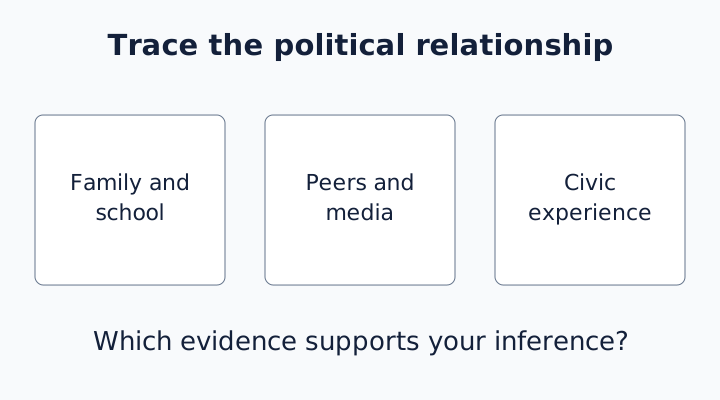
Political socialization is the process through which individuals develop political beliefs, values, opinions, and behaviors. Family conversations can introduce ideas about public authority. Schools can teach constitutional principles and give students experience discussing public rules. Neither influence guarantees that a person will adopt the same party identification as a parent or teacher.
Separate the agent from the result. A student may learn political vocabulary at school but reject a particular policy discussed there. The influence is still part of socialization. More than one agent can operate at the same time, and an individual can reconsider a belief.
For the end-of-lesson concept match, review this section together with the next two sections; the match combines their definitions.
Quick check · Fill the statement
Complete the explanation using the evidence.
A parent discussing elections is a influence; a civics course is a influence.
2b. Peers and public environments
Peers, media, social environments, and civic or religious organizations also transmit political ideas. Friends can make a local campaign feel relevant; a news report can draw attention to a problem; volunteering can expose a participant to competing claims about public responsibility. Religious organizations can provide settings for political discussion without every member sharing one view.
When reading a survey, describe exactly what was measured. A percentage saying that family was a major influence reports respondents’ perceptions. It does not measure how many beliefs family actually caused. Categories such as media and peers may overlap in daily life, especially when friends share news.
Quick check · Fill the statement
Complete the explanation using the evidence.
Friends discussing a campaign act as ; volunteering with a neighborhood association places a person in a environment.
2c. Political culture crosses borders
U.S. political culture centers on democratic ideals, principles, and core values. Globalization brings communication, migration, trade, and other connections across national boundaries. American ideas can influence people elsewhere, while experiences and ideas from other countries can influence debate in the United States. The exchange runs in both directions.
A student learning about participatory budgeting abroad may propose a local adaptation. Another country’s activists may draw on American constitutional ideals. Neither example proves that the countries become politically identical. Explain the route by which the encounter introduces or reshapes a political belief.
Quick check · Fill the statement
Complete the explanation using the evidence.
When U.S. movements influence foreign debates and overseas practices influence U.S. debate, cultural influence is .
Part 3 Watch it done Describe the data before explaining it
Original fictional survey: Among 200 students, 80 named family, 50 school, 40 peers, and 30 media as their single strongest reported influence.
Step 1 · Identify the evidence
Identify the denominator: 200 respondents.
Step 2 · Connect the mechanism
Read family’s count, 80; 80 of 200 is 40%.
Why this step?
Why retain the phrase strongest reported influence?
It describes what respondents selected without claiming other agents had no role.
Step 3 · Limit the inference
State what the item measures: the strongest influence respondents report.
Your step · Decide and justify
New survey design: the same 200 students may now select every influence that contributed, rather than only one strongest influence. Which response total is possible without any student changing beliefs?
Which explanation supports this inference?
A contrasting worked example
Contrasting example: A student names media as the strongest influence but discusses news with friends. The single-choice response identifies a reported priority; it does not show that peer influence is absent.
Part 4 Try it Classify the institutional action
Original teaching situations: distinguish what each institution can do.
Try it · Sort it
Classify each situation by the feature it directly describes.
Family
School
Civic or religious organization
| Reported influence | Students |
|---|---|
| Family | 80 |
| School | 50 |
| Peers | 40 |
| Media | 30 |
Part 5 Explain it Describe a pattern and its meaning
Free response is 50% of the exam score. This one is shaped like Question 2, Quantitative Analysis.
Free-response practice · Question 2 style
Use the fictional survey table just above. Identify the largest reported influence and state its count. Describe family’s share of the sample. Explain how a school or civic organization can contribute to socialization even for students who selected family. Explain one route by which globalization can change U.S. political culture. Hint for a share: divide the category count by 200 and multiply by 100.
Model answer
Family is the largest category, with 80 students, or 40% of 200. The item asks for a strongest influence, so students can also learn constitutional ideas at school or political habits in civic groups. Overseas civic practices can enter American debate through exchange, communication, or migration while American ideals also influence other countries.
Score your own answer. This is a self-check, not a grade. Tick each point your answer makes.
Part 6 Check yourself Read the evidence, then test the claim
Original fictional survey of 200 students. Each student selected one strongest reported influence; this is a classroom illustration, not a national estimate.
| Reported influence | Students |
|---|---|
| Family | 80 |
| School | 50 |
| Peers | 40 |
| Media | 30 |
Case question 1 · Multiple choice
Which description accurately reports the table?
Case question 2 · Multiple choice
An exchange student introduces a foreign civic practice to a U.S. club. What additional observation would illustrate influence in the opposite direction?
The rest stand on their own and do not use the case.
Check yourself · Spot the error
Select the statement that makes an institutional error.
Check yourself · Match
Match the concept to its defining feature.
Part 7 Keep it Retrieve and connect
From 4.1 American Attitudes About Government and Politics · Fill the statement
Complete the explanation using the evidence.
Smith links self-interest and to efficient resource allocation, while retaining a public role in .
From 2.1 Congress: The Senate and the House of Representatives · Fill the statement
Apply the representation rule.
The House uses representation, while the Senate gives states representation.
In three lines
- Socialization includes values, opinions, and behaviors.
- Agents overlap without determining identical outcomes.
- Global cultural influence moves in both directions.
Exam strategy for this topic
- Section I, Multiple Choice: 55 questions in 80 minutes.
- Section II, Free Response: 4 questions in 100 minutes.
- This lesson's Explain it is shaped like free-response question 2, Quantitative Analysis.
A reported association or influence is not proof that one agent determined every belief.
Questions students ask
Does socialization end after childhood?
No. New peers, media, civic experiences, and events can contribute throughout life.
Does family influence mean a child must share a parent’s party?
No. Exposure can shape vocabulary, priorities, or habits even when party choice differs.
Can religious organizations be agents without one political position?
Yes. They can provide discussion and civic experience while members disagree.
Does globalization replace U.S. political culture?
No. It creates channels for mutual influence, which citizens interpret within existing values and institutions.
Course alignment, for teachers
AP U.S. Government and Politics topic 4.2, Unit 4: American Political Ideologies and Beliefs.
- Skill 3.A: Describe the data presented.
This lesson maps all 2 essential knowledge statements of the topic to the part that teaches each one: 2 are checked by a scored question. The map is in the lesson file.