Unit 4 · Topic 4.4 · about 30 minutes · 7 parts · 9 scored checks, 2 of them multiple choice, plus 2 from earlier lessons
AP U.S. Government and Politics 4.4: Influence of Political Events on Ideology
Unit 4: 10 to 15% of the multiple-choice section
What you'll be able to do
- Explain how major political events influence political ideology.
Key vocabulary
| Term | What it means | The exam trap |
|---|---|---|
| Political event | A public occurrence involving political authority, conflict, or collective action. | An event’s prominence does not establish one response from everyone. |
| Political attitude | An evaluation or opinion about a political object or issue. | A single preference need not represent a complete ideology. |
| Ideological change | A change in connected beliefs about government and public policy. | Distinguish durable connected change from a temporary position. |
| Source perspective | The viewpoint from which a source interprets events or evidence. | A speaker’s interpretation is different from proof of audience agreement. |
 Tap to open the picture full size
Part 1 Think first Predict the institutional consequence
Use the source’s argument to explain a possible mechanism without inventing universal agreement.
Predict first
Two citizens experience the same crisis. One demands more federal action; the other demands less. Is one response impossible under political socialization?
In short. Major political events can reshape attitudes through political socialization and thereby influence broader beliefs about government.
- Events contribute to political socialization.
- Interpretation connects experience to government expectations.
- One source does not measure universal or permanent ideological change.
Part 2 Learn it An event becomes political learning
2a. An event becomes political learning
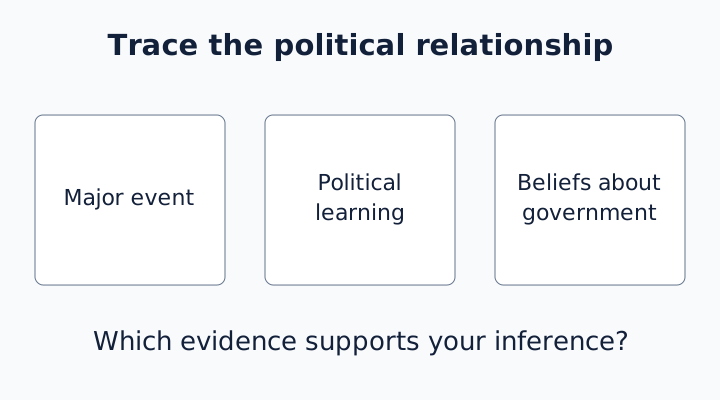
A major political event can expose people to new problems, government actions, or competing interpretations of authority. A war, economic crisis, major attack, or political movement can change which problems people notice and what they expect government to do. This process is political socialization because experience contributes to the development of beliefs and attitudes.
Trace a mechanism: event, encounter or interpretation, changed attitude, then a possible broader ideological implication. The event alone does not establish one inevitable response. A person who sees a crisis as evidence of market failure can favor more public action; another who sees a failed official response can become more skeptical of government.
For the end-of-lesson concept match, review this section together with the next two sections; the match combines their definitions.
Quick check · Fill the statement
Complete the explanation using the evidence.
When an economic crisis changes expectations of government through political learning, the process is .
2b. A primary source is an argument
In his First Inaugural Address on March 4, 1933, Franklin Roosevelt described economic distress and urged energetic national action. His argument connected a crisis to an expanded role for government. Reading that appeal helps explain how leaders interpret events and attempt to influence public expectations.
A presidential speech is evidence of the speaker’s argument. It is not a survey showing that every listener accepted the argument. Explain how the proposed response follows from the speaker’s account of the crisis, then distinguish that claim from evidence about actual changes in citizens’ beliefs. Roosevelt, First Inaugural Address, March 4, 1933
Quick check · Fill the statement
Complete the explanation using the evidence.
Roosevelt’s inaugural address is direct evidence of his about national action, while public agreement would require evidence about the .
2c. From an attitude to ideology
An attitude can concern one action, such as support for emergency assistance. Ideology is a broader connected view of government and policy. A crisis can influence both, but temporary support for one measure does not prove a permanent ideological transformation. Persistence and connections to other positions matter.
To explain a source, identify its claim and reasoning, connect them to government’s role, and state the limits of the inference. Two people exposed to the same event may interpret responsibility differently. Evidence showing a change after an event establishes timing; a stronger causal claim also needs evidence about mechanisms and alternative influences.
Quick check · Fill the statement
Complete the explanation using the evidence.
Support for one temporary emergency measure is an ; a connected view of government across issues is an .
Part 3 Watch it done Connect crisis reasoning to government’s role
Primary-source paraphrase: In his March 4, 1933 inaugural address, Roosevelt portrayed severe economic distress as requiring energetic national leadership and action.
Step 1 · Identify the evidence
Identify the problem the speaker emphasizes: economic distress.
Step 2 · Connect the mechanism
Identify the proposed institutional response: national action.
Why this step?
Why separate the speaker’s appeal from public agreement?
A speech records the argument being offered, while audience acceptance requires additional evidence.
Step 3 · Limit the inference
Connect the argument to a possible change in expectations about government, while separating the audience’s response.
Your step · Decide and justify
New evidence: one listener says the crisis persuaded her that voluntary private aid was insufficient, so she began supporting a national employment program. What mechanism does this report illustrate?
Which explanation supports this inference?
A contrasting worked example
Contrasting example: After an original fictional agency failure, a citizen argues for less centralized control. The event can socialize distrust rather than support for expansion. A different interpretation of responsibility produces a different ideological implication.
Part 4 Try it Classify the institutional action
Original teaching situations: distinguish what each institution can do.
Try it · Sort it
Classify each situation by the feature it directly describes.
Speaker’s argument
Observed attitude
Unsupported universal inference
Primary-source paraphrase for the written task: Roosevelt’s March 4, 1933 First Inaugural Address connects severe economic distress with energetic national action. This records his argument rather than a measure of public acceptance. Read the address
Part 5 Explain it Explain a source’s political implication
Free response is 50% of the exam score. This one is shaped like Question 1, Concept Application.
Free-response practice · Question 1 style
Read the Roosevelt paraphrase above and its linked primary address. Describe the argument about the crisis. Explain how that argument could contribute to political socialization. Explain why the address alone cannot establish a permanent ideological shift among all citizens.
Model answer
Roosevelt argues that severe economic distress calls for energetic national action. Listeners persuaded by that interpretation could develop greater expectations of government intervention, connecting experience to political beliefs through socialization. The source records an appeal, not a representative measurement of every listener or evidence of durable change across issues.
Score your own answer. This is a self-check, not a grade. Tick each point your answer makes.
Part 6 Check yourself Read the evidence, then test the claim
Original source-reading comparison. Row A paraphrases Roosevelt’s March 4, 1933 inaugural argument, not a public-opinion measurement. Row B is a fictional citizen’s response to a different crisis.
| Source | Claim |
|---|---|
| A: Roosevelt address | Economic distress requires energetic national action. |
| B: Fictional citizen | Failed central coordination shows local discretion should expand. |
Case question 1 · Multiple choice
How does Source A relate the event to government?
Case question 2 · Multiple choice
What explains the different policy implications in A and B?
The rest stand on their own and do not use the case.
Check yourself · Spot the error
Select the statement that makes an institutional error.
Check yourself · Match
Match the concept to its defining feature.
Part 7 Keep it Retrieve and connect
From 1.1 Ideals of Democracy · Fill the statement
Complete the distinction between rights and the source of public power.
Rights people possess apart from government permission are . The principle that public authority comes from the people is .
From 2.1 Congress: The Senate and the House of Representatives · Fill the statement
Apply the representation rule.
The House uses representation, while the Senate gives states representation.
In three lines
- Events contribute to political socialization.
- Interpretation connects experience to government expectations.
- One source does not measure universal or permanent ideological change.
Exam strategy for this topic
- Section I, Multiple Choice: 55 questions in 80 minutes.
- Section II, Free Response: 4 questions in 100 minutes.
- This lesson's Explain it is shaped like free-response question 1, Concept Application.
Use the source’s argument to explain a possible mechanism without inventing universal agreement.
Questions students ask
Does every major event change everyone’s ideology?
No. Effects differ across people, and some beliefs remain stable.
Is a speech evidence of public opinion?
It is evidence of the speaker’s public argument. Audience agreement requires separate observations.
Can a crisis increase distrust of government?
Yes. People can interpret failure as a reason to reduce an institution’s role, depending on responsibility and experience.
How is an attitude different from ideology here?
An attitude can address one response to one event; ideology connects beliefs about government across issues.
Course alignment, for teachers
AP U.S. Government and Politics topic 4.4, Unit 4: American Political Ideologies and Beliefs.
- Skill 4.B: Explain how the argument or perspective in the source relates to political principles, institutions, processes, policies, and behaviors.
This lesson maps the one essential knowledge statement of the topic to the part that teaches each one: 1 is checked by a scored question. The map is in the lesson file.