Unit 4 · Topic 4.5 · about 30 minutes · 7 parts · 9 scored checks, 2 of them multiple choice, plus 2 from earlier lessons
AP U.S. Government and Politics 4.5: Measuring Public Opinion
Unit 4: 10 to 15% of the multiple-choice section
What you'll be able to do
- Describe the elements of a scientific poll.
Key vocabulary
| Term | What it means | The exam trap |
|---|---|---|
| Opinion poll | A poll measuring public views on political issues. | An issue measure and a candidate measure serve different questions. |
| Benchmark poll | An initial measurement establishing baseline views of a candidate. | A baseline does not itself track change. |
| Tracking poll | Repeated measurements following candidate opinion during a campaign. | Check whether methods remain comparable across waves. |
| Exit poll | A poll of people after voting about their choices and reasons. | Voters leaving the polls do not include all nonvoters. |
| Margin of error | A reported measure of sampling uncertainty under specified conditions. | It does not account for every source of polling error. |
| Neutral framing | Specific question wording that avoids pushing a preferred answer. | A precise question can still contain evaluative language. |
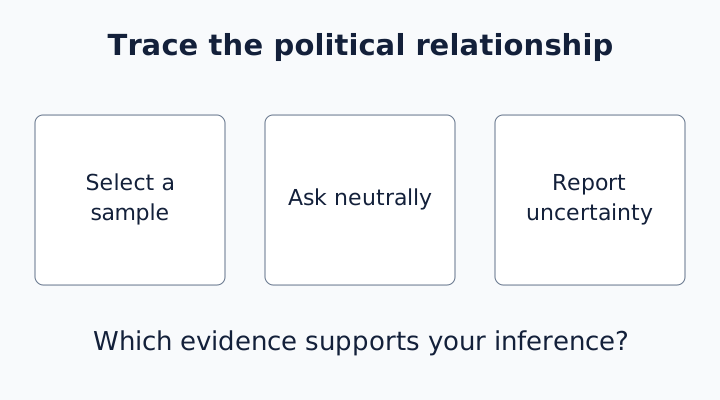 Tap to open the picture full size
Part 1 Think first Predict the institutional consequence
Connect a pattern to the polling method before drawing a population conclusion.
Predict first
A candidate’s website receives 50,000 voluntary responses. A probability poll samples 1,000 registered voters. Which question should you ask before trusting the larger number?
In short. Scientific polls measure public opinion using defined populations, defensible sampling, neutral questions, and reporting that respects uncertainty.
- Poll types answer different questions.
- Sampling, neutral wording, and reporting each matter.
- Sampling margins do not measure every source of error.
Part 2 Learn it Match the poll to its purpose
2a. Match the poll to its purpose
An opinion poll measures views on issues. A benchmark poll establishes baseline views of a candidate. A tracking poll follows changes in candidate views during a campaign using repeated measurements. An exit poll asks people about their vote and reasons after voting. The purpose identifies the type; the label does not guarantee sound methods.
A candidate can compare a benchmark with later tracking results to see whether measured support changed. Exit polling can help describe why participating voters say they voted as they did, but it does not directly represent people who did not vote. Public opinion findings can shape campaign messages and policy debate because political actors respond to what they believe citizens want.
For the end-of-lesson concept match, review this section together with the next two sections; the match combines their definitions.
Quick check · Fill the statement
Complete the explanation using the evidence.
An initial candidate baseline is a poll; repeated candidate measurements form a poll; asking people after voting is an poll.
2b. Sampling and uncertainty
A scientific poll defines its target population and uses defensible sampling methods to reach a sample that can inform claims about that population. A probability sample gives members known chances of selection. A voluntary website response can attract especially interested users, so a large response count alone does not make it representative. Nonresponse and coverage problems can still affect a probability poll.
A reported margin of error describes sampling uncertainty under the poll’s stated method and confidence level. It does not remove question wording, coverage, or nonresponse bias. In a fictional poll reporting 52% support with a margin of error of plus or minus 3 percentage points, a simple reported interval is 49% to 55%. Report uncertainty alongside the estimate.
Quick check · Fill the statement
Complete the explanation using the evidence. Hint: subtract and add the reported margin in percentage points.
At 52% support with a reported margin of error of 3 points, the simple interval runs from % to %.
2c. Questions and reports shape the meaning
Neutral framing asks a specific question without pushing the respondent toward a preferred judgment. Calling a proposal a wasteful scheme embeds an evaluation; asking whether the respondent supports the described proposal allows a less directed response. Even neutral wording must specify what policy is being evaluated.
Accurate reporting preserves population, date, wording, and uncertainty. A repeated series can support a description of a trend when methods remain comparable. It does not establish why the trend occurred. Read the measured change first, then distinguish candidate explanations from conclusions the poll supports. Changes in wording or population can produce differences that resemble opinion change.
Quick check · Fill the statement
Complete the explanation using the evidence.
A report that retains the target population and uncertainty practices ; a question avoiding loaded judgments uses .
Part 3 Watch it done Interpret a tracking series
Original fictional comparable probability samples of registered voters report candidate support at 41%, 45%, and 48% in three weekly waves; each has a reported margin of error of plus or minus 3 points.
Step 1 · Identify the evidence
Identify the repeated candidate measurement as tracking.
Step 2 · Connect the mechanism
The estimates rise by 7 percentage points from first to third wave.
Why this step?
Why preserve comparability across tracking waves?
Changes in recruitment or wording can change estimates even when underlying views do not change.
Step 3 · Limit the inference
Comparable methods support describing the measured trend, while uncertainty and other influences limit causal claims.
Your step · Decide and justify
New condition: Week 4 replaces the neutral candidate question with one praising the candidate and criticizing the opponent. What happens to the tracking comparison?
Which explanation supports this inference?
A contrasting worked example
Contrasting example: A campaign website records 90% support from volunteers. Even 50,000 responses cannot justify a national estimate if the recruitment method systematically selects the candidate’s supporters.
Part 4 Try it Classify the institutional action
Original teaching situations: distinguish what each institution can do.
Try it · Sort it
Classify each situation by the feature it directly describes.
Issue opinion
Candidate baseline
Candidate tracking
After-vote reasons
| Week | Support |
|---|---|
| 1 | 41% |
| 2 | 45% |
| 3 | 48% |
Part 5 Explain it Explain a polling trend and its limits
Free response is 50% of the exam score. This one is shaped like Question 2, Quantitative Analysis.
Free-response practice · Question 2 style
Use the fictional tracking table above. Describe the trend and the first-to-last difference in percentage points. Explain why comparable sampling and wording strengthen that comparison. Explain why the series cannot establish that one advertisement caused the change. Identify one feature an accurate report should retain. Hint: subtract the first wave’s percentage from the last wave’s percentage; report percentage points.
Model answer
Estimates rise from 41% to 45% to 48%, an increase of 7 percentage points from first to last wave. Comparable sampling and neutral wording reduce the risk that a procedural change creates the observed difference. The study does not isolate the advertisement from other events or influences, so it does not establish that cause. An accurate report retains the registered-voter population and sampling margin as well as dates and wording.
Score your own answer. This is a self-check, not a grade. Tick each point your answer makes.
Part 6 Check yourself Read the evidence, then test the claim
Original fictional tracking study. Each wave samples 1,000 registered voters using the same probability method and neutral wording. Reported sampling margin: plus or minus 3 percentage points at a 95% confidence level.
| Wave | Candidate support |
|---|---|
| Week 1 | 41% |
| Week 2 | 45% |
| Week 3 | 48% |
Case question 1 · Multiple choice
Which conclusion best follows from the repeated data?
Case question 2 · Multiple choice
Which change most directly addresses self-selection in an online volunteer poll?
The rest stand on their own and do not use the case.
Check yourself · Spot the error
Select the statement that makes an institutional error.
Check yourself · Match
Match the concept to its defining feature.
Part 7 Keep it Retrieve and connect
From 1.1 Ideals of Democracy · Fill the statement
Complete the distinction between rights and the source of public power.
Rights people possess apart from government permission are . The principle that public authority comes from the people is .
From 2.1 Congress: The Senate and the House of Representatives · Fill the statement
Apply the representation rule.
The House uses representation, while the Senate gives states representation.
In three lines
- Poll types answer different questions.
- Sampling, neutral wording, and reporting each matter.
- Sampling margins do not measure every source of error.
Exam strategy for this topic
- Section I, Multiple Choice: 55 questions in 80 minutes.
- Section II, Free Response: 4 questions in 100 minutes.
- This lesson's Explain it is shaped like free-response question 2, Quantitative Analysis.
Connect a pattern to the polling method before drawing a population conclusion.
Questions students ask
Does a larger sample always make a poll better?
It can reduce sampling variability, but it does not repair systematic selection or wording problems.
Does a margin of error cover every mistake?
No. Coverage, nonresponse, wording, and reporting errors require separate scrutiny.
Can an exit poll describe nonvoters?
Its respondents are voters, so claims about nonvoters require another source.
Does a tracking trend explain its own cause?
No. Comparable waves can show measured change while leaving competing explanations unresolved.
Course alignment, for teachers
AP U.S. Government and Politics topic 4.5, Unit 4: American Political Ideologies and Beliefs.
- Skill 3.C: Explain patterns and trends in data to draw conclusions.
This lesson maps all 2 essential knowledge statements of the topic to the part that teaches each one: 2 are checked by a scored question. The map is in the lesson file.