Unit 5 · Topic 5.11 · about 30 minutes · 7 parts · 11 scored checks, 2 of them multiple choice, plus 2 from earlier lessons
AP U.S. Government and Politics 5.11: Campaign Finance
Unit 5: 20 to 27% of the multiple-choice section
What you'll be able to do
- Explain how the organization, finance, and strategies of national political campaigns affect the election process.
Key vocabulary
| Term | What it means | The exam trap |
|---|---|---|
| Contribution | Money or something of value given to a campaign or political committee. | Identify the recipient and applicable source rules. |
| Independent expenditure | Spending on express electoral advocacy without candidate or party coordination. | Independence depends on coordination, not the sponsor’s label. |
| Soft money | Funds outside federal contribution rules used in political activity. | The BCRA national-party restrictions are not a universal ban on political spending. |
| Traditional PAC | A political committee that may make regulated candidate contributions. | Its contribution channel differs from independent-only activity. |
| Super PAC | An independent-expenditure-only political committee. | Independent-only committees cannot donate directly to candidates. |
| Disclaimer | A required statement identifying responsibility or authorization for a communication. | A sponsor statement does not certify factual accuracy. |
| Quid pro quo corruption | An exchange of something of value for an official action. | The majority distinguished this concern from generalized influence or access. |
 Tap to open the picture full size
Part 1 Think first Investigate a political mechanism
Explain a mechanism using specific evidence. A label by itself does not establish how an outcome follows.
Predict first
A corporation pays for an election ad without coordinating with a candidate. Another corporation sends money to a candidate. What distinction should be investigated?
In short. Campaign finance rules distinguish contributions from independent spending while balancing political speech, transparency, and election fairness.
- Identify recipient and coordination.
- Explain the majority’s actual reasoning.
- Keep protected independent spending distinct from direct donations.
Part 2 Learn it Identify the transaction before discussing the rule
2a. Identify the transaction before discussing the rule
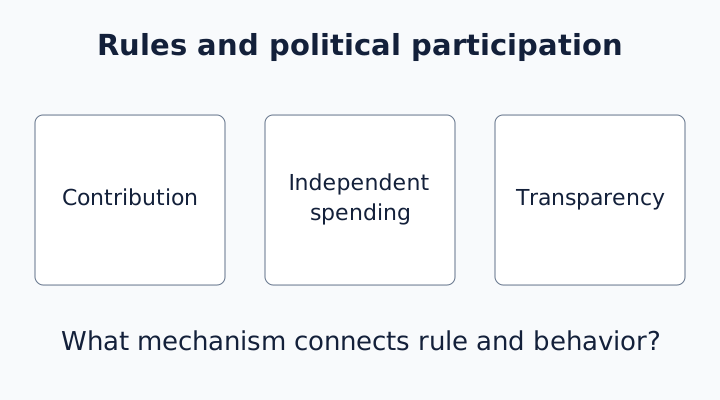
A contribution transfers money or something of value to a campaign or committee. An independent expenditure pays for advocacy expressly supporting or opposing a candidate without coordination with that candidate or party. The distinction is essential: protected independent spending does not mean unlimited direct donations to candidates.
The Bipartisan Campaign Reform Act of 2002 sought to restrict soft money, including national parties’ raising and spending of funds outside federal contribution rules. It also added the candidate approval requirements often called “Stand by Your Ad” for covered candidate broadcast messages. The approval requirement sought to discourage irresponsible attack advertising by making candidates publicly accept responsibility for covered messages; it does not ban criticism or certify that every claim is true. The law reflects continuing debate over money, electoral competition, and political speech. FEC, candidate disclaimers and approval statements.
Quick check · Fill the statement
Complete the explanation using the evidence.
Money given to a candidate is a . Uncoordinated spending on express electoral advocacy is an .
2b. Read the Citizens United majority carefully
In Citizens United v. Federal Election Commission (2010), a nonprofit corporation wanted to distribute a film critical of a presidential primary candidate through video-on-demand and advertise it. Federal law restricted corporate treasury funding of the relevant election advocacy. The First Amendment issue was whether the government could suppress this independent political speech because of the speaker’s corporate identity.
The majority held that the corporate independent-expenditure prohibition was unconstitutional. The protection covers independent political speech by corporations, associations, and labor unions. The majority reasoned that political speech does not lose First Amendment protection because its source is a corporation, and that independent expenditures do not create the quid pro quo corruption associated with direct contributions. The Court distinguished expenditure restrictions from direct contribution restrictions; the latter were not invalidated by this ruling. It upheld the challenged disclosure and disclaimer requirements. Do not attribute a dissent’s concerns or counsel’s arguments to the majority. Citizens United, majority opinion, Parts I, III, and IV.
Quick check · Fill the statement
Complete the explanation using the evidence.
Citizens United protected corporate political spending while upholding challenged requirements.
2c. PAC types and competing concerns
Political action committees raise and spend money to influence elections. A traditional PAC can make candidate contributions subject to applicable limits and source restrictions. An independent-expenditure-only committee, often called a super PAC, can raise unlimited permitted funds for independent expenditures but cannot make candidate contributions. Corporate and union treasury contributions directly to federal candidates remain prohibited. These distinctions reflect the wider post-decision legal framework, not a claim that Citizens United itself established every PAC rule.
Individuals, PACs, and political parties participate through different regulated channels. One argument emphasizes political expression and wider advocacy; another emphasizes unequal access, transparency, and fair competition when wealthy speakers can amplify messages. State the legal distinction before evaluating the policy debate. The First Amendment protects speech, but that fact alone does not settle every question about disclosure, coordination, or contributions. FEC, registering a PAC and committee types.
Quick check · Fill the statement
Complete the explanation using the evidence.
A traditional PAC may make regulated candidate ; a super PAC is restricted to election spending rather than candidate donations.
Part 3 Watch it done Connect the case to the First Amendment
Primary-source paraphrase: Citizens United’s majority rejects suppression of independent political speech based on corporate identity while distinguishing contribution limits.
Step 1 · Identify the source claim
The First Amendment protects political expression; corporate identity alone does not justify suppressing independent advocacy.
Why this step?
Why is the spending/contribution distinction necessary?
The majority’s reasoning concerns independent expenditures. It did not turn candidate contribution restrictions into unlimited donation rights.
Step 2 · Retain the transparency holding
The Court upheld the challenged disclaimer and disclosure rules, showing protection from a spending ban does not eliminate every regulation.
Your step · Decide and justify
A labor union coordinates an advocacy ad with a candidate, then invokes the majority’s protection for independent expenditures. Does that protection alone settle this new situation?
Which reason supports this new inference?
A contrasting worked example
Contrast: A corporation independently pays for an advocacy ad without coordination. Step 1: identify independent spending rather than a transfer to a campaign. Step 2: connect the majority’s speech protection to the corporate-speaker restriction. Step 3: retain applicable disclaimer, disclosure, and coordination rules instead of inferring complete deregulation.
Part 4 Try it Classify the institutional action
Original teaching situations: distinguish what each institution can do.
Try it · Sort it
Sort each example by its defining feature.
Direct candidate contribution
Independent advocacy spending
Try it · Sort it
Identify the BCRA provision most directly relevant to each fictional action.
National-party soft-money restriction
Covered candidate approval requirement
Try it · Fill the statement
Apply the institutional distinction.
An association buys an uncoordinated express-advocacy ad. This is an . A labor union transfers treasury money directly to a federal candidate. This is a prohibited direct .
Primary-source text, U.S. Constitution, First Amendment: “Congress shall make no law ... abridging the freedom of speech, or of the press.” National Archives, Bill of Rights. Majority paraphrase, Citizens United, Parts III and IV: corporate identity does not justify suppressing independent political speech; the Court distinguishes contribution limits and upholds the challenged transparency rules. Read the primary majority opinion.
Part 5 Explain it Relate the majority to a primary source
Free response is 50% of the exam score. This one is shaped like Question 1, Concept Application.
Free-response practice · Question 1 style
Original concept-application practice: Two organizations plan electoral advocacy: one pays for an uncoordinated ad, while the other sends corporate treasury funds to a federal candidate. Read the First Amendment text and the majority paraphrase in Try it. Explain how Citizens United relates to the freedom of speech. Distinguish an uncoordinated corporate advocacy ad from a direct corporate treasury donation to a federal candidate. Explain one continuing rule and one contested policy concern.
Model answer
The majority applied the First Amendment’s speech protection to independent political expression, rejecting suppression based on corporate identity. An uncoordinated advocacy ad is an independent expenditure, whereas money transferred to the candidate is a direct contribution. The decision did not authorize direct corporate treasury donations to federal candidates. The challenged disclosure and disclaimer requirements survived. Critics can raise concerns about unequal amplification or access, while supporters emphasize protected political expression; those debates must preserve the legal channel distinction.
Score your own answer. This is a self-check, not a grade. Tick each point your answer makes.
Part 6 Check yourself Apply the actual holding
Original applications of the primary majority opinion. The scenarios are not additional court cases.
| Activity | Relevant fact |
|---|---|
| Corporate advocacy ad | Express advocacy without coordination |
| Corporate check to a federal candidate | Direct treasury contribution |
| Covered campaign broadcast | Candidate approval statement |
Case question 1 · Multiple choice
Which activity most closely fits the expenditure restriction invalidated in Citizens United?
Case question 2 · Multiple choice
Which statement accurately compares committee channels?
The rest stand on their own and do not use the case.
Check yourself · Spot the error
Select the statement that makes an institutional error.
Check yourself · Match
Match each concept to its defining feature.
Part 7 Keep it Retrieve and connect
From 1.5 Ratification of the U.S. Constitution · Fill the statement
Apply the distinction in the completed statement.
The Great Compromise tied House representation to and gave states representation in the Senate.
From 1.6 Principles of American Government · Fill the statement
Apply the distinction in the completed statement.
In an attributed paraphrase of Federalist No. 51, one branch’s institutional interest can restrain another through , limiting the concentration of power and possible abuse.
In three lines
- Identify recipient and coordination.
- Explain the majority’s actual reasoning.
- Keep protected independent spending distinct from direct donations.
Exam strategy for this topic
- Section I, Multiple Choice: 55 questions in 80 minutes.
- Section II, Free Response: 4 questions in 100 minutes.
- This lesson's Explain it is shaped like free-response question 1, Concept Application.
Explain a mechanism using specific evidence. A label by itself does not establish how an outcome follows.
Questions students ask
Did Citizens United remove all campaign finance rules?
No. It invalidated the corporate independent-expenditure restriction while upholding the challenged disclaimer and disclosure requirements.
Can a super PAC donate directly to a candidate?
No. It is an independent-expenditure-only committee, despite its ability to raise unlimited permitted funds.
Does “I approve this message” make an ad true?
No. It identifies candidate responsibility for a covered communication; it does not verify the content.
Why separate contributions from expenditures?
A transfer to a campaign and uncoordinated advocacy are different channels with different legal rules and corruption analyses.
Course alignment, for teachers
AP U.S. Government and Politics topic 5.11, Unit 5: Political Participation.
- Skill 2.B: Explain how a required Supreme Court case relates to a foundational document or to other primary or secondary sources.
This lesson maps all 3 essential knowledge statements of the topic to the part that teaches each one: 2 are checked by a scored question and 1 by the written response. The map is in the lesson file.