Unit 5 · Topic 5.10 · about 30 minutes · 7 parts · 9 scored checks, 2 of them multiple choice, plus 2 from earlier lessons
AP U.S. Government and Politics 5.10: Modern Campaigns
Unit 5: 20 to 27% of the multiple-choice section
What you'll be able to do
- Explain how campaign organizations and strategies affect the election process.
Key vocabulary
| Term | What it means | The exam trap |
|---|---|---|
| Campaign consultant | A professional adviser providing specialized campaign services. | Expertise and infallibility are different claims. |
| Fundraising | Obtaining money to support a campaign’s activities. | A donation and an election outcome are different events. |
| Opportunity cost | The next-best use of a resource forgone when choosing an activity. | Name the alternative use rather than calling every expense waste. |
| Election cycle | The period of activity leading toward an election. | A longer timeline can increase both reach and resource demands. |
| Social media outreach | Campaign communication through digital social platforms. | Visibility does not by itself measure persuasion. |
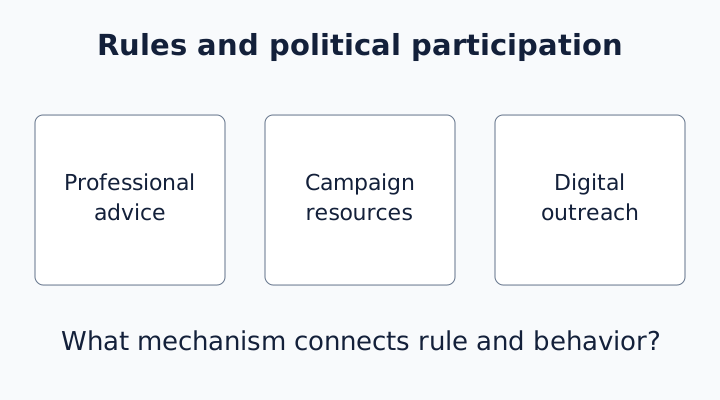 Tap to open the picture full size
Part 1 Think first Investigate a political mechanism
Explain a mechanism using specific evidence. A label by itself does not establish how an outcome follows.
Predict first
A campaign’s online appeal attracts volunteers, but the candidate spends more hours raising money. How would you evaluate the strategy?
In short. Modern campaigns use professional expertise, fundraising, long timelines, and social media, creating both communication benefits and resource tradeoffs.
- Name benefits and tradeoffs.
- Explain why each fact supports the claim.
- Keep exposure, participation, and votes distinct.
Part 2 Learn it Expertise can improve a campaign and create dependence
2a. Expertise can improve a campaign and create dependence
Modern campaigns often depend on professional consultants for polling, message design, advertising, fundraising, and voter outreach. Specialists can improve the quality and coordination of these tasks. Dependence can also make campaigns expensive and encourage candidates to devote attention to professional advice rather than direct conversations with constituents. Expertise improves a process without making every recommendation correct.
Explain benefits and drawbacks through a mechanism. A consultant who tests whether voters understand a policy message may help a candidate communicate clearly. A campaign relying heavily on that service must pay for it and may focus on tested messages at the expense of less easily measured concerns. Neither “consultants are always harmful” nor “expertise guarantees victory” follows. Distinguish a claim about communication capacity from a claim about the final election result.
Quick check · Fill the statement
Complete the explanation using the evidence.
Specialists provide campaign , while reliance on paid advice can increase .
2b. Costs and duration create opportunity costs
Rising campaign costs can make sustained fundraising an important part of a candidate’s schedule. Fundraising pays for communication, staff, travel, and organization. It can also consume time that might otherwise go to policy development or public contact, and it can raise concerns about access for large donors. Those concerns do not prove every contribution purchases an official decision.
Long election cycles give candidates time to become known and organize supporters, but can also increase fatigue, cost, and pressure to keep raising money. Duration and cost can reinforce each other as an organization operates for more months. To explain the tradeoff, identify the scarce resource, such as candidate time or campaign funds, and the alternative use. A claim becomes stronger when it explains why spending on one activity limits another rather than simply listing campaign features.
A campaign consultant is a professional adviser supplying specialized campaign services. Paying for that advice is one activity that can create the resource tradeoffs described here.
Quick check · Fill the statement
Complete the explanation using the evidence.
A candidate spending hours raising funds faces a tradeoff; a longer campaign can extend its operating .
2c. Social media changes reach and control
Campaigns use social media to communicate directly, circulate messages quickly, recruit volunteers, and solicit donations. A small contribution appeal can reach supporters without buying traditional television airtime. Yet online visibility depends on platforms and audience behavior; information can spread without verification, and a campaign cannot fully control how messages are copied or interpreted.
In an original fictional campaign log, a policy video brings volunteer sign-ups while consultants require additional funds to revise advertisements. This evidence supports a claim about communication reach and resource demands. It does not prove the video changed anyone’s vote. When writing an argument, organize evidence around the claim: explain the contribution of each fact, then acknowledge what it does not establish. A list of features with no causal connection is a description, not a reasoned argument.
Quick check · Fill the statement
Complete the explanation using the evidence.
Showing an appeal to more unique viewers expands communication . A viewer changing her candidate preference because of the appeal demonstrates .
Part 3 Watch it done Turn evidence into reasoning
Original fictional campaign log: a social-media appeal produces volunteer contacts; the candidate spends extra hours fundraising to pay consultants.
Step 1 · Choose a bounded claim
Modern campaigning can expand outreach while imposing time and financial costs.
Why this step?
Why must each fact be connected to the claim?
Volunteer contacts support reach; fundraising hours show a time tradeoff. Listing them without explanation leaves the significance unstated.
Step 2 · Respect measurement
Neither contacts nor spending measures whether the campaign wins or changes a vote.
Your step · Decide and justify
A long campaign reaches more communities but requires additional months of staff pay. Which judgment follows?
Which reason supports this new inference?
A contrasting worked example
Contrast: A long campaign lets an unfamiliar candidate visit more communities but requires months of staff pay. Step 1: identify improved reach. Step 2: identify continuing operating cost. Step 3: explain the tradeoff instead of declaring duration purely beneficial or harmful.
Part 4 Try it Classify the institutional action
Original teaching situations: distinguish what each institution can do.
Try it · Sort it
Sort each example by its defining feature.
Communication or organization benefit
Resource or information drawback
| Activity | Consequence |
|---|---|
| Online policy appeal | New volunteer contacts |
| Consultant revision | Additional payment |
| More fundraising hours | Fewer public-meeting hours |
Part 5 Explain it Organize evidence to justify a claim
Free response is 50% of the exam score. This one is shaped like Question 4, Argument Essay.
Free-response practice · Question 4 style
Original argument practice: Defend the claim that modern campaigns can broaden participation while creating resource tradeoffs. Use two different facts from the log in Try it, explain how each supports the claim, and identify one limitation of the evidence.
Model answer
The online appeal brought volunteer contacts, showing how digital communication can connect people to a campaign. The extra fundraising sessions reduced time for public meetings, illustrating an opportunity cost of financing professional activities. Together the facts show expanded organizing reach alongside a resource constraint. They do not measure changed votes, so they cannot establish electoral success.
Score your own answer. This is a self-check, not a grade. Tick each point your answer makes.
Part 6 Check yourself Evidence for a campaign argument
Original fictional campaign activity log, not a study of electoral effects.
| Activity | Observed consequence |
|---|---|
| Online policy appeal | New volunteer contacts |
| Consultant advertising revision | Additional payments required |
| Extended fundraising sessions | Fewer hours available for public meetings |
Case question 1 · Multiple choice
Which claim can use the first row as evidence?
Case question 2 · Multiple choice
Which reasoning best uses the last row?
The rest stand on their own and do not use the case.
Check yourself · Spot the error
Select the statement that makes an institutional error.
Check yourself · Match
Match each concept to its defining feature.
Part 7 Keep it Retrieve and connect
From 1.5 Ratification of the U.S. Constitution · Fill the statement
Apply the distinction in the completed statement.
The Great Compromise tied House representation to and gave states representation in the Senate.
From 1.6 Principles of American Government · Fill the statement
Apply the distinction in the completed statement.
In an attributed paraphrase of Federalist No. 51, one branch’s institutional interest can restrain another through , limiting the concentration of power and possible abuse.
In three lines
- Name benefits and tradeoffs.
- Explain why each fact supports the claim.
- Keep exposure, participation, and votes distinct.
Exam strategy for this topic
- Section I, Multiple Choice: 55 questions in 80 minutes.
- Section II, Free Response: 4 questions in 100 minutes.
- This lesson's Explain it is shaped like free-response question 4, Argument Essay.
Explain a mechanism using specific evidence. A label by itself does not establish how an outcome follows.
Questions students ask
Are consultants always a disadvantage?
No. They supply expertise and coordination while creating costs and dependence.
Does fundraising prove corruption?
No. It finances activities and can raise access concerns, but a contribution alone does not prove a purchased decision.
Why does a longer campaign cost more?
Staff, communications, and organizing may operate for more months. Duration can also give candidates more time to reach voters.
Can online views show changed votes?
Views show exposure. Persuasion and turnout require separate evidence.
Course alignment, for teachers
AP U.S. Government and Politics topic 5.10, Unit 5: Political Participation.
- Skill 5.C: Use reasoning to organize and analyze evidence, explaining its significance to justify an argument or claim/thesis.
This lesson maps the one essential knowledge statement of the topic to the part that teaches each one: 1 is checked by a scored question. The map is in the lesson file.