Unit 5 · Topic 5.4 · about 30 minutes · 7 parts · 10 scored checks, 2 of them multiple choice, plus 2 from earlier lessons
AP U.S. Government and Politics 5.4: How and Why Political Parties Change and Adapt
Unit 5: 20 to 27% of the multiple-choice section
What you'll be able to do
- Explain why and how political parties change and adapt.
Key vocabulary
| Term | What it means | The exam trap |
|---|---|---|
| Candidate-centered campaign | A campaign focused on the individual candidate’s qualities and organization. | An individual focus does not eliminate every party function. |
| Coalition | An alliance of groups supporting a political effort. | Group membership is not uniform individual agreement. |
| Critical election | An election associated with a durable realignment of party support. | A surprising result alone does not establish durability. |
| Voter data management | Organizing voter-related information to guide political outreach. | An outreach record is different from a guaranteed vote. |
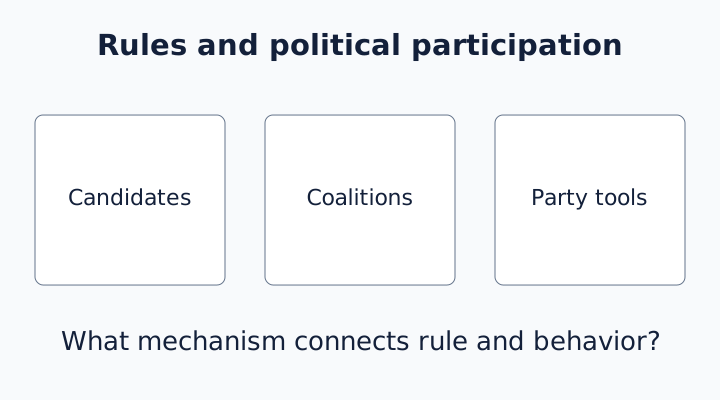 Tap to open the picture full size
Part 1 Think first Investigate a political mechanism
Explain a mechanism using specific evidence. A label by itself does not establish how an outcome follows.
Predict first
A nominee reaches supporters through a personal online audience. The party still has local volunteers. What adaptation seems worth testing?
In short. Parties adapt their candidates, messages, coalitions, and organization as electoral rules, voter alignments, and technology change.
- Identify the function that changes.
- Distinguish durable coalition shifts from single results.
- Explain the source’s strategy and its limits.
Part 2 Learn it Candidates can become the center
2a. Candidates can become the center
A candidate-centered campaign emphasizes an individual’s experience, image, and policy promises rather than simply the party label. Candidates can build their own fundraising and communication operations. Primary elections also give voters a direct role in nomination, reducing party leaders’ ability to determine the nominee themselves. This weakens one traditional party gatekeeping role without making parties irrelevant.
Parties still recruit, mobilize, provide resources, and organize officeholders. A candidate who attracts attention independently may nevertheless depend on the party’s voter outreach. When explaining adaptation, identify which function changes. “Parties disappeared” is too broad; “leaders have less control over nomination as candidates appeal directly to primary voters” identifies a mechanism. Candidate-centered campaigning can also create tension when the candidate’s personal message differs from a national platform.
Quick check · Fill the statement
Complete the explanation using the evidence.
Direct appeals to primary voters can weaken party leaders’ control over , while a personal campaign emphasizes the .
2b. Coalitions and rules change incentives
A demographic coalition is an alliance of groups whose support helps a party compete. Parties may adapt policies or messages to reach different groups. That does not mean every group member supports the party or that a demographic category has one fixed preference. A critical election marks a durable realignment in party support, rather than merely a close contest or a one-time loss. Look for a lasting change in the coalitions.
Campaign finance rules can influence how parties organize fundraising and spending. Communication and data technology can change how they locate potential supporters and coordinate outreach. These changes affect organizational structure as well as advertising. Explain the connection: a new rule may alter a funding channel; a durable electoral shift may reward a different policy coalition. Do not infer a realignment from a single poll or describe a campaign finance change without identifying the activity it changes.
A candidate-centered campaign focuses public attention on the individual’s qualities and personal operation, even when a party continues supporting it.
Quick check · Fill the statement
Complete the explanation using the evidence.
A lasting shift in party support is a ; revising messages to reach different groups responds to a changing .
2c. Technology serves persuasion and mobilization
Parties use communication technology to disseminate messages, clarify positions after conflicting reports, and coordinate what supporters hear. Voter data management helps identify where outreach might matter, organize contacts, and track campaign activities. These systems can support mobilization as well as persuasion. A reminder about voting hours tries to increase participation; a policy comparison tries to shape preference.
The following original fictional memo is a source, not an actual party document: “Our nominee built a personal audience. The party should supply local voter-contact capacity, revise our housing message for renters, and use a shared contact system so volunteers do not duplicate calls.” Its perspective favors adaptation rather than abandoning party organization. Explain how its argument relates to candidate-centered politics, coalition outreach, and technology. Evaluate what the memo argues without treating its preferred strategy as a proven election result.
Quick check · Fill the statement
Complete the explanation using the evidence.
A shared contact system organizes voter ; correcting conflicting policy statements the party’s message.
Part 3 Watch it done Explain the memo’s perspective
Use the original fictional memo in the last Learn chunk: the nominee has a personal audience, while the party proposes coordinated contact and a revised housing message.
Step 1 · Identify the argument
The memo argues that the party should adapt its role around the nominee and target coalition.
Why this step?
Why is that more precise than saying technology replaces parties?
The proposed shared system is a party response that coordinates outreach; it does not remove the organization.
Step 2 · Connect source to behavior
A renter-focused housing message seeks coalition support, while coordinated calls seek more effective mobilization.
Your step · Decide and justify
After one surprising loss, a memo declares a permanent voter realignment. Is the evidence sufficient?
Which reason supports this new inference?
A contrasting worked example
Contrast: A party loses one election after a scandal. Step 1: note the immediate candidate problem. Step 2: ask whether voter alliances changed durably across elections. Step 3: with only one result, explain adaptation as possible without declaring a critical realignment.
Part 4 Try it Classify the institutional action
Original teaching situations: distinguish what each institution can do.
Try it · Sort it
Sort each example by its defining feature.
Candidate-centered change
Party organizational response
Try it · Fill the statement
Apply the institutional distinction.
A new campaign-finance restriction can change a party’s channels, while a durable coalition shift can be associated with a election.
Original fictional memo for source analysis: “Our nominee built a personal audience. The party should supply local voter-contact capacity, revise our housing message for renters, and use a shared contact system so volunteers do not duplicate calls.”
Part 5 Explain it Connect a source argument to party change
Free response is 50% of the exam score. This one is shaped like Question 1, Concept Application.
Free-response practice · Question 1 style
Read the fictional memo in Try it. Explain its argument about the party’s role in a candidate-centered campaign. Connect one proposed action to coalition-building and one to communication or data management. Explain why this source does not establish a critical election. A hypothetical finance rule closes a party’s former unregulated fundraising channel. Explain one organizational response and why it follows from the rule.
Model answer
The memo favors adapting the party’s support role rather than relying solely on the candidate’s audience. A renter-focused housing message seeks a broader or stronger coalition. Shared lists coordinate voter contact, reducing duplicate calls and directing mobilization effort. The memo describes a strategy, not durable changes in party support across elections, so it cannot establish a critical realignment. Closing the former channel can lead the party to reorganize fundraising through permitted contributions and adjust its budget because the previous resource stream is unavailable.
Score your own answer. This is a self-check, not a grade. Tick each point your answer makes.
Part 6 Check yourself Read an adaptation proposal
Original fictional strategy memo: “Our candidate’s personal following cannot replace local organizing. The party should coordinate contact lists and clarify a housing message for renters.”
| Proposal | Intended effect |
|---|---|
| Shared contact lists | Reduce duplicate outreach |
| Revised housing message | Appeal to a demographic coalition |
Case question 1 · Multiple choice
How does the contact-list proposal relate to party organization?
Case question 2 · Multiple choice
Which conclusion about coalition change is warranted?
The rest stand on their own and do not use the case.
Check yourself · Spot the error
Select the statement that makes an institutional error.
Check yourself · Match
Match each concept to its defining feature.
Part 7 Keep it Retrieve and connect
From 1.5 Ratification of the U.S. Constitution · Fill the statement
Apply the distinction in the completed statement.
The Great Compromise tied House representation to and gave states representation in the Senate.
From 1.6 Principles of American Government · Fill the statement
Apply the distinction in the completed statement.
In an attributed paraphrase of Federalist No. 51, one branch’s institutional interest can restrain another through , limiting the concentration of power and possible abuse.
In three lines
- Identify the function that changes.
- Distinguish durable coalition shifts from single results.
- Explain the source’s strategy and its limits.
Exam strategy for this topic
- Section I, Multiple Choice: 55 questions in 80 minutes.
- Section II, Free Response: 4 questions in 100 minutes.
- This lesson's Explain it is shaped like free-response question 1, Concept Application.
Explain a mechanism using specific evidence. A label by itself does not establish how an outcome follows.
Questions students ask
Does candidate-centered politics make parties vanish?
No. Parties can lose nomination control while retaining recruitment, outreach, fundraising, and governing roles.
Is every major electoral upset a realignment?
No. A realignment requires durable changes in voter coalitions, not one surprising result.
Can technology do more than advertise?
Yes. Parties use it to organize contacts, coordinate volunteers, clarify messages, and mobilize participation.
Why can finance law change party organization?
Rules alter available fundraising or spending channels, giving organizations incentives to adjust their operations.
Course alignment, for teachers
AP U.S. Government and Politics topic 5.4, Unit 5: Political Participation.
- Skill 4.B: Explain how the argument or perspective in the source relates to political principles, institutions, processes, policies, and behaviors.
This lesson maps all 4 essential knowledge statements of the topic to the part that teaches each one: 4 are checked by a scored question. The map is in the lesson file.