Unit 5 · Topic 5.3 · about 30 minutes · 7 parts · 10 scored checks, 2 of them multiple choice, plus 2 from earlier lessons
AP U.S. Government and Politics 5.3: Political Parties
Unit 5: 20 to 27% of the multiple-choice section
What you'll be able to do
- Describe linkage institutions.
- Explain the function and impact of political parties on the electorate and government
Key vocabulary
| Term | What it means | The exam trap |
|---|---|---|
| Linkage institution | A channel connecting public preferences to policymakers. | Communication can occur outside formal government offices. |
| Party platform | A party’s statement of policy commitments. | A statement of goals is different from an enacted law. |
| Candidate recruitment | Encouraging and supporting people to seek office. | Recruitment and formal nomination are separate activities. |
| Mobilization | Efforts to encourage political participation. | Persuasion and participation can overlap but are distinct outcomes. |
| Party leadership | Legislative party officials who coordinate members and priorities. | Coordination does not erase institutional voting requirements. |
 Tap to open the picture full size
Part 1 Think first Investigate a political mechanism
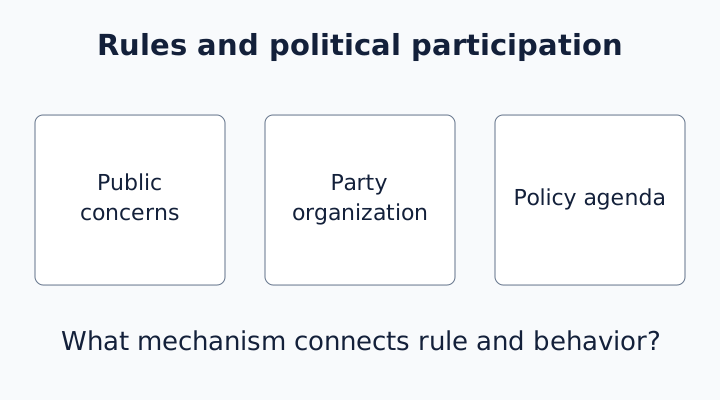
Explain a mechanism using specific evidence. A label by itself does not establish how an outcome follows.
Predict first
Residents press for bridge repairs. A party recruits candidates who support repairs and wins seats. What would you follow next?
In short. Political parties link voters to policymakers by organizing elections and coordinating action inside government.
- Trace preferences to decision makers.
- Separate recruiting, mobilizing, and platforms.
- Connect party leadership to legislative priorities.
Part 2 Learn it Linkage works in more than one direction
2a. Linkage works in more than one direction
Linkage institutions are channels through which people communicate preferences to policymakers. Parties, interest groups, elections, and media all serve this role, although they operate differently. A party recruits candidates and offers a program; an interest group presses selected concerns; elections aggregate voter choices; media distribute information and draw attention to issues.
These channels connect. A news investigation can prompt citizens to contact an interest group, which pressures candidates during an election. A party can respond by changing its program. A linkage institution is not itself a fourth constitutional branch. Explain who communicates what preference to which public decision maker. That chain is stronger than merely labeling every political organization a linkage institution.
Quick check · Fill the statement
Complete the explanation using the evidence.
Ballots record voter selections, also called ; news reports supply political .
2b. From voters to candidates
Parties mobilize and educate voters by explaining policy alternatives and encouraging participation. A party platform is a statement of policy commitments; it helps voters identify a collective program, but it does not legally compel every official to follow every plank. Parties recruit candidates, helping produce a slate for public offices. Campaign management includes fundraising, voter outreach, and media strategy.
Recruiting someone to run differs from nominating that person through the applicable election process. Likewise, a campaign message explaining a platform differs from a neutral civics lesson. Parties seek electoral support. Their coordination can reduce the information voters need to compare many candidates, while presenting choices through a partisan lens. Explain the practical effect: shared labels and platforms organize alternatives that would otherwise require separate research on each candidate.
These party functions serve linkage: a linkage institution is a channel carrying public preferences to policymakers.
Quick check · Fill the statement
Complete the explanation using the evidence.
A list of party policy commitments is a ; finding people to run is candidate .
2c. Winning office changes the tools
Parties also organize government. Committee and party leadership systems in legislatures help coordinate agendas, assignments, and bargaining. A party’s campaign promises can guide its legislative priorities after the election. Yet internal differences, institutional rules, and opposition limit what a party can enact.
Suppose a fictional party campaigns on repairing water systems, wins seats, and gives the issue priority in committee hearings. Mobilization and platforms linked public concerns to an election; leadership and committees linked the election to legislative work. Winning a plurality of votes is not the same event as enacting a statute. To explain party influence, identify both the electoral function and the governmental mechanism, rather than asserting that a party label makes policy automatically.
Quick check · Fill the statement
Complete the explanation using the evidence.
After an election, party can coordinate the agenda, while legislative hold specialized policy hearings.
Part 3 Watch it done Trace a preference into government
Original scenario: residents demand safer bridges. A party recruits engineers as candidates, includes bridge repair in its platform, and later directs legislative attention to the issue.
Step 1 · Locate public communication
Residents’ concerns supply a policy preference.
Why this step?
Why distinguish campaigning from legislating?
A platform communicates an intention; legislative institutions must still consider and enact a policy.
Step 2 · Name the party’s tools
Recruitment changes the candidate field; committee and leadership coordination shape the legislative agenda.
Your step · Decide and justify
In a later election the party loses its legislative majority. It continues recruiting candidates and publishing a revised platform. Has its linkage role necessarily ended?
Which reason supports this new inference?
A contrasting worked example
Contrast: An interest group asks both parties for the same repair program. Step 1: identify issue advocacy rather than a party candidate slate. Step 2: recognize another linkage route. Step 3: explain that influence can reach policymakers across party lines.
Part 4 Try it Classify the institutional action
Original teaching situations: distinguish what each institution can do.
Try it · Sort it
Sort each example by its defining feature.
Electoral organization
Legislative organization
Try it · Fill the statement
Apply the institutional distinction.
An advocacy group pressing an issue is an ; candidates organized under a shared electoral label belong to a political .
Part 5 Explain it Explain a linkage mechanism
Free response is 50% of the exam score. This one is shaped like Question 1, Concept Application.
Free-response practice · Question 1 style
Original concept application: A party responds to public concern about drinking water, recruits candidates, publishes a platform, wins seats, and coordinates committee hearings. Explain how two electoral functions and one legislative function connect residents to policymakers.
Model answer
Recruiting candidates gives residents people seeking office on the issue. The platform makes the party’s proposed policy visible so voters can compare alternatives. Committee and leadership coordination then directs legislative attention toward the concern. These actions link preferences to policymaking, although hearings do not guarantee enactment.
Score your own answer. This is a self-check, not a grade. Tick each point your answer makes.
Part 6 Check yourself One issue, several party functions
Original fictional sequence. Each row identifies an action rather than an election result.
| Stage | Party action |
|---|---|
| Before voting | Publishes a housing platform and recruits candidates |
| During campaign | Coordinates fundraising and media strategy |
| In legislature | Leadership and committees prioritize a housing proposal |
Case question 1 · Multiple choice
What does the first row most directly illustrate?
Case question 2 · Multiple choice
How can the last row affect policy?
The rest stand on their own and do not use the case.
Check yourself · Spot the error
Select the statement that makes an institutional error.
Check yourself · Match
Match each concept to its defining feature.
Part 7 Keep it Retrieve and connect
From 1.5 Ratification of the U.S. Constitution · Fill the statement
Apply the distinction in the completed statement.
The Great Compromise tied House representation to and gave states representation in the Senate.
From 1.6 Principles of American Government · Fill the statement
Apply the distinction in the completed statement.
In an attributed paraphrase of Federalist No. 51, one branch’s institutional interest can restrain another through , limiting the concentration of power and possible abuse.
In three lines
- Trace preferences to decision makers.
- Separate recruiting, mobilizing, and platforms.
- Connect party leadership to legislative priorities.
Exam strategy for this topic
- Section I, Multiple Choice: 55 questions in 80 minutes.
- Section II, Free Response: 4 questions in 100 minutes.
- This lesson's Explain it is shaped like free-response question 1, Concept Application.
Explain a mechanism using specific evidence. A label by itself does not establish how an outcome follows.
Questions students ask
Are parties part of government?
They compete outside government and organize members within legislatures. They are not a separate constitutional branch.
Must all party members follow the platform?
The platform communicates collective commitments, but does not legally compel uniform votes.
How are parties different from interest groups?
Parties organize candidates and governing coalitions; interest groups primarily press particular policy interests, often across parties.
Why call elections linkage institutions?
They aggregate choices and give policymakers information and incentives through electoral support or rejection.
Course alignment, for teachers
AP U.S. Government and Politics topic 5.3, Unit 5: Political Participation.
- Skill 1.B: Explain political principles, institutions, processes, policies, and behaviors.
This lesson maps all 2 essential knowledge statements of the topic to the part that teaches each one: 2 are checked by a scored question. The map is in the lesson file.