Unit 5 · Topic 5.6 · about 30 minutes · 7 parts · 9 scored checks, 2 of them multiple choice, plus 2 from earlier lessons
AP U.S. Government and Politics 5.6: Interest Groups Influencing Policymaking
Unit 5: 20 to 27% of the multiple-choice section
What you'll be able to do
- Explain the benefits and potential problems of interest group influence on elections and policymaking.
- Explain how variation in types of interest groups and the resources interest groups possess affects their ability to influence elections and policymaking.
Key vocabulary
| Term | What it means | The exam trap |
|---|---|---|
| Lobbying | Attempts to influence public officials’ decisions. | Access and persuasion do not transfer formal decision authority. |
| Amicus curiae brief | A friend-of-the-court submission offering information or legal arguments. | Submitting a brief is different from becoming the court. |
| Iron triangle | A stable relationship among a legislative committee, agency, and interest group. | Look for the three institutional roles and their durable relationship. |
| Issue network | A fluid set of participants active around a policy issue. | A network can include competing perspectives. |
| Free rider | A person who benefits from collective action without supporting it. | Public benefits and member-only benefits create different incentives. |
| Selective benefit | A good or service restricted to members to encourage joining. | A benefit available to everyone cannot serve the same membership incentive. |
 Tap to open the picture full size
Part 1 Think first Investigate a political mechanism
Explain a mechanism using specific evidence. A label by itself does not establish how an outcome follows.
Predict first
A chart makes one advocacy group’s meeting count look twice as large as another’s. What would you check first?
In short. Interest groups offer expertise and participation channels, but unequal resources and access can produce unequal policy influence.
- Trace the tool to the institution.
- Compare resources without assuming victory.
- Check what the chart’s bar lengths actually encode.
Part 2 Learn it Many tools, different institutions
2a. Many tools, different institutions
Interest groups seek to influence policy rather than primarily nominate a full slate of governing candidates. A group may represent a narrow occupation or a broad public concern. It can educate voters and officials, lobby lawmakers, help draft legislative language, and mobilize members to contact legislators or agencies. These tools can provide expertise while also favoring organized voices.
Groups can file amicus curiae briefs, offering information or legal arguments as friends of the court. A brief is not a judgment and does not give the group the power to decide a case. Compare the institution and mechanism: lobbying a legislator seeks a policy decision; submitting agency comments addresses implementation; filing a brief seeks to inform judicial consideration. None guarantees the desired outcome. A strong explanation weighs the benefit of specialized information against the potential for unequal access.
Quick check · Fill the statement
Complete the explanation using the evidence.
A group seeking a legislator’s support engages in ; a friend-of-the-court submission is an .
2b. Relationships can cross party coalitions
An iron triangle is a relatively stable relationship among an interest group, a congressional committee or subcommittee, and a relevant agency. Expertise, legislative support, and administrative implementation can reinforce the relationship. The concern is that durable insiders may dominate a policy area. An issue network includes a wider, more fluid set of participants, such as researchers, advocates, officials, and competing groups.
Groups also work within party coalitions, but their policy influence need not stop at party boundaries. An industry organization may seek supportive lawmakers from both parties and maintain working relationships with an agency regardless of the president’s party. Do not label every meeting an iron triangle. Identify the stable three-part relationship; distinguish it from the broader and less fixed network surrounding the issue.
Lobbying seeks to influence public officials; an amicus curiae brief supplies information or legal arguments to a court. These tools can operate alongside the relationships described here.
Quick check · Fill the statement
Complete the explanation using the evidence.
A stable committee-agency-group relationship is an ; a broad fluid set of participants is an .
2c. Resources matter, and charts can mislead
Groups differ in membership, financial reserves, expertise, and direct access to decision makers. AARP illustrates how a large membership and substantial organizational resources can support mobilization. Frequent access can let a group present concerns earlier or more often, though resources do not guarantee victory. A free rider benefits from a group’s collective work without supporting it financially. Selective benefits, available only to members, can encourage joining.
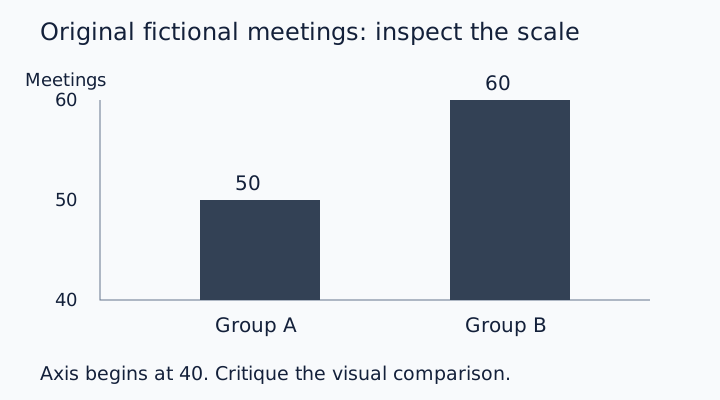
The original fictional chart in Try it compares groups with 50 and 60 scheduled meetings. Its axis begins at 40, making the displayed bars look twice as different even though the totals differ by only 10 meetings. That is a limitation of visual representation, distinct from a limitation of the data. Redrawing from zero improves the magnitude comparison; it still would not tell you whether meetings produced favorable policy. Distinguish the encoding problem from missing causal evidence.
Quick check · Fill the statement
Complete the explanation using the evidence.
Someone benefiting from a group’s work without financially supporting that group is a . A member-only service is a benefit.
Part 3 Watch it done Critique a chart before inferring influence
Original fictional data: Group A has 50 scheduled meetings and Group B has 60. A bar chart shows only the span above an axis baseline of 40.
Step 1 · Read the encoded baseline
The bars display lengths corresponding to 10 and 20 above 40, though total counts are 50 and 60.
Why this step?
Why is this a visual limitation rather than proof the counts are wrong?
The same counts can be plotted accurately while the nonzero bar baseline exaggerates their apparent relative magnitude.
Step 2 · Separate access from outcomes
The counts measure meetings, not policy victories; a corrected graph would not establish causation.
Your step · Decide and justify
An editor redraws the chart from zero but omits Group A, then headlines the remaining Group B bar “Only this group has meetings.” Is the revised display sufficient for that headline?
Which reason supports this new inference?
A contrasting worked example
Contrast: Redraw the bars from zero at heights 50 and 60. Step 1: preserve the totals. Step 2: show the modest relative difference. Step 3: explain that equal-scale plotting fixes the encoding problem but does not reveal the groups’ policy success.
Part 4 Try it Classify the institutional action
Original teaching situations: distinguish what each institution can do.
Tap to open the picture full sizeTry it · Sort it
Sort each example by its defining feature.
Policy influence activity
Membership incentive
Part 5 Explain it Evaluate an interest-group display
Free response is 50% of the exam score. This one is shaped like Question 2, Quantitative Analysis.
Free-response practice · Question 2 style
Using the original fictional meetings chart in Try it, explain one limitation of its visual representation and how to improve it. Then explain why the meeting counts cannot establish policy success. Identify one benefit and one potential problem of group influence. An original fictional association has a large membership and substantial financial reserves. Explain how one resource can support influence without guaranteeing policy victory.
Model answer
The bars begin at 40, making counts of 50 and 60 appear in a two-to-one height ratio. Starting at zero preserves a fair magnitude comparison. Meetings indicate access but do not show decisions or isolate the effects of other resources. Groups can provide useful expertise, while unequal access can give some interests greater opportunity to shape policy. A large membership can supply many people to contact officials, while reserves can pay for sustained communication and research. These resources create opportunities for influence without determining officials’ final decisions.
Score your own answer. This is a self-check, not a grade. Tick each point your answer makes.
Part 6 Check yourself Access is one resource
Original fictional counts of scheduled policy meetings. Counts do not report outcomes or the content of meetings.
| Group | Scheduled meetings | Membership service |
|---|---|---|
| A | 50 | None |
| B | 60 | Member-only training |
Case question 1 · Multiple choice
What is a limitation of the truncated chart shown in Try it?
Case question 2 · Multiple choice
Which action would offer information to justices?
The rest stand on their own and do not use the case.
Check yourself · Spot the error
Select the statement that makes an institutional error.
Check yourself · Match
Match each concept to its defining feature.
Part 7 Keep it Retrieve and connect
From 1.5 Ratification of the U.S. Constitution · Fill the statement
Apply the distinction in the completed statement.
The Great Compromise tied House representation to and gave states representation in the Senate.
From 1.6 Principles of American Government · Fill the statement
Apply the distinction in the completed statement.
In an attributed paraphrase of Federalist No. 51, one branch’s institutional interest can restrain another through , limiting the concentration of power and possible abuse.
In three lines
- Trace the tool to the institution.
- Compare resources without assuming victory.
- Check what the chart’s bar lengths actually encode.
Exam strategy for this topic
- Section I, Multiple Choice: 55 questions in 80 minutes.
- Section II, Free Response: 4 questions in 100 minutes.
- This lesson's Explain it is shaped like free-response question 2, Quantitative Analysis.
Explain a mechanism using specific evidence. A label by itself does not establish how an outcome follows.
Questions students ask
Does a group’s money guarantee success?
No. Resources create opportunities, while institutional rules, opposition, and public attention can limit results.
How is an issue network different from an iron triangle?
The network is broader and more fluid. The triangle identifies a durable committee-agency-group relationship.
Can a free rider agree with the group?
Yes. The concept concerns receiving benefits without financial support, not necessarily disagreement.
Why start bars at zero?
Bar length communicates magnitude. A nonzero baseline can make a small relative difference appear much larger.
Course alignment, for teachers
AP U.S. Government and Politics topic 5.6, Unit 5: Political Participation.
- Skill 3.F: Explain possible limitations of the visual representation of the data provided.
This lesson maps all 3 essential knowledge statements of the topic to the part that teaches each one: 3 are checked by a scored question. The map is in the lesson file.