Unit 5 · Topic 5.9 · about 30 minutes · 7 parts · 10 scored checks, 2 of them multiple choice, plus 2 from earlier lessons
AP U.S. Government and Politics 5.9: Congressional Elections
Unit 5: 20 to 27% of the multiple-choice section
What you'll be able to do
- Explain how the different processes work in U.S. congressional elections.
Key vocabulary
| Term | What it means | The exam trap |
|---|---|---|
| Congressional primary | A nomination contest for a party’s congressional candidate. | Winning the nomination differs from winning the public office. |
| Midterm election | A federal election held between presidential elections. | Congressional seats are contested in presidential years too. |
| Constituency | The people represented by an elected official. | A House district and a whole state are different electorates. |
| Incumbent | The person currently holding an office. | Holding office creates advantages without ensuring reelection. |
| Caucus | A party meeting process used in candidate or delegate selection. | It is distinct from a general-election ballot. |
 Tap to open the picture full size
Part 1 Think first Investigate a political mechanism
Explain a mechanism using specific evidence. A label by itself does not establish how an outcome follows.
Predict first
A longtime representative faces a challenger with a popular local issue. What evidence would help evaluate the race?
In short. Congressional elections combine party nomination, general-election competition, and incumbency advantages within district or statewide constituencies.
- Identify office, electorate, and stage.
- Use concrete evidence of advantage.
- Explain how resources matter without guaranteeing results.
Part 2 Learn it Nomination determines the party choice
2a. Nomination determines the party choice
Congressional candidates can be selected through primaries or caucus processes according to applicable party and state rules. Open primaries permit participation beyond previously registered party members under the rules; closed primaries restrict participation to eligible party members. Caucuses use a meeting-based party selection process. A candidate winning nomination has won the right to represent the party in the next contest, not the public office itself.
Nomination rules affect incentives. A candidate competing in a closed primary must appeal to the participating party electorate, which can differ from the general electorate. In an open process the participating voters may differ, but openness does not establish that every voter is moderate or that one outcome must follow. Explain the selector and the incentive rather than assuming a universal ideological effect.
Quick check · Fill the statement
Complete the explanation using the evidence.
A party’s nominee is selected in the stage; the public office is won in the election.
2b. The constituency and calendar matter
House candidates compete for district constituencies; Senate candidates compete statewide. Congressional general elections occur in presidential-election years and in midterm years. All House seats and the scheduled Senate class face regular election on their respective calendars. Presidential contests can bring greater national attention and turnout; midterm conditions can change who participates and which issues dominate.
A congressional race remains a distinct election even when it shares a ballot with a presidential race. Congressional winners are not chosen by the Electoral College. To explain a contest, identify the office, the electorate, and the selection stage. A district’s preferences, candidate characteristics, party identification, and current concerns can interact with the national context. A national wave can help explain a pattern without determining every district result.
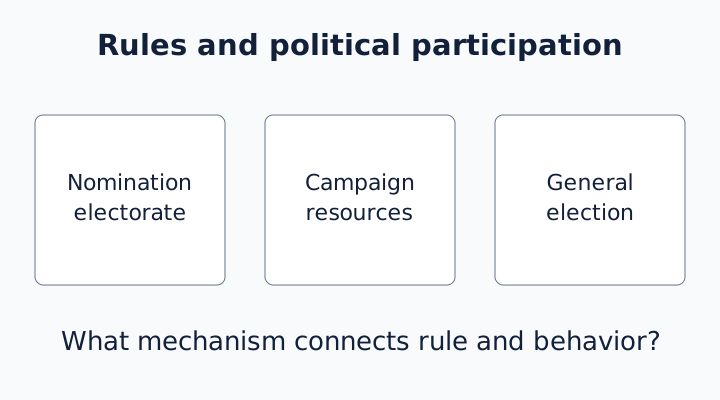
A congressional primary selects a party’s nominee; its participation rules belong to the nomination stage, before the constituency chooses the officeholder in the general election.
Quick check · Fill the statement
Complete the explanation using the evidence.
A House candidate represents a , while a Senate candidate seeks a constituency.
2c. Use evidence to argue about incumbency
An incumbent can have name recognition, a known service record, fundraising networks, staff experience, and opportunities to communicate with constituents. These benefits can raise barriers for a challenger. Yet a disputed record, scandal, electoral mood, or strong opponent can make the incumbent vulnerable. Distinguish an advantage from a guaranteed outcome.
In an original fictional race, the incumbent has a district service record and established donors, while the challenger has a popular local issue. A claim that the incumbent has an organizational advantage can use the service record and donor network as evidence. A claim that the incumbent must win cannot follow from those facts. Evidence supports an argument only when you explain how it bears on the claim. Donor access can help pay for voter communication; it does not reveal how every constituent will vote.
Quick check · Fill the statement
Complete the explanation using the evidence.
An established donor network is evidence of an advantage; it does not establish a guaranteed .
Part 3 Watch it done Use relevant evidence rather than certainty
Original fictional race: an incumbent has an established donor network and constituent service record. A challenger emphasizes an issue attracting new volunteers.
Step 1 · State a bounded claim
The incumbent has resources that can improve campaign organization.
Why this step?
Why is the donor network relevant evidence?
It can support fundraising and voter communication, giving a mechanism for the organizational claim.
Step 2 · Limit the inference
The challenger’s mobilization and voter evaluations can offset these advantages; no final vote totals are given.
Your step · Decide and justify
The challenger wins despite the incumbent’s donor network. Does this prove incumbency advantages never exist?
Which reason supports this new inference?
A contrasting worked example
Contrast: A challenger wins despite less fundraising. Step 1: separate resources from results. Step 2: examine issue salience and voter response. Step 3: explain that the result does not prove incumbency advantages never exist; advantages can be overcome.
Part 4 Try it Classify the institutional action
Original teaching situations: distinguish what each institution can do.
Try it · Sort it
Sort each example by its defining feature.
Nomination rule
Campaign advantage
Try it · Fill the statement
Apply the institutional distinction.
A primary restricted to eligible party members is ; allowing participation beyond previously registered party members is under applicable rules.
| Incumbent | Challenger |
|---|---|
| Established donor network | New volunteer base |
| Known constituent service record | Popular local issue |
Part 5 Explain it Support a claim about a congressional campaign
Free response is 50% of the exam score. This one is shaped like Question 4, Argument Essay.
Free-response practice · Question 4 style
Original argument practice: Claim that the fictional incumbent has organizational advantages but is not assured reelection. Support the claim with two specific facts from the table in Try it and explain their relevance. Describe how the closed primary differs from the general election.
Model answer
The incumbent has organizational advantages because established donors can fund voter contact and the service record can increase recognition or furnish campaign evidence. These resources do not guarantee voter approval, and the challenger may mobilize support. The closed primary selects a party nominee through eligible party members, whereas the general election determines the officeholder among the competing candidates.
Score your own answer. This is a self-check, not a grade. Tick each point your answer makes.
Part 6 Check yourself A congressional race in stages
Original fictional House contest. These facts support analysis, not a forecast.
| Evidence | Stage or implication |
|---|---|
| Party members choose a nominee | Closed primary |
| Incumbent has a service record and donors | Organizational resources |
| General election occurs between presidential elections | Midterm context |
Case question 1 · Multiple choice
What is selected in the first row?
Case question 2 · Multiple choice
Which use of evidence best supports a claim?
The rest stand on their own and do not use the case.
Check yourself · Spot the error
Select the statement that makes an institutional error.
Check yourself · Match
Match each concept to its defining feature.
Part 7 Keep it Retrieve and connect
From 1.5 Ratification of the U.S. Constitution · Fill the statement
Apply the distinction in the completed statement.
The Great Compromise tied House representation to and gave states representation in the Senate.
From 1.6 Principles of American Government · Fill the statement
Apply the distinction in the completed statement.
In an attributed paraphrase of Federalist No. 51, one branch’s institutional interest can restrain another through , limiting the concentration of power and possible abuse.
In three lines
- Identify office, electorate, and stage.
- Use concrete evidence of advantage.
- Explain how resources matter without guaranteeing results.
Exam strategy for this topic
- Section I, Multiple Choice: 55 questions in 80 minutes.
- Section II, Free Response: 4 questions in 100 minutes.
- This lesson's Explain it is shaped like free-response question 4, Argument Essay.
Explain a mechanism using specific evidence. A label by itself does not establish how an outcome follows.
Questions students ask
Are congressional elections only midterms?
No. Congressional races also occur in presidential-election years.
Does an incumbent always win?
No. Organizational benefits can be overcome by voter dissatisfaction or a strong challenger.
Does the Electoral College select senators?
No. It selects the president and vice president; senators are directly elected by state voters.
Why might a closed primary shape strategy?
The candidate must appeal to the eligible party electorate in the nomination stage, which can differ from the general electorate.
Course alignment, for teachers
AP U.S. Government and Politics topic 5.9, Unit 5: Political Participation.
- Skill 5.B: Support an argument or claim/thesis using relevant evidence.
This lesson maps the one essential knowledge statement of the topic to the part that teaches each one: 1 is checked by a scored question. The map is in the lesson file.