Unit 7 · Topic 7.10 · about 30 minutes · 7 parts · 11 scored checks, 1 of them multiple choice, plus 2 from earlier lessons
AP Chemistry 7.10: Reaction Quotient and Le Châtelier’s Principle
Unit 7: 7 to 9% of the multiple-choice section
What you'll be able to do
- Explain how Q, K and the direction a reversible reaction proceeds are related, and use them to say which way a system goes after a disturbance.
Key vocabulary
| Term | What it means | The exam trap |
|---|---|---|
| Reaction quotient (Q) | A ratio with the same form as K, calculated from the concentrations or partial pressures present at any moment. | Q and K look alike, so check which concentrations went into a number before you call it Q or K. |
| Equilibrium constant (K) | The value of Q when a reversible reaction is at equilibrium, written without units. | A question may give K for one situation and ask about another, so read what each number belongs to before you compare them. |
| Disturbance | A change to a system at equilibrium, such as adding or removing a species, changing the volume or changing the temperature, that makes Q differ from K. | Name what a disturbance changed before you act on it, because a change to the system does not always change the same quantity. |
| New equilibrium | The state a system reaches after a disturbance, when Q again equals K. | When a question compares amounts, say whether it means the old equilibrium or the moment right after the disturbance. |
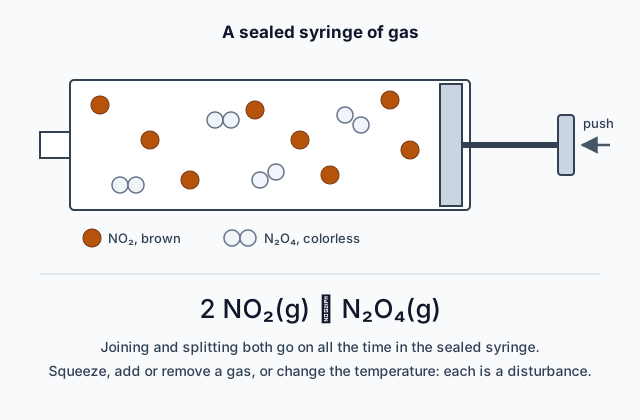 Tap to open the picture full size
Part 1 Think first Squeezing a syringe of gas
Commit to a guess first. Being wrong now makes the right idea stick better.
Predict first
A sealed syringe holds a mixture of two gases at room temperature: brown nitrogen dioxide, NO₂, and colorless dinitrogen tetroxide, N₂O₄. Two NO₂ molecules can join to make one N₂O₄, and one N₂O₄ can split into two NO₂, and both happen all the time. The mixture is a steady medium brown. You push the plunger in quickly to half the volume and hold it there. The gas turns darker at once, then over several seconds the color fades part of the way back. What is going on?
In short. A disturbance to a system at equilibrium makes Q differ from K, and the system shifts in whichever direction brings Q back into agreement with K.
- Adding or removing a species, or changing the volume, changes Q only; K stays the same.
- A change in temperature changes the value of K itself, and the system then shifts until Q equals the new K.
- If Q is less than K the forward reaction is favored, and if Q is greater than K the reverse reaction is favored; the new equilibrium has new concentrations.
Part 2 Learn it Q, K and the direction a reaction goes
2a. A disturbance changes Q
For a reversible reaction, the reaction quotient, Q, has the same form as the equilibrium constant K, but you calculate it at any moment from the concentrations (or partial pressures) present then. For 2 NO₂(g) ⇌ N₂O₄(g):
Qc = [N₂O₄] / [NO₂]²
At equilibrium, Q = K. K is written without units.
Example, a teaching example: at one temperature Kc = 170. An equilibrium mixture has [NO₂] = 0.020 M and [N₂O₄] = 0.068 M, and 0.068 / (0.020)² = 170, so Q = K.
A disturbance is any change that makes Q differ from K, so the system is no longer at equilibrium. Two common disturbances change Q and leave K alone:
- Adding or removing a species changes one concentration.
- Changing the volume changes every concentration at once. Halving the volume of a gas mixture doubles each concentration.
In both, the numbers that go into the Q expression change. K does not, because it is set by the reaction and the temperature, and neither changed.
Quick check · Calculate
An equilibrium mixture of 2 NO₂(g) ⇌ N₂O₄(g) (Kc = 170, [NO₂] = 0.020 M, [N₂O₄] = 0.068 M) is squeezed to half its volume, and the temperature does not change. What is Q right after the squeeze, before anything reacts? Give your answer to two significant figures.
2b. The system shifts until Q equals K
Compare Q with K to find the direction the reaction goes:
- Q < K: there is too little product for equilibrium, so the forward reaction is favored until Q rises to K.
- Q > K: there is too much product, so the reverse reaction is favored until Q falls to K.
- Q = K: the system is at equilibrium and shows no net change.
In the squeezed syringe, Q = 85 and K = 170, so Q < K and the forward reaction makes more N₂O₄. That is the fading you saw in Think first. As N₂O₄ forms and NO₂ is used, Q rises until it is 170 again.
The system does not go back to its old concentrations. It reaches a new equilibrium, a different mixture that satisfies Q = K again. Here, [NO₂] and [N₂O₄] both end higher than before the squeeze, because the same gas now fills half the space. The K it settles at is the K it started with: the squeeze moved Q, and K never moved.
Quick check · Sort it
Kc for 2 NO₂ ⇌ N₂O₄ is 170 at this temperature. Each card gives Q for a mixture right after a disturbance. Tap a card, then the bin for what the mixture does next.
Forward reaction favored
Reverse reaction favored
No net change
2c. Temperature changes K
A change in concentration or volume changes Q. A change in temperature is different: it changes the value of K itself.
Heating or cooling does not change any concentration at the moment it happens, so Q stays the same for an instant. But K now has a new value, so Q and K differ, and the system shifts until Q equals the new K.
Teaching example for 2 NO₂ ⇌ N₂O₄: Kc is 170 at 300 K and 12 at 350 K. A mixture at equilibrium at 300 K has Q = 170. Heat it to 350 K. For an instant, Q is still 170, but K is now 12. Q > K, so the reverse reaction is favored: N₂O₄ splits into NO₂ until Q falls to 12, and the gas turns browner.
So the two kinds of disturbance differ in what moves:
- concentration or volume: Q changes and K stays; the system shifts until Q is back to K;
- temperature: K changes and Q does not at first; the system shifts until Q matches the new K.
In either case, the concentrations or partial pressures redistribute until Q and K are equal again.
Quick check · Decide and justify
A mixture of 2 NO₂ ⇌ N₂O₄ is at equilibrium at 350 K, where Kc = 12. It is cooled to 300 K, where Kc = 170. These values are a teaching example. Which reaction is favored right after the cooling?
Which reason supports your decision?
Part 3 Watch it done Adding iodine to an equilibrium
Predict first, then watch each step, then finish the calculation yourself.
Hydrogen and iodine form hydrogen iodide in H₂(g) + I₂(g) ⇌ 2 HI(g). At one temperature Kc = 49, a teaching example. A mixture at equilibrium has [H₂] = 0.020 M, [I₂] = 0.020 M and [HI] = 0.14 M. A student adds I₂ so that [I₂] rises at once to 0.060 M. The other concentrations are unchanged for that instant, and the temperature does not change. Find Q right after the addition and decide which way the reaction goes.
Predict first
Before you open the first step, predict: when the system has settled again, will the mixture hold more HI or less HI than it started with?
Step 1 · Check the starting mixture
Qc = [HI]² / ([H₂][I₂]) = (0.14)² / ((0.020)(0.020)) = 49, which equals Kc. The mixture was at equilibrium before the addition.
Step 2 · Name what the disturbance changed
Only [I₂] changed, from 0.020 M to 0.060 M. The temperature did not change, so K is still 49. The addition changed one number in Q and nothing about K.
Why this step?
Why is K still 49 after the iodine is added?
K is set by the reaction and the temperature. Adding a species changes the concentrations that go into Q, but the temperature is the same, so K is the same.
Your step · Calculate
Finish it. What is Q right after the I₂ is added, with [H₂] = 0.020 M, [I₂] = 0.060 M and [HI] = 0.14 M? Give your answer to two significant figures.
Q = 16 is less than K = 49, so the forward reaction is favored: H₂ and I₂ react to make more HI. Some of the added I₂ is used up, [H₂] falls, [HI] rises, and Q climbs until it is 49 again. The new equilibrium has new concentrations, and K is still 49. So the mixture ends with more HI than it started with.
Part 4 Try it Pulling a piston out
A cylinder with a piston holds PCl₅(g), PCl₃(g) and Cl₂(g) at equilibrium: PCl₅(g) ⇌ PCl₃(g) + Cl₂(g). At this temperature Kc = 0.040. The equilibrium concentrations are [PCl₅] = 1.0 M, [PCl₃] = 0.20 M and [Cl₂] = 0.20 M. The piston is pulled out until the volume doubles, and the temperature stays the same. These numbers are a teaching example.
Try it · Calculate
What is Q right after the volume doubles, before anything reacts? Give your answer to two significant figures, as a number times 10⁻² (type 3.5 for 3.5 × 10⁻²).
Try it · Fill the statement
Complete the description of what happens next.
Doubling the volume makes each concentration . Q becomes than K, so the reaction is favored, making more .
Part 5 Explain it Adding carbon monoxide, then heating
On the exam this is handwritten, so answer on paper first. Nothing you type here leaves this page. Then check your answer against the model and each scoring point.
Free response is 50% of the exam score. This one is shaped like a short-answer question, which is worth 4 points.
Free-response practice · Short-answer style
For COCl₂(g) ⇌ CO(g) + Cl₂(g), a sealed vessel at one temperature holds an equilibrium mixture with [COCl₂] = 0.200 M, [CO] = 0.030 M and [Cl₂] = 0.030 M, and Kc = 0.0045. These numbers are a teaching example. Extra CO is added at constant volume and temperature, so [CO] rises at once to 0.080 M.
(a) Calculate Q right after the CO is added.
(b) Identify the direction, forward or reverse, in which the reaction goes to reach equilibrium again, using Q and K.
(c) Explain what happens to [Cl₂] and to the value of Kc as the system returns to equilibrium.
(d) In a separate experiment, a different sealed vessel of the same reaction is heated to a higher temperature and reaches equilibrium with [COCl₂] = 0.100 M, [CO] = 0.100 M and [Cl₂] = 0.100 M. Determine the value of Kc at the higher temperature, and state what the change in temperature did to Kc.
Model answer
(a) Qc = [CO][Cl₂] / [COCl₂] = (0.080)(0.030) / 0.200 = 0.012.
(b) Q = 0.012 is greater than K = 0.0045, so the reverse reaction is favored. CO and Cl₂ combine to form COCl₂ until Q falls back to 0.0045.
(c) [Cl₂] decreases, because the reverse reaction uses up Cl₂ along with CO. Kc does not change: adding CO changed Q only, and K depends on the temperature, which stayed the same.
(d) Kc = (0.100)(0.100) / 0.100 = 0.100. Kc rose from 0.0045 to 0.100, so the change in temperature changed the value of K.
Score your own answer. This is a self-check, not a grade. Tick each point your answer makes.
Part 6 Check yourself Four mixtures after four changes
All three case questions use the table.
A student studies H₂(g) + I₂(g) ⇌ 2 HI(g) at one temperature, where Kc = 49.0. Mixture W is an equilibrium mixture. Mixtures X, Y and Z each show the concentrations right after a change was made to W by adding or removing substances at the same temperature, before any reaction. These numbers are a teaching example.
| Mixture | [H₂] (M) | [I₂] (M) | [HI] (M) |
|---|---|---|---|
| W | 0.0200 | 0.0200 | 0.140 |
| X | 0.0500 | 0.0200 | 0.140 |
| Y | 0.0100 | 0.0100 | 0.140 |
| Z | 0.0200 | 0.0200 | 0.0700 |
Case question 1 · Calculate
Using the table: what is Q for mixture Y? Give your answer to three significant figures.
Case question 2 · Select all
Using the table: which two mixtures will favor the forward reaction? Select two.
Select 2 answers, then check.
Case question 3 · Multiple choice
Using the table: mixture Y was made from mixture W at the same temperature. Which statement about Y is correct?
The rest stand on their own and do not use the case.
Check yourself · Match
A reaction A(g) ⇌ B(g) is at equilibrium. Match each change to what it does to Q and K at that moment.
Check yourself · Spot the error
A student explains what happens when an equilibrium mixture of 2 NO₂ ⇌ N₂O₄ (Kc = 170) is squeezed to half its volume at constant temperature. Tap the line with the mistake.
Part 7 Keep it Bring back earlier ideas
This lesson leans on two earlier ideas: which way a stress shifts an equilibrium, and how a gas behaves when its volume changes. Pulling them back up is what makes them last.
From 7.9 Introduction to Le Châtelier’s Principle · Decide and justify
The reaction 2SO₂(g) + O₂(g) ⇌ 2SO₃(g) has a negative ΔH. A sealed mixture at equilibrium is heated. Which way does the equilibrium shift?
Which reason supports your decision?
From 3.4 Ideal Gas Law · Sketch the graph
A fixed amount of gas is held at constant temperature in a cylinder with a movable piston. At 1 L its pressure is 1200 kPa. Sketch how its pressure changes as the volume is raised one liter at a time to 6 L. The first point is placed for you; drag the others so the graph rises or falls the way the pressure does, and bends the same way along its whole length, as the pressure does.
One shape that fits
Drag a point up or down, or tap it and use the arrow keys. Only the shape is checked.
In three lines
- A disturbance makes Q differ from K, and the system shifts in the direction that brings Q back to K: forward if Q is less than K, reverse if Q is greater.
- Adding or removing a species, or changing the volume, changes Q only. A change in temperature changes K itself, and Q then moves to meet the new K.
- A new equilibrium has new concentrations that satisfy Q = K again; they are not the old ones.
Exam strategy for this topic
- Section I, Multiple Choice: 60 questions in 90 minutes.
- Section II, Free Response: 7 questions in 105 minutes.
- A scientific or graphing calculator is recommended for use on both sections of the exam.
When a question changes a reaction mixture, first say whether the change affects Q or K, then compare Q with K and name the direction. Write the comparison with numbers, for example Q = 85 is less than K = 170, so the forward reaction is favored.
Questions students ask
What is the reaction quotient?
Q is a ratio with the same form as K, calculated from the concentrations or partial pressures present at any moment. At equilibrium, Q equals K.
How do I tell which way a reaction goes?
Compare Q with K. If Q is less than K, the forward reaction is favored, and if Q is greater than K, the reverse reaction is favored, until Q equals K again.
Does adding a reactant change K?
No. Adding or removing a species changes Q only. K stays the same, and the system shifts until Q equals K again.
What does change K?
A change in temperature. K has a new value at the new temperature, and the system shifts until Q equals that new K.
Does the system return to its old concentrations?
No. It reaches a new equilibrium, with new concentrations that satisfy Q = K again.
Course alignment, for teachers
AP Chemistry topic 7.10, Unit 7: Equilibrium.
- Skill 5.F: Calculate, estimate, or predict an unknown quantity from known quantities by selecting and following a logical computational pathway and attending to precision (e.g., performing dimensional analysis and attending to significant figures).
This lesson maps all 2 essential knowledge statements of the topic to the part that teaches each one: 2 are checked by a scored question. The map is in the lesson file.