Unit 7 · Topic 7.11 · about 30 minutes · 7 parts · 12 scored checks, 0 of them multiple choice, plus 2 from earlier lessons
AP Chemistry 7.11: Introduction to Solubility Equilibria
Unit 7: 7 to 9% of the multiple-choice section
What you'll be able to do
- Calculate the solubility of a salt from its Ksp, and the Ksp of a salt from its molar solubility.
Key vocabulary
| Term | What it means | The exam trap |
|---|---|---|
| Solubility-product constant (Ksp) | The equilibrium constant for a salt dissolving in water, written from the ion concentrations raised to their coefficients, with the solid left out. | Ksp belongs to one salt's dissolving equation, so write that equation before you write the expression. |
| Saturated solution | A solution holding as much dissolved salt as it can at that temperature, in equilibrium with undissolved solid. | Ksp describes a solution at equilibrium with solid, so check that a question says the solution is saturated before you use it. |
| Molar solubility (s) | The number of moles of a salt that dissolve per liter of saturated solution, in mol/L. | Molar solubility counts moles of the salt, so read whether a question asks about the salt or about one of its ions. |
| Relative solubility | How the amounts of two salts that dissolve in saturated solution compare, found from their molar solubilities. | A comparison is only as good as the numbers behind it, so check what each number measures before you rank two salts. |
 Tap to open the picture full size
Part 1 Think first A poison that is safe to drink
Commit to a guess first. Being wrong now makes the right idea stick better.
Predict first
Barium ions, Ba²⁺, are poisonous. Yet before some X-rays of the stomach, a patient drinks a thick, milky white mixture of barium sulfate, BaSO₄, a salt of barium, and is not poisoned. Most of the white solid never goes into solution. Why can the patient drink it safely?
In short. Dissolving a salt is a reversible process whose extent is described by Ksp, the solubility-product constant, which lets you calculate how much of the salt dissolves in a saturated solution.
- Ksp is written from the dissolving equation, with the solid left out and each ion's concentration raised to its coefficient.
- Molar solubility comes from Ksp by writing each ion's concentration in terms of s, and Ksp comes from a measured molar solubility the same way in reverse.
- Ksp values compare solubilities directly only for salts that give the same number of ions; salts called soluble have Ksp greater than 1.
Part 2 Learn it Ksp and how much of a salt dissolves
2a. Ksp and the saturated solution
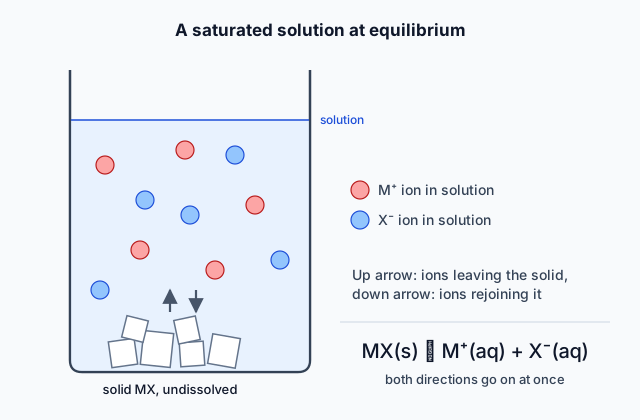
When an ionic solid dissolves, its ions leave the crystal. Ions in the solution can also return to the solid, so dissolving is a reversible process. For silver chloride:
AgCl(s) ⇌ Ag⁺(aq) + Cl⁻(aq)
A solution holding as much dissolved salt as it can, in contact with undissolved solid, is a saturated solution. In it the solid and its dissolved ions are at equilibrium, and the extent of dissolving is described by the equilibrium constant, the solubility-product constant, Ksp. Like any equilibrium expression, it leaves out the pure solid, and each ion's concentration is raised to the power of its coefficient:
Ksp = [Ag⁺][Cl⁻]
For calcium fluoride, CaF₂(s) ⇌ Ca²⁺(aq) + 2 F⁻(aq), the coefficient 2 becomes an exponent:
Ksp = [Ca²⁺][F⁻]²
A small Ksp means a saturated solution holds only low concentrations of its ions, so little of the salt dissolves. The Ksp values in this lesson are for 25 °C and are teaching examples, rounded from common tables.
Quick check · Match
Match each salt to the Ksp expression for its dissolving.
2b. From Ksp to molar solubility
The molar solubility, s, of a salt is the number of moles of it that dissolve per liter of saturated solution, in mol/L (M). The coefficients of the dissolving equation tell how each ion's concentration relates to s.
For AgCl, each formula unit gives one Ag⁺ and one Cl⁻, so [Ag⁺] = [Cl⁻] = s and Ksp = s². With Ksp = 1.8 × 10⁻¹⁰, s = √(1.8 × 10⁻¹⁰) = 1.3 × 10⁻⁵ M.
For CaF₂, each formula unit gives one Ca²⁺ and two F⁻, so [Ca²⁺] = s and [F⁻] = 2s:
Ksp = (s)(2s)² = 4s³
and so s = ³√(Ksp / 4). The steps are the same for any salt:
- Write the dissolving equation and the Ksp expression.
- Write each ion's concentration in terms of s.
- Put them into the expression and solve for s.
Molar solubility is in mol/L. To give a solubility in grams per liter, multiply it by the molar mass. Keep extra figures through the middle of the calculation and round at the end.
Quick check · Calculate
Calcium fluoride has Ksp = 3.2 × 10⁻¹¹ at 25 °C, a teaching example. What is its molar solubility? Give your answer to two significant figures, as a number times 10⁻⁴ M (type 3.5 for 3.5 × 10⁻⁴ M).
2c. From molar solubility to Ksp
Ksp can be found the other way around. If you measure how much of a salt dissolves in a saturated solution, the molar solubility gives every ion's concentration, and putting those into the Ksp expression gives Ksp.
Example, a teaching example: a saturated solution of silver bromide holds 7.35 × 10⁻⁷ mol of dissolved AgBr per liter. Each AgBr gives one Ag⁺ and one Br⁻, so [Ag⁺] = [Br⁻] = 7.35 × 10⁻⁷ M, and Ksp = (7.35 × 10⁻⁷)² = 5.4 × 10⁻¹³.
For a salt that gives two of one ion, the coefficient goes in two places: the ion's concentration is twice s, and its concentration is also raised to the power 2. For Ag₂CrO₄(s) ⇌ 2 Ag⁺(aq) + CrO₄²⁻(aq), [Ag⁺] = 2s and [CrO₄²⁻] = s, so Ksp = (2s)²(s) = 4s³.
If a measurement gives only one ion's concentration in a saturated solution, the dissolving equation gives the others. If the solubility is in grams per liter, divide by the molar mass first to get mol/L.
Quick check · Calculate
A saturated solution of lead(II) iodide, PbI₂, holds 1.3 × 10⁻³ mol of dissolved PbI₂ per liter, a teaching example. What is Ksp for PbI₂? Give your answer to two significant figures, as a number times 10⁻⁹ (type 3.5 for 3.5 × 10⁻⁹).
2d. Comparing salts
A larger Ksp means more of the salt dissolves, but Ksp values compare solubilities directly only for salts that give the same number of ions per formula unit. AgCl, AgBr and AgI each give one cation and one anion, so Ksp = s² for all three, and the order of Ksp is the order of molar solubility: AgCl (1.8 × 10⁻¹⁰) dissolves more than AgBr (5.4 × 10⁻¹³), and AgBr more than AgI (8.5 × 10⁻¹⁷).
When the numbers of ions differ, the relationship between Ksp and s is different for each salt, one with s² and another with 4s³. Their Ksp values cannot be compared directly. Calculate s for each salt, then compare the molar solubilities.
Ksp also ties to the solubility rules. A salt the rules call soluble has a Ksp greater than 1, and the salts in this lesson, which dissolve only slightly, have Ksp values far below 1.
Quick check · Decide and justify
At 25 °C, silver chloride, AgCl, has Ksp = 1.8 × 10⁻¹⁰ and silver chromate, Ag₂CrO₄, has Ksp = 1.1 × 10⁻¹². These values are teaching examples. Which salt has the greater molar solubility?
Which reason supports your decision?
Part 3 Watch it done Ksp of silver chromate from a mass
Predict first, then watch each step, then finish the calculation yourself.
A chemist shakes solid silver chromate, Ag₂CrO₄ (molar mass 331.73 g/mol), with water until the solution is saturated, filters it, and finds that each liter of solution holds 0.0215 g of dissolved Ag₂CrO₄. This is a teaching example. What is Ksp for Ag₂CrO₄?
Predict first
Before you open the first step, predict: in this saturated solution, which ion is present at the higher concentration?
Step 1 · Write the equation and the expression
Ag₂CrO₄(s) ⇌ 2 Ag⁺(aq) + CrO₄²⁻(aq), so Ksp = [Ag⁺]²[CrO₄²⁻]. The solid is left out.
Step 2 · Turn the mass into the molar solubility
s = (0.0215 g/L) ÷ (331.73 g/mol) = 6.481 × 10⁻⁵ mol/L. Keep the unrounded value for the next step.
Why this step?
Why is [Ag⁺] twice the molar solubility?
Each formula unit of Ag₂CrO₄ that dissolves puts two Ag⁺ ions and one CrO₄²⁻ ion into solution, so the silver ion is at twice the concentration of the salt that dissolved, and the chromate ion is at s.
Step 3 · Find each ion's concentration
[Ag⁺] = 2s = 1.296 × 10⁻⁴ M and [CrO₄²⁻] = s = 6.481 × 10⁻⁵ M.
Your step · Calculate
Finish it. With [Ag⁺] = 1.296 × 10⁻⁴ M and [CrO₄²⁻] = 6.481 × 10⁻⁵ M, what is Ksp for Ag₂CrO₄? Give your answer to three significant figures, as a number times 10⁻¹² (type 3.50 for 3.50 × 10⁻¹²).
× 10⁻¹²
Ksp = 1.09 × 10⁻¹², which matches the 1.1 × 10⁻¹² used for silver chromate in this lesson. The silver ion is at the higher concentration because two of them come from each formula unit that dissolves.
Part 4 Try it Back to the barium drink
Back to the X-ray drink. Barium sulfate, BaSO₄, has Ksp = 1.1 × 10⁻¹⁰ at 25 °C and a molar mass of 233.39 g/mol. A technician shakes 250. mL of water with excess BaSO₄ until the solution is saturated. These numbers are a teaching example.
Try it · Calculate
What mass of BaSO₄ is dissolved in the 250. mL of solution? Give your answer in micrograms (1 g = 10⁶ μg), to two significant figures.
Try it · Put it in order
A student finds the molar solubility of a salt from its Ksp. Put the steps in order.
Part 5 Explain it Magnesium fluoride
On the exam this is handwritten, so answer on paper first. Nothing you type here leaves this page. Then check your answer against the model and each scoring point.
Free response is 50% of the exam score. This one is shaped like a short-answer question, which is worth 4 points.
Free-response practice · Short-answer style
Magnesium fluoride, MgF₂, is a sparingly soluble salt with Ksp = 5.2 × 10⁻¹¹ at 25 °C. These numbers are a teaching example.
(a) Represent the dissolving of MgF₂ in water with an equation, and write the Ksp expression.
(b) Calculate the molar solubility of MgF₂ in water at 25 °C.
(c) At a higher temperature, a saturated solution of MgF₂ has a molar solubility of 3.0 × 10⁻⁴ M. Calculate Ksp at that temperature.
(d) A different salt, MX, gives one M⁺ and one X⁻ and also has Ksp = 5.2 × 10⁻¹¹ at 25 °C. Justify whether MX and MgF₂ have the same molar solubility.
Model answer
(a) MgF₂(s) ⇌ Mg²⁺(aq) + 2 F⁻(aq), and Ksp = [Mg²⁺][F⁻]².
(b) [Mg²⁺] = s and [F⁻] = 2s, so Ksp = (s)(2s)² = 4s³ = 5.2 × 10⁻¹¹. Then s³ = 1.3 × 10⁻¹¹ and s = 2.4 × 10⁻⁴ M.
(c) Ksp = 4s³ = 4(3.0 × 10⁻⁴)³ = 1.1 × 10⁻¹⁰.
(d) No. For MX, Ksp = s², so s = √(5.2 × 10⁻¹¹) = 7.2 × 10⁻⁶ M, far less than the 2.4 × 10⁻⁴ M of MgF₂. Equal Ksp values do not mean equal solubilities when the salts give different numbers of ions, because Ksp = s² for MX but 4s³ for MgF₂.
Score your own answer. This is a self-check, not a grade. Tick each point your answer makes.
Part 6 Check yourself Four sparingly soluble salts
All three case questions use the table.
A class looks up the solubility-product constants of four sparingly soluble salts at 25 °C. The values are teaching examples, rounded from common tables.
| Salt | Dissolving | Ksp |
|---|---|---|
| AgCl | AgCl(s) ⇌ Ag⁺(aq) + Cl⁻(aq) | 1.8 × 10⁻¹⁰ |
| SrSO₄ | SrSO₄(s) ⇌ Sr²⁺(aq) + SO₄²⁻(aq) | 3.4 × 10⁻⁷ |
| AgI | AgI(s) ⇌ Ag⁺(aq) + I⁻(aq) | 8.5 × 10⁻¹⁷ |
| BaSO₄ | BaSO₄(s) ⇌ Ba²⁺(aq) + SO₄²⁻(aq) | 1.1 × 10⁻¹⁰ |
Case question 1 · Rank it
Using the table: rank the four salts by molar solubility.
Greatest molar solubility first
Give each one a place, 1 for first. Give two the same place if they are equal.
Your ranking: none yet
Case question 2 · Calculate
Using the table: what is the molar solubility of SrSO₄? Give your answer to two significant figures, as a number times 10⁻⁴ M (type 3.5 for 3.5 × 10⁻⁴ M).
Case question 3 · Select all
Using the table: which two statements are true? Select two.
Select 2 answers, then check.
The rest stand on their own and do not use the case.
Check yourself · Sort it
Each card describes a salt. Tap a card, then the bin for its Ksp.
Ksp greater than 1
Ksp far less than 1
Check yourself · Spot the error
A saturated solution of calcium fluoride, CaF₂, has a molar solubility of 2.0 × 10⁻⁴ M. A student calculates Ksp. Tap the line with the mistake.
Part 7 Keep it Bring back earlier ideas
This lesson leans on two earlier ideas: calculating a K from concentrations, and how an element's charge sets the ratio of ions in its formula. Pulling them back up is what makes them last.
From 7.5 Magnitude of the Equilibrium Constant · Calculate
For A ⇌ B at equilibrium, [A] = 4.0 × 10⁻⁷ M and [B] = 0.200 M (teaching example). What is K? Give your answer to two significant figures, typed in e-notation (6.0 × 10⁵ is typed 6.0e5).
Radium sits at the bottom of group 2, below barium. Marie and Pierre Curie discovered it in 1898, and Marie Curie first isolated radium as a salt, radium chloride. Barium's chloride is BaCl₂.
From 1.8 Valence Electrons and Ionic Compounds · Decide and justify
What is the formula of radium chloride?
Which reason supports your decision?
In three lines
- Ksp is the equilibrium constant for a salt dissolving: the ion concentrations raised to their coefficients, with the solid left out, in a saturated solution.
- Write each ion's concentration in terms of the molar solubility s to find s from Ksp, or Ksp from a measured s; for CaF₂, Ksp = 4s³.
- Ksp values compare solubilities directly only for salts that give the same number of ions, and Ksp greater than 1 goes with a soluble salt.
Exam strategy for this topic
- Section I, Multiple Choice: 60 questions in 90 minutes.
- Section II, Free Response: 7 questions in 105 minutes.
- A scientific or graphing calculator is recommended for use on both sections of the exam.
Write the dissolving equation before the Ksp expression, define s as moles of salt per liter, and write each ion's concentration in terms of s from the coefficients. Compare two Ksp values directly only when the salts give the same number of ions; otherwise calculate each molar solubility and compare those.
Questions students ask
What is Ksp?
Ksp is the solubility-product constant: the equilibrium constant for a salt dissolving in water. It is the product of the ion concentrations, each raised to its coefficient, with the solid left out.
How do I find molar solubility from Ksp?
Write each ion's concentration in terms of s from the dissolving equation, put them into the Ksp expression, and solve for s. For CaF₂, Ksp = 4s³, so s = ³√(Ksp / 4).
How do I find Ksp from a molar solubility?
Use the molar solubility to give each ion's concentration, then put those into the Ksp expression with their exponents. If the solubility is in grams per liter, divide by the molar mass first.
Does a larger Ksp always mean a more soluble salt?
Only when the salts give the same number of ions. Otherwise calculate the molar solubility of each salt and compare those.
What does Ksp greater than 1 mean?
Salts the solubility rules call soluble have Ksp values greater than 1. Salts that barely dissolve have Ksp values far below 1.
Course alignment, for teachers
AP Chemistry topic 7.11, Unit 7: Equilibrium.
- Skill 5.B: Identify an appropriate theory, definition, or mathematical relationship to solve a problem.
This lesson maps all 4 essential knowledge statements of the topic to the part that teaches each one: 4 are checked by a scored question. The map is in the lesson file.