Unit 7 · Topic 7.9 · about 30 minutes · 7 parts · 12 scored checks, 2 of them multiple choice, plus 2 from earlier lessons
AP Chemistry 7.9: Introduction to Le Châtelier’s Principle
Unit 7: 7 to 9% of the multiple-choice section
What you'll be able to do
- Identify the response of a system at equilibrium to an external stress, using Le Châtelier’s principle.
Key vocabulary
| Term | What it means | The exam trap |
|---|---|---|
| Le Châtelier’s principle | A system at equilibrium that is disturbed shifts in the direction that partly counteracts the disturbance. | The principle gives a direction of response, so name the direction in words, toward products or toward reactants, before you say what color or pH does. |
| Stress | A change made to a system at equilibrium, such as adding or removing a species, or changing the temperature, volume or concentration. | Be specific about what the stress changed, because the same experiment can change more than one thing. |
| Shift | The net change a system makes after a stress, named by the side it makes more of, products or reactants. | A shift is named by the side that gains, so decide that side before you describe any observation. |
| Dilution | Adding solvent to a solution, which lowers the concentration of every dissolved species. | Dilution only changes dissolved species, so decide what counts as a dissolved particle before you compare the two sides. |
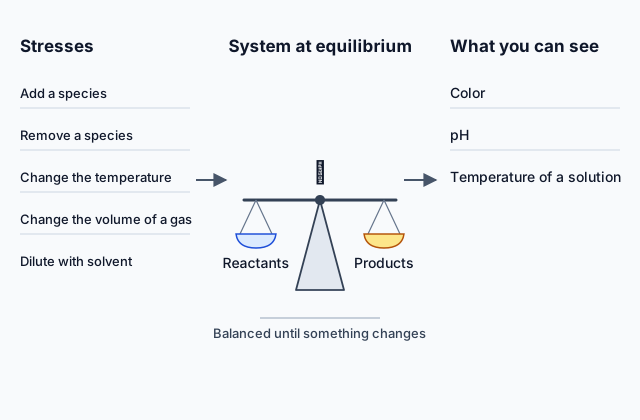 Tap to open the picture full size
Part 1 Think first Pink, blue, pink
Commit to a guess first. Being wrong now makes the right idea stick better.
Predict first
A test tube holds a pink solution. You put it in hot water and it turns blue. You move it to ice water and it turns pink again, and you can repeat this as many times as you like. Nothing was added or taken out. What is the best explanation?
In short. Le Châtelier’s principle says a system at equilibrium that is disturbed shifts in the direction that partly counteracts the disturbance.
- Adding a species shifts the system away from it, and removing a species shifts it toward making more.
- For temperature, treat heat as a reactant or product by the sign of ΔH; for gases, a smaller volume shifts toward fewer moles of gas; dilution shifts toward more dissolved particles.
- A shift changes what you can measure, such as color, pH and the temperature of a solution.
Part 2 Learn it How a system at equilibrium responds to a stress
2a. Adding or removing a species
A system at equilibrium is balanced, and a change from outside, a stress, disturbs the balance. Le Châtelier’s principle says the system responds by shifting in the direction that partly counteracts the stress, until it settles at a new equilibrium. A shift is named by what it makes more of: a shift toward the products (to the right) or toward the reactants (to the left).
- Add a species: the system shifts away from it, using some of it up.
- Remove a species: the system shifts toward it, making some more.
Example: Fe³⁺(aq) + SCN⁻(aq) ⇌ FeSCN²⁺(aq). Fe³⁺ is pale yellow, SCN⁻ is colorless and FeSCN²⁺ is deep red. Adding more Fe³⁺ shifts the equilibrium toward FeSCN²⁺, and the red deepens. Adding a substance that ties up Fe³⁺ and takes it out of solution shifts the equilibrium toward Fe³⁺, and the red fades.
The shift only partly undoes the stress. After Fe³⁺ is added and the system settles, there is still more Fe³⁺ than before, but less than there was just after it was added.
Quick check · Sort it
Fe³⁺(aq) + SCN⁻(aq) ⇌ FeSCN²⁺(aq) is at equilibrium. Each card is a change made to the solution. Tap a card, then the bin for the direction the equilibrium shifts.
Toward the products (right)
Toward the reactants (left)
2b. Temperature: heat as a reactant or product
Temperature is a stress too. To predict the shift, treat heat as if it were a reactant or a product, using the sign of ΔH.
- If ΔH is positive, the forward reaction absorbs energy, so heat is a reactant: heat + reactants ⇌ products.
- If ΔH is negative, the forward reaction releases energy, so heat is a product: reactants ⇌ products + heat.
Then heating is adding heat, and cooling is removing heat, exactly as in the last chunk. Heating shifts the system away from the side that has the heat on it, and cooling shifts it toward that side.
Example: N₂O₄(g) ⇌ 2NO₂(g) has a positive ΔH. N₂O₄ is colorless and NO₂ is brown. Heat is a reactant: heat + N₂O₄ ⇌ 2NO₂. Heating a sealed tube shifts the equilibrium toward NO₂, so the gas gets browner. Cooling it shifts the equilibrium toward N₂O₄, so the gas gets paler.
Quick check · Decide and justify
The reaction 2SO₂(g) + O₂(g) ⇌ 2SO₃(g) has a negative ΔH. A sealed mixture at equilibrium is heated. Which way does the equilibrium shift?
Which reason supports your decision?
2c. Volume, pressure and dilution
Gases: volume and pressure. Squeezing a gas mixture into a smaller volume raises the pressure, and the system shifts toward the side with fewer moles of gas, which lowers the pressure part of the way back. Expanding it into a larger volume shifts it toward the side with more moles of gas. Count only gases; solids and liquids in the equation do not count. If both sides have the same moles of gas, a volume change shifts nothing.
Example: N₂(g) + 3H₂(g) ⇌ 2NH₃(g) has 4 mol of gas on the left and 2 mol on the right. Compressing the mixture shifts it toward NH₃.
Solutions: dilution. Adding solvent lowers the concentration of every dissolved species. The system shifts toward the side with more dissolved particles, which raises the concentration of particles part of the way back. In Fe³⁺(aq) + SCN⁻(aq) ⇌ FeSCN²⁺(aq) there are two dissolved particles on the left and one on the right, so dilution shifts the equilibrium toward Fe³⁺ and SCN⁻. The red fades by more than the dilution alone would explain.
Quick check · Fill the statement
Complete the description of what happens when a gas mixture is squeezed into half its volume.
In PCl₅(g) ⇌ PCl₃(g) + Cl₂(g), the left side has mol of gas and the right side has mol of gas. Compressing the mixture raises the pressure, so the equilibrium shifts toward the .
2d. What a shift changes that you can measure
A shift in equilibrium shows up in things you can measure.
- Color. If a species is colored, more of it deepens its color and less of it fades the color. A shift toward FeSCN²⁺ deepens the red.
- pH. pH is lower when the concentration of H⁺ is higher. If H⁺ takes part in the equilibrium, a shift that makes H⁺ lowers the pH, and a shift that uses it up raises the pH.
- Temperature. A shift in the endothermic direction absorbs energy from the solution, so a thermometer reads lower. A shift in the exothermic direction releases energy, so it reads higher.
Example: N₂O₄(g) ⇌ 2NO₂(g) has a positive ΔH, so the forward direction is endothermic. In an insulated, sealed flask, anything that shifts the equilibrium toward NO₂ also makes the gas browner and cools it slightly, because the forward reaction absorbs energy.
Quick check · Multiple choice
A sealed, insulated flask holds N₂O₄(g) ⇌ 2NO₂(g) at equilibrium, and ΔH is positive. A little more N₂O₄ is added without changing the volume. Which observation is expected?
Part 3 Watch it done Three changes to one solution
Predict first, then watch each step, then finish the prediction yourself.
In water, yellow chromate ions and orange dichromate ions are in equilibrium: 2CrO₄²⁻(aq) + 2H⁺(aq) ⇌ Cr₂O₇²⁻(aq) + H₂O(l). A solution at equilibrium looks orange-yellow. A student makes three changes to separate samples of it: (1) adds hydrochloric acid, a source of H⁺, (2) adds sodium hydroxide, which reacts with H⁺ and removes it, and (3) adds a large volume of water. Predict the color change for each.
Predict first
Before you open the first step, predict: when hydrochloric acid is added, which way does the color go?
Step 1 · Add H⁺
H⁺ is a reactant, so adding it is a stress on the left side. The system shifts away from it, toward Cr₂O₇²⁻, so the solution becomes more orange.
Why this step?
Why does adding NaOH, which is not in the equation, change the equilibrium?
OH⁻ reacts with H⁺ to make water, so it removes H⁺ from the solution. Removing a reactant shifts the equilibrium toward the reactants, which makes more CrO₄²⁻, so the solution becomes more yellow.
Step 2 · Count dissolved particles for the dilution
Water is a liquid, so it is not counted among the dissolved particles. The left side has 2 CrO₄²⁻ and 2 H⁺, which is 4 dissolved particles, and the right side has 1 Cr₂O₇²⁻, which is 1.
Your step · Fill the statement
Finish it. Complete the prediction for adding a large volume of water.
Dilution lowers every dissolved concentration. The system shifts toward the side with dissolved particles, which is the side, so the solution becomes more .
Each of the three changes fits one rule: the system shifts to partly undo the stress. And each shows up as a color you can see, which is why color is the usual way to follow a shift.
Part 4 Try it A syringe and a vinegar
First a gas. A glass syringe holds a brown mixture of NO₂ and colorless N₂O₄ at equilibrium, N₂O₄(g) ⇌ 2NO₂(g). A student pushes the plunger in quickly and holds it there.
Try it · Put it in order
Put what the student sees, and why, in order from the moment the plunger goes in.
Now a solution. Vinegar is a solution of acetic acid, HC₂H₃O₂, which is in equilibrium with its ions: HC₂H₃O₂(aq) ⇌ H⁺(aq) + C₂H₃O₂⁻(aq). A student dissolves some sodium acetate, NaC₂H₃O₂, in the vinegar. It supplies C₂H₃O₂⁻ and does not change the volume much.
Try it · Decide and justify
Does the pH of the vinegar go up or down when the sodium acetate dissolves?
Which reason supports your decision?
Part 5 Explain it Stresses on an ammonia system
On the exam this is handwritten, so answer on paper first. Nothing you type here leaves this page. Then check your answer against the model and each scoring point.
Free response is 50% of the exam score. This one is shaped like a short-answer question, which is worth 4 points.
Free-response practice · Short-answer style
N₂(g) + 3H₂(g) ⇌ 2NH₃(g) has a negative ΔH. A mixture of the three gases is at equilibrium in a closed vessel.
(a) Predict which way the equilibrium shifts when more H₂ is added at constant volume, and justify your prediction.
(b) Predict which way it shifts when the mixture is compressed into a smaller volume, and justify it by counting moles of gas.
(c) Predict which way it shifts when the mixture is heated, and justify it using the sign of ΔH.
(d) Some NH₃ is removed from an insulated vessel. Predict whether the temperature of the gas rises or falls as the equilibrium shifts, and justify your answer.
Model answer
(a) The equilibrium shifts toward the products, toward NH₃. Adding H₂ is a stress on the reactant side, and the system shifts away from the added species, using some of it up.
(b) The equilibrium shifts toward NH₃. The left side has 1 + 3 = 4 mol of gas and the right side has 2 mol. A smaller volume raises the pressure, and the system shifts toward the side with fewer moles of gas.
(c) The equilibrium shifts toward the reactants, toward N₂ and H₂. ΔH is negative, so the forward reaction releases energy and heat is a product: N₂ + 3H₂ ⇌ 2NH₃ + heat. Heating adds a product, so the system shifts away from it.
(d) The temperature rises. Removing NH₃ shifts the equilibrium toward NH₃, the forward direction, and the forward direction is exothermic (ΔH negative), so it releases energy into the gas.
| Stress | Shift | Reason |
|---|---|---|
| Add H₂ | Toward NH₃ | Away from the added species |
| Compress | Toward NH₃ | 2 mol of gas against 4 mol |
| Heat | Toward N₂ and H₂ | Heat is a product (ΔH negative) |
| Remove NH₃ | Toward NH₃, temperature rises | Forward direction is exothermic |
Score your own answer. This is a self-check, not a grade. Tick each point your answer makes.
Part 6 Check yourself Four test tubes of cobalt
All three case questions use the table.
Co(H₂O)₆²⁺(aq) + 4Cl⁻(aq) ⇌ CoCl₄²⁻(aq) + 6H₂O(l) is at equilibrium. Co(H₂O)₆²⁺ is pink and CoCl₄²⁻ is blue. A student starts four test tubes from the same purple solution at equilibrium, makes one change to each, and records the color. This is a teaching example.
| Tube | Change | Color afterward |
|---|---|---|
| A | Add concentrated hydrochloric acid, a source of Cl⁻ | Bluer |
| B | Add a large volume of water | Pinker |
| C | Place in hot water | Bluer |
| D | Place in ice water | Pinker |
Case question 1 · Multiple choice
Using the table: what does tube C show about the forward reaction, which makes CoCl₄²⁻?
Case question 2 · Decide and justify
Using the table: in tube B the solution turned pinker when water was added. Which way did the equilibrium shift?
Which reason supports your decision?
Case question 3 · Select all
Using the table: select the two changes that would also make the solution bluer. Select two.
Select 2 answers, then check.
The rest stand on their own and do not use the case.
Check yourself · Spot the error
A student explains what happens when water is added to Fe³⁺(aq) + SCN⁻(aq) ⇌ FeSCN²⁺(aq) at equilibrium. Tap the line with the mistake.
Check yourself · Match
Match each change to what you would observe.
Part 7 Keep it Bring back earlier ideas
This lesson uses Q and K to see which way a mixture goes, and reads energy flow from a thermometer. Pulling back both is what makes them last.
From 7.7 Calculating Equilibrium Concentrations · Decide and justify
For H₂(g) + I₂(g) ⇌ 2HI(g), Kc = 49.0. A flask at that temperature holds [H₂] = 0.010 M, [I₂] = 0.010 M and [HI] = 0.20 M. Which way does the mixture change?
Which reason supports your decision?
From 6.4 Heat Capacity and Calorimetry · Decide and justify
A student dissolves a few grams of calcium chloride in 50.0 g of water in a coffee-cup calorimeter. The thermometer reads 21.0 °C before and 30.5 °C after the solid dissolves. Is dissolving calcium chloride exothermic or endothermic?
Which reason supports your decision?
In three lines
- A system at equilibrium that is disturbed shifts to partly counteract the stress: away from an added species, toward a removed one.
- Treat heat as a reactant or product by the sign of ΔH; a smaller volume shifts a gas mixture toward fewer moles of gas; dilution shifts a solution toward more dissolved particles.
- A shift changes what you can measure: the color of a colored species, the pH when H⁺ takes part, and the temperature of a solution.
Exam strategy for this topic
- Section I, Multiple Choice: 60 questions in 90 minutes.
- Section II, Free Response: 7 questions in 105 minutes.
- A scientific or graphing calculator is recommended for use on both sections of the exam.
Name the stress, then name the direction of the shift in words, then say what you would observe. For temperature, write heat into the equation from the sign of ΔH. For a gas, count moles of gas on each side. Justify every prediction with the principle, not just the answer.
Questions students ask
What does Le Châtelier’s principle say?
When a stress is applied to a system at equilibrium, the system shifts in the direction that partly counteracts the stress, until it reaches a new equilibrium.
How do you predict the effect of a change in temperature?
Treat heat as a reactant if ΔH is positive and as a product if ΔH is negative. Heating shifts the system away from the side with the heat, and cooling shifts it toward that side.
What does a change in volume do to a gas at equilibrium?
A smaller volume raises the pressure, and the system shifts toward the side with fewer moles of gas. A larger volume shifts it toward the side with more moles of gas.
What does dilution do to a system at equilibrium in solution?
Dilution lowers every dissolved concentration, and the system shifts toward the side with more dissolved particles.
How can a shift in equilibrium be seen?
In a change of color if a species is colored, in a change of pH if H⁺ or OH⁻ takes part, and in a change of the solution's temperature, since a shift in the endothermic direction absorbs energy and the exothermic direction releases it.
Course alignment, for teachers
AP Chemistry topic 7.9, Unit 7: Equilibrium.
- Skill 6.F: Explain the connection between experimental results and chemical concepts, processes, or theories.
This lesson maps all 2 essential knowledge statements of the topic to the part that teaches each one: 2 are checked by a scored question. The map is in the lesson file.