Unit 7 · Topic 7.4 · about 30 minutes · 7 parts · 11 scored checks, 1 of them multiple choice, plus 2 from earlier lessons
AP Chemistry 7.4: Calculating the Equilibrium Constant
Unit 7: 7 to 9% of the multiple-choice section
What you'll be able to do
- Calculate Kc or Kp from experimental measurements of the concentrations or partial pressures of the reactants and products at equilibrium.
Key vocabulary
| Term | What it means | The exam trap |
|---|---|---|
| Equilibrium constant (Kc, Kp) | The value of the equilibrium expression for a reaction at equilibrium, found from concentrations (Kc) or partial pressures (Kp). | A K is tied to one moment in an experiment, so check when each number you are given was measured. |
| Equilibrium concentration | The concentration of a species, in moles per liter, once the mixture has stopped changing. | A problem may give several amounts for one species, so decide which of them describes the settled mixture. |
| Partial pressure | The pressure one gas in a mixture would exert if it were alone in the container, in atmospheres when used for Kp. | A gas mixture has one total pressure and a partial pressure for each gas, so match the number to the species before you substitute. |
| Molarity (M) | Moles of a species per liter of solution or container, the unit of every concentration in Kc. | A number of moles is not a concentration until you have used the volume, so look for the volume in the question. |
 Tap to open the picture full size
Part 1 Think first A flask of brown gas
Commit to a guess first. Being wrong now makes the right idea stick better.
Predict first
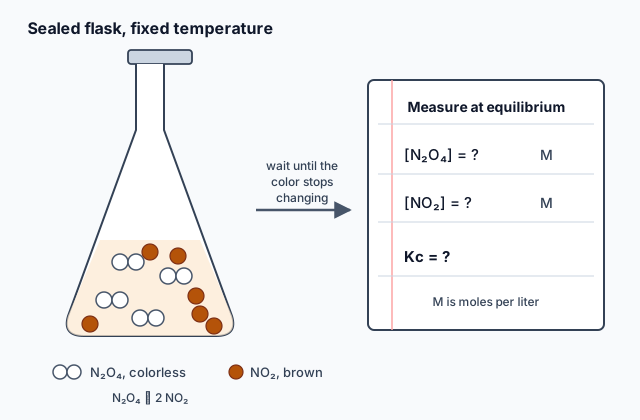
Dinitrogen tetroxide, N₂O₄, is a colorless gas. Sealed in a flask at a fixed temperature, some of it turns into brown nitrogen dioxide, NO₂, until the color stops getting darker: N₂O₄ ⇌ 2 NO₂. A chemist loads three identical flasks with three different amounts of N₂O₄ and waits. Each flask ends up a different shade of brown, and she measures a different concentration of each gas in each flask. She wants one number, built from the two concentrations, that comes out the same in all three flasks. Which should she try?
In short. An equilibrium constant is calculated by substituting the concentrations (for Kc) or partial pressures (for Kp) measured at equilibrium into the equilibrium expression.
- Only values measured once the mixture has stopped changing go into the expression, never the amounts first put in.
- Each concentration or partial pressure is raised to the power of its coefficient, with products on top and reactants on the bottom.
- Data given as moles must be divided by the volume in liters before they go into Kc.
Part 2 Learn it From measurements to a number
2a. Concentrations give Kc
In the last topic you wrote the equilibrium expression for a reaction. This topic puts numbers into it. An equilibrium constant is not looked up or guessed; it comes from an experiment. Let a reaction run in a closed container at a fixed temperature until nothing measurable changes, measure the concentration of every species, and substitute those values.
For a A + b B ⇌ c C + d D:
Kc = [C]ᶜ[D]ᵈ ÷ ([A]ᵃ[B]ᵇ)
Each concentration is in moles per liter (M), the products are on top, and each concentration is raised to the power of its coefficient. In this course K is written as a plain number, without units.
Example (a teaching example): 2 NOCl(g) ⇌ 2 NO(g) + Cl₂(g). At equilibrium, [NOCl] = 0.0600 M, [NO] = 0.0400 M and [Cl₂] = 0.0200 M.
Kc = [NO]²[Cl₂] ÷ [NOCl]² = (0.0400)²(0.0200) ÷ (0.0600)² = 8.89 × 10⁻³
Every measurement has three significant figures, so the answer keeps three. Keep every digit on the calculator until the last step, then round once.
Quick check · Calculate
In a sealed flask at a fixed temperature, N₂O₄(g) ⇌ 2 NO₂(g) reaches equilibrium with [N₂O₄] = 0.0450 M and [NO₂] = 0.0300 M. These numbers are a teaching example. What is Kc? Give your answer to three significant figures.
2b. Partial pressures give Kp
Gas-phase reactions can be measured as partial pressures instead. The same pattern gives Kp, with each partial pressure in atmospheres:
Kp = P(C)ᶜ P(D)ᵈ ÷ (P(A)ᵃ P(B)ᵇ)
Use Kc when the data are concentrations and Kp when they are partial pressures. They are different numbers for the same reaction, and this course does not ask you to convert one into the other, so read which constant a question wants.
Example (a teaching example): PCl₅(g) ⇌ PCl₃(g) + Cl₂(g). At equilibrium, P(PCl₅) = 0.250 atm, P(PCl₃) = 0.180 atm and P(Cl₂) = 0.180 atm.
Kp = P(PCl₃) × P(Cl₂) ÷ P(PCl₅) = (0.180)(0.180) ÷ 0.250 = 0.130
A partial pressure is the pressure one gas in a mixture would exert alone, as in Unit 3. In a mixture each gas has its own, and each goes into the expression raised to its own coefficient.
Quick check · Calculate
In a sealed vessel at a fixed temperature, 2 SO₂(g) + O₂(g) ⇌ 2 SO₃(g) reaches equilibrium with partial pressures P(SO₂) = 0.220 atm, P(O₂) = 0.150 atm and P(SO₃) = 0.620 atm. These numbers are a teaching example. What is Kp? Give your answer to three significant figures.
2c. Only equilibrium values go in
A K comes from the mixture at equilibrium, so every value in the expression is measured after the system has stopped changing. The amount of reactant first put in the container is not a value for the expression: by the time you measure, some of it has turned into product.
Data often come as moles, not concentrations. The expression needs concentrations, so divide each amount in moles by the volume of the container in liters, as you did for molarity in Unit 3.
Example (a teaching example): a 2.00 L flask holds 0.0600 mol of N₂O₄ and 0.0440 mol of NO₂ at equilibrium. Then [N₂O₄] = 0.0600 mol ÷ 2.00 L = 0.0300 M and [NO₂] = 0.0440 mol ÷ 2.00 L = 0.0220 M, so
Kc = (0.0220)² ÷ 0.0300 = 0.0161
Putting the moles straight into the expression would give 0.0323, a different number. The volume does not cancel here, because the top has two concentration factors and the bottom has one.
Quick check · Sort it
A student calculates Kc for N₂O₄ ⇌ 2 NO₂ from an experiment in a closed flask. Each card is something the student has. Tap a card, then the bin that says whether it goes into the calculation of Kc.
Used to calculate Kc
Not used to calculate Kc
Part 3 Watch it done Ammonia in a flask
Predict first, then watch each step, then finish the calculation yourself.
A 5.00 L flask is held at a fixed temperature while N₂(g) + 3 H₂(g) ⇌ 2 NH₃(g) reaches equilibrium. Analysis of the mixture finds 0.200 mol of N₂, 0.100 mol of H₂ and 0.0600 mol of NH₃. These numbers are a teaching example. What is Kc?
Predict first
Before you open the first step, predict: which concentration will be raised to the highest power in the expression?
Step 1 · Turn moles into concentrations
The expression needs moles per liter. [N₂] = 0.200 mol ÷ 5.00 L = 0.0400 M, [H₂] = 0.100 mol ÷ 5.00 L = 0.0200 M and [NH₃] = 0.0600 mol ÷ 5.00 L = 0.0120 M.
Step 2 · Write the expression from the balanced equation
Kc = [NH₃]² ÷ ([N₂][H₂]³). The product is on top, and each concentration is raised to its coefficient: 2 for NH₃, 1 for N₂ and 3 for H₂.
Why this step?
Why must these be the amounts found at equilibrium, and not the amounts first put in the flask?
Kc describes the mixture once nothing is changing. The amounts first put in will have partly turned into other species by then, so only the measured equilibrium amounts describe the mixture the constant is about.
Step 3 · Substitute and simplify the parts
The numerator is (0.0120)² = 1.44 × 10⁻⁴. The denominator is (0.0400)(0.0200)³ = (0.0400)(8.00 × 10⁻⁶) = 3.20 × 10⁻⁷. Keep both unrounded for the last step.
Your step · Calculate
Finish it. With [N₂] = 0.0400 M, [H₂] = 0.0200 M and [NH₃] = 0.0120 M, what is Kc for N₂ + 3 H₂ ⇌ 2 NH₃? Give your answer to three significant figures.
Three things made this work: moles became concentrations first, the coefficients became exponents, and the answer was rounded once at the end. Keep the order the same every time.
Part 4 Try it Two experiments to analyze
Nitrosyl chloride forms from nitrogen monoxide and chlorine: 2 NO(g) + Cl₂(g) ⇌ 2 NOCl(g). In a sealed vessel at a fixed temperature the equilibrium partial pressures are 0.150 atm for NO, 0.0800 atm for Cl₂ and 0.410 atm for NOCl. These numbers are a teaching example.
Try it · Calculate
What is Kp for 2 NO(g) + Cl₂(g) ⇌ 2 NOCl(g)? Give your answer to three significant figures.
A second student fills a 2.00 L flask with 0.500 mol of N₂O₄ at a fixed temperature. After the color stops changing, analysis finds 0.380 mol of N₂O₄ and 0.240 mol of NO₂ in the flask. The student calculates Kc for N₂O₄ ⇌ 2 NO₂. This is a teaching example.
Try it · Spot the error
Tap the line with the mistake in the student's work.
Part 5 Explain it Find Kc from a sealed flask
On the exam this is handwritten, so answer on paper first. Nothing you type here leaves this page. Then check your answer against the model and each scoring point.
Free response is 50% of the exam score. This one is shaped like a short-answer question, which is worth 4 points.
Free-response practice · Short-answer style
A 2.00 L flask is held at a fixed temperature while 2 SO₂(g) + O₂(g) ⇌ 2 SO₃(g) reaches equilibrium. Analysis of the mixture finds 0.0800 mol of SO₂, 0.0500 mol of O₂ and 0.200 mol of SO₃. These numbers are a teaching example.
(a) Represent the equilibrium constant expression Kc for this reaction.
(b) Calculate the equilibrium concentration of each of the three species, in M.
(c) Calculate the value of Kc.
(d) A second student substitutes the numbers of moles directly into the expression instead of the concentrations. Determine whether the second student gets the same value of Kc, and justify your answer.
Model answer
(a) Kc = [SO₃]² ÷ ([SO₂]²[O₂]).
(b) [SO₂] = 0.0800 mol ÷ 2.00 L = 0.0400 M; [O₂] = 0.0500 mol ÷ 2.00 L = 0.0250 M; [SO₃] = 0.200 mol ÷ 2.00 L = 0.100 M.
(c) Kc = (0.100)² ÷ ((0.0400)²(0.0250)) = 0.0100 ÷ 4.00 × 10⁻⁵ = 250.
(d) No. With moles, (0.200)² ÷ ((0.0800)²(0.0500)) = 0.0400 ÷ 3.20 × 10⁻⁴ = 125, which is not 250. The top has two concentration factors and the bottom has three, so the volume does not cancel; dividing each amount by 2.00 L changes the result.
Score your own answer. This is a self-check, not a grade. Tick each point your answer makes.
Part 6 Check yourself Three flasks, one temperature
Both case questions use the table.
A student loads three flasks with three different amounts of N₂O₄ and holds them at the same temperature until the color stops changing in each. The student then measures the equilibrium concentrations of the two gases in N₂O₄(g) ⇌ 2 NO₂(g). These numbers are a teaching example.
| Flask | [N₂O₄] (M) | [NO₂] (M) |
|---|---|---|
| 1 | 0.0200 | 0.0173 |
| 2 | 0.0800 | 0.0346 |
| 3 | 0.120 | 0.0424 |
Case question 1 · Calculate
Using the table: what is Kc for N₂O₄ ⇌ 2 NO₂ from flask 1? Give your answer to three significant figures.
Case question 2 · Multiple choice
Using the table: a student reports Kc = 0.353 for flask 3. Which mistake gives that value?
The rest stand on their own and do not use the case.
Check yourself · Fill the statement
Complete the description of how Kc is found from an experiment.
To find Kc, measure the of every species after the color stops changing, raise each one to the power of its in the balanced equation, and put the on top and the on the bottom.
Check yourself · Put it in order
A student finds Kc for N₂O₄ ⇌ 2 NO₂ by experiment. Put the steps in order.
Check yourself · Select all
Which two statements about calculating Kc = [NO₂]² ÷ [N₂O₄] from an experiment are true? Select two.
Select 2 answers, then check.
Part 7 Keep it Bring back earlier ideas
This lesson leans on two earlier ideas: writing the expression for a reaction, and the share of a gas mixture that one gas exerts as its partial pressure. Pulling them back up is what makes them last.
From 7.3 Reaction Quotient and Equilibrium Constant · Multiple choice
Which expression is Qc for 2 SO₂(g) + O₂(g) ⇌ 2 SO₃(g)?
From 3.4 Ideal Gas Law · Calculate
A cylinder holds a mixture of 0.640 mol of oxygen and 1.36 mol of nitrogen at a total pressure of 3.00 atm. What is the partial pressure of the oxygen, in atmospheres? Give three significant figures.
In three lines
- An equilibrium constant is calculated by substituting measured equilibrium concentrations (Kc) or partial pressures (Kp) into the equilibrium expression, with products over reactants.
- Each value is raised to the power of its coefficient, only values measured at equilibrium are used, and amounts in moles are divided by the volume in liters first.
- Keep every digit until the last step, round once to the figures the measurements allow, and write K as a plain number without units.
Exam strategy for this topic
- Section I, Multiple Choice: 60 questions in 90 minutes.
- Section II, Free Response: 7 questions in 105 minutes.
- A scientific or graphing calculator is recommended for use on both sections of the exam.
Write the expression first, from the balanced equation, before you substitute anything. Then convert every amount to the unit the constant needs, keep the unrounded values between steps, and round once at the end to the figures the data allow. Show each substitution so partial credit is possible.
Questions students ask
How do you calculate the equilibrium constant?
Write the equilibrium expression from the balanced equation, substitute the concentrations (for Kc) or partial pressures (for Kp) measured at equilibrium, and calculate.
Do I use initial or equilibrium concentrations to find K?
Equilibrium values only. By the time the mixture has settled, some of the starting reactant has become product, so the starting amounts do not describe it.
What is the difference between Kc and Kp?
Kc is calculated from concentrations in moles per liter and Kp from partial pressures in atmospheres. They are different numbers, and a question will say which one it wants.
Does K have units?
In this course K is written as a plain number, without units.
Why do I have to divide moles by the volume first?
Kc is built from concentrations, which are moles per liter. When the top and the bottom of the expression have different numbers of factors, using moles directly gives a different value.
Course alignment, for teachers
AP Chemistry topic 7.4, Unit 7: Equilibrium.
- Skill 5.C: Explain the relationship between variables within an equation when one variable changes.
This lesson maps the one essential knowledge statement of the topic to the part that teaches each one: 1 is checked by a scored question. The map is in the lesson file.